

Most store-brand juice costs roughly 5 to 10 cents per fluid ounce, and the biggest container is usually the cheapest. Cold-pressed bottles can cost several times that. To get your own number, divide the shelf price by the fluid ounces in the container. That gives you a price per ounce you can compare across any brand or size.
Below you'll find the formula, real price examples from US grocers, how 100% juice differs from juice drinks, and when a sale is actually a deal.
TL;DR
- Price per fluid ounce = shelf price ÷ fluid ounces. A gallon is 128 fl oz, a half gallon is 64, a quart is 32.
- Grocer listings we reviewed put store-brand and national-brand orange juice at about $0.05 to $0.14 per fl oz. Cold-pressed juice can run much higher.
- A bigger carton is not always cheaper per ounce, so check the unit price. Subtract coupons before you compare.
- "Juice drink" and "100% juice" are different products. Compare like with like.
Table of Contents
- How to calculate juice price per ounce
- What juice costs per ounce in US stores
- 100% juice vs. juice drinks: compare like with like
- Is a sale really a deal?
- Why juice prices change
- Making juice at home: how to price it per ounce
- Using the same math on other everyday products
- See real cost per unit on OutletPicks
- FAQ
- Sources
How to calculate juice price per ounce
The math is one division. Take the price, divide by the number of fluid ounces, and you have the cost of each ounce. Our price per ounce formula guide walks through the common mistakes, such as mixing weight ounces with fluid ounces.
Convert everything to fluid ounces first. Consumer Reports lists the equivalents: 16 fluid ounces make a pint, 2 pints make a quart, and 4 quarts make a gallon. That gives these container sizes:
| Container | Fluid ounces |
|---|---|
| Single-serve bottle | 12 to 16 |
| Carton or bottle | 46 |
| Quart | 32 |
| Half gallon | 64 |
| Gallon | 128 |
| Large bottle | 89 |
Two worked examples
The University of Tennessee's nutrition education program gives a clear case. A 1-gallon apple juice at $3.99 works out to about $0.03 per ounce, while a 32-ounce bottle at $2.88 comes to $0.09 per ounce. The gallon wins by a wide margin.
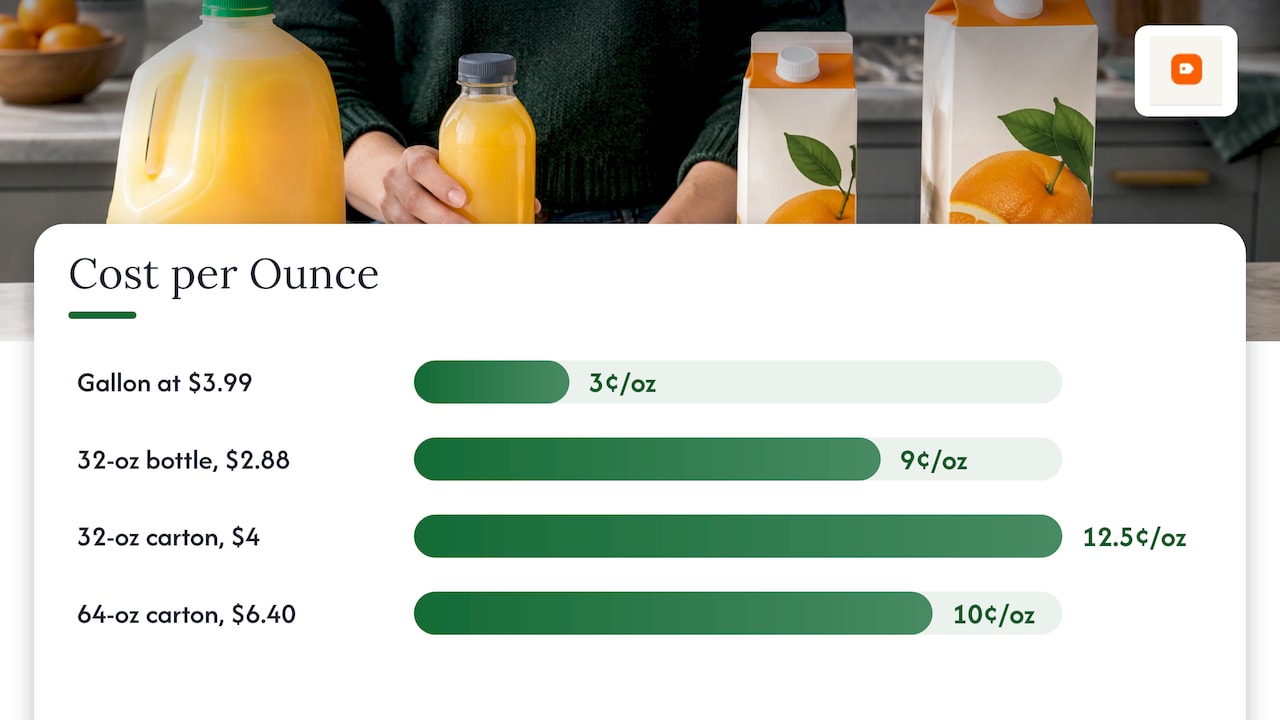
Size doesn't always settle it, though. Shopify's guide shows that a 32-ounce carton at $4 costs 12.5 cents per ounce, while a 64-ounce carton at $6.40 costs 10 cents. The larger carton costs more at the register and less per ounce. The only way to know is to run the numbers.
If your juice is sold by weight or by the pound, our guide to converting price per pound to price per ounce shows the divide-by-16 shortcut.
What juice costs per ounce in US stores
Prices move with the season, the region and the retailer, so treat these as a snapshot of what listings looked like when we researched this. Orange juice is the most-searched type, so it makes the best benchmark.
- Store-brand gallons. One national grocer listed a gallon of its 100% orange juice at $7.00 on sale, about $0.05 per fl oz, with the half gallon at $4.49, or $0.07 per fl oz. A supermarket brand gallon of orange juice at $7.99 works out to $0.06 per fl oz.
- National brands in cartons. A warehouse-style grocer listed a 46 fl oz pulp-free orange juice at $3.99, or $0.09 per fl oz, and an 89 fl oz Tropicana carton at $8.99, or $0.10 per fl oz. Its own-label gallon was $7.99.
- Delivery pricing. FreshDirect listed Tropicana Pure Premium at $5.19 for 46 fl oz, or $0.11 per fl oz, and an organic apple juice at $0.15 per fl oz.
- The full range. QFC's juice aisle ranged from $0.03 per fl oz for a citrus drink to $0.45 per fl oz for a cold-pressed bottle. Within 100% orange juice, an organic brand was $0.20 per fl oz and Tropicana Pure Premium $0.12.
The USDA's Economic Research Service also tracks what juice costs per cup. In 2022, ready-to-drink orange juice cost $0.53 per cup equivalent, while frozen concentrated apple juice cost $0.30. A cup is 8 fluid ounces, so that is roughly 6.6 and 3.8 cents per ounce.
A quick price ladder
| Type | Typical per-ounce range (from the listings above) |
|---|---|
| Concentrate or store-brand gallon | about $0.03 to $0.07 |
| National-brand carton | about $0.09 to $0.14 |
| Organic or premium bottled | about $0.15 to $0.20 |
| Cold-pressed | $0.45 and up |
As a rule of thumb, a gallon of orange juice at $7 to $8 is normal in these listings. Anything under $0.06 per ounce for 100% juice is a good price, and above $0.12 you're paying for brand, organic status or processing.
100% juice vs. juice drinks: compare like with like
A low price per ounce can mean you're buying something other than juice. The University of Maine Cooperative Extension explains that 100% fruit juice comes entirely from real fruit with no added sugars or sweeteners, while fruit drinks typically contain less than 100% juice and often added sweeteners and flavorings.
The label tells you which you have. The American Academy of Pediatrics notes that under FDA rules, anything under 100% juice must state the juice percentage and carry a term like "drink," "beverage" or "cocktail". Juice drinks generally contain between 10% and 99% juice.
A 2019 study of 581 stores in four US cities found weighted average prices of 5.2 cents per ounce for juice drinks, against 3.4 cents for soda. So a cheap-looking juice drink is often just cheap because it is diluted. Compare 100% juice to 100% juice, and drinks to drinks.
Before you compare, check three things on the label:
- Juice percentage. Look for "100% juice" on the front.
- Container size in fluid ounces. Some labels show only liters or milliliters, so convert (1 liter is about 33.8 fl oz).
- Concentrate or not. Ingredient lists such as water plus juice concentrate point to from-concentrate juice, which is often cheaper than not-from-concentrate.
Is a sale really a deal?
A "sale" tag only helps if the per-ounce price beats your usual one. Use this routine:
- Work out the unit price of the sale item.
- Work out the unit price of the size you normally buy.
- Subtract any coupon first. Consumer Reports recommends subtracting coupons and discounts before comparing unit prices.
- Buy the lower number, as long as you'll finish the juice before it spoils.
That last part matters. A cheaper gallon that spoils half-full costs more per ounce you actually drink. Once opened, juice doesn't keep long, so buy the size your household will finish.
For a longer walkthrough of this routine, see our four-step guide to comparing unit prices. You can also use our unit price calculator guide to check two sizes in under a minute. Buying online? Our guide to Amazon unit pricing shows how to find the real cost per ounce on multipacks.
Why juice prices change
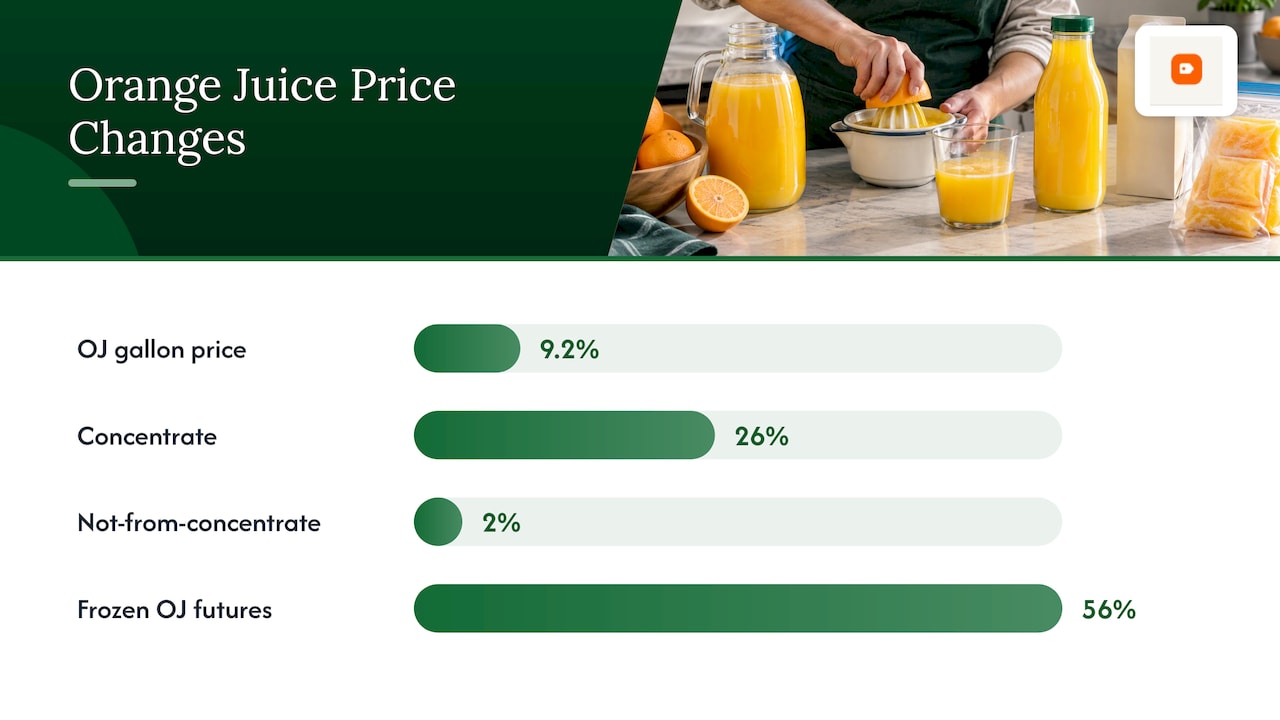
Orange juice is the clearest example of a price that swings. University of Florida research found that average orange juice prices per gallon rose 9.2%, from $8.78 in 2022/23 to $9.59 in 2023/24. Concentrate jumped 26% while not-from-concentrate rose only 2%. The same study ties the wholesale spike to a 56% rise in frozen concentrated orange juice futures, driven mainly by forecast declines in Brazil's orange crop.
Other IFAS researchers point to overall inflation, labor and transport disruptions, freezes and hurricanes, and citrus greening disease as contributors. The same research found that price was a rising factor for orange juice buyers, chosen by 20% of respondents in 2022 and 2023, though taste still ranked first.
What that means at the shelf:
- Concentrate tends to move more than not-from-concentrate when wholesale prices change, so the price gap between them can shift.
- Premium processing costs more. Cold-pressed juice involves more labor and lower yield, which shows in the $0.45 per ounce listing above.
- Size and brand. Store brands and big containers sit at the bottom of the per-ounce range.
Because prices shift, a ranking that was right last spring may be wrong today. That's why we recheck prices on a rolling cycle rather than publishing a static list.
Making juice at home: how to price it per ounce
People often ask whether homemade is cheaper. The answer depends on your ingredients and how often you juice, and you can test it with the same unit-price math.
Here's a hypothetical example, not a market figure. Say you spend $4.50 on oranges and get 32 fl oz of juice. That is $0.14 per ounce, which is above the cost of a store-brand gallon at $0.05 to $0.07. Change the ingredients to cheaper produce or a higher yield and the result shifts.
To run your own comparison:
- Add up what you paid for the produce for one batch.
- Measure the juice you get, in fluid ounces.
- Divide cost by ounces.
- If you bought a juicer for this, spread its price over the number of glasses you expect to make.
- Compare against the per-ounce price of the juice you'd otherwise buy, matching 100% juice to 100% juice.
Homemade juice is fresher and you control what goes in. As a pure per-ounce cost, though, a store-brand gallon is hard to beat for plain orange or apple juice.
Using the same math on other everyday products
Per-unit thinking works far beyond the juice aisle. Perfume shoppers do the same thing with milliliters, and this guide to perfume price per ml shows how bottle size and decant size change the true cost. For food, our guide to price per serving shows how to compare when package sizes and servings differ.
If you shop at more than one chain, our comparison of Aldi and Walmart prices per unit shows how the same basket can cost different amounts depending on where you buy it.
Our take on unit pricing
Sticker price is the least useful number on a juice label. We built OutletPicks around the idea that the only fair comparison is real cost per unit: per fluid ounce for juice, per milliliter for fragrance, per diaper, per page, per foot.
Pack sizes are designed to make comparison hard. A 46-ounce carton, an 89-ounce bottle and a gallon rarely line up, and promotions muddy it further. Normalizing everything to one unit removes the guesswork, and it is why we recheck retailer prices on a rolling cycle.
Our advice: pick your unit, convert once, and let the number decide. Brand loyalty is fine when the per-unit gap is small. When it is wide, you'll want to know.
Alex
See real cost per unit on OutletPicks
Juice is one of many things worth comparing by the unit. OutletPicks ranks products by true cost per unit across Amazon and partner retailers, so you don't have to do the division by hand. We currently cover skincare, hair care, fragrance, body care, light bulbs, cables, baby care, pet food, and more.
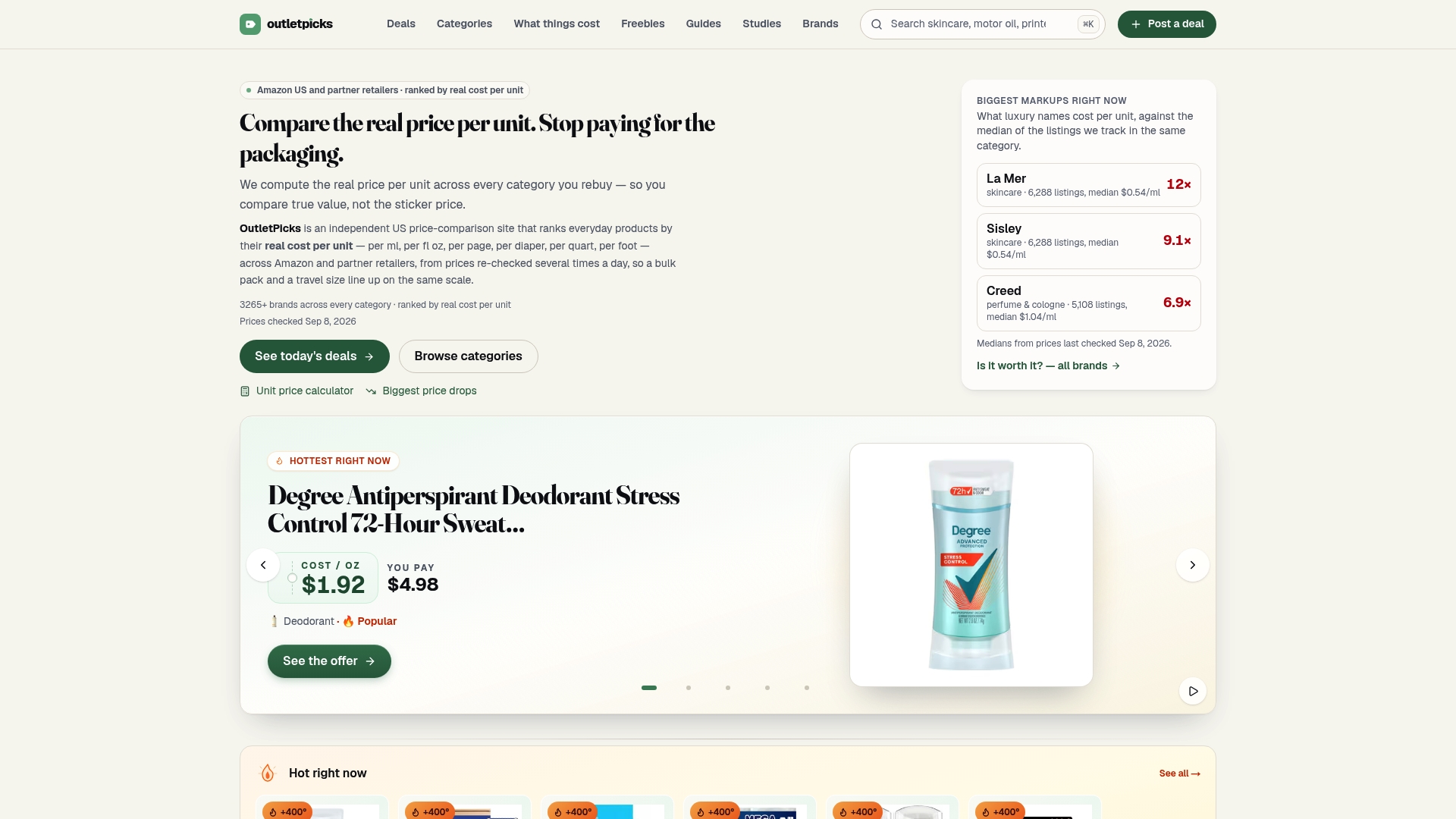
Browse all our categories or see the stores we price per unit to start comparing.
FAQ
How do I calculate the price per ounce of juice?
Divide the price by the number of fluid ounces in the container. A 64 fl oz carton at $6.40 costs $0.10 per ounce. If the label shows liters or milliliters, convert first: a liter is about 33.8 fl oz.
How much does a gallon of orange juice cost?
In the grocer listings we reviewed, a gallon of store-brand 100% orange juice ranged from about $7 to $8, or roughly $0.05 to $0.06 per fl oz. Name brands in smaller cartons ran about $0.09 to $0.14 per ounce. Prices vary by store, region and season, so check current listings.
Is it cheaper to juice at home or buy juice?
It depends on your produce, your yield and whether you count the juicer. Divide your ingredient cost by the ounces you get, then compare with the per-ounce price of store juice of the same kind. For plain orange juice, a store-brand gallon is a low bar to beat.
Is 100% fruit juice more expensive than juice drinks?
Often yes, per ounce, because juice drinks are diluted and sweetened. The FDA requires beverages with less than 100% juice to say so on the label, usually with a word like "drink" or "cocktail." Compare each type only against its own kind.
What is the best natural juice?
Look for "100% juice" on the front and an ingredient list with only juice, not added sugar or flavorings. Beyond that, the best choice comes down to taste and budget. Compare the per-ounce price among the 100% juices you like.
Sources
- Unit Pricing: Compare Apples to Apples, University of Tennessee
- Want the Best Grocery Deals? Use This Savings Tool, Consumer Reports
- How To Calculate Unit Price, Shopify
- Gallon orange juice listings, Kroger
- Bowl & Basket Orange Juice, ShopRite
- Orange Juice, Smart & Final
- Juice & Fruit Drinks, FreshDirect
- Juice listings, QFC
- Satisfying Fruit and Vegetable Recommendations, USDA ERS
- Sugar-sweetened beverage prices, Preventive Medicine Reports
- The Juicy Details, University of Maine Cooperative Extension
- Fruit Juice in Infants, Children, and Adolescents, American Academy of Pediatrics
- How Consumer Demand for Orange Juice Changed, University of Florida IFAS
- Inflation in Orange Juice Prices and Consumer Responses, University of Florida IFAS