
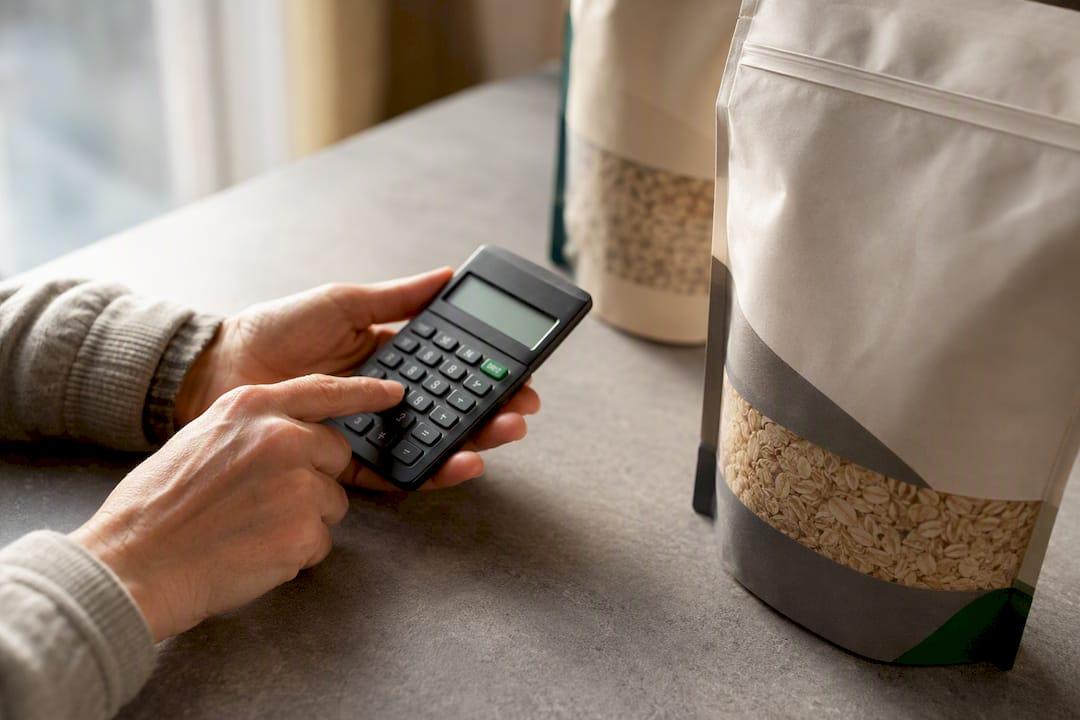
Price per ounce equals total price divided by size in ounces. That's the whole formula. The only catch is making sure you use the right kind of ounce: weight ounces for solids and powders, fluid ounces for liquids, since mixing the two produces a wrong answer that looks right. If you'd rather skip the math, OutletPicks' calculator does the conversion and division instantly.
TL;DR:
- Using the correct unit, weight or fluid ounces, is essential to accurately compare product prices because they are not interchangeable.
- Convert all measurements into ounces using standard factors before dividing to avoid errors caused by mixing weight and volume units.
- When comparing multi-packs, multiply the per-item weight by the item count to find the total package size for correct per-ounce calculations.
- Rounding should only occur after completing the full calculation to prevent small errors from accumulating during intermediate steps.
- The outletPicks calculator simplifies conversions and multi-pack math, ensuring precise unit prices directly on the spot.
Table of Contents
- Price-Per-Ounce Formula With a Worked Example
- Unit Conversions: Why Weight and Fluid Ounces Are Not the Same
- Comparing Multi-Packs and Bulk Items Fairly
- Common Mistakes That Throw Off Your Math
- Reading Shelf Labels and Posted Unit Prices Correctly
- Why Precise Unit Pricing Actually Matters
- Skip the Math With OutletPicks' Unit Price Calculator
- Sources
- FAQ
Price-Per-Ounce Formula With a Worked Example
The formula looks like this: price per ounce = total cost ÷ package size (in ounces). In plain English, take what you actually paid and divide it by how many ounces are in the package.
Two details make or break the accuracy of that number. First, "total cost" means the final price you paid, not the sticker price. That includes any coupon or in-store discount, and excludes tax only if you're comparing pre-tax listed prices consistently across products. Second, "package size" has to be expressed in ounces before you divide, which sometimes means converting from pounds, grams, or milliliters first.
Here's how it plays out with real numbers:
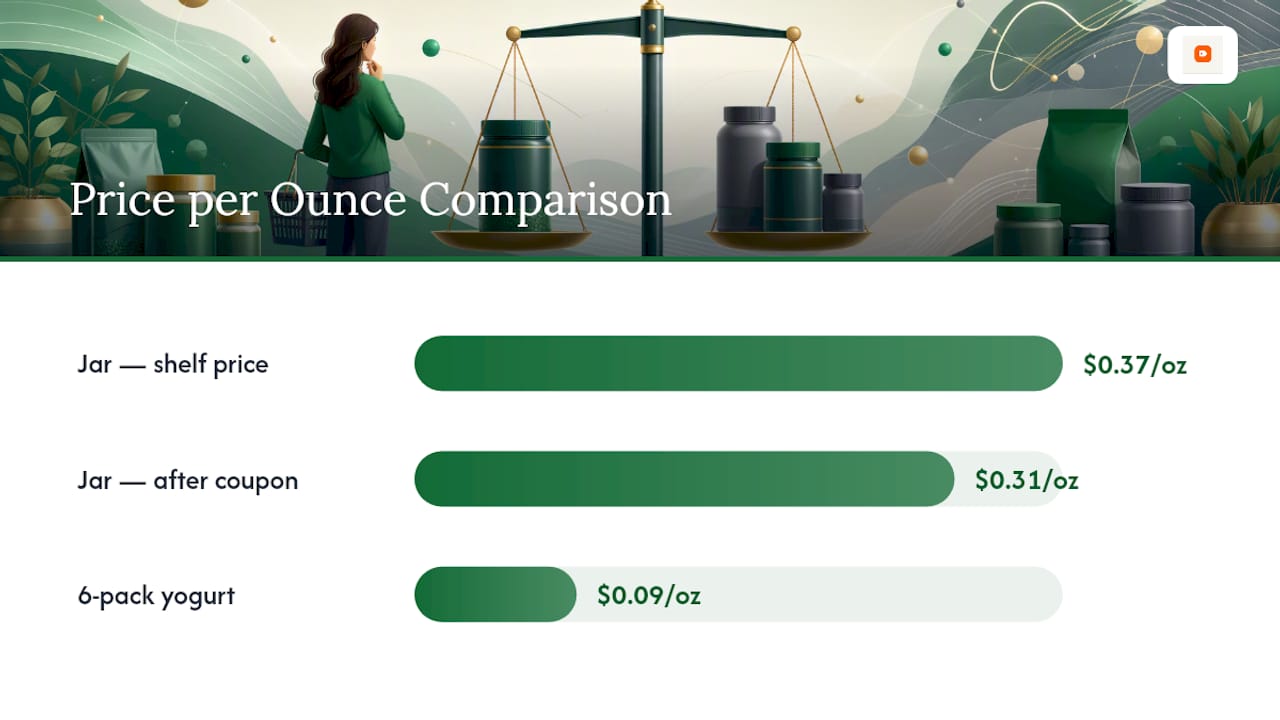
- Single item: A jar of peanut butter costs $5.99 and weighs 16 oz. Price per ounce is found by dividing the cost by the weight in ounces.
- Discounted item: The same jar has a $1 coupon, dropping the price to $4.99. New price per ounce = $4.99 ÷ 16 = $0.31 per oz. That's a meaningful gap, and it's why the calculator implementation logic at Best-Calculators recommends using the after-coupon price, not the shelf price, for real comparisons.
- Multi-pack: A 6-pack of 8 oz yogurt cups costs $4.50 total. To find price per ounce, divide the total cost by the total ounces obtained by multiplying the item weight by the item count.
If you're working backward, say you have a target price of $0.30 per ounce and want to know the maximum you should pay for a 24 oz product, just flip the formula: target price × ounces = maximum total cost. Here, that's $0.30 × 24 = $7.20.
Unit Conversions: Why Weight and Fluid Ounces Are Not the Same
A weight ounce measures mass. A fluid ounce measures volume. They are not interchangeable, and grocery packaging uses both depending on the product. A bag of flour is labeled in weight ounces. A bottle of olive oil is labeled in fluid ounces. Confuse the two and your per-ounce math becomes meaningless, even though the arithmetic looks identical.
Before you divide, convert every measurement into the same unit. That means turning pounds into ounces, grams into ounces, or milliliters into fluid ounces, using standard, non-rounded conversion factors.
| Convert from | Convert to | Factor |
|---|---|---|
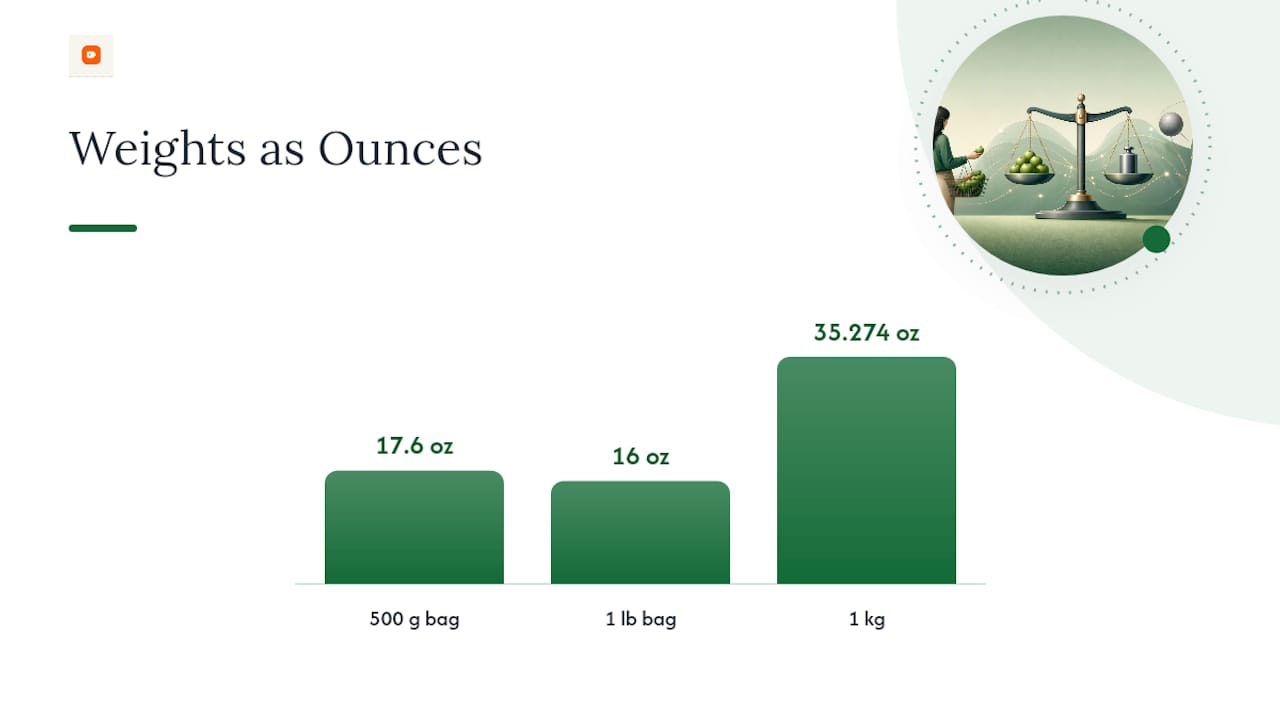
| Pounds (lb) | Ounces (oz) | 1 lb = 16 oz |
| Grams (g) | Ounces (oz) | 1 g = 0.035274 oz |
| Kilograms (kg) | Ounces (oz) | 1 kg = 35.274 oz |
| Milliliters (mL) | Fluid ounces (fl oz) | 1 mL = 0.033814 fl oz |
| Liters (L) | Fluid ounces (fl oz) | 1 L = 33.814 fl oz |
These factors come from the NIST Guide to SI, Appendix B, the federal reference standard for unit conversions in the United States. If you're converting a specific product, OutletPicks maintains dedicated pages for pounds to ounces, grams to ounces, and fluid ounces to milliliters that walk through the same math with live examples.
Pro Tip: Never eyeball a conversion. A 500g bag looks similar in size to a 1 lb bag, but 500g equals about 17.6 oz, roughly 10% more product than 16 oz. That gap disappears fast when you skip the actual conversion step.
Comparing Multi-Packs and Bulk Items Fairly
Multi-packs are where most shoppers get the math wrong, because the price tag shows the pack total, not the per-item weight. The formula needs one extra step: price per ounce = total price ÷ (weight per item × number of items).
Say a case of sixteen 12 oz soda cans costs $7.99. Total ounces = 16 × 12 = 192. Price per ounce = $7.99 ÷ 192 = $0.042 per oz. Compare that to a single 2-liter bottle at $2.29. Converting 2 liters to fluid ounces using the NIST factor of 33.814 fl oz per liter gives you 67.6 fl oz. Price per ounce = $2.29 ÷ 67.6 = $0.034 per oz. The bottle wins, even though the case looks like the "bulk deal."
- Find the weight or volume printed on a single item, not the pack.
- Multiply that figure by the item count to get total package size.
- Divide total price by that total to get your true per-ounce cost.
You can also run this formula backward. If you know the per-ounce price you're willing to pay and the pack size, multiply the two to find your maximum acceptable total price before you even pick up the item.
Common Mistakes That Throw Off Your Math
Most price-per-ounce errors trace back to one of a handful of habits, and they're easy to fix once you know what to watch for.
- Mixing weight ounces with fluid ounces instead of converting both to the same unit first.
- Rounding too early. Round only the final displayed answer, since rounding mid-calculation compounds small errors across multiple steps.
- Ignoring "net weight" versus "drained weight" on canned goods. A can of beans might list 15 oz net weight but only 9 oz drained, and recipes often care about the drained figure.
- Comparing the shelf price instead of the price you'll actually pay after a coupon or loyalty discount is applied.
Pro Tip: When two products both claim to be "family size" but list different units, that's usually a sign one brand wants to make direct comparison harder. Convert both to the same unit before trusting either label.
Reading Shelf Labels and Posted Unit Prices Correctly
Most grocery stores already post a unit price on the shelf tag, usually in small print below the item price. The problem is that stores don't always use the same unit for competing products, and that inconsistency is exactly what makes side-by-side comparisons unreliable without doing the math yourself.
One tag might read "per oz," the next "per lb," and a third "per count." According to unit pricing guidance from University of Minnesota Extension, a bigger package is not automatically the better per-unit deal, and shelf tags in different units make that trap easy to miss.
- Check the small unit label on the tag before comparing two prices directly.
- If the units differ, convert one to match the other before you decide.
- Keep your phone handy, or pull up OutletPicks' calculator to double-check the math in seconds rather than trusting a mental estimate.
Why Precise Unit Pricing Actually Matters
The gap between a rough guess and an exact price-per-ounce figure is usually small on any single item and adds up fast across a full cart. A few cents of difference on a jar of peanut butter is trivial. That same few cents, repeated across thirty items a week, becomes real money over a year, and shoppers rarely notice it happening because sticker prices are designed to distract from unit cost, not clarify it.
OutletPicks exists because that gap is worth closing. The platform rechecks retailer prices on a rolling cycle and normalizes every product down to a real cost per unit, so the comparison is already done by the time you see it. When you're staring down five brands of the same product with five different pack sizes, that's exactly the moment to run the numbers instead of guessing, and OutletPicks' cost-per-unit research shows just how often the "value size" isn't actually the best value.
— Alex
Skip the Math With OutletPicks' Unit Price Calculator
Outletpicks built its unit price calculator so you never have to convert grams to ounces by hand or second-guess a rounding step. Type in the price and package size, in whatever unit is printed on the label, and it converts everything internally, holds full precision, and only rounds the number it shows you at the end.
Use it any time you're standing in an aisle comparing three sizes of the same brand, checking whether a multi-pack actually beats a single item, or converting a metric label on an imported product into ounces you can compare against a domestic one. It handles multi-pack math automatically, so you're not doing the "weight per item times count" step in your head while a cart blocks the aisle.
Outletpicks also tracks real per-unit prices across categories like household essentials and personal care, rechecked on a rolling basis so the numbers reflect current retailer pricing, not last month's snapshot. If you want to check a specific purchase right now, head to the calculator and run the numbers before you check out.
Sources
Conversion factors in this guide follow the NIST Guide to SI, Appendix B. Unit-pricing guidance draws on University of Minnesota Extension. OutletPicks maintains its own conversion and reference pages for ongoing verification.
- NIST Guide to SI: Appendix B — Conversion Factors
- Unit pricing | Real Life, Good Food — University of Minnesota Extension
- Price Per Ounce - Single-Product Unit Price Calculator — Best-Calculators
FAQ
What Is the Formula for Calculating Price Per Ounce?
Price per ounce equals total cost divided by package size in ounces. Convert the package size to ounces first if it's listed in pounds, grams, or another unit.
What Is the Average Price Per Ounce for Infant Formula?
Infant formula pricing varies widely by brand, container size, and retailer, so there's no single reliable average figure to quote. The best approach is comparing the per-ounce cost directly on the products you're considering, using OutletPicks' calculator or checking current listings on OutletPicks' deals page.
How Do I Calculate the Cost of Liquor Per Ounce?
Divide the total bottle price by the bottle's volume in fluid ounces, since liquor is measured by volume, not weight. A 750 mL bottle converts to about 25.4 fl oz using the NIST conversion factor of 33.814 fl oz per liter.
Is There an App That Can Calculate Price Per Ounce?
Yes. OutletPicks' unit price calculator converts units and handles multi-pack math automatically, so you don't have to do the conversion or division by hand.
Do I Need to Include Tax When Calculating Price Per Ounce?
Include tax only if you're comparing final out-the-door costs consistently across every product; otherwise compare pre-tax prices to keep the math consistent, since tax rates rarely differ between similar grocery items in the same transaction.