

The formula is simple: price divided by quantity equals price per unit, and the lower price per identical unit is the better deal. The one catch is that the units have to match exactly: weight against weight, volume against volume, count against count. Mix those up and the comparison falls apart before it starts.
TL;DR:
- Use the price you will actually pay after current discounts, then divide by net quantity; exclude store credit that applies only to a future purchase.
- Convert both products to the same unit of weight, volume, or count, and never compare weight with volume unless you know the product’s density.
- Check usable quantity and likely waste before buying in bulk, because spoilage, unused product, or nonconsumable accessories can erase an apparent unit price advantage.
- Treat unit price as a first filter, not a final verdict: concentration, serving size, brightness, or lifespan can change the cost of each useful application.
Table of Contents
- Step-by-step method to calculate price per unit
- Worked examples for ounces, liters, and counts
- Units, conversions, and when you can't normalize
- Practical shopping tips for stores and online
- NIST-backed best practices and how unit pricing fights shrinkflation
- Quick verification checklist before you buy
- How to handle promotional offers and multipack discounts when comparing unit prices
- Common pitfalls and mistakes to avoid in unit price comparisons
- How to compare unit prices for non-standard products like skincare and electronics
- How to interpret unit prices in relation to product quality and brand differences
- Using technology tools and apps to simplify and automate unit price comparison
- Author perspective: why we teach unit pricing
- Try OutletPicks' unit price calculator
- FAQ
- Sources
Step-by-step method to calculate price per unit
Once you know the formula, the process takes seconds. Here's how to work it every time, whether you're standing in an aisle or scrolling a product page:
- Get the total price. Use the price you'd actually pay, including any listed discount, not the pre-sale sticker price.
- Find the net quantity. Check the package label for the net weight, volume, or count, usually printed near the ingredients or barcode.
- Normalize the units if needed. Convert both products to the same unit (both in ounces, both in liters, both in count) before you divide anything.
- Divide to get price per unit. Price ÷ quantity = price per unit. That number is what you compare, not the total price on the shelf tag.
For multipacks, divide the pack price by the total number of individual units inside it, not by the number of packages. A 12-pack of granola bars at $4.80 comes out to $0.40 per bar: that per-item figure is what you line up against a single bar sold elsewhere.
On rounding, keep at least two decimal places when the per-unit price is in cents (like $0.03 per sheet), since rounding to whole cents too early can hide a real price gap between similar products. If you're comparing listings in different currencies, skip the comparison or convert both to the same currency first using the exchange rate shown by your bank or card issuer, never an assumed rate.
Worked examples for ounces, liters, and counts
Grocery store math gets easier once you see it done. Here are two common comparisons shoppers run into:
- Ketchup, per ounce: A 20-ounce bottle at $3.00 works out to $0.15 per ounce. A 32-ounce bottle at $4.48 works out to $0.14 per ounce. The larger bottle is slightly cheaper per ounce.
- Paper towels, per roll: A 6-roll pack at $7.50 is $1.25 per roll. An 8-roll pack at $9.60 is $1.20 per roll, making the larger pack the better per-roll value.
Percent saved: (higher unit price − lower unit price) ÷ higher unit price. In the ketchup example, that's ($0.15 − $0.14) ÷ $0.15, or about 6.7% saved by choosing the 32-ounce bottle. Extension-service consumer guides use this same step-by-step unit-price method, dividing price by quantity and calculating percent saved to compare grocery sizes, which is exactly the shortcut worth keeping in your head at the shelf.
Units, conversions, and when you can't normalize
Unit prices only mean something when you're comparing like with like. Group products this way:
- Weight: ounces, pounds, grams, kilograms.
- Volume: milliliters, liters, fluid ounces, quarts.
- Count: each, per item, per load, per sheet.
A few conversions are worth memorizing: 16 ounces equal 1 pound, 1,000 milliliters equal 1 liter, and 32 fluid ounces equal 1 quart. These let you flip between labels fast without a converter app.
What you can't do is cross weight and volume without knowing the product's density, since a milliliter of honey weighs more than a milliliter of water. Comparing a product priced per fluid ounce against one priced per ounce by weight is comparing two different things, even though the units sound similar.
Practical shopping tips for stores and online
Shelf tags in most stores print the unit price in small type just below or beside the total price, usually labeled "per oz," "per lb," or "per 100 count." Online, that figure is often missing entirely, buried in the product description, or listed in a unit that doesn't match the competing listing.
- If the unit price isn't shown, pull the net quantity from the product details and do the division yourself with your phone's calculator.
- Double-check that the "size" listed on an online marketplace matches the actual net weight or volume on the package, since photos and titles sometimes lag behind real packaging changes.
- Before grabbing the bigger size, think about whether you'll use it all. Bulk-size cleaning supplies, spices, or perishables that expire or take up pantry space can erase the savings a lower per-unit price promises.
For shoppers who want more structured ways to cut grocery waste while buying in bulk, grocery shopping tips for home cooks cover planning and storage habits that pair naturally with unit-price math.
Pro Tip: Snap a photo of the shelf tag before you compare brands online later, since the in-store unit price often reveals a better deal than the app listing shows.
NIST-backed best practices and how unit pricing fights shrinkflation
Unit pricing exists because total price alone hides the real story, especially as package sizes shrink while prices hold steady or rise. The NIST unit pricing guide recommends consistent unit labeling across a product category, legible "per" wording (like "per ounce" rather than just a number), and simple, consistent rounding rules for the cents shown. The goal is that two jars of peanut butter on the same shelf display their unit price in the exact same unit, so you're not doing mental conversion just to compare them.
Unit pricing is one of the most effective tools available to consumers for comparing value across package sizes and helps counter the effects of shrinkflation, where packages shrink but prices stay flat or climb.
That's also why NIST's updated unit pricing guidance pushes retailers to place the unit price right next to the retail price, both on shelf tags and online. When you're comparing products, glance at the adjacent labels on the shelf first: if they're already using the same unit, the comparison is done for you.
Quick verification checklist before you buy
Before you commit to the lower per-unit price, run through a few final checks:
- Confirm both prices use the exact same unit after any conversion you did.
- Confirm the usable quantity, like actual sheets, servings, or diapers, not just package count.
- Check whether the displayed price already includes tax, since that can shift the real per-unit cost slightly at checkout.
How to handle promotional offers and multipack discounts when comparing unit prices
A "buy one, get one half off" deal or a multipack discount changes the real price you're paying, so the unit price calculation has to use your actual out-of-pocket cost, not the regular shelf price.
Multipack bundles marketed as a "value pack" deserve the same scrutiny. Divide the bundle's total price by the total quantity inside it (total ounces, total count, total loads) and compare that figure against the single-unit price of the same product. Sometimes the bundle is genuinely cheaper per unit; sometimes the "value" framing is doing more work than the math supports.
Loyalty program prices, digital coupons, and "clip the coupon" discounts should also be folded into the price you use before dividing, since the point of a unit price is to reflect what you will actually pay. If a promotion only applies to a future purchase, like a store credit for next time, treat the current purchase at its full price and don't count the future credit as a discount on today's unit cost.
Watch for promotions that apply to a bundle of different items rather than multiples of the same product. In that case, a single blended unit price doesn't mean much. It's more useful to calculate each item's individual contribution to the total price before working out its per-unit cost.
Common pitfalls and mistakes to avoid in unit price comparisons
The most frequent mistake is comparing numbers that look similar but measure different things, like price per fluid ounce against price per ounce by weight on two products with different densities. Always check the unit label itself, not just the number next to it.
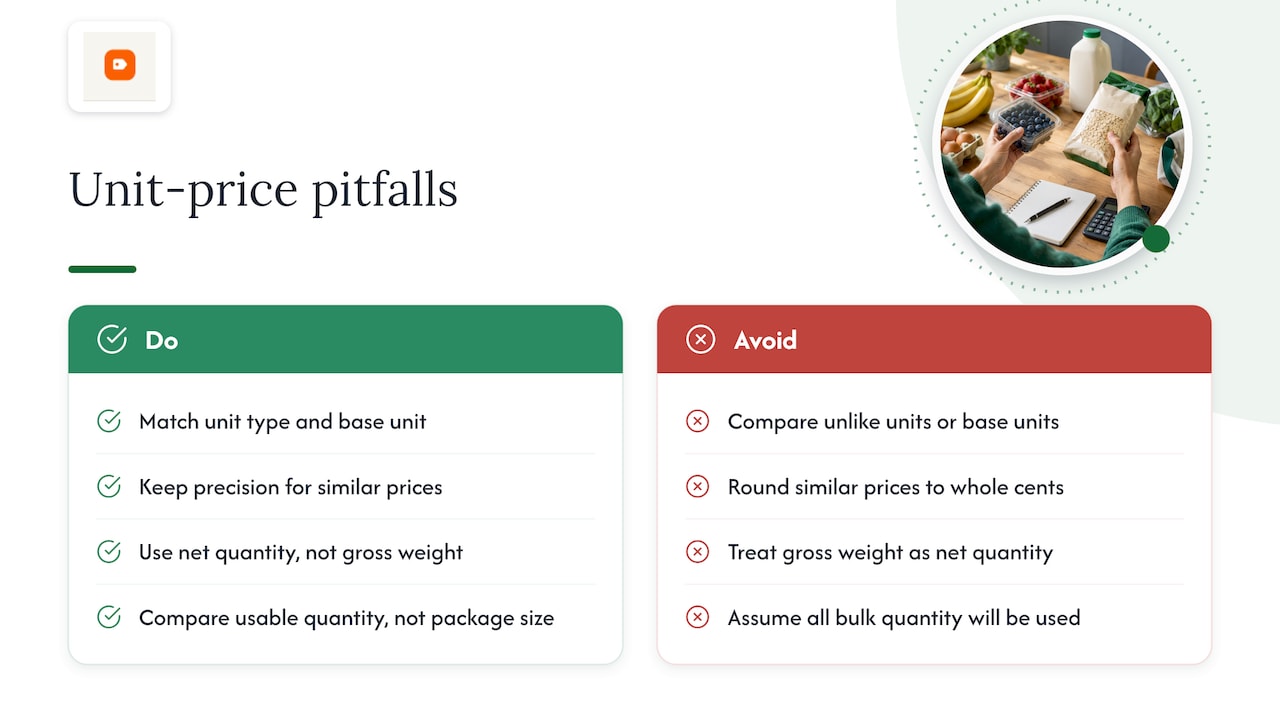
Another common error is trusting the shelf tag or app-listed unit price without checking that both products use the same base unit. Some stores price one brand per ounce and a competing brand per pound on the same shelf, which makes the lower number look like the better deal even when it isn't once converted.
Rounding too aggressively is a quieter problem. A unit price rounded to the nearest cent can mask a meaningful gap between two very similarly priced products, especially for small, high-volume items like laundry pods or diapers where tiny per-unit differences add up fast over a year of purchases.
Shoppers also sometimes forget to account for package weight that isn't part of the usable product, such as the tare weight of a jar versus its contents, or a kit that includes non-consumable accessories alongside the actual product. Reading the net quantity, not the gross package weight, avoids that trap.
Finally, ignoring usable quantity rather than package size leads to overpaying for bulk items that spoil, expire, or simply never get used before they're thrown out, which erases any savings the lower unit price promised.
How to compare unit prices for non-standard products like skincare and electronics
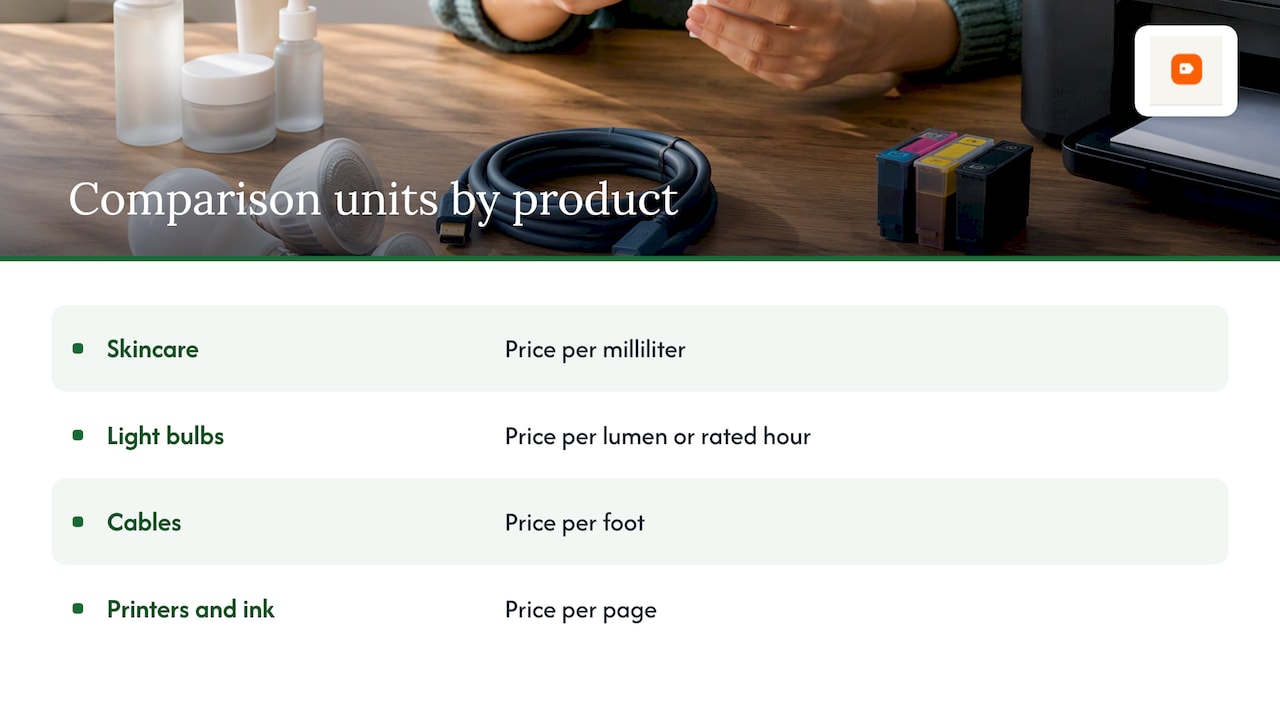
Not every category prices cleanly in ounces or pounds. Skincare and personal care items often list volume in milliliters, so compare serums and lotions per milliliter rather than per bottle, especially when package shapes vary widely in how much product they actually hold.
For electronics, there often isn't a single shared unit at all. Light bulbs compare more fairly by price per lumen or per rated hour of life than by price per bulb, since brightness and lifespan vary even among bulbs that look similar on a shelf. Cables are often worth comparing by price per foot, particularly when similar cables are sold in different lengths. Printers and ink cartridges are best compared by price per page, using the manufacturer's page-yield estimate rather than the cartridge's sticker price alone.
The underlying principle stays the same across all of these: identify the measurable unit that reflects how you'll actually use the product, then divide price by that quantity. When two products genuinely don't share a comparable unit, like a cream priced per milliliter against one priced per application, the fairest approach is to estimate the usable quantity (number of applications you'd realistically get) and divide from there rather than skipping the comparison entirely.
How to interpret unit prices in relation to product quality and brand differences
A lower unit price doesn't automatically mean the better purchase. It means the better price for that specific measurable unit, which is a narrower claim. Concentration, formulation, and ingredient quality can vary enough between brands that two products priced per ounce aren't delivering equivalent results per ounce.
This matters most in categories like skincare, where a serum with a higher concentration of active ingredients might cost more per milliliter but require less product per use, narrowing or even reversing the gap in practical cost. It also shows up in pet food, where a less expensive option priced per pound might call for larger daily servings than a pricier, more calorie-dense formula, changing the real cost per feeding.
Unit price is the fairest starting point for comparing package value, but it works best alongside a look at what the product actually is, not just what it costs. Treat the per-unit number as the first filter, not the final word, especially when brands differ meaningfully in formulation or intended use.
Using technology tools and apps to simplify and automate unit price comparison
Doing this math by hand works fine for a quick in-aisle decision, but it gets tedious across a full cart or when comparing more than two or three sizes at once. That's the gap tools built specifically for unit-price comparison are meant to close.
We built our unit price calculator to handle exactly this kind of repetitive math across categories like household essentials, personal care, and electronics, converting mismatched units automatically so you're not doing mental conversions between milliliters and fluid ounces mid-comparison. Our platform also tracks per-unit prices across retailers on a rolling basis, which matters because the better per-unit deal today isn't always the better deal next week once prices shift.
For readers who want a faster path than manual math, a short four-step guide to calculating unit price walks through the same method with a printable checklist you can keep on hand. Tools like these don't replace understanding the formula, but they remove the friction of applying it across dozens of products in a single shopping trip.
Author perspective: why we teach unit pricing
We spend our time tracking real per-unit prices across retailers because the sticker price rarely tells the full story, and we've watched package downsizing make that gap wider. Our calculator and ongoing price tracking exist to shortcut the manual math whenever you need a fast, trustworthy answer. Try it the next time two sizes have you stuck.
— Alex
Try OutletPicks' unit price calculator
We built our tools around one idea: the real cost per unit, not the sticker price, is what tells you whether you're getting a deal. Our unit price calculator handles the conversion and division for you, so comparing a 20-ounce bottle against a 1.5-liter one takes a few taps instead of a notepad.
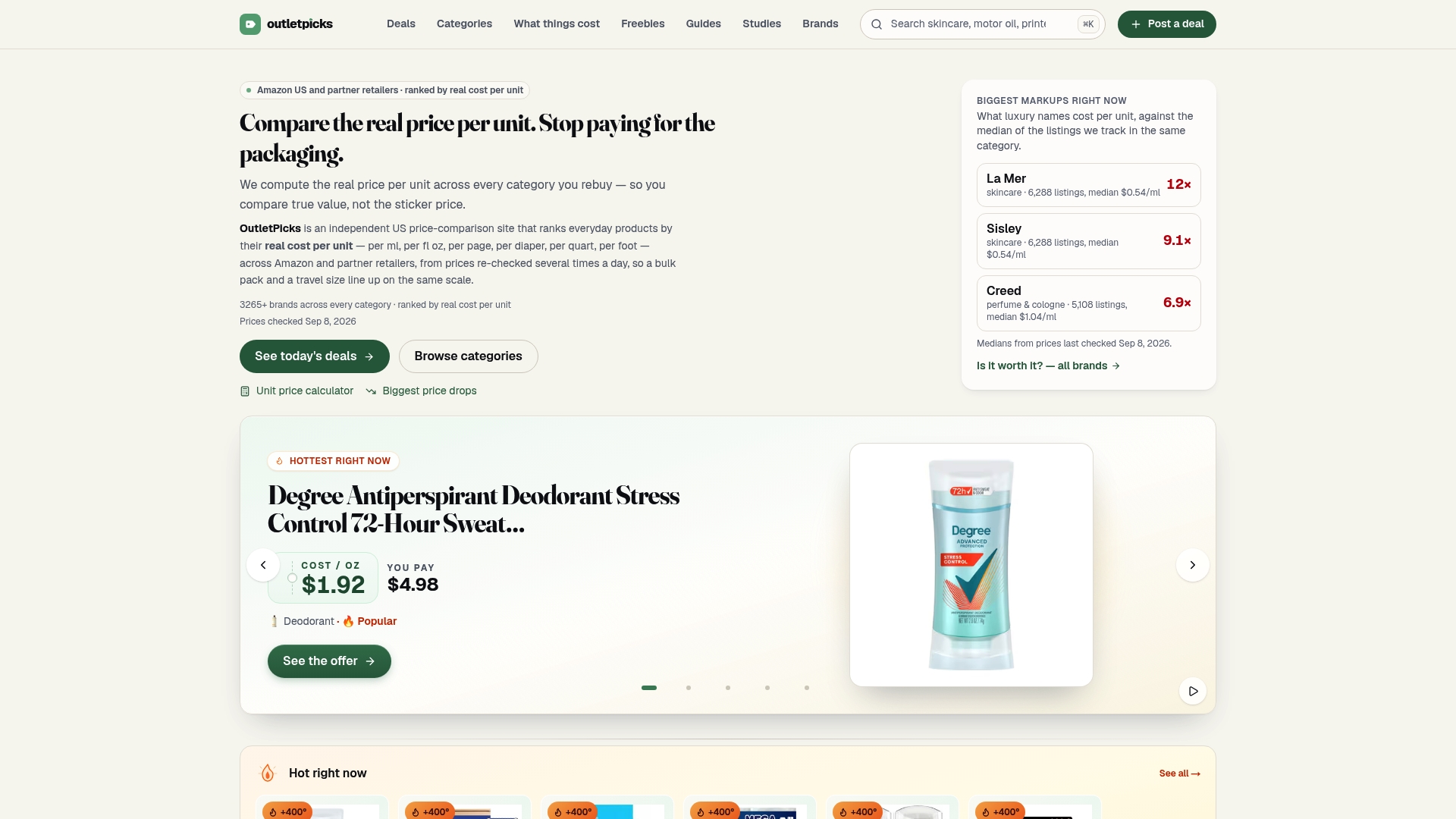
It's especially useful when you're weighing several sizes of the same product at once, since manually converting five or six listings to a shared unit eats up time you don't have standing in an aisle. Browse our category pages for curated per-unit rankings across household essentials, personal care, and more, or run a quick check on your current cart before you hit purchase. A minute with the calculator often turns up a cheaper option sitting right next to the one you were about to grab.
FAQ
How do we find the unit price?
Divide the total price by the net quantity listed on the package or product page, such as price divided by ounces or price divided by count. Many shelf tags and online listings already show this number, usually labeled "per oz," "per lb," or "per count," next to the retail price.
Is $15 per hour a unit rate?
Yes, a unit rate expresses a cost or quantity per single unit of something else, like price per ounce or price per item. The same divide-to-find-the-rate logic applies whether the unit is time, weight, volume, or count.
How do you calculate price per kilogram?
Divide the total price by the product's net weight in kilograms; if the package lists grams, divide the grams by 1,000 first to convert to kilograms before dividing. This gives you a figure you can line up directly against any other product priced per kilogram.
How do you compare unit rates?
Convert both rates to the same unit first, then compare the resulting numbers directly, choosing the lower price per identical unit as the better value. This only works when the units genuinely match, like both being price per ounce or both being price per liter, not one in weight and the other in volume.