
To turn a price per pound into a price per ounce, divide by 16. A pound holds 16 avoirdupois ounces, according to NIST's General Tables of Units of Measurement. So $4.00 per pound is $0.25 per ounce, and $9.11 per pound is about $0.57 per ounce. To go the other way, multiply by 16.
The arithmetic takes ten seconds. The mistakes come from the details around it: the label says grams, the sale pack is a different size, or the "ounce" is a fluid ounce. This guide covers the formula, a reference chart, grams, and the traps.
TL;DR
- Price per ounce = price per pound ÷ 16. Price per pound = price per ounce × 16.
- For a package, divide the total price by the total ounces. If the label says pounds, multiply by 16 first.
- For grams, one ounce is about 28 g (more precisely 28.3495 g), and one pound is 453.59237 g.
- Weight ounces and fluid ounces are different units. Don't compare them without a density figure.
- Compare unit prices, not sticker prices. Package sizes change, and the shelf tag can show it.
Table of Contents
- The formula, with numbers you can check
- A quick-reference chart for the supermarket aisle
- Step by step: from a package label to a unit price
- Why the bigger package isn't always cheaper
- Grams to ounces: converting metric labels
- Three ways this conversion goes wrong
- Shrinkflation: where per-ounce math pays for itself
- Our perspective: the per-ounce habit that saves real money
- Check a price against live listings
- Practical habits for everyday shopping
- FAQ
- Sources
The formula, with numbers you can check
One pound equals 16 ounces. Everything else follows from that.
Price per ounce = price per pound ÷ 16
Price per pound = price per ounce × 16
Here are a few worked examples:
- $9.11 per lb. $9.11 ÷ 16 = $0.569375, which you would normally read as $0.57 per ounce.
- $4.99 per lb (a typical deli or produce tag). $4.99 ÷ 16 = $0.311875, or about 31¢ per ounce.
- $2.49 per lb. $2.49 ÷ 16 = $0.155625, or about 15.6¢ per ounce.
- 20 cents per ounce, back to pounds. $0.20 × 16 = $3.20 per pound. This is a common question, and the answer is $3.20.
Keep the extra decimals while you work and round only at the end. Rounding 31.19¢ to 31¢ is harmless on one item. It matters if you are comparing two products that differ by a fraction of a cent.
A quick-reference chart for the supermarket aisle
Most people don't need a calculator for round numbers. These anchors follow directly from multiplying by 16:
| Price per ounce | Price per pound |
|---|---|
| 5¢ | $0.80 |
| 10¢ | $1.60 |
| 20¢ | $3.20 |
| 25¢ | $4.00 |
| 50¢ | $8.00 |
| $1.00 | $16.00 |
And in the other direction:
| Price per pound | Price per ounce |
|---|---|
| $1.00 | 6.25¢ |
| $2.00 | 12.5¢ |
| $4.00 | 25¢ |
| $8.00 | 50¢ |
| $12.00 | 75¢ |
| $16.00 | $1.00 |
A handy mental shortcut: $1.00 per pound is 6.25¢ per ounce. For any price, think "how many dollars per pound" and multiply by 6.25 to get cents per ounce. $5 per pound is about 31¢ per ounce, which matches the $4.99 example above.
Step by step: from a package label to a unit price
The tag on the shelf isn't always in the unit you want. Sometimes you only have the sticker price and the net weight. The method is the same each time: total price divided by total ounces.
- Find the net weight on the package, not the front-of-pack banner. Net weight is the amount of product inside.
- Convert to ounces. Pounds × 16. Grams ÷ 28.3495. Kilograms × 35.274 (that is 1,000 ÷ 28.3495).
- Count every unit in the pack. A 4-pack of 6 oz cups holds 24 oz.
- Divide the total price by the total ounces.
- Compare only against another price per ounce, never against a price per pound or per count.
A worked example: a $12 bag weighs 2 lb. That's 32 oz, so $12 ÷ 32 = $0.375, or 37.5¢ per ounce. Multiply back by 16 and you get $6.00 per pound, which is exactly $12 ÷ 2 lb. The two routes agree, which is a good sanity check.
For a longer treatment of the pound side of this, our guide to converting 16 oz to 1 lb before you calculate cost per pound walks through more examples. If you'd rather see the full process for any unit, calculate unit price in four steps covers it.
Why the bigger package isn't always cheaper
Two packages, same product:
| Package A | Package B | |
|---|---|---|
| Price | $7.49 | $14.99 |
| Net weight | 12 oz | 30.5 oz |
| Price per ounce | about 62.4¢ | about 49.1¢ |
| Price per pound | about $9.99 | about $7.86 |
The unit price for Package B is lower, so it's the better value if you will use it all. (These are illustrative figures, not current shelf prices.) The reverse can happen too. Some warehouse-style "value" packs cost more per ounce than the regular size, especially when the regular size is on sale. The only way to know is to convert both to the same unit.
The same logic applies when one retailer sells by the pound (deli, bulk bins, produce) and another sells by the package. Convert both to price per ounce, and the comparison is fair. We went through this in more detail for two big retail formats in our piece on Aldi vs. Walmart prices by cost per unit.
Does the cheaper unit price survive a meal plan?
Unit price tells you the cost of the product, not the cost of what you throw away. A cheaper-per-ounce bulk pack that spoils halfway through is more expensive per ounce eaten. The same goes for deals bundled around food. This piece on how meal deals reduce food costs for smart shoppers is a useful reminder to compare what you actually get against what you would otherwise pay.
Grams to ounces: converting metric labels
Most US packaging prints both systems, but imported goods, supplements and some specialty foods lead with grams. NIST gives about 28 g per ounce and about 454 g per pound as rounded values. The more precise figure for a pound is 453.59237 g.
The formulas:
- Price per ounce = price per gram × 28.3495
- Price per gram = price per ounce ÷ 28.3495
- Price per pound = price per gram × 453.59237
A worked example: a 500 g bag costs $9.78.
- Price per gram: $9.78 ÷ 500 = $0.01956.
- Price per ounce: $0.01956 × 28.3495 = $0.5545, or about 55¢.
- Price per pound: $0.5545 × 16 = $8.87.
If you use the rough 28 g approximation instead, you get $0.548 per ounce. The difference is about 1%, fine for a quick aisle check but worth avoiding when two products are within a few cents of each other. For kitchen-scale work, NIST's metric kitchen equivalencies list the household approximations.
A price per kilogram works the same way. $19.56 per kg is about $0.554 per ounce, since a kilogram holds about 35.27 ounces.
Three ways this conversion goes wrong
1. Mixing weight ounces and fluid ounces
An ounce on a bag of coffee measures weight. An ounce on a bottle of shampoo usually measures volume. NIST treats them as different dimensions: a fluid ounce is about 30 mL, while a weight ounce is about 28 g. The two only line up for water-like liquids, and even then by coincidence.
The dividing-by-16 rule works for pounds and weight ounces. A pint is also 16 fluid ounces in US measure, so people sometimes apply the same "16" to liquids and get a number that looks right but means something else. If you need to convert liquid labels, use a volume tool such as our fluid ounces to milliliters converter, fluid ounces to liters converter or fluid ounces to cups converter.
2. Using the wrong kind of ounce
Retail food and household goods use avoirdupois ounces, 16 to the pound. Precious metals are priced in troy ounces, and a troy pound has only 12 troy ounces, as the NIST tables note. If you're pricing gold, silver or similar goods, "divide by 16" is the wrong rule. Check which ounce the seller means before calculating.
3. Trusting the front-of-pack size
The FTC points out that a familiar can can quietly change from 15 oz to 14.5 oz. Last year's size is not a safe assumption. Read the net weight each time you buy.
Shrinkflation: where per-ounce math pays for itself
Unit price is the cleanest way to catch a package that has gotten smaller without getting cheaper. The FTC's consumer guidance gives an example: a package drops from 6 oz to 5.3 oz while the price stays at $1.29. The unit price moves from $0.22 to $0.24 per ounce, according to FTC-hosted research on product downsizing. That same research reports an average 9.3% unit-price increase after package-size reductions.
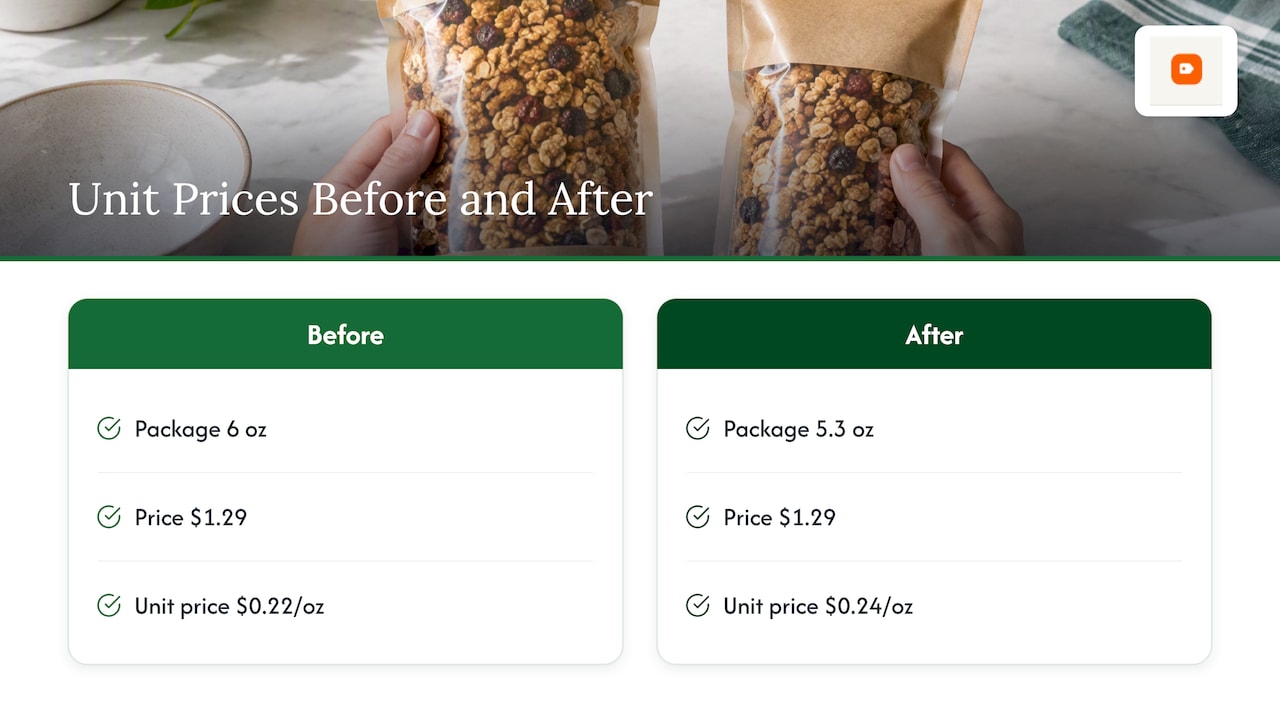
The sticker never changed, so shoppers who watch only the sticker miss it. Our own look at this, the shrinkflation study, measures how much per-unit cost has climbed across tracked products.
Our perspective: the per-ounce habit that saves real money
We built OutletPicks around one idea: the sticker price is the least useful number on the package. What matters is what you pay for each ounce, milliliter, sheet or diaper. When we rank products, we put them all on the same unit so pack size and brand stop distracting you.
What we've seen in practice is that conversion errors are rarely about math. They come from comparing things that aren't comparable: a per-pound deli tag against a per-package shelf price, a fluid ounce against a weight ounce, or last month's size against this month's. Fix the units first, and the decision usually becomes obvious.
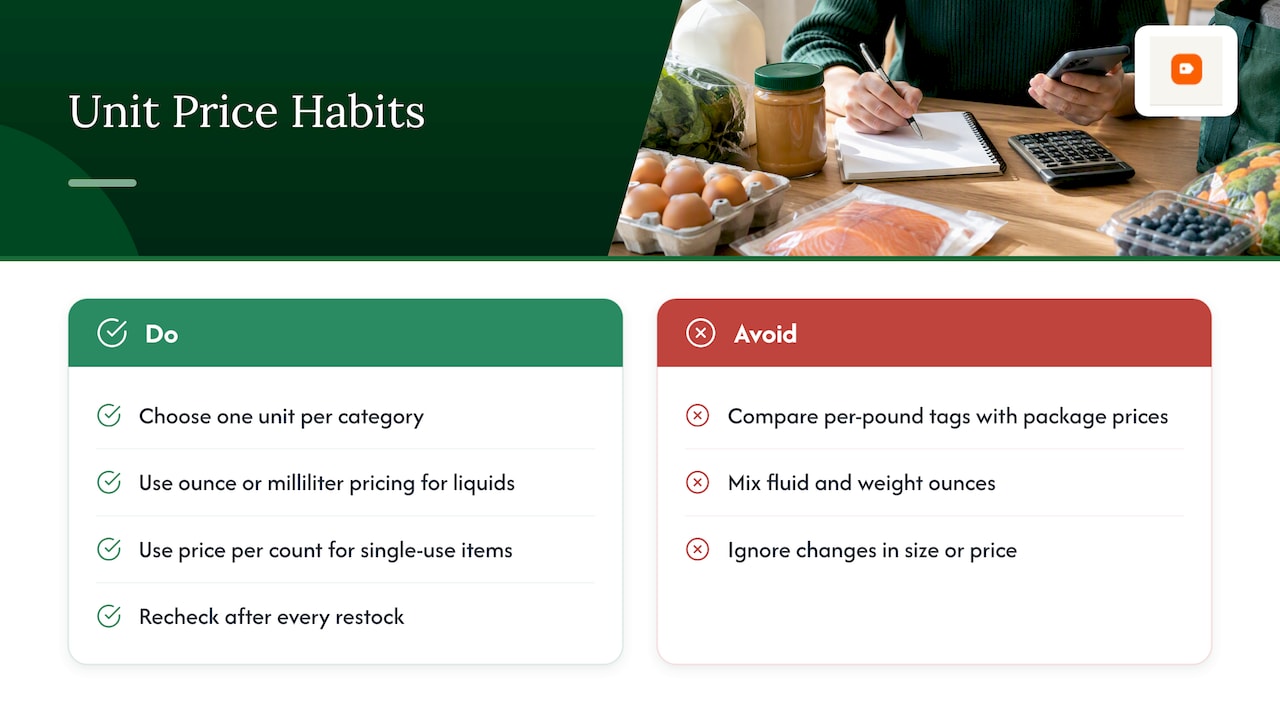
Our advice is simple. Pick one unit per category and stick with it. Price per ounce for dry goods and snacks, price per fluid ounce or per milliliter for liquids, price per count for things you use one at a time. Then re-check after every restock, because sizes and prices both drift.
— Alex
Check a price against live listings
If you want to skip the arithmetic, OutletPicks lists everyday products ranked by real cost per unit, with prices rechecked on a rolling cycle across Amazon and other retailers. Browse all of our categories, from skincare and body care to baby care, pet food, cables and more. For a current deal list in one aisle, try skincare on sale this week or body care on sale this week.
Practical habits for everyday shopping
- Read the shelf unit price first. Stores often print it, and the FTC calls it the practical figure for comparison shopping. Where it's missing, calculate it yourself. Our explainer on unit pricing for US shoppers covers the final-cost side.
- Match units across products. If one tag says per ounce and another says per pound, convert one of them before judging.
- Compare generics too. The sticker gap between store brand and name brand often shrinks or grows once you convert to a unit price. See our measurement of the generic vs. name brand price gap.
- Use a repeatable method. Our four-step guide to comparing grocery unit prices uses NIST guidance and works for any category.
- Check servings. The FTC advises looking at net weight, unit price and serving information before assuming a sale or bulk pack is cheaper.
FAQ
How do I calculate a price per ounce?
Divide the total price by the total ounces in the package. If the label lists pounds, multiply by 16 first. A $12 bag weighing 2 lb has 32 oz, so it costs $0.375 (37.5¢) per ounce.
How many pounds are 20 cents per ounce?
Twenty cents per ounce is $3.20 per pound. Multiply the per-ounce price by 16: $0.20 × 16 = $3.20. Going back, $3.20 ÷ 16 returns $0.20.
How much is 1 pound in ounces?
One pound is 16 avoirdupois ounces, per NIST. That is the ounce used for food and household goods. Troy ounces, used for precious metals, are a different unit, with 12 to the troy pound.
How do I convert a price per gram to a price per ounce?
Multiply the price per gram by 28.3495. For example, $0.02 per gram is about $0.567 per ounce. For a fast estimate at the shelf, using 28 g per ounce is close enough, but use the precise figure when two products are near each other in price.
Can I use the same math for fluid ounces?
Not to compare against weight ounces. A fluid ounce measures volume, and a weight ounce measures mass, so the two are not interchangeable without knowing the product's density. Compare liquids against other liquids by price per fluid ounce or per milliliter.
Sources
- NIST Handbook 44, Appendix C: General Tables of Units of Measurement
- NIST Metric Kitchen: Cooking Measurement Equivalencies
- FTC Consumer Advice: The case of the shrinking packaging (October 15, 2024)
- FTC-hosted research: Shrinkflation, evidence on product downsizing and consumer response