

Short answer: Aldi usually wins on private-label staples because of its tight assortment and store-brand focus, while Walmart competes hardest on national brands and convenience through pickup and delivery. The real winner for your cart depends on unit pricing, not shelf price, and checking that for your own basket with a tool like OutletPicks is the fastest way to confirm which store wins near you.
TL;DR:
- Consumer Reports found most of 70 tested store brand foods tasted as good as national brands while costing 5% to 72% less per serving.
- Only nine states plus Washington, D.C., require shelf unit pricing, and Walmart omits it from some sponsored listings; include pickup or delivery fees.
- Aldi tends to undercut Walmart on dairy, pantry staples, and frozen private label, while Walmart often wins on bulk household goods and specific national brands.
- Regional basket prices can differ by more than 33% within a metro area, and seasonal produce shifts or temporary rollbacks can change which store costs less.
Table of Contents
- At a glance: Aldi vs Walmart vs OutletPicks
- What a real grocery basket shows, category by category
- How to compare prices yourself: unit pricing, pack sizes, and fees
- Data and methodology: where these numbers come from
- Comparing prices beyond groceries: household and personal care
- Quality and variety: why Aldi and Walmart price so differently
- Average prices and unit costs across categories at a glance
- Seasonal swings and availability affect the real savings
- Author perspective: what each shopper profile should actually do
- How OutletPicks helps you settle Aldi vs Walmart for your own cart
- FAQ
- Sources
At a glance: Aldi vs Walmart vs OutletPicks
Each of these serves a different job. Aldi strips down its shelves to private-label staples and a handful of name brands, which keeps its sticker prices low on everyday items. Walmart carries far more variety, including most major national brands, and backs that up with pickup and delivery options that Aldi's smaller stores generally don't match. OutletPicks isn't a store at all. It's the tool you use to settle an argument between the two by normalizing pack sizes into a real cost per unit.
| Option | Best for | Unit-price visibility | Store-brand value | Online fees impact |
|---|---|---|---|---|
| OutletPicks | Comparing true per-unit cost across retailers before you buy | Built-in, normalized across pack sizes | Ranks private-label and name-brand items side by side | None, it's a comparison tool, not a store |
| Aldi | Shoppers who want low-cost private-label staples and fast, no-frills trips | Limited; shelf unit pricing varies by state law | Strong; private label is most of what it sells | Minimal, Aldi has limited delivery partnerships |
| Walmart | Shoppers who want wide selection, online ordering, and frequent rollbacks | Shown online for most items, but sponsored listings can omit it | Solid; Great Value spans most grocery categories | Pickup fees and delivery fees can erase small savings |
A few quick rules of thumb:
- Pick Aldi when your list is mostly staples like eggs, milk, canned goods, and produce, and you're comfortable with a smaller store.
- Pick Walmart when you need specific national brands, want to order online, or your list includes non-grocery items in the same trip.
- Use OutletPicks before either trip when you want to know, item by item, which store actually charges less per ounce, pound, or unit.
What a real grocery basket shows, category by category
Sticker prices only tell part of the story. A box of cereal that costs less per package can cost more per ounce if the box is smaller, which is exactly the kind of gap unit pricing is built to catch.
Breaking a cart down by category shows where each store tends to pull ahead:
- Produce: Aldi's rotating, smaller selection often beats Walmart on bagged salads and bananas, though quality consistency can vary week to week.
- Meat and dairy: Both stores price milk and eggs aggressively, but Aldi's private-label dairy frequently undercuts Walmart's Great Value equivalents by a noticeable margin per unit.
- Pantry staples: Canned vegetables, pasta, and baking goods are where Aldi's private label does its heaviest lifting against Walmart's national-brand shelf space, much like how authentic Swedish snacks compete with local treats in unit price and selection (IKEA Candy Is Real Swedish for Global Shoppers).
- Frozen foods: Walmart's broader frozen aisle gives more brand choice, but Aldi's frozen private label often prices lower per pound.
- Household and paper goods: Walmart's bulk pack sizes can offer a lower per-unit cost here, especially with rollback pricing.
Independent testing backs up the pattern on private label specifically. Consumer Reports testing found that of 70 store-brand products evaluated, most tasted as good as their name-brand counterparts while typically costing 5% to 72% less per serving, with one striking example being ketchup: Heinz ran about 33 cents per quarter-cup serving, while Aldi's Burman's brand came in at about 9 cents for the same serving size.
A representative 18-item basket of staples, including milk, eggs, bread, bananas, chicken breast, pasta, canned tomatoes, cheese, butter, cereal, coffee, frozen vegetables, paper towels, dish soap, rice, peanut butter, yogurt, and ground beef, is the kind of list where Aldi's private-label strength typically shows up most clearly. The exact total depends heavily on where you shop. Consumer Reports' supermarket pricing analysis found that when a basket study compared pricing across different U.S.
One sourced figure worth remembering: store-brand groceries typically cost 5% to 72% less per serving than their name-brand equivalents, which is the single biggest lever in either store's private-label aisle.
How to compare prices yourself: unit pricing, pack sizes, and fees
You don't need a finance degree to catch the gap between sticker price and real cost. You need the per-unit price, and a short process to get there.
- Find the unit measure on the shelf tag or online listing (per ounce, per pound, per milliliter, or per count) if your state requires it.
- Divide total price by total units when the tag doesn't show it: a $4.99, 28-ounce jar of peanut butter works out to about 17.8 cents per ounce.
- Repeat the calculation for the competing product at the other store, matching the unit of measure exactly.
- Add delivery, pickup, or substitution fees to the total before comparing, since a $3.99 flat delivery fee can wipe out a small per-item savings on a modest order.
- Check for rollbacks, digital coupons, or loyalty pricing that might only apply at checkout and aren't reflected on the shelf tag.
Shelf unit pricing isn't guaranteed everywhere. Nine states plus Washington, D.C. require unit pricing on grocery shelves, but most states don't, and even where Walmart shows unit pricing online, it's often missing from sponsored product listings. That's the gap a tool like OutletPicks' unit price calculator is built to close, since it normalizes pack sizes automatically instead of leaving you to do the math in the aisle.
Pro Tip: Round to the nearest cent per unit on your phone's calculator before you leave the aisle. A five-second division is almost always enough to catch a "larger pack, worse deal" trap.
Data and methodology: where these numbers come from
The figures in this piece draw on a small set of sources chosen for being specific and checkable rather than anecdotal.
- Consumer Reports' private-label testing, covering 70 store-brand products evaluated against name-brand equivalents.
- Consumer Reports' regional supermarket pricing analysis, comparing basket totals across six U.S. metro areas.
- Consumer Reports' unit-pricing guidance, documenting which states mandate shelf unit pricing.
- The Bureau of Labor Statistics Consumer Price Index, used here only for broader context on grocery inflation over time, not for any store-specific figure.
Unit-price normalization has real limits. Aldi and Walmart rarely sell identical items, so a comparison often matches "closest equivalent" rather than the exact same product, and regional assortment differences mean a city's Aldi basket won't always mirror the national pattern.
Normalizing every price to a common unit, and updating those prices on a rolling basis rather than a one-time snapshot, is what separates a real comparison from a guess.
Specific author credentials for this piece are not publicly listed.
Comparing prices beyond groceries: household and personal care
The Aldi-versus-Walmart question doesn't stop at the grocery aisle for most households. Shoppers buying skincare, hair care, fragrance, body care, baby care, or pet food often run the same stores against general retailers and specialty shops, and the same unit-price logic applies: a bigger bottle or bulk multipack isn't automatically cheaper per use.
The same is true further from the grocery cart entirely. Light bulbs priced per lumen, cables priced per foot, and electronics like cameras, makeup, desktop PCs, tablets, and printers priced per feature tier all hide their real cost behind pack size, bundle deals, and model numbers. A $45 four-pack of LED bulbs can cost more per usable lumen-hour than a $30 two-pack, depending on wattage equivalence, and a printer bundled with "starter" ink cartridges often costs more per printed page than a pricier printer sold with standard cartridges.
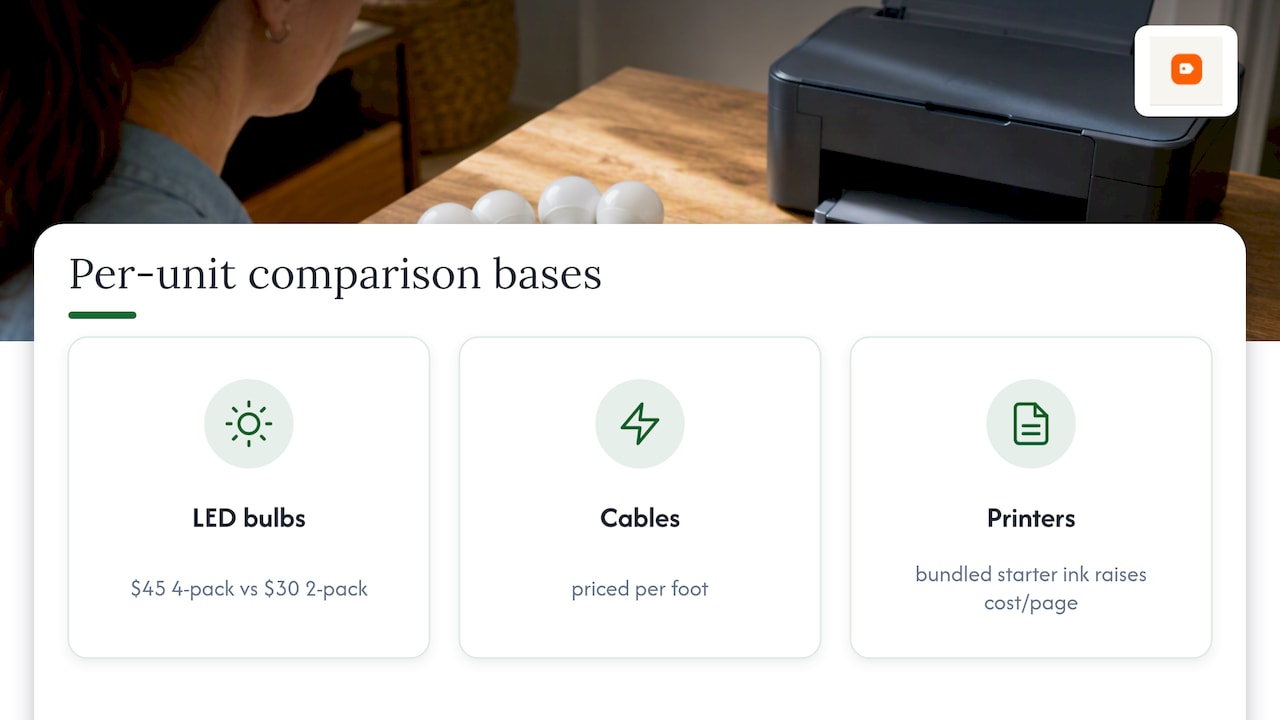
This is the exact gap OutletPicks is built to close across categories, not just groceries. The private-label versus name-brand comparison applies the same per-unit math to skincare and body care that Consumer Reports applied to ketchup, and the generic-versus-name-brand study extends that logic across personal care and household categories. Whether you're comparing a drugstore moisturizer to a store-brand version or two printers with different cartridge systems, the per-unit price, not the shelf price, is the number that decides who actually saves.
Quality and variety: why Aldi and Walmart price so differently
Aldi's low prices come from a deliberate trade-off: a smaller store, a tighter product selection, and a catalog dominated by its own private label instead of paying for national-brand shelf space and marketing. Fewer SKUs means lower overhead per item, and that overhead savings shows up directly in Aldi private label pricing on staples.
Walmart takes the opposite bet. Its stores stock a wider variety of brands, sizes, and categories under one roof, which costs more to operate but gives shoppers more choice in a single trip, including non-grocery items. That variety is also where Walmart earns back ground: Walmart Great Value spans far more categories than Aldi's private label does, so a shopper who needs both groceries and household goods in one stop may find Walmart's breadth worth a few cents more per item.
Quality is closer than price differences suggest. Consumer Reports' blind taste testing found most store-brand foods, Aldi's and Walmart's included, performed about as well as name brands, which means the price gap between the two retailers rarely reflects an actual quality gap on private-label staples. The bigger variable is simply how much assortment you need in one trip.
Average prices and unit costs across categories at a glance
Pulling the category notes together into one view makes the pattern easier to act on. These are directional comparisons based on the sourced basket and testing data above, not a single universal price list, since actual totals shift by region and by week.
| Category | Where Aldi typically wins | Where Walmart typically wins |
|---|---|---|
| Produce and dairy | Private-label milk, eggs, bagged produce | Branded specialty items not stocked at Aldi |
| Pantry staples | Canned goods, pasta, baking supplies | Specific national brands by request |
| Frozen foods | Private-label frozen vegetables and meals | Wider brand selection and bulk sizes |
| Household goods | Smaller, simpler SKUs | Bulk packs with rollback pricing |
| Non-grocery (personal care, electronics) | Limited assortment, few comparisons possible | Broader selection, more price-matching opportunities |
The takeaway isn't that one store wins everything. It's that Aldi tends to win on a narrow set of staples where private label does the heavy lifting, while Walmart's advantage grows as your list gets broader and includes items Aldi simply doesn't stock.
Seasonal swings and availability affect the real savings
Grocery prices aren't static, and neither store holds its pricing edge year-round. Produce pricing shifts with growing seasons, which can widen or shrink the gap between Aldi's rotating selection and Walmart's more consistent, broader sourcing. Holiday periods bring temporary promotions at both chains, and Walmart's rollback pricing cycles in particular can erase a private-label price advantage for a week or two at a time.
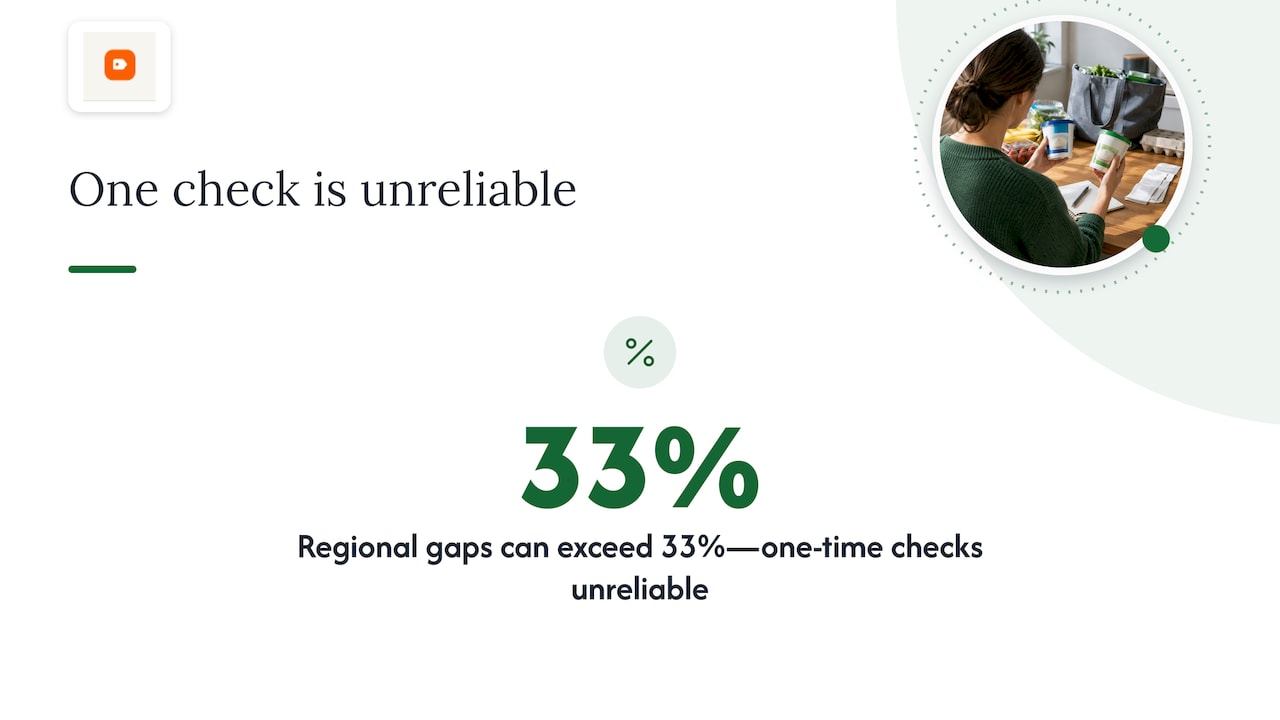
Regional pricing adds another layer of unpredictability. Consumer Reports' metro-area basket study found price gaps between the cheapest and most expensive retailer in a city exceeding 33% on average, which means the season and the specific month you're shopping can matter almost as much as the store you choose. Broader inflation trends tracked by the Bureau of Labor Statistics also shift grocery costs over time at both retailers, so a comparison done a year ago may no longer hold.
The practical implication is that a one-time price check isn't enough. A store that wins your basket comparison in March might not win it again in August when produce sourcing changes, which is exactly why continuously updated price tools matter more than a single receipt comparison.
Author perspective: what each shopper profile should actually do
Families with a long staples list usually come out ahead leaning Aldi, since private-label savings compound across a bigger cart. Singles and occasional shoppers who value convenience and brand choice tend to do better at Walmart, especially when pickup saves a second trip. Bulk buyers and anyone comparing non-grocery categories should skip guessing entirely and check unit prices directly before committing to either store.
The action worth taking right now: pick three staples from your usual list and compare their per-unit price on OutletPicks before your next trip. The store that wins on paper isn't always the one that wins for your actual cart.
— Alex
How OutletPicks helps you settle Aldi vs Walmart for your own cart
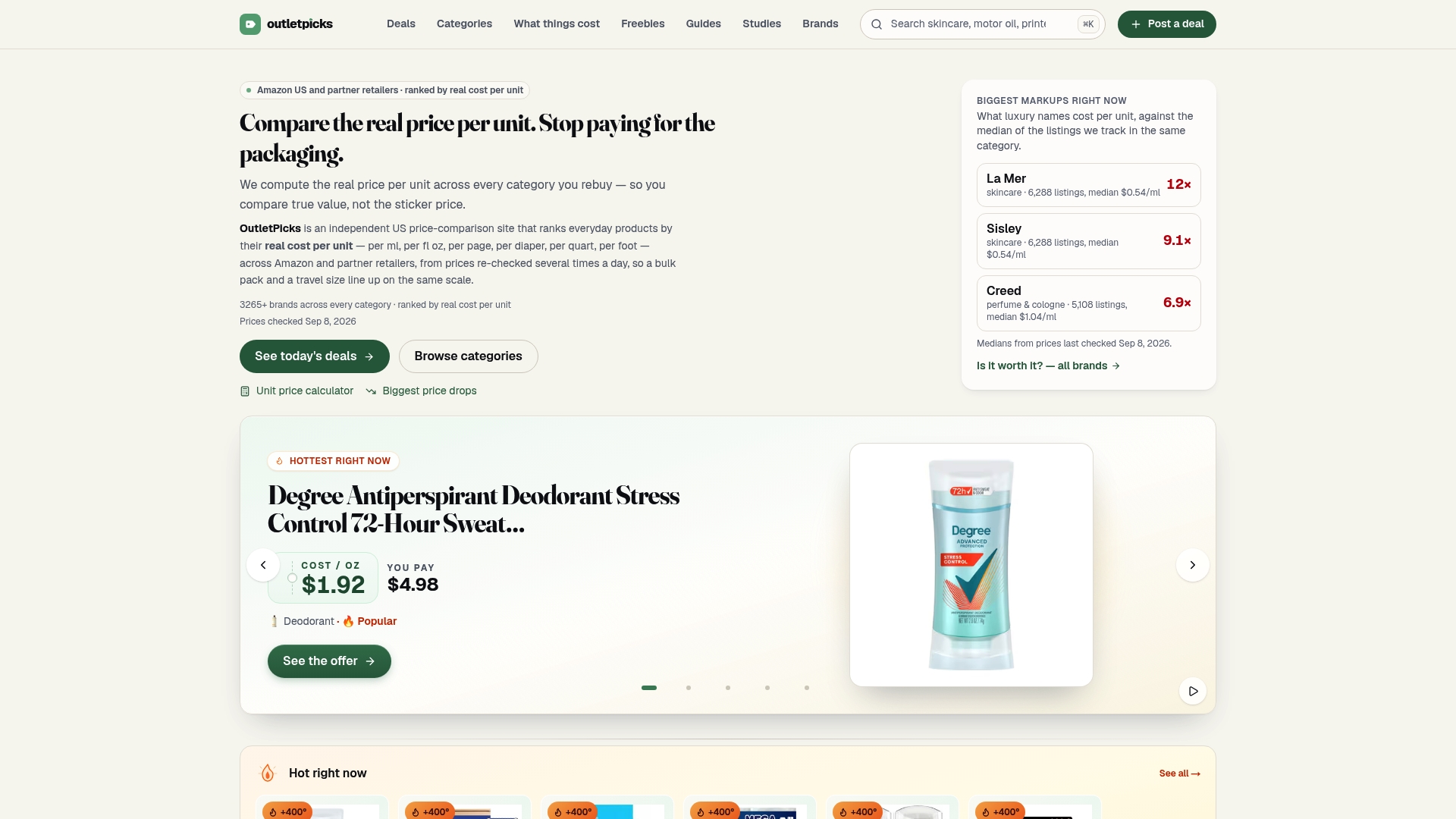
We built OutletPicks to answer exactly the question this article raises: not which store looks cheaper, but which one actually is, for the specific items in your cart. The unit-price calculator normalizes pack sizes automatically, so you can compare cents per ounce or per unit instead of guessing from sticker price alone, and prices are rechecked on a rolling cycle rather than relying on a single snapshot.
A quick way to put this to work:
- Pull up our brand-versus-brand comparison tool and enter the two products you're deciding between.
- Browse our category pages for everyday items like skincare, baby care, and pet food where pack-size tricks are common.
- Check our brand index ranked by real cost per unit when you want a broader view before you shop.
Start with our brand comparison tool on the three items you buy most often. It takes less time than reading a shelf tag twice, and it settles the Aldi-versus-Walmart question for your actual list instead of a national average.
FAQ
Who is currently the cheapest supermarket?
There's no single retailer that's cheapest across every category and region, since regional basket studies show price gaps between the highest and lowest-priced stores in a metro area can exceed 33%. Discount grocers with strong private-label programs, including Aldi, tend to price lowest on staples nationally, but the actual cheapest option for you depends on your specific list and location.
Why is Aldi sometimes called the "Aisle of Shame"?
Shoppers use this nickname for Aldi's center aisle of rotating, limited-time seasonal and discount items, like tools, kitchen gadgets, or clothing, that often tempt impulse buys beyond the grocery list. It's a playful nod to how easy it is to leave with more than you planned, not a comment on product quality.
What is the best day to buy from Aldi?
Aldi typically rotates its special-buy items on Wednesdays and Sundays, which is when the newest seasonal and limited-time products hit shelves. For regular grocery staples, pricing doesn't follow a specific weekly pattern, so checking unit prices before you go matters more than timing your trip to a particular day.
Can you sit while working as a cashier at Aldi?
Seating policies for cashiers vary by individual Aldi store and local labor practices, and this detail isn't something we can confirm from pricing research. Anyone considering employment there should check directly with the specific store location.
Is Target cheaper than Amazon, or CVS cheaper than Walmart?
These comparisons depend heavily on the specific product and category, since general merchandise, grocery, and pharmacy pricing each follow different competitive patterns. The most reliable way to answer it for a specific item is the same approach used here: compare the per-unit price rather than relying on a general reputation for being "cheap."
Sources
- Store brand foods we love and a few we don't - Consumer Reports
- Most and least expensive supermarkets - Consumer Reports
- Want the best grocery deals? Use this savings tool - Consumer Reports
- Consumer Price Index (CPI) - U.S. Bureau of Labor Statistics