
Most common ground spices cost between about $0.35 and $1.25 per ounce at U.S. mass-market stores. Specialty and tiny jars can run 10 to 20 times that. To compare any two spices, divide the price by the net weight in ounces. Then compare the results, not the sticker prices.
This guide gives you the formula, real per-ounce figures from U.S. retailers, and a way to judge whether a spice set or a big warehouse jar is worth buying.
TL;DR
- Price per ounce = package price ÷ net weight in ounces. Use weight, not teaspoons or jar size.
- Retailer figures we found ranged from about $0.36 per ounce for chili powder to $1.80 for ground ginger in standard jars, and far higher for tiny specialty packages.
- Bigger packages usually cost less per ounce, but only if you will use them before the spice goes stale.
- A spice set is good value only if its per-ounce price beats buying the jars you will actually use one by one.
- Prices and stock differ by store and change often, so check the current listing before you buy.
Table of Contents
- How to calculate the price per ounce of a spice
- What common spices cost per ounce in the U.S.
- Why spice prices per ounce vary so much
- Is a bigger jar worth it? The freshness check
- How to judge a spice set
- A repeatable way to compare spices at the store
- Our perspective: ignore the jar, read the ounce
- Find the best unit price across categories
- FAQ
- Sources
How to calculate the price per ounce of a spice
The math is one division. The University of Minnesota's consumer guide says unit price is the product cost divided by the package quantity in the unit you compare, such as ounces or pounds. Their example: $2.69 for 19 ounces comes to $0.14 per ounce.
For spices, three details trip people up.
- Use net weight, not the jar size. A large-looking jar of a light spice such as paprika can hold less than a smaller, dense jar of salt-heavy seasoning. The weight printed on the label is what counts.
- Convert everything to ounces. If a bulk bin is priced per pound, divide by 16. Our price per pound to price per ounce guide shows the shortcut, and the price per ounce formula page covers the rounding errors that can add up to a 10% mistake.
- Grams to ounces. Many spice labels print both. Use the ounce figure when it is listed, and divide grams by 28.35 when it is not.
Worked example: a 2.5-ounce jar at $1.08 is $1.08 ÷ 2.5 = $0.432 per ounce. A 0.5-ounce jar at $2.00 is $4.00 per ounce, more than nine times as much for the same kind of product.
Why not compare by teaspoons? Density differs from spice to spice and from brand to brand, so volume charts are only estimates. Weight is the one measure printed on every label and comparable everywhere.
What common spices cost per ounce in the U.S.
There is no single national price. Here is what we found in published listings and reporting. Treat these as snapshots, not quotes.
Mass-market jars and warehouse sizes
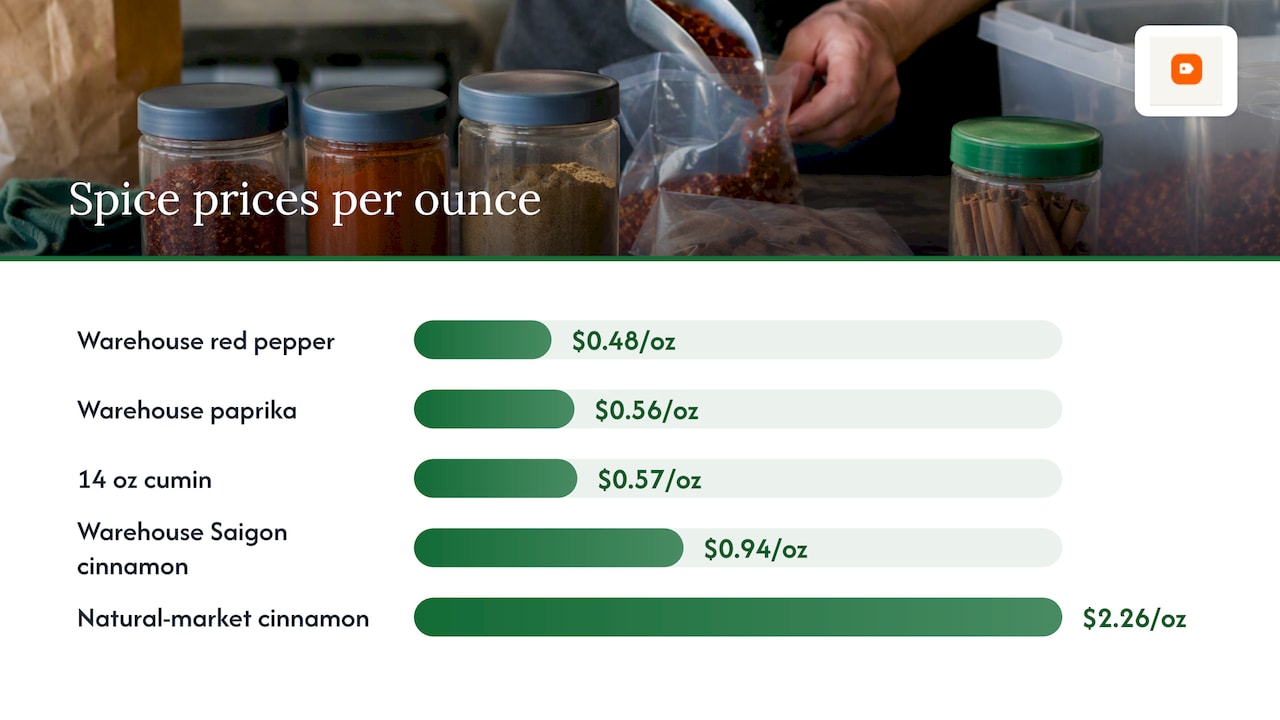
Food & Wine's Costco spice comparison reported per-ounce prices from $0.48 for crushed red pepper up to $0.94 for Kirkland organic ground Saigon cinnamon. The same piece listed Kirkland organic paprika at $0.56 per ounce and a 14-ounce McCormick ground cumin canister at $0.57 per ounce. It also noted that prices and products vary by store location.
For comparison, the same article put Whole Foods 365 organic cinnamon at $2.26 per ounce. So "how much is an ounce of cinnamon?" has a real answer only for a specific product: roughly $0.94 at the warehouse club for the organic Saigon type, and more than double that at a natural-foods supermarket for organic.
| Spice and package | Reported price per ounce | Source |
|---|---|---|
| Crushed red pepper (warehouse size) | $0.48 | Food & Wine |
| Organic paprika (warehouse size) | $0.56 | Food & Wine |
| Ground cumin, 14 oz canister | $0.57 | Food & Wine |
| Organic ground Saigon cinnamon (warehouse size) | $0.94 | Food & Wine |
| Organic cinnamon, natural-foods supermarket brand | $2.26 | Food & Wine |
Cumin: the same spice at three prices
Cumin is a good test case because it appears everywhere. Walmart's Great Value 4.5-ounce ground cumin was listed at $4.37, or 97.1¢ per ounce. ALDI's Stonemill ground cumin was listed at $1.09 for 2 ounces, or $0.54 per ounce, though the page marked it out of stock when we checked. The 14-ounce canister above came to $0.57.
The lesson: the smaller ALDI jar beat the larger Walmart jar per ounce. Bigger is not automatically cheaper. Retailer and house brand matter as much as size, which is why we compare store by store on a per-unit basis, and why our Aldi vs. Walmart price comparison is worth a look if those are your two stores.
Same spice, different package sizes
H-E-B's Hill Country Fare ground comino (cumin) shows the size effect clearly. Using the listed prices, we calculated:
| Package | Price | Price per ounce |
|---|---|---|
| 1.25 oz | $1.25 | $1.00 |
| 6.5 oz | $3.28 | about $0.50 |
| 16 oz | $6.98 | about $0.44 |
Going from the smallest jar to the 6.5-ounce package cut the unit price roughly in half. Going from 6.5 to 16 ounces saved only another 6 cents per ounce. That is a classic diminishing return: most of the savings come from leaving the smallest size, not from buying the largest.
Specialty shops: where the ounce price jumps
Specialty retailers sell freshness, origin and tiny quantities, and the per-ounce price shows it. The Spice House lists Turkish bay leaves at $3.99 for a 0.2-ounce jar, $3.79 for a 0.2-ounce flatpack and $10.99 for a 1-ounce bag. That works out to $19.95, $18.95 and $10.99 per ounce. Bay leaves are very light, so a fraction of an ounce goes a long way, and the weights can look tiny. Even so, the 1-ounce bag is cheaper per ounce by a wide margin.
That does not make specialty spices a bad buy. A spice you use in pinches, such as saffron or a rare chile, may be worth a premium. The point is to know the premium you are paying and pick it on purpose.
Why spice prices per ounce vary so much
Four things drive the gap.
- Package size. Larger packages usually have a lower unit price, as the University of Minnesota guidance notes, and Food & Wine credits warehouse-size quantities for lower prices.
- Store brand versus national brand. Private-label jars at big grocers are often the cheapest per ounce in the aisle. The examples above show the same cumin at 54¢ and 97¢ depending on the shelf.
- Organic and origin claims. Organic ground Saigon cinnamon and plain cassia-type cinnamon are different products. Compare like with like.
- Whole versus ground, and the spice itself. Light, leafy herbs come in few ounces per jar, so their per-ounce price looks high. Dense ground seeds look cheaper.
Store location matters too. Food & Wine cautions that prices and exact product offerings can differ by store, so a figure from one city may not match your local shelf.
Is a bigger jar worth it? The freshness check
A lower unit price only saves money if you use the spice. The University of Minnesota guidance says buying larger is only the better deal if the household will use the product before it goes bad.
Here is a simple test, using our own illustration (not a published figure):
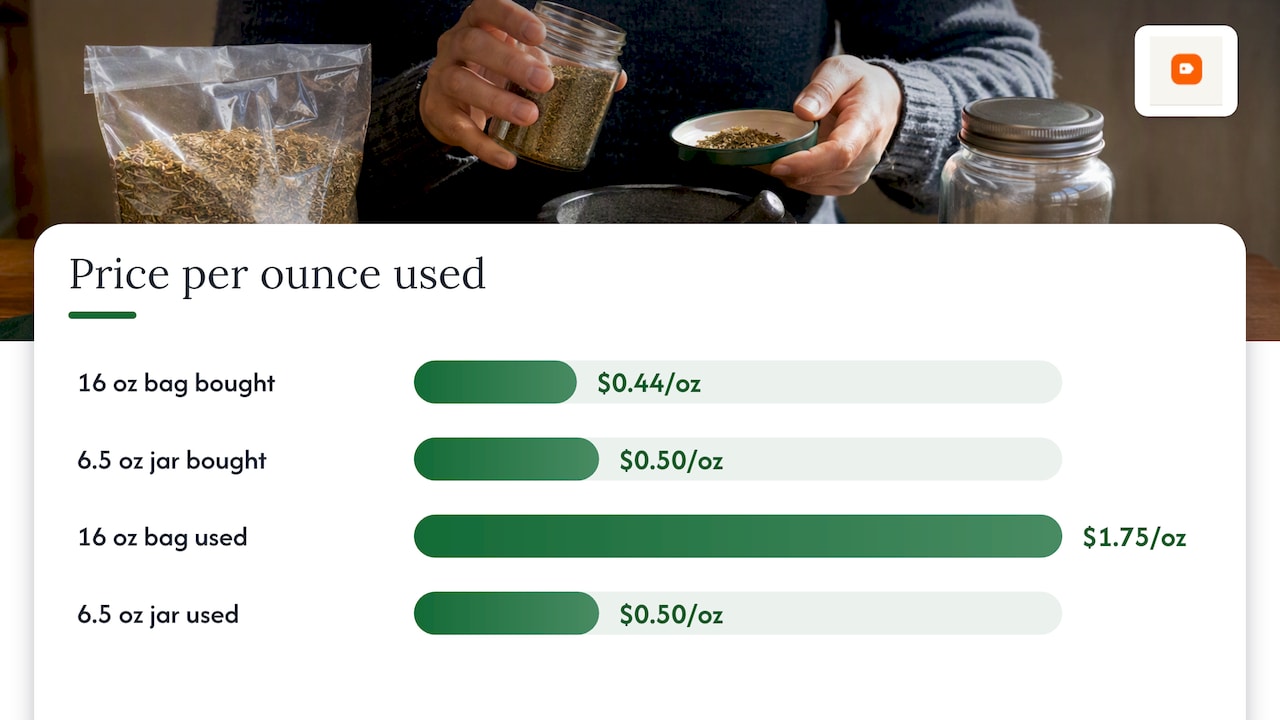
- A 16-ounce bag at $6.98 is $0.44 per ounce. A 6.5-ounce jar at $3.28 is $0.50 per ounce.
- If you would use only 4 ounces before the spice loses its punch, the 16-ounce bag costs $6.98 for 4 ounces used, or $1.75 per ounce used.
- The 6.5-ounce jar, if you finish it, is $0.50 per ounce used.
So the right question is not which jar has the lowest unit price. It is which jar has the lowest price per ounce you will actually use. For a spice you cook with weekly, such as chili powder, garlic powder or cumin, big sizes tend to win. For allspice, cloves or a once-a-year baking spice, a small jar often wins.
Two practical ways to capture bulk savings without waste: split a large bag with a neighbor, or refill a small jar you already own and keep the rest sealed, dry and away from the stove.
How to judge a spice set
Spice sets are the main reason people search for value by the ounce, because sets hide the weight behind pretty packaging. Here is how to see through it.
- Find the total net weight. Add up the weight of every jar. If the listing only says "12-piece set," look at the label photos or product details.
- Divide the set price by total ounces. An illustration: a 12-jar set at $24 with 0.5 ounce per jar holds 6 ounces, or $4.00 per ounce.
- Price the jars you will use. If six of the twelve jars are ones you would never buy, the useful ounces are only half, and the real price per useful ounce doubles.
- Compare with the shelf. At the mass-market prices above, many staples cost well under $1.25 per ounce. A set priced at several dollars per ounce needs a good reason: gift packaging, a rack, rare blends or whole spices you cannot find locally.
- Check the rack and the grinder. Racks and refills have value, but price them separately, not inside the ounce math.
Sets can be a smart buy for a new cook who is starting from zero and wants a dozen basics in one purchase. For everyone else, a short list of the six to eight spices you use most, bought in the best size per store, almost always costs less per ounce.
The same small-bottle logic applies well outside the kitchen. This breakdown of per-ounce math on beard oil shows how fast the ounce price falls when you move up a size, and how the same check applies there.
A repeatable way to compare spices at the store
Before you shop, run this routine.
- Make a short list of the spices you use monthly.
- For each, note the unit price shown on the shelf tag. Many tags already print a price per ounce. If they do not, divide the price by the net weight.
- Confirm both items are measured in the same unit. Some tags show per ounce, others per 100 grams.
- Compare the same form: whole with whole, ground with ground, organic with organic.
- Pick the size you will finish within a reasonable time.
Our four-step unit price comparison guide walks through this in more detail, and the unit price in four steps page is the shortest version. If you want to make it a habit, try the daily Packle game, which asks which pack is cheapest per unit, or build a list with our per-unit shopping checklists.
Our perspective: ignore the jar, read the ounce
We built OutletPicks because the sticker price tells you very little. Spices are one of the clearest cases. Jars come in shapes that make small amounts look large, sets are priced as a bundle, and the same spice appears at different prices in different aisles. Once every product is converted to a single unit, the picture changes fast.
Our experience comparing everyday products by real unit cost is that two habits do most of the work. First, convert before you compare: ounces for spices, always. Second, price what you will use, not what you could buy. The cheapest unit price on a shelf is no bargain if half of it ends up in the trash.
We also think shoppers should expect the price of the same jar to move. Retailers change prices and stock constantly, which is why we recheck listings on a rolling cycle rather than publishing a number once and leaving it. Use any spice price you read, ours or anyone else's, as a starting point and confirm it on the current listing.
— Alex
Find the best unit price across categories
Spices are one corner of the pantry. If you like seeing every product converted to its real cost per unit, browse the categories on OutletPicks, where we rank items by price per unit across retailers instead of by sticker price. The same method applies to personal care, baby care, pet food and more, so one habit saves you money across the whole shopping list.
FAQ
How do I calculate the price per ounce of a spice?
Divide the package price by the net weight in ounces. A 2.5-ounce jar at $1.08 is about $0.43 per ounce. If the weight is in grams, divide by 28.35 first.
How much is 1 oz of cinnamon?
It depends on the product. Food & Wine reported about $0.94 per ounce for Costco's Kirkland organic ground Saigon cinnamon and $2.26 per ounce for a Whole Foods 365 organic cinnamon. Prices vary by store and change over time, so check the current listing.
Is it cheaper to buy spices in bulk?
Usually, per ounce, yes. The H-E-B cumin example fell from $1.00 per ounce in a 1.25-ounce jar to about $0.44 in a 16-ounce package. The saving only counts if you use the spice before it goes stale, so buy big for staples and small for rarely used spices.
Are spice sets a good value?
Only if the price per ounce of the whole set, counting just the jars you would use, beats buying those jars individually. Add up the net weight, divide the set price by it, and compare with shelf prices for your staples. Sets with tiny jars often cost several times more per ounce.
Why does the same spice cost different amounts at different stores?
Store brand versus national brand, package size and organic status all change the price. Our cumin examples ranged from 54¢ to 97.1¢ per ounce between two stores. Local pricing differences add to that.
Sources
- Unit pricing | Real Life, Good Food, University of Minnesota
- How to Save Money on Spices by Shopping at Costco, Food & Wine
- Great Value Ground Cumin 4.5 oz, Walmart
- Stonemill Ground Cumin 2 oz, ALDI
- Hill Country Fare Ground Comino, H-E-B
- Whole Turkish Bay Leaves, The Spice House
- Stop Overpaying for Beard Oil: Per Ounce Math