

Price per mL equals total price divided by total volume in milliliters. A bottle holding 250 mL costing $12 costs about $0.05 per mL, or roughly $5 per 100 mL. That single division is the whole trick, and the only real risk is feeding it the wrong volume, which is where NIST conversion standards come in handy.
TL;DR:
- Comparing prices per milliliter requires using the labeled net volume, not packaging size or weight, and always in the same unit of measurement.
- The actual cost per mL is most reliable when based on the net contents listed in both metric and U.S. customary units, with conversions verified by NIST standards.
- For liquids, multiplying the price per mL by 100 or by 29.57353 efficiently provides the price per 100 mL or per fluid ounce, respectively, for easier comparison.
- Mistakes to avoid include confusing fluid ounces with weight ounces, ignoring multipack volumes, or using the wrong denominator like box size instead of net volume.
- Online tools and calculators can streamline multiple comparisons, but for quick decisions, consistent rounding and proper unit conversion are sufficient.
Table of Contents
- What the formula means and which number to divide by
- How to calculate it step by step
- Unit conversions and quick reference
- Quick tricks for comparing prices on the fly
- Common mistakes and troubleshooting
- Calculators and tools that do the math for you
- Why these numbers and methods hold up
- A quick example from an actual shopping decision
- Compare more than one bottle at once
- Sources
- FAQ
What the formula means and which number to divide by
The numerator is the price you'd actually pay at checkout. Most shoppers compare using the pre-tax shelf price, since tax rates vary by location and would skew comparisons between products sold in different places.
The denominator is trickier. You need the labeled net volume, not the size of the box or bottle it ships in. The FDA's net quantity guidance exists specifically so that the number printed on a label reflects what's actually inside, not the packaging around it. That printed figure, usually shown in both metric and U.S. customary units, is the number you want.
Price per mL works best for:
- Liquids with meaningful volume differences between brands, like lotions, serums, and shampoos.
- Fragrances, where bottle size varies wildly and the per-mL rate is the only fair comparison.
- Any product where you're choosing between a small premium bottle and a larger value size.
For solid goods, count-based products like diapers, or anything sold by weight, a different unit price applies, such as price per count or price per kilogram.
How to calculate it step by step
Here's the full process from label to final number.
- Write down the price and copy the labeled net volume in milliliters straight off the package.
- Divide price by volume to get your raw price per mL.
- Multiply that result by 100 to get price per 100 mL, or divide the mL figure by 29.57353 first if you want price per U.S. fluid ounce.
A $9.50 bottle labeled 150 mL works out to $0.063 per mL. Multiply by 100 and that's $6.33 per 100 mL. To get the fluid ounce price, convert 150 mL to fluid ounces first: 150 ÷ 29.57353 is about 5.07 fl oz, so $9.50 ÷ 5.07 comes to roughly $1.87 per fluid ounce, a figure confirmed by the NIST conversion constant of 29.57353 mL per U.S. fluid ounce.
Round to two decimal places for the dollar figure and you've got a number you can compare against any other bottle on the shelf, regardless of its size.
Unit conversions and quick reference
Every price-per-mL comparison breaks down the moment two products are listed in different units. The fix is converting everything to milliliters before you divide anything. The NIST metric-household reference lays out the exact constants: one U.S. fluid ounce equals 29.57353 mL, one liter equals 1,000 mL, and one milliliter equals roughly 0.033814 fluid ounces.
To convert in either direction: mL = fl oz × 29.57353, and fl oz = mL ÷ 29.57353.
| Unit | Equivalent in milliliters |
|---|---|
| 1 U.S. fluid ounce | 29.57353 mL |
| 1 liter | 1,000 mL |
| 1 mL | 0.033814 fl oz |
Bookmark this table, or use a dedicated fluid ounces to milliliters converter when a label only lists customary units.
Quick tricks for comparing prices on the fly
You rarely need the raw price per mL once you're standing in an aisle. Two scaled versions do the actual comparing.
- Multiply price per mL by 100 to get price per 100 mL, which most shoppers find easier to read than a fraction of a cent.
- Multiply price per mL by 29.57353 to get price per fluid ounce, or use a milliliters to fluid ounces page if you'd rather skip the math.
- Round price per mL to two decimal places and price per fluid ounce to the nearest cent. Anything more precise doesn't change a buying decision.
Keeping the rounding consistent across every product you compare matters more than the precision itself.
Common mistakes and troubleshooting
The single biggest error is confusing fluid ounces with weight ounces. They measure different things entirely, and a product labeled in weight ounces can't be divided the same way as one labeled in fluid ounces. The NIST conversion guidance is explicit that a fluid ounce is a volume unit, not a mass unit.
Other frequent slip-ups: using the box or outer packaging size instead of the labeled net contents, and for multipacks, forgetting to multiply the per-unit volume by the number of units before dividing. A four-pack of 50 mL bottles has 200 mL total, not 50.
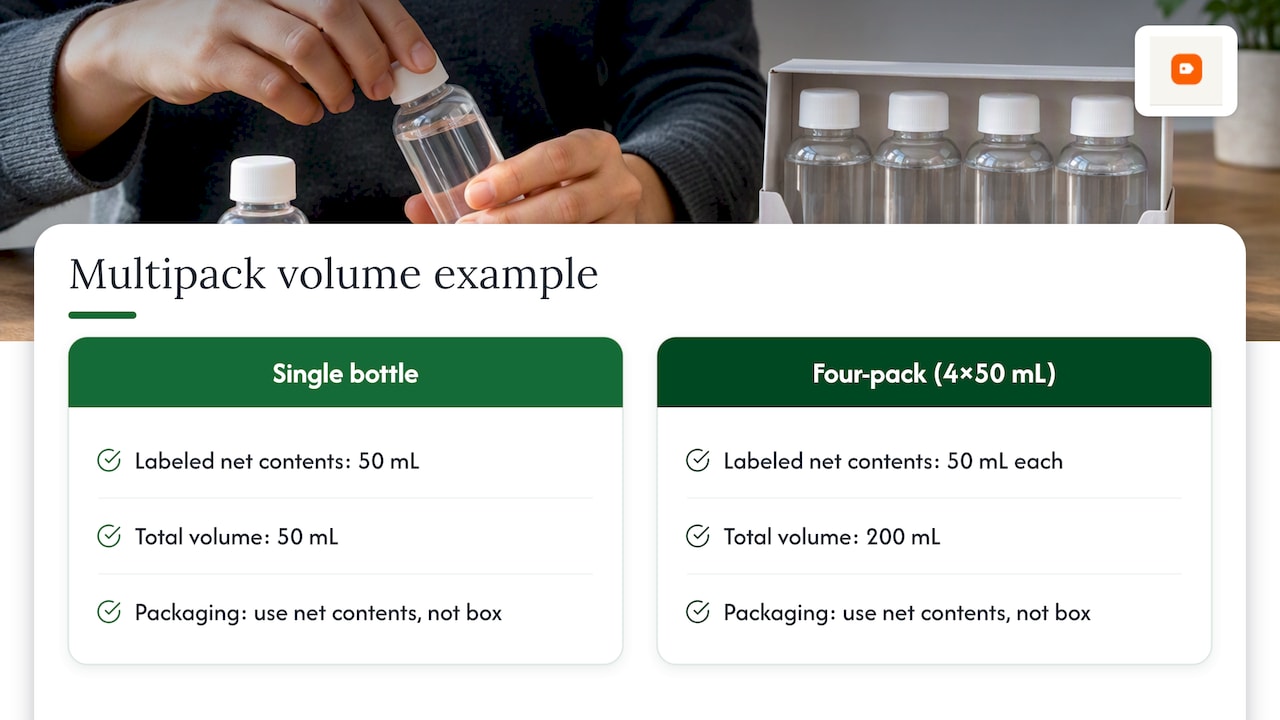
Pro Tip: Before comparing two listings, check that both show volume in the same unit, mL to mL or fl oz to fl oz, so you're not accidentally mixing denominators.
Calculators and tools that do the math for you
A manual calculation takes seconds for one comparison. Once you're weighing five or six bottles against each other, a calculator saves time and avoids typos.
- Enter the price and the labeled volume in milliliters, or convert fluid ounces first using a standard conversion rate.
- The OutletPicks unit price calculator takes a price and a volume and returns the per-mL, per-100-mL, and per-fluid-ounce figures in one pass.
- For a quick single comparison, doing the division by hand is often faster than opening a tool.
- For scanning a whole shelf of options, a calculator or a page like what things actually cost per unit handles the repetition for you.
Why these numbers and methods hold up
The math in this guide rests on sources that don't shift with marketing trends.
- NIST's conversion tables supply the exact constant, 29.57353 mL per U.S. fluid ounce, used in every conversion above.
- FDA labeling guidance establishes that net contents, not packaging size, is the correct denominator.
- OutletPicks rechecks retailer prices on a rolling cycle and normalizes listings to a per-unit basis, so a bottle's rank reflects its actual cost per mL rather than its sticker price.
A quick example from an actual shopping decision
Picture two serums on a shelf: a 30 mL bottle at $42 and a 50 mL bottle at $58. Divide each: $1.40 per mL versus $1.16 per mL. The larger bottle wins on cost, even though it carries the higher sticker price. Always check the net contents line on the package before running the numbers, since a bottle's shape can make two very different volumes look nearly identical.
— Alex
Compare more than one bottle at once
Doing this math by hand works fine for two products. It gets tedious fast once you're comparing six skincare serums or a shelf of fragrances in different sizes.
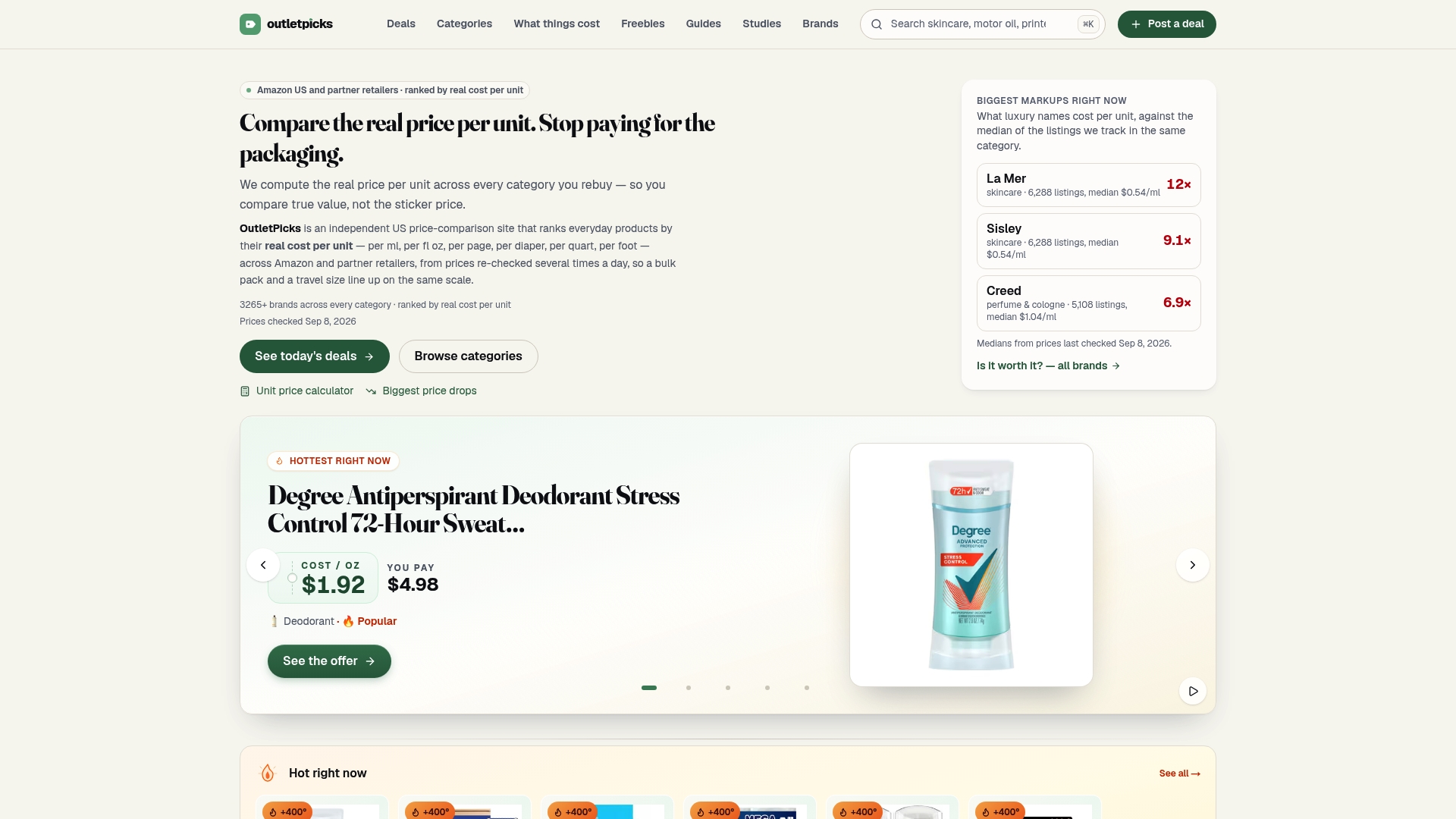
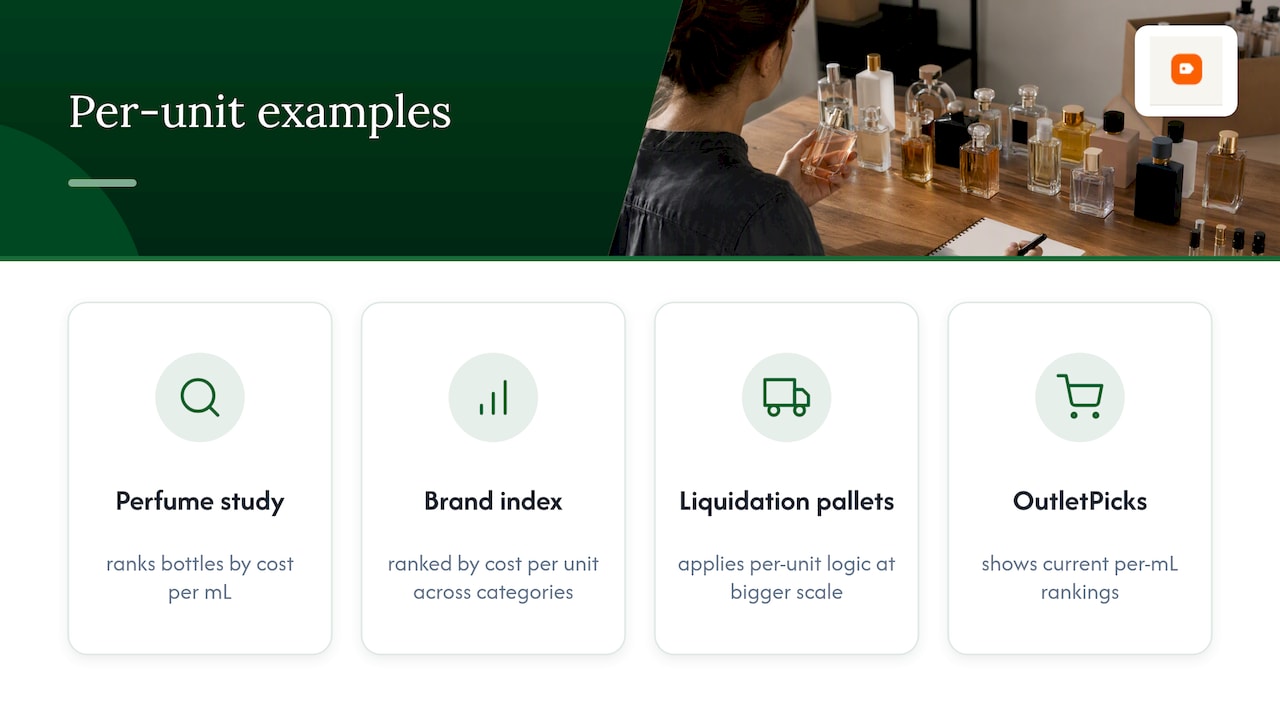
Some websites normalize listings across retailers into a single price per unit, so you can rank bottles by actual cost per mL instead of recalculating each one yourself. The perfume cost-per-spray study shows how this plays out in a category where bottle sizes swing wildly and sticker price alone is misleading. For bulk comparisons, the brand index ranked by cost per unit applies the same logic across skincare, hair care, and fragrance lines.
If you're weighing a large lot purchase instead of a single bottle, liquidation pallet pricing follows the same per-unit logic at a bigger scale.
Browse OutletPicks categories to see current per-mL rankings across skincare, fragrance, and body care.
Sources
These are the sources behind the constants and rules used throughout this guide.
- Approximate Conversions from U.S. Customary Measures to Metric | NIST
- Dietary Supplement Labeling Guide: Chapter III. Net Quantity of Contents | FDA
FAQ
How do I calculate the price per 100 mL?
Divide the total price by the volume in milliliters, then multiply by 100. A $9.50 bottle labeled 150 mL comes out to $6.33 per 100 mL, matching the worked example above.
How do you calculate cost price formula?
Cost price generally refers to what a seller pays before markup, which is a different question from unit pricing. For comparing what you pay as a shopper, the relevant formula is simply total price divided by total volume or quantity.
How do I calculate the price per fluid ounce?
Divide the price by the volume in milliliters, then multiply by 29.57353, the NIST conversion constant for one U.S. fluid ounce. Alternatively, convert the volume to fluid ounces first, then divide the price by that number.
What is the MRP formula?
MRP, or maximum retail price, is a labeling and regulatory concept used in some markets outside the one this guide covers, and it isn't the same calculation as price per unit. For comparing bottles on a shelf, the formula that matters is price divided by labeled net volume.