
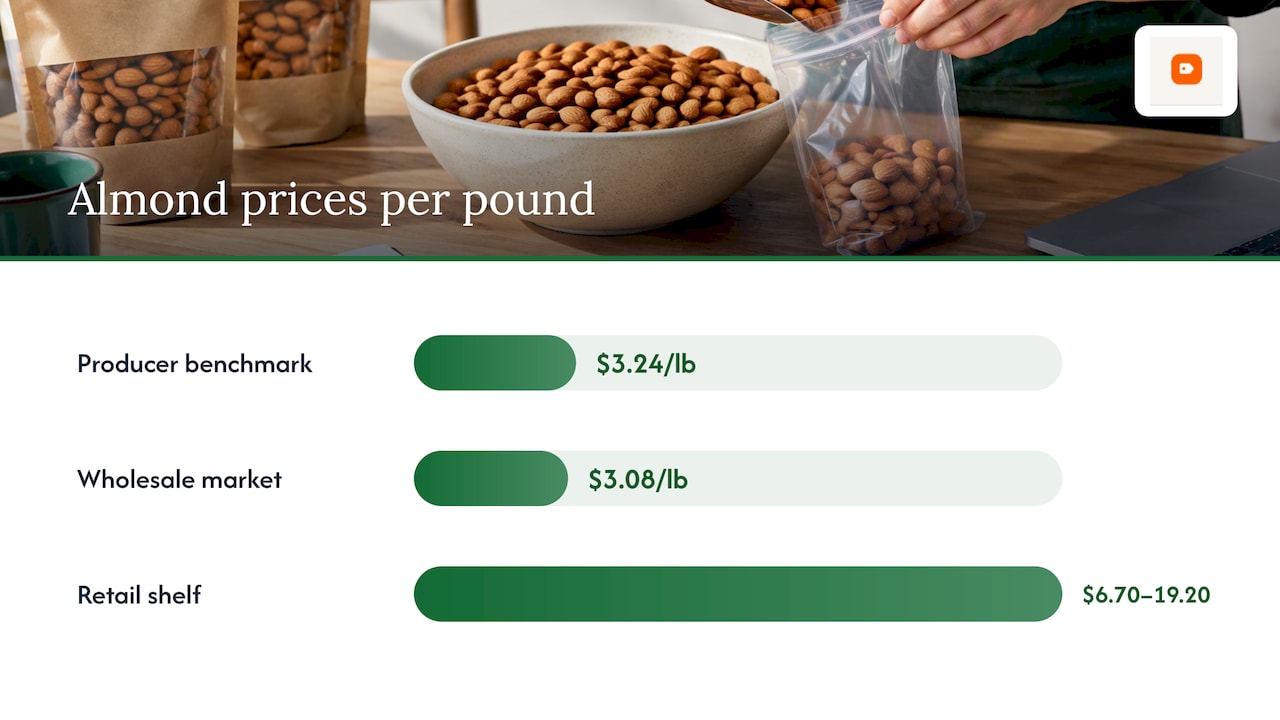
Almonds cost anywhere from about $3 per pound at the producer level to nearly $19 per pound for small, processed retail packs. The shelf price you pay depends mostly on bag size, how the nuts are processed and where you buy them, not on the almonds themselves. A fair target for plain raw whole almonds in a larger bag is the low end of the retail range. Anything near the top is usually paying for convenience.
Below you will find the numbers behind that range, a worked example of how to compare bags, and a checklist for finding the best value in almonds and other nuts.
TL;DR
- Retail almonds span roughly $6.70 to $19.20 per pound at major grocery retailers, depending on form and pack size.
- The producer-level benchmark is far lower, about $3.24 per pound, so most of what you pay at the shelf is processing, packaging and retail margin.
- Bigger bags usually cost less per pound, and the same product can differ a lot between retailers, so always convert to a price per pound or per ounce.
- Raw whole almonds in a 2 to 3 lb bag are typically the best everyday value. Slivered, roasted, flavored and snack-size packs cost the most per pound.
Table of Contents
- What almonds cost per pound right now
- Why almond prices move
- What changes the price per pound on the shelf
- A worked example: three bags, one winner
- Where to buy almonds for the best value
- Our perspective on almond prices
- Compare prices across categories on OutletPicks
- Is the cheapest almond always the best value?
- FAQ
- Sources
What almonds cost per pound right now
There is no single almond price, because three different prices get quoted under the same name.
| Price level | Typical figure | What it tells you |
|---|---|---|
| Producer benchmark | $3.24 per lb ($7.14 per kg), June 2026 reading | What the raw commodity is worth before packing and shipping |
| Wholesale terminal market | $154.00 for a 50 lb sack of California Peerless, about $3.08 per lb | What buyers of full sacks pay, before retail markup |
| Retail shelf | $0.42 to $1.20 per oz, or about $6.70 to $19.20 per lb | What you pay for packaged almonds |
The wholesale row is our own arithmetic: $154.00 divided by 50 lb. The retail row converts ounces to pounds by multiplying by 16.
So a shopper paying $12 for a one-pound bag is paying roughly four times the producer benchmark. Some of that is legitimate: cleaning, sorting, packing, freight, shelf space. Some of it is a small-bag premium you can avoid.
Why the quoted prices seem to disagree
When you search this topic you see $3 to $6 per pound in one place and $12 in another. Both can be right. Import and producer prices describe the raw commodity. Store prices describe a finished product on a shelf near you. Compare like with like: a farm benchmark with a farm benchmark, a one-pound bag with a one-pound bag.
Why almond prices move
Almond pricing is seasonal and sensitive to crop quality. Expana's weekly benchmark shows US-origin almond prices up about 8.6% year on year as of mid-2026, with a small month-on-month dip of 0.74%. Expana also notes that retail prices in the US often lag the broader wholesale market, so a spike or drop at the grower level may take a while to reach your store.
For a shopper, this has two practical consequences:
- A sale price today may reflect inventory bought months ago, so it can be a genuine bargain or simply old stock priced fairly.
- Do not assume a higher price is permanent. Re-check before stocking up, and compare the per-pound figure rather than the headline.
On the grower side, the USDA's Risk Management Agency set 2026 crop year price elections of $1.70 per lb for conventional and $2.55 per lb for organic almonds. Those are insurance reference prices, not market quotes. They are still a useful reminder that organic almonds carry a premium of roughly half again over conventional at the farm gate, before any retail markup.
What changes the price per pound on the shelf
Form: in-shell versus shelled
In-shell almonds are typically the cheapest per pound, but you pay for shell weight you throw away. An industry cost study from the Almond Board of California measures yield in pounds of kernels, which is the edible part. If you want to compare in-shell with shelled, you must adjust for the lower edible yield. Otherwise the cheap bag is not really cheap.

Processing: raw, roasted, salted, sliced
Every extra step adds cost. Raw whole almonds are the baseline. Blanching, slicing, slivering, roasting, salting and flavoring all raise the price per pound. Slivered and sliced almonds are convenient for baking and salads, but if you only need them occasionally, a small pack is fine. If you use them weekly, the premium adds up.
Processing and sourcing drive the price of any specialty food in much the same way. This breakdown of why specialty coffee costs more walks through the same logic: each step between the farm and your cup or bowl carries its own cost.
Pack size: where the savings are
Larger quantities consistently lower the unit price. The same Almond Board of California document points to purchases of 3 lb and up as the point where price per pound drops compared with small retail bags. We see the same pattern across everyday products when we rank them by unit cost. Our piece on when bulk beats single packs explains where the savings are real and where they are not.
Organic and brand
Organic almonds cost more at every level of the supply chain, and brand-name snack packs add a convenience premium on top. Nutrition guides such as Wise Bread's comparison of nuts by nutrition and price suggest buying in bulk or from specialty nut sellers to avoid the premium on small branded snack packaging.
A worked example: three bags, one winner
The figures below are illustrations of the method, not current listings. Say you see these three bags of raw whole almonds:
| Bag | Weight | Shelf price | Price per oz | Price per lb |
|---|---|---|---|---|
| Snack bag | 6 oz | $5.49 | $0.915 | $14.64 |
| Standard bag | 16 oz (1 lb) | $9.99 | $0.624 | $9.99 |
| Value bag | 48 oz (3 lb) | $19.50 | $0.406 | $6.50 |
The steps:
- Convert every weight to ounces (pounds times 16).
- Divide the price by the ounces to get the price per ounce.
- Multiply by 16 to get the price per pound.
- Compare the final column only.
The snack bag costs more than twice as much per pound as the value bag. Yet the value bag has the lowest sticker-to-sticker gap from the middle option, which makes it easy to overlook. If you will eat the almonds before they go stale, the 3 lb bag wins easily. Our guide to calculating unit price in four steps and the unit price calculator walkthrough cover the same method for any product.
Do not forget price per serving
A serving of almonds is about one ounce, which is roughly a quarter cup of whole nuts per Wise Bread. At $6.50 per lb, one ounce costs about 41 cents. At $14.64 per lb it is about 92 cents. If you snack daily, that is the difference between about $150 and about $335 a year. Our price per serving formula shows how to run this for any food.
Where to buy almonds for the best value
We do not rank stores here, because prices change weekly and by region. What we can say is how the types of seller tend to differ.
- Warehouse clubs and big-box grocery chains: often the lowest price per pound for large bags, but you must buy more at once.
- Discount grocers: strong on mid-size bags and private labels. Our comparison of discount grocer and big-box prices shows how to check cost per unit instead of trusting the sticker.
- Bulk bins: good for buying exactly what you need. Check that the price is per pound, since some stores label bins per ounce.
- Specialty nut and online sellers: sometimes cheaper in 5 lb and 25 lb cases, but shipping can erase the savings.
- Online marketplaces: the same product can differ widely between sellers. Zinc's research on nut prices found gaps of up to 40% for identical products, and advises checking price per ounce or pound to cut through pack-size noise.
For online listings, the same product often appears in several sizes. Our Amazon price variations tool lists every size of a product ranked by price per unit, and our Amazon unit pricing guide walks through the four steps to the true cheapest option.
Our perspective on almond prices
We built OutletPicks around one idea: the sticker price tells you very little. Almonds are a perfect case. A 6 oz pack and a 3 lb bag can sit a few dollars apart on the shelf and be worlds apart per pound.
What we see when we normalize prices is that the biggest savings rarely come from hunting for a coupon. They come from converting every option to the same unit and picking the right pack size for how fast you actually use the product. For almonds, that means asking three questions: Is this raw, roasted or flavored? What is the price per pound? Will I finish the bag before it goes stale?
We also try to be honest about limits. The larger bag is only a bargain if you use it. Almonds keep best in a cool, dry place, and a half-eaten giant bag is a poor deal. Prices on our site are rechecked on a rolling cycle, but retail prices move, so confirm the final price at checkout.
— Alex
Compare prices across categories on OutletPicks
The unit-price method works on almost everything you buy regularly. If you want to see it applied across product types, browse our category pages, where products in categories such as skincare, body care, baby care, pet food and cables are ranked by real cost per unit across Amazon and partner retailers. You can also try Packle, our daily game, to practice spotting the cheapest pack per unit.
Is the cheapest almond always the best value?
Not always. Check these before you buy.
- Freshness. Stale almonds taste flat, and a very low price on a large bag is no bargain if half goes to waste.
- Edible yield. In-shell almonds look cheap per pound but deliver fewer edible ounces.
- Shipping. Online per-pound prices often exclude it. Several of the top search results state this explicitly.
- Use. If you bake with almond flour or slivers, a pre-processed product may save you time, but compare its price per pound with whole almonds so you know what the convenience costs.
- Nutrition. Almonds are high in vitamin E and contain more magnesium than most nuts, so they are often a sensible value choice among tree nuts.
For other nuts, the method is identical. Convert to price per pound or per ounce, compare the same form (raw with raw, roasted with roasted), and choose the largest pack you will finish. For a general approach, our four-step guide to comparing grocery unit prices covers the method with guidance from NIST, and our explainer on unit pricing and usable units shows how to count usable units, not just the label.
FAQ
How much are almonds per pound in the US?
Retail packaged almonds run from about $6.70 to $19.20 per pound at major retailers, based on a range of $0.42 to $1.20 per ounce. The producer-level benchmark is about $3.24 per pound. Your price depends on pack size, processing and the store.
Why are almonds so expensive?
They are not always. Raw almonds at the farm and wholesale level cost far less than at the shelf. Retail prices include processing, packing, freight and retailer margin, and small bags carry the biggest premium. Year on year, Expana reports US-origin almond prices up about 8.6% as of mid-2026.
Is it cheaper to buy almonds in bulk?
Usually yes. Larger quantities, especially 3 lb and up, tend to lower the price per pound compared with small retail bags. Bulk only pays off if you will use the almonds while they are fresh, and online bulk orders can lose their advantage to shipping fees.
How do I compare almond prices between different bag sizes?
Convert every bag to price per ounce or per pound. Divide the price by the weight in ounces, then multiply by 16 for the price per pound. Compare raw with raw and roasted with roasted so you are not comparing different products.
Which nuts are the best value?
Almonds are often competitive among tree nuts once you factor in vitamin E, magnesium and protein, according to Wise Bread's nut comparison. The best value on any given week depends on current prices, so compare the price per pound of the exact form you want.
Sources
- Almond Prices Today and Forecasts, Expana
- Almonds Price in US, Selina Wamucii
- Terminal Market Price Report, USDA AMS
- PM-25-073: 2026 Crop Year Additional Price Elections for Almonds, USDA RMA
- Sample Costs to Establish an Orchard and Produce Almonds, Almond Board of California
- The Best and Worst Nuts, by Nutrition and Price, Wise Bread
- Amazon vs. Walmart nut prices, Zinc research
- Fresh packed nuts price listings