

Cost per pound equals total price divided by weight in pounds. Buy a 2-pound bag of rice for $4.00, and the math is simple: $4.00 ÷ 2 lb = $2.00 per pound. If the package lists ounces, grams, or kilograms instead of pounds, convert the weight first, then divide.
TL;DR:
- Converting ounces, grams, or kilograms to pounds before dividing is essential to avoid misleading cost-per-pound figures and ensure accuracy.
- When calculating multiple packages, sum their total costs and total weights in pounds, then divide to find the true unit price.
- Use net weight rather than gross weight to prevent inflated cost estimates caused by packaging, liquids, or ice glaze.
- Rounding should only occur after completing the division to minimize cumulative errors during comparison.
- Relying on correct conversion factors from official standards guarantees consistent and accurate unit price calculations.
Table of Contents
- How the cost-per-pound formula works
- Unit conversions: ounces, grams, and kilograms to pounds
- Calculating cost per pound for multiple packages and multipacks
- Common errors, rounding rules, and quick pro tips
- Worked examples: ounces, metric, and a multipack
- Why net weight and official conversion guidance matter
- What the cost-per-pound formula actually protects you from
- Sources
- FAQ
How the cost-per-pound formula works
The formula itself never changes, but getting a correct answer depends on three steps done in order.
- Find the net price. Use what you actually paid, including any sale price, not the shelf tag if a discount applies at checkout.
- Find the net weight. This number appears on the package label and reflects the product itself, not the box, jar, or wrapper around it.
- Convert to pounds, then divide. If the label already shows pounds, skip straight to dividing price by weight.
A quick check: a $4.00 item weighing 2 pounds gives $4.00 ÷ 2 lb = $2.00 per pound. That figure is your unit price, the number that lets you compare a small jar against a bulk tub without guessing which one actually costs less. Skipping the conversion step is where most errors creep in. A label reading "12 oz" or "500 g" needs to become pounds before it goes anywhere near the division sign, because dividing a dollar amount by an unconverted number produces a figure that looks like a price per pound but isn't one.
Unit conversions: ounces, grams, and kilograms to pounds
Package labels rarely use pounds consistently, so converting first is the step that separates an accurate unit price from a misleading one. NIST's cooking measurement guidance confirms the standard factors shoppers need:
- 16 ounces = 1 pound, so pounds = ounces ÷ 16.
- 1 pound is approximately 453.592 grams, so pounds = grams ÷ 453.592.
- 1 kilogram is approximately 2.2046 pounds, so pounds = kilograms × 2.2046.
For a 12-ounce package: 12 ÷ 16 = 0.75 lb. For a 750-gram package: 750 ÷ 453.592 = 1.65 lb. Once you have the pound figure, the division step is identical every time. If doing this math on a receipt or in a store aisle feels tedious, OutletPicks' pounds to ounces and pounds to grams conversion pages handle the arithmetic instantly, as does the kilograms to pounds tool for metric labels.
Calculating cost per pound for multiple packages and multipacks
Multipacks and bulk cases need a slightly different approach than a single item, but the underlying formula still holds.
- Add up the total price paid for all packages in the multipack, not the price of one unit.
- Add up the total weight across every package, converting to pounds first if the label uses ounces or grams.
- Divide total cost by total weight in pounds to get the true $/lb, rather than estimating from a single package.
Say a case contains 6 bags at $2.50 each, and each bag weighs 1.5 lb. Total cost is $15.00, total weight is 9 lb, and $15.00 ÷ 9 lb = $1.67 per pound. That single number replaces guesswork about whether the case price is a good deal.
Common errors, rounding rules, and quick pro tips
A few habits quietly wreck an otherwise correct calculation.
- Using gross weight instead of net weight. Packaging, ice glaze on frozen items, or liquid brine can inflate the denominator and understate the real cost per pound.
- Mixing fluid ounces with weight ounces. Fluid ounces measure volume, not mass, and converting between the two requires knowing the product's density, which most labels don't provide.
- Rounding too early. Round only at the final display step, after the division is complete, to avoid compounding small errors across a comparison.
Pro Tip: When two products land within a few cents of each other per pound, redo the math with the unrounded numbers before deciding which is actually cheaper.
Worked examples: ounces, metric, and a multipack
These three examples cover the situations shoppers run into most often.
- 12 oz at $3.99. Convert first: 12 ÷ 16 = 0.75 lb. Then divide: $3.99 ÷ 0.75 lb = $5.32 per pound.
- 750 g at $6.50. Convert grams to pounds: 750 ÷ 453.592 = 1.65 lb. Then divide: $6.50 ÷ 1.65 lb = $3.94 per pound.
- A multipack of 4 bags at $1.75 each, 0.5 lb per bag. Total cost is $7.00, total weight is 2 lb, and $7.00 ÷ 2 lb = $3.50 per pound.
Each example follows the same order: get the real price, get the real weight, convert if needed, then divide. Skipping the conversion step in example 1 would produce $3.99 ÷ 12 = $0.33, a number that looks plausible but has nothing to do with the actual price per pound. The OutletPicks unit price calculator runs this same sequence automatically if you'd rather not do it by hand.
Why net weight and official conversion guidance matter
Getting cost per pound right depends on using the correct denominator and the correct conversion factors, not just any numbers on a label.
- NIST's approximate conversions guidance sets the standard factors for translating grams and kilograms into pounds before any division happens.
- NIST Special Publication 1020 governs how net quantity must be declared on consumer packaging and includes Table 9, the reference table for weight conversion factors.
- Net weight, not the weight of the box or container, is the figure labeling rules require manufacturers to state, which is why it's the correct number to divide into.
Conversion and calculator tools built around NIST factors ensure that unit prices shown in many category pages match the method described here.
What the cost-per-pound formula actually protects you from
The formula itself is almost too simple to write an article about, but understanding the true value beyond just the price per pound can be crucial, as explained in this consumer's guide to investing in quality party supplies. Price divided by weight is arithmetic a fourth grader can do. What actually trips shoppers up isn't the division, it's the temptation to skip the conversion step because a label's ounces or grams look close enough to work with directly.
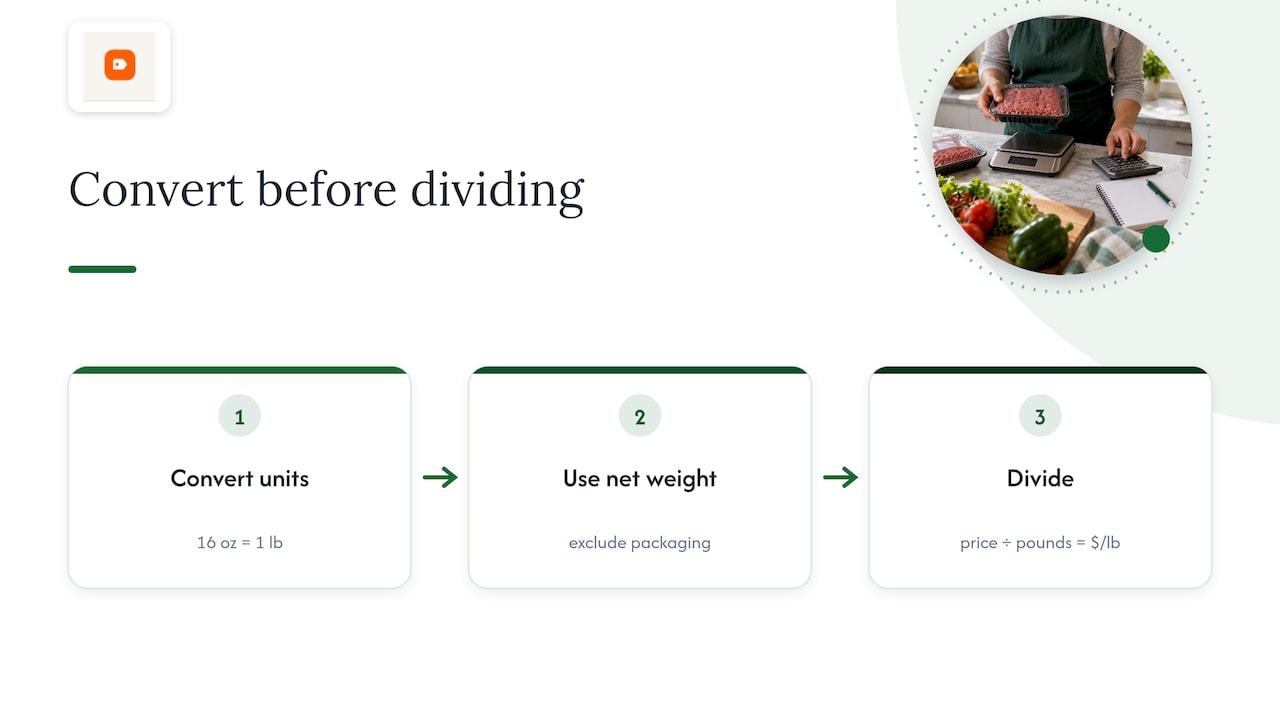
That shortcut is where the real cost of a bad deal hides. A jar that looks cheaper because its 500-gram label got compared against a 1-pound competitor without conversion isn't a rounding error, it's a wrong answer wearing the shape of a right one. The conventional advice on unit pricing tends to stop at "divide price by weight" and never mentions that the weight on the label is frequently in the wrong unit for that division to mean anything.
If you take one habit from this guide, make it this: convert before you divide, and use net weight, not package weight, every single time. Everything else, including rounding and multipack math, is secondary to getting those two things right first.
— Alex
Sources
The conversion factors used throughout this guide come from NIST's cooking measurement equivalencies and its approximate customary-to-metric conversions, along with the labeling standards in NIST SP 1020. For a real-world example of how $/lb figures get tracked at scale, the FRED series on average ground beef prices shows how this exact unit is used in official retail price reporting.
- Metric Kitchen: Cooking Measurement Equivalencies | NIST
- Guide for Labeling Consumer Package by Weight, Volume, Count, or Measure (NIST SP 1020)
FAQ
How do you calculate the cost price formula?
Cost per pound is calculated by dividing the total price paid by the weight in pounds: price ÷ weight in lb = cost per pound. Convert the weight to pounds first if the label lists ounces, grams, or kilograms.
How do I convert a price per pound to a price per ounce?
Divide the price per pound by 16, since there are 16 ounces in a pound according to NIST. For example, $5.32 per pound divided by 16 equals $0.33 per ounce.
What is the cost per pound?
Cost per pound is the price of a product expressed as dollars per pound of net weight, calculated by dividing total price by weight in pounds. It's the standard unit used to compare products of different package sizes on equal footing.
Is $1.99 per pound a unit rate?
Yes, a cost per pound value is a unit rate because it expresses cost for a single, standard unit of weight, one pound, rather than for a variable package size. Unit rates like this let you compare prices across different pack sizes directly.
What's a common mistake when calculating cost per pound?
The most common mistake is dividing by gross or package weight instead of net weight, or mixing up fluid ounces with weight ounces. Both errors produce a number that looks like a valid price per pound but doesn't reflect the actual cost of the product.