
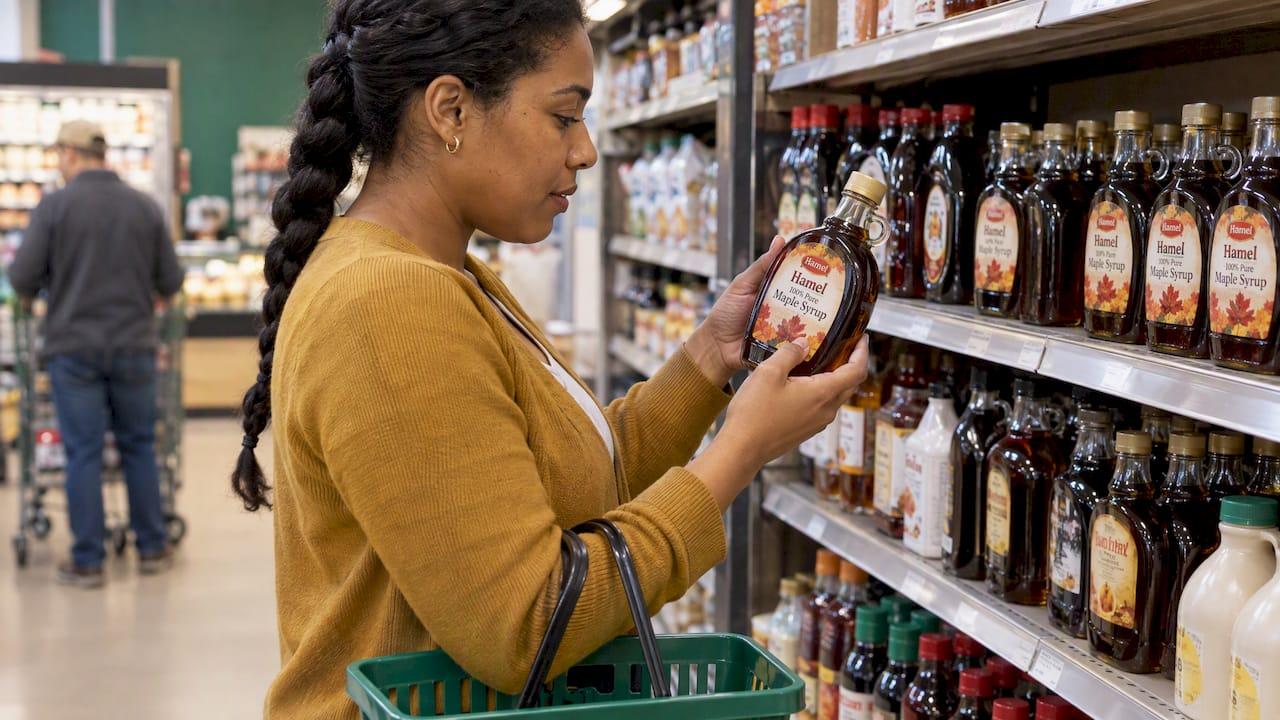
To get the price per 100g, divide the package price by its weight in grams, then multiply by 100. A $4.49 bag that holds 340 g costs $1.32 per 100g. Do that for each product and the lowest number is the cheapest food by weight, whatever the package size says. Below you get the formula, a conversion table for ounces and pounds, and a worked maple syrup comparison. You also get the checks that stop a good-looking unit price from misleading you.
TL;DR
- Price per 100g = price ÷ weight in grams × 100. Convert ounces or pounds to grams first.
- To turn a price per 100g into a price per ounce, multiply by 0.2835. To go the other way, multiply by 3.527.
- Compare only like with like: weight with weight, fluid ounces with fluid ounces. Maple syrup is usually sold by volume, so check which one the label gives.
- Subtract coupons before you divide, and watch for a package that quietly shrank.
- Skip the math: we rank products by real cost per unit across retailers on OutletPicks.
Table of Contents
- The formula, step by step
- Why 100 grams, and how it differs from unit price
- Converting between grams, ounces and pounds
- Worked example: maple syrup
- Beyond the number: what else to check
- What the shelf label gives you, and what it doesn't
- Our perspective: the unit is the whole story
- Let us do the division for you
- FAQ
- Sources
The formula, step by step
The calculation has three moves, and the only one people get wrong is the first.
- Find the net weight in grams. Use the net contents on the label, not the gross weight with packaging. If the label gives ounces or pounds, convert them (see the table below).
- Divide the price by that weight. This gives you the price per gram.
- Multiply by 100. This gives the price per 100g.
Written as one line, it is price per 100g = price ÷ weight in grams × 100. Say you pay $4.49 for a 12 oz package. Twelve ounces is about 340 g, so $4.49 ÷ 340 = $0.0132 per gram, and × 100 gives $1.32 per 100g.
Keep more than two decimals
Don't round to the nearest cent too early. One guide on unit-price math suggests keeping three or four decimal places so small but real differences between products do not vanish. Per gram, almost everything rounds to $0.01 or $0.02, which tells you nothing. Per 100g, you get a number like $1.32 that you can compare at a glance.
Taking a coupon into account
If you have a store or manufacturer coupon, subtract it from the shelf price before dividing. A $5.00 item with a $1.00 coupon is a $4.00 item. Run the formula on $4.00, not $5.00, or the bigger, couponed package can look worse than it is.
Why 100 grams, and how it differs from unit price
Price per gram is the total price divided by the total grams. It is accurate but awkward, because the answer is a fraction of a cent. That is why shelf labels use a bigger base. Grocery unit prices are commonly shown per ounce, per 100 grams or per pound.
"Unit price" is the umbrella term. The National Institute of Standards and Technology (NIST) defines unit pricing as the cost per unit of measure, and its 2025 Unit Pricing Guide lists 100 grams as an appropriate weight unit for retail comparison in the United States. So price per 100g is one flavor of unit price. Price per ounce is another. What matters is using the same one across every product you compare. NIST says the unit price should be expressed uniformly and consistently for all package sizes.
Converting between grams, ounces and pounds
Most US packages list ounces, and many imported or specialty foods list grams. Keep these factors handy. One dry ounce is about 28.35 grams, and a pound is 16 ounces. A more precise reference gives 28.3495 g per ounce and 453.592 g per pound.
| You have | You want | Multiply by |
|---|---|---|
| Price per 100g | Price per ounce | 0.2835 |
| Price per 100g | Price per pound | 4.536 |
| Price per 100g | Price per kilogram | 10 |
| Price per ounce | Price per 100g | 3.527 |
| Price per pound | Price per 100g | 0.2205 |
| Price per kilogram | Price per 100g | 0.1 |
A quick check: $1.32 per 100g × 0.2835 = $0.374 per ounce. That matches $4.49 ÷ 12 oz = $0.374. If you go straight from a pound price to an ounce price, you just divide by 16, which we cover in our guide to converting price per pound to price per ounce. For the weight conversion itself, there is a handy ounces to pounds converter.
The per-ounce formula is simple: total price divided by total ounces. The traps are in the details, which is why we wrote about the price per ounce formula and a common 10% error.
Weight ounces are not fluid ounces
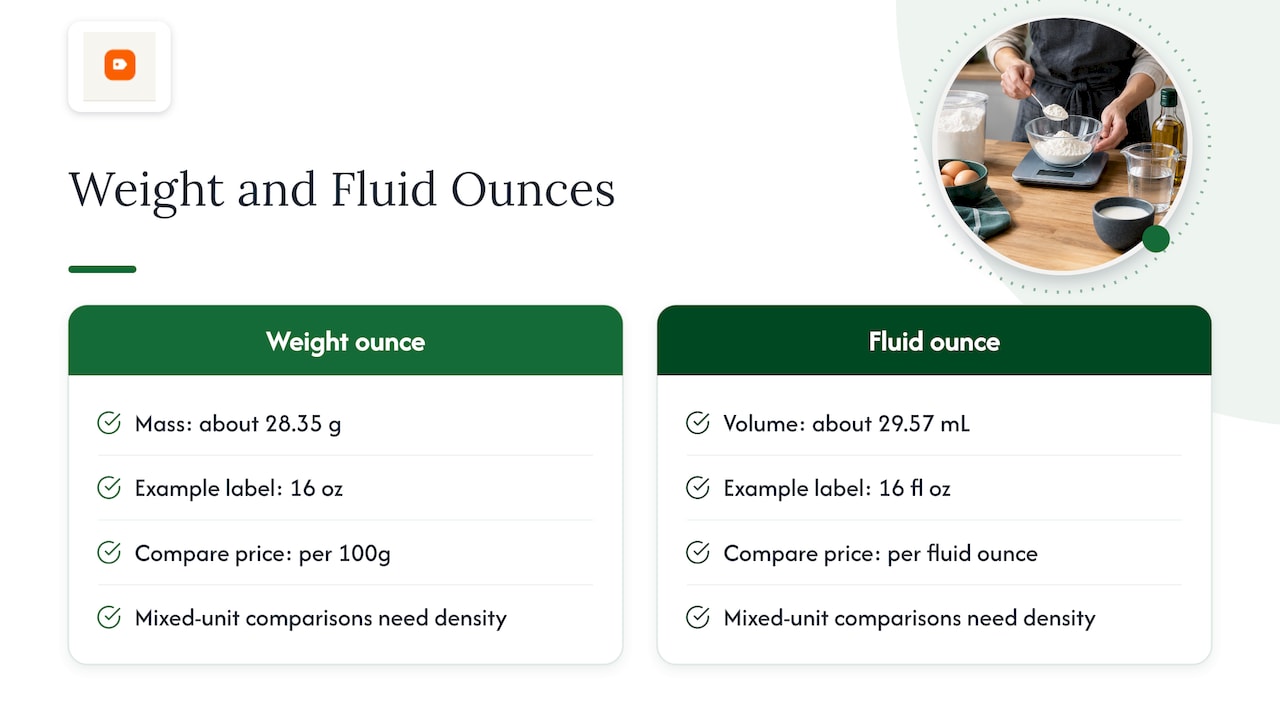
This is the mistake that wrecks the most comparisons. A weight ounce is about 28.35 g. A fluid ounce is a volume, about 29.57 milliliters. Water happens to weigh close to one ounce per fluid ounce, but thick liquids such as syrup, honey and oils do not. Never divide a fluid-ounce price by a weight conversion. If the label says "16 fl oz", compare per fluid ounce. If it says "454 g", compare per 100g. If you must mix the two, you need the product's density, and most shoppers are better off comparing only products labeled the same way.
Worked example: maple syrup
Maple syrup is a good test case because it comes in tiny bottles, big jugs and every size between, in both fluid ounces and grams. Readers search for its price per ounce more than almost any other pantry item.
What prices look like
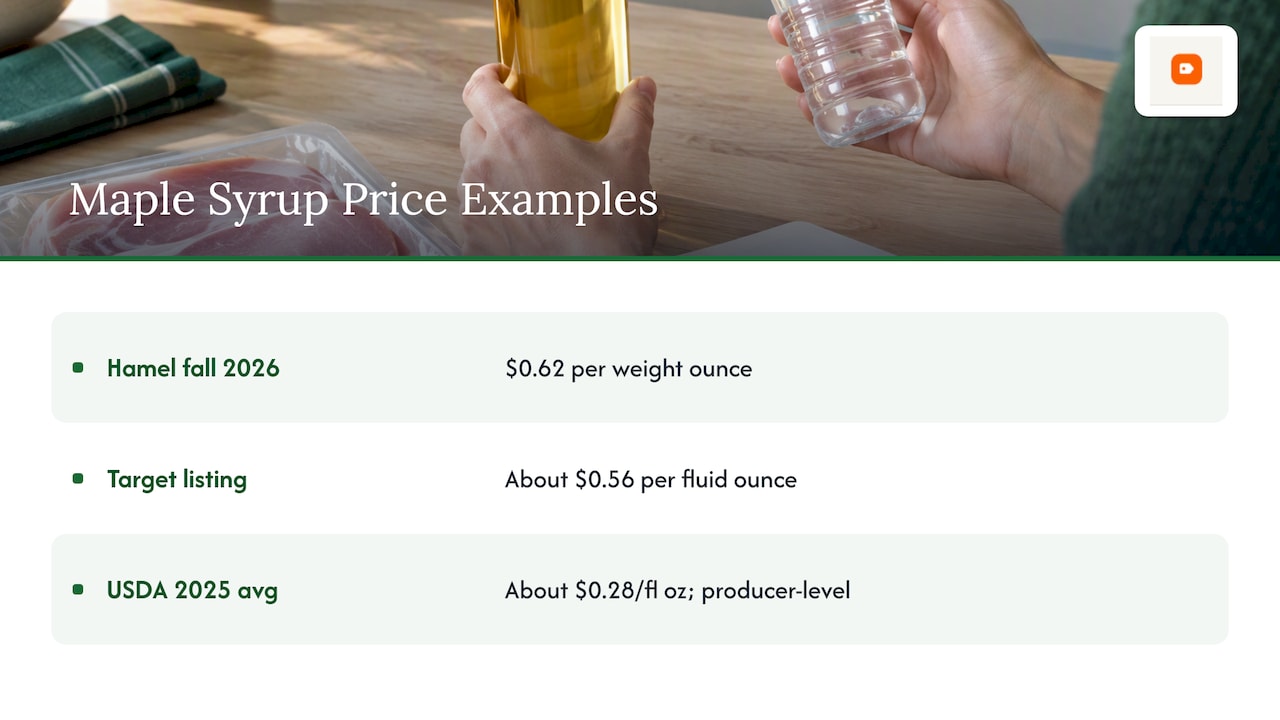
Two retailer listings show the typical spread for one brand and one size. In fall 2026, a 16 oz bottle of Hamel 100% Pure Maple Syrup was listed at $9.99, or $0.62 per ounce. A 16 fl oz bottle of the same brand at Target was listed at $8.89, about $0.56 per fluid ounce. Same brand, same size, a gap of roughly six cents an ounce. On a 16 oz bottle that is about a dollar. Prices move constantly, so treat these as snapshots of how big the retailer gap can be, not as current quotes.
For a reference point on the bulk end, the USDA reported a 2025 US average of $35.60 per gallon for maple syrup. A gallon is 128 fluid ounces, so that works out to about $0.28 per fluid ounce. That is a producer-level average, not a shelf price, but it shows why a large jug usually beats a small bottle.
Comparing sizes with a made-up pair
Suppose a store sells these two bottles (hypothetical prices for the math):
| Bottle | Price | Price per fl oz |
|---|---|---|
| 8 fl oz | $6.49 | $0.811 |
| 32 fl oz | $17.99 | $0.562 |
The 32 oz bottle costs 2.8 times as much but holds four times as much, so each ounce is about 31% cheaper. Yet it only wins if you will use it. Maple syrup keeps well once stored properly, but a jug you never finish is not a bargain. Check the label's storage instructions before you commit to the big size.
If the label gives grams
Some imported syrups and maple sugar products list grams. Take a 500 g pouch at $12.00: $12.00 ÷ 500 × 100 = $2.40 per 100g. To compare against a bottle priced per ounce, you would need to know whether that bottle's ounces are weight or volume. When in doubt, compare syrups only with other syrups labeled in the same unit. Our guide to comparing grocery unit prices in four steps walks through that process.
Beyond the number: what else to check
A low unit price is where your comparison starts, not where it ends.
- Shrinkflation. NIST describes shrinkflation as products sold at the same price with slightly reduced contents. The package looks the same, the price looks the same, and the unit price quietly rose. Re-check your regular buys.
- Usable amount. Water-packed or bone-in items carry weight you do not eat. Our piece on counting final cost and usable units covers how to adjust.
- Quality and grade. The cheapest syrup, coffee or olive oil is not always the one you will enjoy. Compare among products you would actually buy.
- Shelf life. A bigger size only saves money if you finish it.
- Label units. Retailers may show different bases for neighboring products. Per-ounce prices and per-100g prices on the same shelf will not match without conversion.
It also helps to see how labels differ across stores. A five-check approach for judging prices per ounce on labels applies to spirits, but the habit of reading net contents first carries over to any category.
What the shelf label gives you, and what it doesn't
Don't count on a unit price being there. In the United States, unit pricing is not mandatory at the federal level, and only eleven jurisdictions, including New York and Massachusetts, have mandatory provisions. NIST's uniform regulation applies only when stores choose to provide unit pricing. That is why the shelf tag may be missing, small, or in a different unit than the next product's.
NIST also recommends writing net content with a space between quantity and unit, for example 14 oz rather than 14oz, so read labels carefully. When the tag is absent or inconsistent, do the division yourself. Consumer Reports suggests a phone or simple calculator for exactly that. Our walkthrough of unit price labels explained shows what to look for on the tag.
Our perspective: the unit is the whole story
We built OutletPicks around one belief: the sticker price is the least useful number on a product page. A big package can look expensive and be cheap, and a small one can look like a deal and cost twice as much per ounce. So we calculate and rank products by their real cost per unit, whether that is per milliliter, per diaper, per page or per foot, and we compare across Amazon and partner retailers on one normalized scale.
Two habits matter most. First, pick one unit and stay in it. Most errors we see come from comparing a per-ounce price with a per-100g price, or a fluid ounce with a weight ounce. Second, redo the math when you rebuy. Packages change, prices move, and the winner last spring may not be the winner now. That is why we refresh retailer prices daily. For a quick pass at home, our guide to comparing unit prices with a calculator takes under a minute.
— Alex
Let us do the division for you
If you would rather not calculate for every bottle, bag and box, browse our category pages. We rank products in skincare, hair care, fragrance, body care, baby care, pet food, cables and more by real cost per unit, so the cheapest option per milliliter, ounce or piece comes first, regardless of pack size or brand.
Want a place to start? Our weekly roundups, such as shampoo on sale this week and body care deals, apply the same unit math to current prices. You can also see which brands deliver the lowest cost per unit in our brand index.
FAQ
How do I calculate the price per 100g?
Divide the price by the weight in grams, then multiply by 100. For a $3.00 item weighing 250 g: $3.00 ÷ 250 × 100 = $1.20 per 100g. If the weight is in ounces, multiply by 28.35 first to get grams.
How do I convert price per 100g to price per ounce?
Multiply the price per 100g by 0.2835. A product at $2.00 per 100g costs about $0.567 per ounce. This applies to weight ounces only. For liquids sold in fluid ounces, compare against other products priced the same way.
What is a unit price?
A unit price is the cost per standard unit of measure, such as per ounce, per pound or per 100 grams. NIST defines it that way and lists 100 grams as an appropriate unit for US retail comparison. It lets you compare packages of different sizes on the same footing.
What is the maple syrup price per ounce?
It varies by size, brand and store. One 16 oz bottle was listed at about $0.62 per ounce in fall 2026, and a similar bottle at another retailer came to about $0.56. Divide the shelf price by the number of ounces, and compare using fluid ounces when the label lists them.
Is the bigger package always cheaper per unit?
Usually, but not always. Promotions and store brands can make the smaller size cheaper per unit, so check both. Even when the large size wins, it only saves money if you will use it all.
Sources
- How to Calculate Price Per Unit (Formula + Examples)
- Price Per Gram Calculator
- NIST Unit Pricing Guide (2025)
- NIST: Uniform Unit Pricing and shrinkflation
- Unit Pricing: Compare Apples to Apples
- Consumer Reports: Use unit pricing to save
- USDA Crop Production report
- Hamel maple syrup listing at Lunds & Byerlys
- Hamel maple syrup at Target
- Judge tequila prices with per ounce checks