

A unit price label shows the cost of a product per standard measure, like per ounce or per 100 sheets, so you can compare a small jar against a giant tub on equal footing. That comparison is the entire point: educated shoppers who use unit pricing tend to save roughly the mid-to-high teens percentage on everyday purchases on everyday purchases compared with shoppers who just eyeball the sticker price.
TL;DR:
- Comparing unit prices requires checking the specific measure and converting units if they differ, as prices per pound and per ounce are not directly comparable.
- The lowest per-unit price does not always lead to the best deal if you cannot use the entire product before it expires or fits your budget constraints.
- Rounding conventions can affect comparisons, especially for prices under one dollar, so it’s important to verify the actual math rather than relying solely on rounded figures.
- Shrinkflation can be hidden by a steady sticker price while the unit price increases, sometimes up to 32 percent, revealing the true cost increase.
- Using tools like calculators or automatic comparison platforms can streamline the math and improve accuracy, especially when dealing with mismatched units or multiple options.
Table of Contents
- What A Unit Price Label Actually Shows You
- How To Read Unit-Price Labels Without Slowing Down Your Cart
- Where You'll Find Unit Prices (And Where You Won't)
- How To Use Unit Price To Pick The Actual Best Buy
- Rounding Rules, Shrinkflation, And Other Traps
- Tools That Do The Unit-Price Math For You
- Why This Habit Fades (And How To Keep It)
- Compare Real Cost Per Unit Before You Check Out
- Sources
- FAQ
What A Unit Price Label Actually Shows You
A standard unit price tag carries four pieces of information, and missing any one of them makes the comparison useless. Retailers who follow best practice separate these into distinct blocks so your eye lands on the right number fast.
- Product identity: brand, size, and sometimes flavor or variant
- Net quantity: the actual amount in the package (16 oz, 500 mL, 60 count)
- Retail price: the total dollar amount you pay at checkout
- Unit price: the cost divided into a standard measure, usually per ounce, per pound, per fluid ounce, per milliliter, per count, or per sheet
Which unit shows up depends on the product category. Liquids like shampoo or juice get priced per fluid ounce; solids like cereal or pet food get priced per ounce or pound; paper goods like napkins get priced per sheet or per 100 sheets. The label design that works best puts retail price and unit price in separate, equally sized blocks rather than burying the unit price in tiny type below the barcode. That "blocked" layout is exactly what makes a shelf tag scannable in three seconds instead of thirty.
How To Read Unit-Price Labels Without Slowing Down Your Cart
Reading a unit price tag correctly takes about two seconds once you know the sequence. Rushing it is how shoppers end up comparing numbers that aren't actually comparable.
- Check the unit of measure first. A tag priced per ounce and one priced per pound are not the same number, even if both say "$0.32."
- Convert when the units don't match. If one product lists price per fluid ounce and another lists price per liter, normalize before you decide anything.
- Compare only the unit price figures, never the total price, once you're weighing package sizes against each other.
- Skip anything that isn't the unit price. Barcodes, SKU codes, and internal order numbers on the tag are for the store's inventory system, not for you.
NIST's guidance on unit-price label design recommends a specific font size, strong color contrast between the number and its background, and placement close enough to the retail price that your eye catches both at once. If a tag fails that test, meaning you have to squint or hunt for the unit price, that's a sign the store hasn't adopted the "blocked" approach NIST recommends. On a two-block tag, the unit price is almost always the block on the right.
Pro Tip: Snap a photo of a confusing tag with your phone before you leave the aisle. It takes five seconds and saves you from doing math standing in the middle of a crowded store.

Where You'll Find Unit Prices (And Where You Won't)
Unit price labels typically show up in four places: printed shelf-edge tags, electronic shelf labels that update automatically, small tags stuck directly on the container, and the product detail section of online listings. Retailers that follow NIST's unit-pricing framework tend to apply it consistently across all four formats, which also happens to reduce pricing errors and speed up their own inventory operations.
Coverage still varies by state, since unit pricing isn't mandated nationwide, and it's less consistent in small independent stores than in large chains. Online listings are the least reliable spot. Some retailers calculate unit price automatically; others simply list a total price and leave the math to you.
How To Use Unit Price To Pick The Actual Best Buy
Unit price tells you which option is cheaper per ounce or per count. It doesn't tell you whether that option is right for your budget or your pantry. Running through these five steps in order keeps you from falling into either trap.
- Confirm and normalize the units. If one product is priced per pound and another per ounce, convert one to match the other before comparing anything.
- Pick the lowest unit price as your candidate winner. This is the raw math answer, nothing more.
- Run the waste test. Will you realistically use the whole container before it expires or goes stale? A lower unit price only pays off if you use the full quantity; a bargain-sized jar of mayonnaise that spoils before you finish it wasn't actually a bargain.
- Run the budget test. Unit price and total price answer different questions. The 32-ounce jug might be cheaper per ounce, but if the $14 price tag blows your grocery budget for the week, the smaller bottle at a worse unit price might still be the right call today.
- For durable goods, switch to cost-per-use. A $60 pair of shoes worn twice a week for two years costs a lot less per wear than a $25 pair that falls apart in a month. Unit price on the shelf tag won't capture that, so you have to run the division yourself.
That five-step sequence is the whole system. Skip step three or four and you'll end up with a cart full of technically-correct bargains you didn't need.
Rounding Rules, Shrinkflation, And Other Traps
Two unit prices that look identical on the shelf aren't always identical once you check the actual math. Rutgers' unit-pricing fact sheet FS138 lays out the standard rounding conventions: unit prices of $1.00 or more usually round to the nearest cent, while unit prices under $1.00 may round to the nearest cent or the nearest tenth of a cent. That distinction matters most when two products are separated by a fraction of a cent per ounce. If both tags round the same way, the comparison holds. If they round differently, a real price gap can get masked or exaggerated.
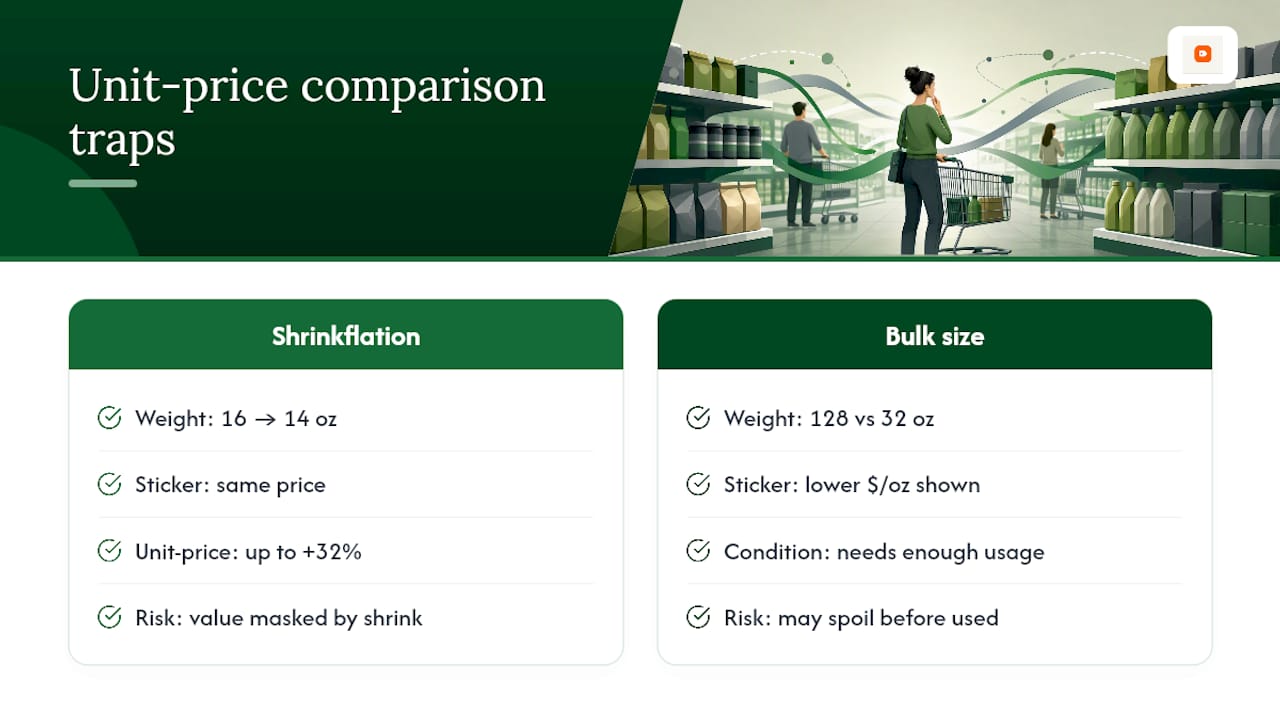
Shrinkflation is where unit pricing earns its keep. A brand can shrink a bag from 16 ounces to 14 ounces, hold the price steady, and the sticker price never changes. The unit price does. Tracking those quiet shrinks has turned up unit-price jumps as high as 32 percent on products where the box looked the same. Bulk sizes deserve the same skepticism: a 128-ounce jug priced lower per ounce than a 32-ounce bottle only wins if you have the freezer space or the household size to use it before it spoils.
Tools That Do The Unit-Price Math For You
Doing this math by hand every trip isn't realistic, especially when packages list quantities in mismatched units. A gram-to-ounce converter or a dedicated unit price calculator turns a multi-step conversion into a five-second lookup, and cuts out the arithmetic errors that creep in when you're doing division in your head in a crowded aisle.
There are platforms that recalculate real cost-per-unit across multiple product categories on a rolling basis, so the comparison is already normalized before you even open the page. That matters most when:
- A shelf tag is missing, damaged, or the store hasn't adopted unit pricing at all
- You're comparing pack sizes across different retailers, not just within one store
- Quick mental math genuinely works fine, like doubling a price to check if a two-pack is worth it
Mental math is fine for simple doubling or halving. Anything involving mixed units or more than two products is where a calculator earns its keep.
Why This Habit Fades (And How To Keep It)
I caught a real example of this last month: two bottles of the same dish soap brand, one labeled "value size," priced 40 cents higher per fluid ounce than the smaller bottle next to it. The bigger bottle looked like the deal. It wasn't.
That's the trap. Unit-price awareness isn't something you learn once and keep forever, it's a habit that decays if you stop checking. The fix isn't complicated: pick one aisle on your next trip; grocery, personal care, whatever, and actually read both numbers before you grab anything. Do it three trips in a row and it stops feeling like homework.
— Alex
Compare Real Cost Per Unit Before You Check Out
Online price comparison platforms exist that help you see the cost per ounce, per diaper, or per page. Instead of hunting down unit prices across multiple sites, you can find them calculated and ranked side by side, rechecked against retailer data on a rolling basis so the numbers stay current.
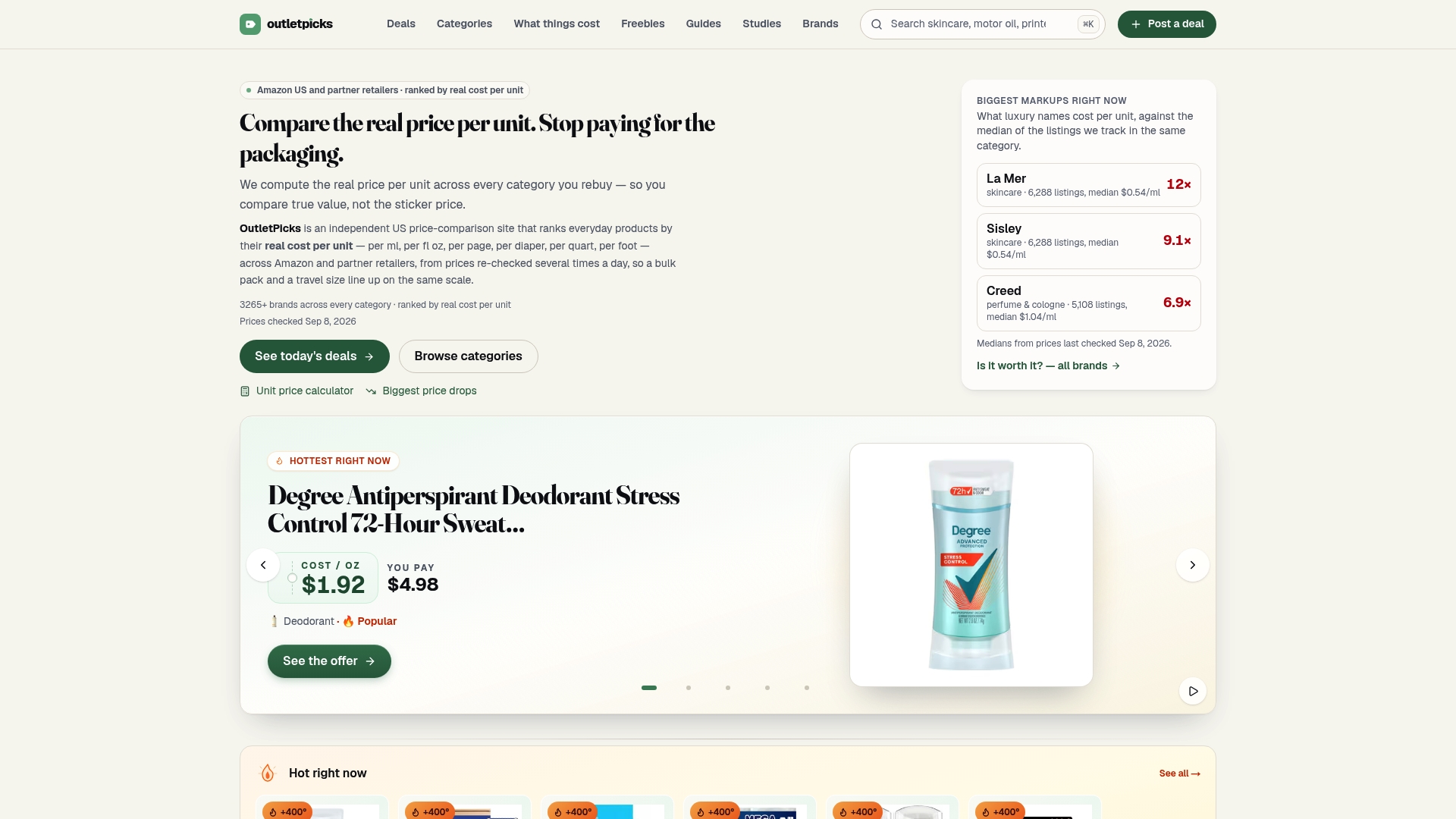
Browse categories like skincare, hair care, fragrance, body care, light bulbs, cables, baby care, and pet food to see real cost-per-unit rankings instead of guessing from pack size alone. If you already know the brand you want, the brand index ranks options by actual per-unit cost, which is often the fastest way to spot the one that's quietly overpriced. Start with the category you buy most often this week and see what the unit price actually says.
Sources
- Uniform Unit Pricing: Tools for Consumers to Fight Shrinkflation — NIST
- FS138: Unit Pricing: What It is and How to Use It — Rutgers NJAES
- Unit price — Wikipedia
FAQ
What Is A Unit Price Label?
A unit price label shows the cost of a product per standard measure, like per ounce, per pound, or per 100 sheets, rather than just the total price you pay at checkout. It lets you compare a small jar against a large container using the same yardstick.
What's The Difference Between Unit Price And Total Price?
Total price is what you pay at the register; unit price is that same cost broken down per ounce, pound, or count. Both numbers matter for different reasons: unit price tells you which package is the better long-term value, while total price tells you whether you can afford it today.
Are Unit Price Labels Required By Law?
Unit pricing isn't required nationwide, and requirements vary by state and store type, so you'll see it consistently in large grocery chains but inconsistently in small independent shops and online listings. Where retailers do use it, NIST's guidance shapes how the tag should look and where it should sit on the shelf.
How Does Unit Pricing Help Spot Shrinkflation?
Shrinkflation shrinks the package while the sticker price stays flat, which hides the real cost increase unless you check the unit price. Since unit price is calculated per ounce or per count, a shrunk package shows up immediately as a higher cost per unit even when the total price never moved.
Can Outletpicks Help Me Compare Unit Prices Across Stores?
Yes. Outletpicks calculates real cost-per-unit across multiple retailers and rechecks pricing data on a rolling cycle, so you can compare categories or specific brands without doing the conversion math yourself.