
Most meal replacements in the US cost between about $2 and $5 per serving. Powders sit at the low end and ready-to-drink bottles at the high end. One review found an average of about $4.04 per serving, with a range of $2.37 to $6.04. The sticker price won't tell you where a product falls in that range. You get there by dividing the full price you pay, shipping included, by the servings you get, and by checking that the servings are comparable.
This guide walks through the formula, shows real price ranges from 2025 and 2026 listings, and covers the details that move the number: serving size, calories, protein, shipping, subscriptions and pack size.
TL;DR
- Price per serving is the total price you pay divided by the labeled servings per container. Count shipping and membership fees if the purchase requires them.
- Powders typically land around $1.50 to $3 per serving. Ready-to-drink shakes usually run higher, often $3 to $5.50.
- A "serving" is not a standard meal. Compare calories and protein too, or you will pick the cheapest small serving instead of the best value.
- Subscriptions and multi-bag discounts can cut the cost by double digits, but only if you will really use that much.
- Use cost per 100 calories or per 10 g of protein as a second yardstick when serving sizes differ.
Table of Contents
- The formula: price per serving in one step
- What meal replacements cost per serving in the US
- A serving is not a meal: compare on equal footing
- What changes the real price you pay
- A five-step method to compare any two meal replacements
- Find unit prices across everyday products
- FAQ
- Sources
The formula: price per serving in one step
Divide the total price by the number of servings in the container. That is all. A $4.50 box with 12 servings costs $0.38 per serving. Extension programs teach the same method: the Nutrition Facts label tells you how many servings are in the package, and you divide the price by that number. Iowa State University's consumer program shows that a $2.29 box with 10 servings costs $0.22 per serving, while a $3.99 box with 15 servings costs $0.26. The bigger, pricier box was the more expensive choice per serving.
Now apply it to a meal replacement. A bag of powder that costs $54.80 and contains 20 meals works out to $54.80 ÷ 20 = $2.74 per meal. That matches a one-time price of $2.74 per meal listed on one plant-based powder's US page, which also shows $43.84 for the same 20 meals on subscription, or $2.19 each.
We cover the same method for other pantry and supplement categories in our guide to store-ready price per serving numbers. Once you can do this math on one product, you can do it on any shelf.
Use servings, not pieces
The label's servings per container is the number to use. It is not always the same as the number of scoops, sticks or capsules. A bottle can hold 120 capsules but only 60 servings if two capsules make one serving. Dividing by 120 gives cost per capsule, not cost per serving. With powders, check whether a serving is one scoop or two, and with stick packs check whether one pack is one meal.
What meal replacements cost per serving in the US
Published prices vary by format, brand positioning and where you buy. The ranges below come from recent product pages, editorial roundups and market research. Treat them as a snapshot of 2025 and 2026 listings, since prices change often.
| Format or tier | Typical price per serving | Source |
|---|---|---|
| Mainstream powders (400 kcal meals) | $1.49 to $2.65 | A major brand's US collection page |
| Ready-to-drink bottles (400 kcal) | $4.42 to $4.83 per bottle | Same collection page |
| Budget organic vegan shake | $2.03 | Fortune's 2025 roundup |
| Premium ready-to-drink chocolate shake | $5.54 | Fortune's 2025 roundup |
| Premium functional powders (market tier) | $0.75 to $1.50 | IndexBox, May 2026 |
| Super-premium direct-to-consumer, clean-label tier | $1.50 to $3.00 | IndexBox, May 2026 |
The IndexBox figures describe the wider powdered-beverage market, so they run lower than products sold as full 400-calorie meals. The pattern still holds. Powders are cheaper per serving than bottles, and the fancier the positioning, the higher the price.
Powder vs. ready-to-drink
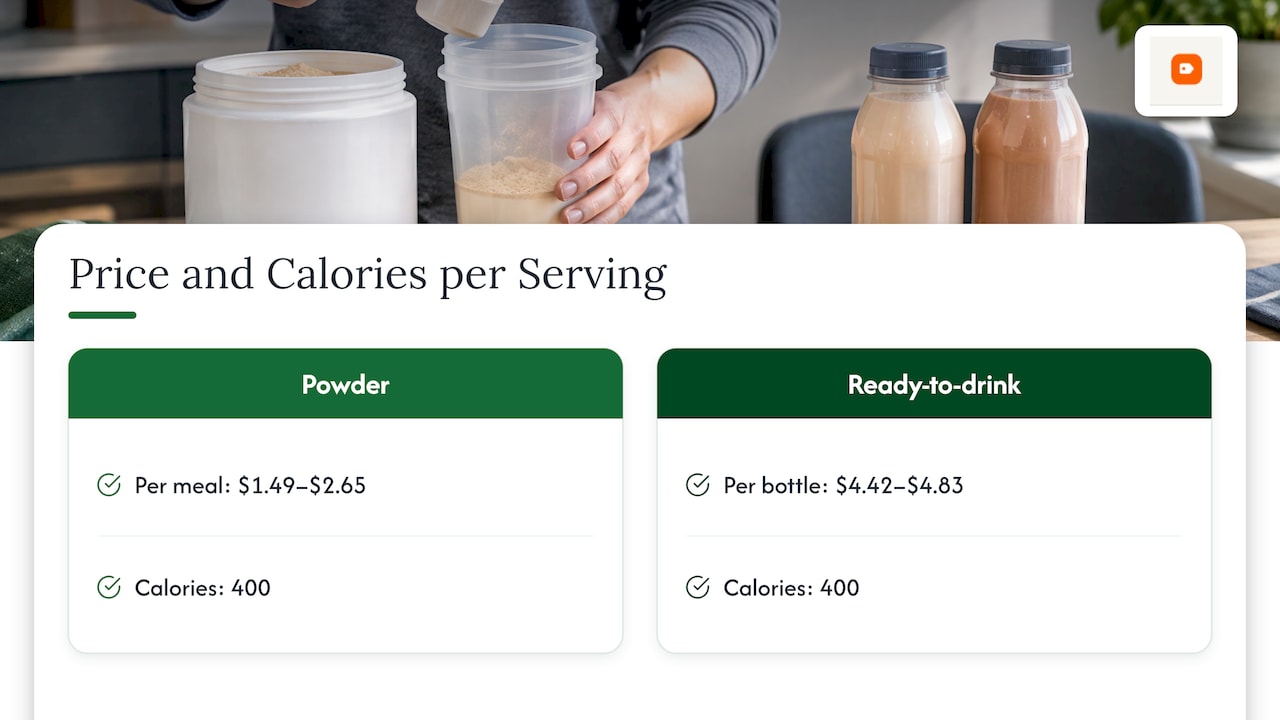
The gap between formats is large. On the same brand's US site, powders run $1.49 to $2.65 per meal, while ready-to-drink bottles with the same 400 calories cost $4.42 to $4.83 per bottle. That is roughly double at the low end of the powder range. You are paying for convenience: no mixing, no shaker, no cleanup.
If you drink one a day, the difference adds up. At $2 a serving, 30 meals cost $60. At $4.50 a serving, they cost $135. Many shoppers use powder at home and keep a few bottles for the car or desk, which pulls the average cost down without giving up convenience.
A serving is not a meal: compare on equal footing
The cheapest price per serving can be a trap. A serving is whatever the manufacturer defines. The FDA says serving sizes on the label reflect the amount people typically eat or drink and are not a recommendation, and all nutrient amounts on the label refer to that one serving. The same agency's label guide adds that when comparing products, the serving size must be the same for the comparison to be valid.
In practice, meal replacement serving sizes range widely. Some shakes are 150 to 200 calories, which is far less than a typical meal, while others are built as 400-calorie meals. A $2 shake with 180 calories and a $3 shake with 400 calories are not in the same league.
Normalize with cost per 100 calories and cost per 10 g of protein
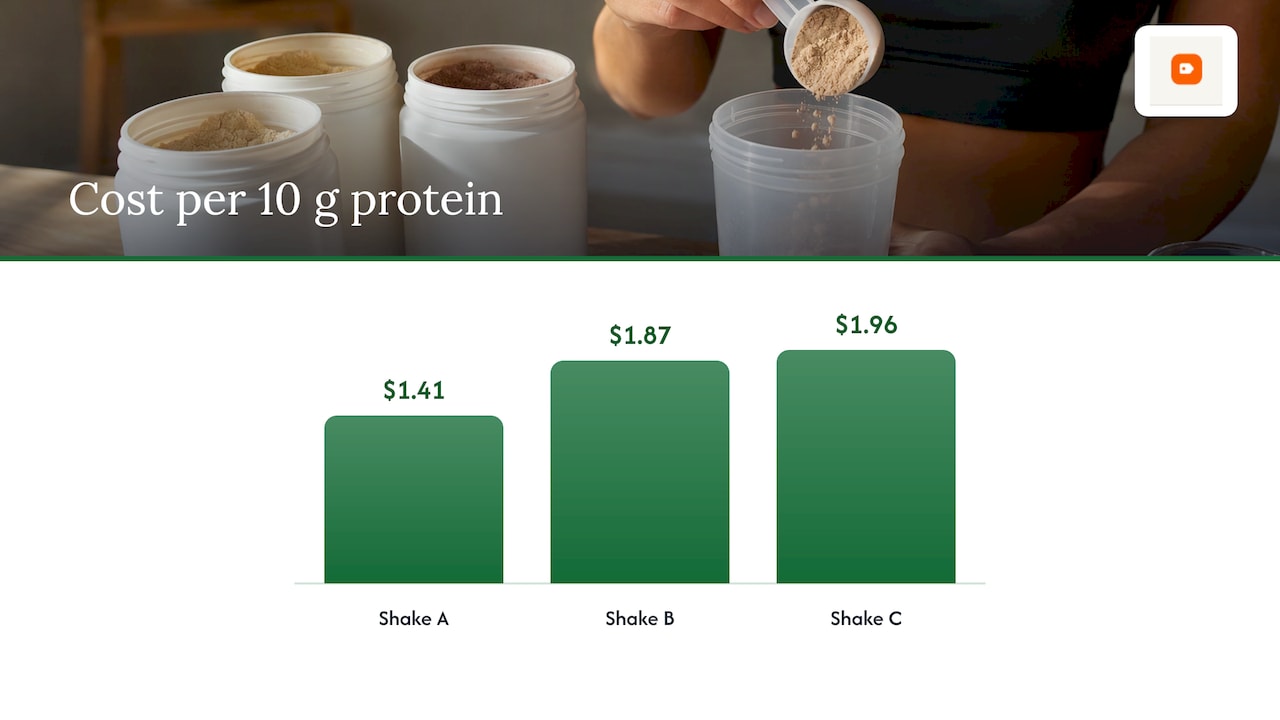
When serving sizes differ, convert to a common unit. Here is a worked example using three ready-to-drink shakes from a dietitian-reviewed 2026 roundup:
| Shake | Price per serving | Calories | Protein | Cost per 100 cal | Cost per 10 g protein |
|---|---|---|---|---|---|
| A | $3.67 | 180 | 26 g | $2.04 | $1.41 |
| B | $2.99 | 240 | 16 g | $1.25 | $1.87 |
| C | $3.91 | 180 | 20 g | $2.17 | $1.96 |
Shake B has the lowest price per serving and the lowest cost per calorie, but it is the most expensive of the three per gram of protein after Shake C. Shake A costs more per serving than B, yet it delivers protein most cheaply. Which one is the best buy depends on what you want the shake to do. If you need energy for a busy morning, cost per 100 calories matters. If protein is the goal, use cost per 10 g.
The same logic is behind our protein price per serving guide, which shows how a cheap scoop can hide a small serving.
Do not stop at price
Equal cost per serving does not mean equal formulas. When two products are close, write down the main ingredient and its source, the amount per serving, the grams in a serving, the other ingredients and the servings per container. Those details tell you whether the two products are really comparable. Use the % Daily Value on the label too: per the FDA, 5% DV or less of a nutrient per serving is low and 20% DV or more is high.
If you have a medical condition, are pregnant, or are replacing meals for weight loss, talk to your doctor or a registered dietitian before relying on shakes as a main source of nutrition.
What changes the real price you pay
The number on the product page is a starting point. Five things move it.
Shipping and membership fees
Count what leaves your account. A $20 package with $6 shipping costs $26 delivered, and with 30 servings that is about $0.87 per serving rather than $0.67. The total package cost should match the purchase you are actually making, including any required shipping or membership for online orders. A free shipping threshold can also push you toward a bigger bag than you need, so compare the delivered price per serving at each size.
Subscriptions and multi-bag discounts
Subscribing is often the easiest saving. One direct-to-consumer brand lists its all-in-one powder at $89.99 for 28 servings, or about $3.21 per meal one-time, and $75.59 with a subscription, roughly $2.70 per meal. It also lists extra savings of 20% for two bags and 25% for three or four bags. A subscription that saves 16% only helps if you drink every serving before the next delivery arrives. A bag that sits in the pantry for months costs more than one you finish.
On Amazon, subscription savings work differently, and the discount is not always the best price. Check the unit price and price history first, as we explain in our guide to checking unit price before Subscribe & Save, and see our list of Subscribe & Save deals that are cheap per unit.
Packaging format
Single-serve formats cost more to make. Market research puts the added cost of stick packs and single-serve pouches at $0.05 to $0.15 per unit versus bulk formats. That is small per serving, but it is real money over a year. A tub with a scoop is usually cheaper per serving than individual packets. Packets are better for travel and for people who would otherwise skip a meal.
Ingredients and sweeteners
Protein and sweeteners are major cost drivers. The same market report says dairy and plant-based protein isolates have risen 15 to 30% since 2021 and that natural sweeteners such as stevia and monk fruit often cost two to four times more than artificial ones. If a product costs more per serving, check whether you are paying for higher protein, an organic or plant-based formula or a natural sweetener. Those may be exactly what you want.
Your time
Cheaper options often take more work. Iowa State's extension program notes that unit pricing shows the best value but that shoppers should also weigh whether they have the time to prepare the cheaper option. A powder that you mix in 30 seconds is cheap. A homemade shake with five ingredients may be cheaper still, but only if you will actually make it.
A five-step method to compare any two meal replacements
- Find the real serving. Read the label for servings per container, and check how many scoops or packs make one.
- Use the delivered price. Add shipping, tax where relevant and any membership fee. Use the subscription price only if you will subscribe.
- Divide. Delivered price ÷ servings = price per serving.
- Normalize. Divide price per serving by calories (times 100) and by protein grams (times 10).
- Check the label. Compare % DV for key nutrients at the same serving size, and glance at the ingredient list.
Keep the results in a simple note or spreadsheet. Seeing five products in a row makes the outliers obvious.
Our take on price per serving
We built Outletpicks around one idea: the sticker price is the least useful number on the page. A big bag can look like a bargain and turn out to cost more per unit, and a small tub can be the better buy. That is true for diapers, perfume and light bulbs, and it is just as true for meal replacements.
When we rank products, we put them on the same footing: the real cost per unit, whatever the pack size or brand. We recheck prices on a rolling cycle so the ranking reflects what shoppers see when they click through. Our approach is to give you the unit price first and let you decide what the unit is worth to you.
For meal replacements, we would pick the unit that fits your goal. Use price per serving for a quick scan, cost per 100 calories if the shake is a meal, and cost per 10 g of protein if it is a supplement. Then check delivered price and your real consumption rate before you commit to a big bag or a subscription.
Alex
Find unit prices across everyday products
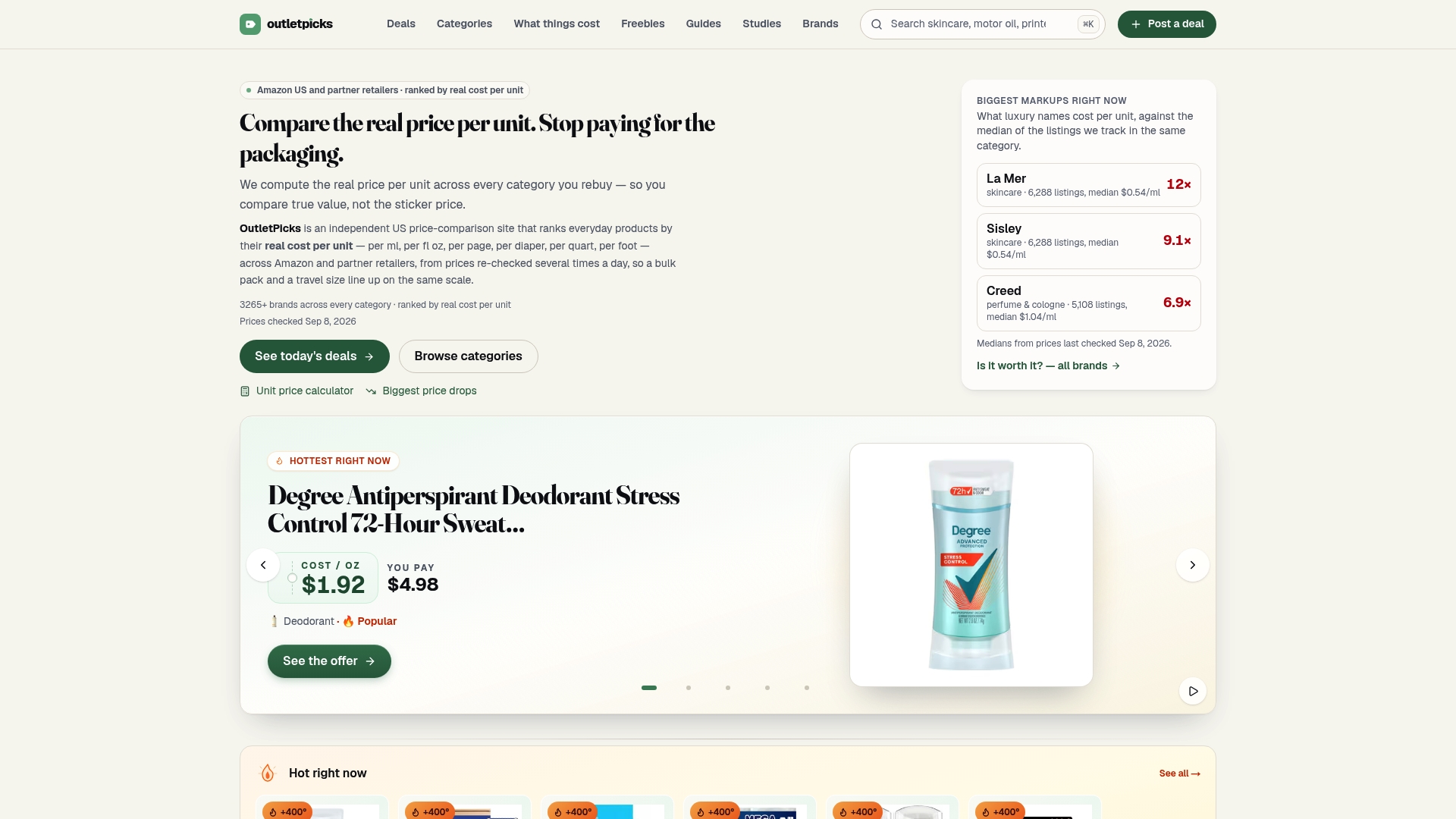
Meal replacements are one of many products where pack size hides the real cost. On Outletpicks we calculate and rank products by cost per unit, such as per milliliter, per diaper or per page, across Amazon and partner retailers. You can browse the full list of categories ranked by real cost per unit, including skincare, baby care, pet food and cables.
If you want to practice the method on something else first, our brand index ranks brands by real cost per unit. Our guides on bulk versus single packs and the price per mL formula apply the same thinking to other products.
FAQ
How much should a meal replacement cost per serving?
For powders sold as full meals, expect about $1.50 to $3 per serving, and for ready-to-drink bottles about $3 to $5.50. One published review found an average of about $4.04 per serving, across a range of $2.37 to $6.04. Anything well below that range deserves a check of the serving size and calories.
Is powder cheaper than ready-to-drink?
Usually, yes. On one major brand's US site, powders run $1.49 to $2.65 per meal while 400-calorie bottles cost $4.42 to $4.83 each. Bottles make sense when convenience matters more than cost, for example at work or while traveling.
Does a subscription really lower the price per serving?
It can. One brand lists a 16% subscription discount, with 20% to 25% off for multiple bags. The saving is real only if you use each delivery on schedule. Compare the subscribed price per serving to the best one-time price, then skip or pause deliveries if your stock builds up.
Should I compare cost per serving or cost per calorie?
Use both. Cost per serving is fast, but serving sizes differ, and the FDA notes that serving size must match for a valid comparison. Cost per 100 calories works for shakes used as meals, and cost per 10 g of protein works when protein is the goal.
Do shipping costs matter?
Yes. A $20 product with $6 shipping and 30 servings costs about $0.87 per serving, not $0.67. Always compare the delivered price, especially when one seller charges for shipping and another includes it.
Sources
- Fatskills: nutrition label math
- Iowa State University Extension: unit pricing
- Plenny Shake Pro US product page
- Huel US meal replacement collection
- Fortune: best meal replacement shakes
- IndexBox: US powdered beverages market
- FDA: serving size on the Nutrition Facts label
- FDA: Understanding and using the Nutrition Facts label
- Good Housekeeping: best meal replacement shakes
- Better Health Shelf: how to calculate cost per serving
- 310 Nutrition: all-in-one meal replacement shakes
- Healthline: meal replacement shakes