

Most sports drinks cost between about 4 and 13 cents per fluid ounce at U.S. stores, and the pack size usually decides where in that range you land. Large multipacks of the big brands tend to sit at the low end, single bottles and premium brands at the high end. Divide the shelf price by the total fluid ounces in the package and you can compare any two products in seconds.
Below you will find the formula, real retailer snapshots, a worked comparison of bottles, multipacks and powders, and the reasons the same drink can cost twice as much one aisle over.
TL;DR
- Unit price = total price ÷ total fluid ounces. For a multipack, multiply bottle size by bottle count first.
- Retailer pages we reviewed show big-brand 8-packs of 20 fl oz bottles at roughly 4 to 6 cents per fl oz, while premium single bottles run 8 to 13 cents.
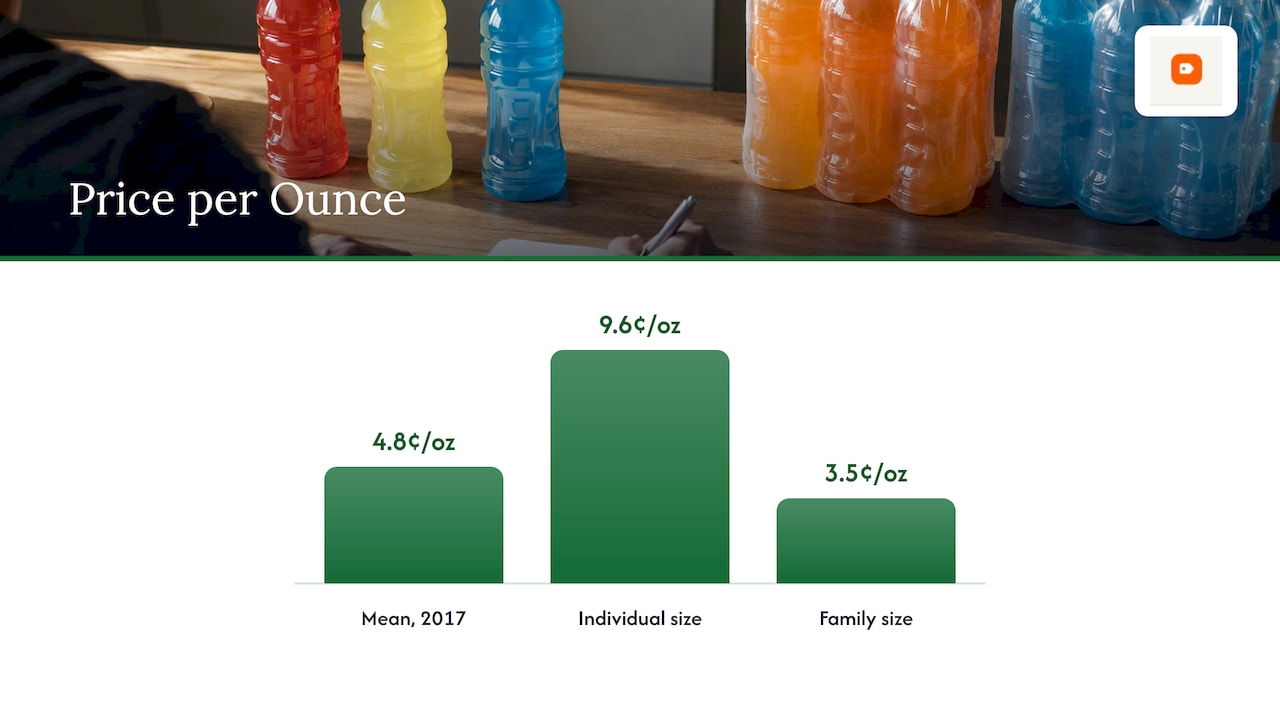
- A peer-reviewed study found family-sized and multipack drinks averaged 3.5 cents per ounce versus 9.6 cents for single servings (2017 data).
- Check that "oz" means fluid ounces, not weight, before you compare labels.
- Prices move constantly, so treat any figure here as a snapshot and run the math on the day you buy.
Table of Contents
- How to calculate sports drink price per ounce
- What sports drinks cost per fluid ounce right now
- Bottles, multipacks and powders compared
- Why the same drink costs more in some places
- How to find the cheapest sports drink per ounce
- Our perspective
- Compare real cost per unit across categories
- FAQ
- Sources
How to calculate sports drink price per ounce
The formula is the same one any grocery unit price uses. Shopify's unit-price guide states it as total price divided by number of units, and shows that a 32-ounce carton of juice at $4 costs 12.5 cents per ounce while a 64-ounce carton at $6.40 costs 10 cents per ounce. The bigger carton looks pricier on the shelf and is cheaper where it counts.
For sports drinks, the steps are:
- Find the size of one bottle in fluid ounces (for example 20 fl oz).
- Multiply by the count in the pack. Eight bottles of 20 fl oz is 160 fl oz.
- Divide the price by the total ounces. At $9.49, that is $9.49 ÷ 160 = about $0.059, or 5.9 cents per fl oz.
- Compare in cents. Cents per ounce are easier to read than fractions of a dollar.
The same shopper logic applies in any category, and our price per ounce formula guide walks through the most common mistakes, including mixing up units.
Use the same unit on both sides
The guide above stresses that the unit has to match before you compare: you cannot set ounces against pounds or liters against fluid ounces without converting first. Sports drinks are the classic trap, because a 1-liter bottle sits next to a 28 fl oz bottle and a 12-pack of 355 mL cans. If you need to convert, these pages do it quickly: milliliters to fluid ounces, fluid ounces to milliliters, liters to fluid ounces and cups to fluid ounces.
One liter is 33.814 fl oz, so a $2.50 liter bottle works out to about 7.4 cents per fl oz.
Fluid ounces are not weight ounces
A U.S. fluid ounce measures volume and equals exactly 29.5735 mL. An ounce by weight is a unit of mass. For drinks, the label's "oz" almost always means fluid ounces, and a metric figure in parentheses settles any doubt: a number in mL means fluid ounces, a number in grams means weight. This matters most for powders, which are usually sold by weight.
Why stores show a unit price at all
The model rule published by NIST says that when a retailer gives unit pricing for liquids, it must state it consistently per liter, 100 mL, gallon, quart, pint or fluid ounce across package sizes. It also says that when the unit price is under a dollar, it is listed to the tenth of a cent or the whole cent, with the store using the same rounding method every time. That is why one shelf tag says 6 cents and another says 5.9.
The same rule exempts packages under 1 fl oz and items with a total price of 50 cents or less. A tiny single bottle may carry no unit price, so do the math yourself. Unit pricing is also a standard stores can adopt voluntarily, so not every retailer shows it.
What sports drinks cost per fluid ounce right now
The table below uses prices that retailers displayed on their own product pages. We recalculated the per-ounce figure from the pack size so you can see the work. Prices and promotions change often, so use these as a snapshot of the pattern, not a quote.
| Product and pack | Listed price | Total fl oz | Cost per fl oz |
|---|---|---|---|
| Gatorade Frost Blue Glacier Freeze, 8 x 20 fl oz (Kroger) | $9.49 | 160 | about 5.9 cents |
| Gatorade Lemon Lime, 8 x 20 fl oz, discounted (Kroger) | $8.49 | 160 | about 5.3 cents |
| Gatorade Frost Glacier Freeze, 8 x 20 oz (H-E-B) | $6.98 | 160 | about 4.4 cents |
| Gatorade Thirst Quencher Variety Pack, 18 x 12 fl oz (ShopRite) | $11.99 (sale) | 216 | about 5.6 cents |
| Gatorade Zero Sugar, 8 x 20 fl oz (Walmart) | $7.47 | 160 | about 4.7 cents |
| Gatorade Fierce, 28 fl oz single bottle (ShopRite) | $2.29 | 28 | about 8.2 cents |
The retailer pages show their own rounded unit prices: $0.06 or $0.05 at Kroger, $0.04 at H-E-B, and $0.08 for the 28 fl oz bottle at ShopRite. Our recalculated numbers match once you round.
Two patterns stand out:
- The same drink at the same bottle size varies by store. An 8-pack of 20 oz Gatorade is about 4.4 cents per ounce in one table row and 5.9 in another, a gap of roughly a third.
- Premium brands sit higher. A retailer page in the same research lists a BODYARMOR Flash I.V. bottle at $0.13 per fl oz, and a Gatorade bottle on the same page at $0.06.
The long-run average
A peer-reviewed analysis by Leider and Powell found that the mean sports drink price in U.S. food stores in 2017 was 4.8 cents per ounce. Individual-sized drinks averaged 9.6 cents per ounce, while family-sized drinks (over 1 liter or multipacks) averaged 3.5 cents. That is a nearly three-to-one spread, and it is the single most reliable rule in this category: buy the bigger pack if you will drink it.
Prices have risen since. The Institute of Food Technologists, citing Circana data, reported that the average price per unit of sports drinks grew 16.4% to $3.17 in the 52 weeks ending October 8, 2023, while unit sales fell 4.8%.
Bottles, multipacks and powders compared
The format matters more than the brand name for most shoppers. Here is how the three common formats behave.
Single bottles
A single 20 fl oz bottle at $2.19 is about 11 cents per fl oz. At a convenience counter it can be higher. You pay for being cold, close and ready. If you buy singles regularly, the best fix is to carry bottles from a multipack and keep them chilled at home.
Multipacks
Multipacks are where the lowest per-ounce prices live. The same IFT report notes that cost was the top consideration for 41% of U.S. consumers buying sports and functional nutrition products in a 2023 Innova survey. It adds that 24-count multipacks grew faster than 8- and 12-count packs, and that the 16.9-ounce size saw the biggest uptick among single-count beverages.
Bigger counts do not always win by default. Check the math, because a promotion on a smaller pack can beat the everyday price of a bigger one. Our worked examples:
- 18 bottles of 12 fl oz = 216 fl oz. At $11.99 that is 5.6 cents per fl oz.
- 8 bottles of 20 fl oz = 160 fl oz. At $8.49 that is 5.3 cents per fl oz, so the smaller, discounted pack is cheaper per ounce than the bigger-looking variety pack.
Powders and mixes
Powders and concentrates are sold in canisters, sticks and single-serve packets. Big retailers such as Target list powdered and mix formats alongside ready-to-drink bottles, including canisters and stick packs for making 20 oz servings.
The key step for powders is to price the finished drink, not the powder. Use the mixed volume on the label:
- Find how many fluid ounces the container makes when mixed as directed.
- Divide the price by that total.
- Compare the result to the ready-to-drink cents per ounce.
Here is a hypothetical example to show the method. If a canister costs $8.00 and the label says it makes 128 fl oz of drink, the result is 6.25 cents per fl oz. Put real numbers in from the package you are holding. Powder's advantage is less about price and more about being light to carry and flexible on strength, so you can make a single serving or a gallon.
Why the same drink costs more in some places
Price per ounce is not only about the product. Several things push it around.
Package size and material. Market research from Mordor Intelligence puts the average base price of a U.S. sports drink in 2023 between $1.40 and $7.05 per liter, and links pricing to packaging material cost and ingredients such as flavors, sweeteners and electrolytes. Add-ins like protein push a drink toward the top of that range.
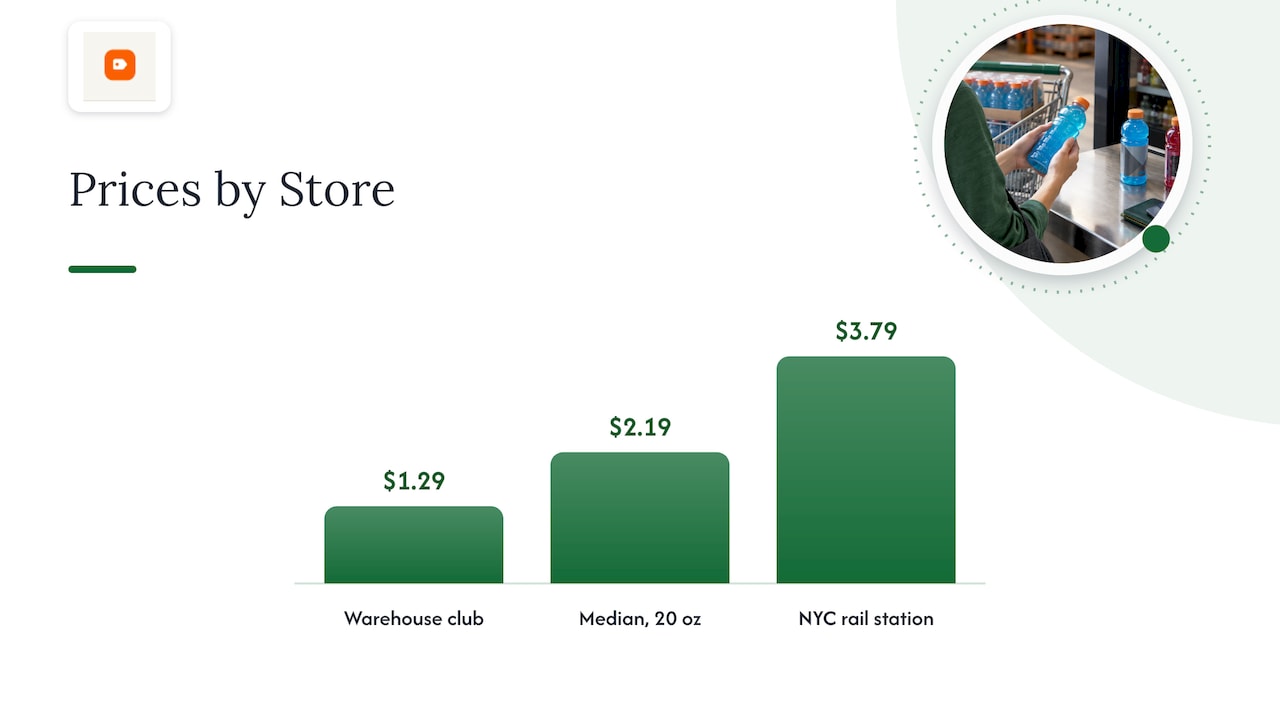
Where you shop. Warehouse clubs and grocery chains with private labels run lower than convenience stores, airports and train stations. A 2024 write-up by Glass & Note, drawing on retail data, reports a median 20 oz price of $2.19, ranging from $1.29 in a 24-pack at a warehouse club to $3.79 at a New York City rail station. Treat it as a blog's analysis rather than a primary price source, but the direction matches what we see on retailer pages.
Promotions. Sale prices change the ranking overnight. A discounted Gatorade 8-pack at 5.3 cents beat a full-price variety pack above, and a retailer's "was" price tells you little about what you will pay next week. If you like to see how a markdown reshapes a per-serving calculation in another everyday category, this guide to per-cup savings uses the same logic.
Neighborhood. The same Glass & Note piece cites a 2023 Johns Hopkins audit of 142 stores in three cities that found sports drinks priced 22% higher in low-income ZIP codes. Because that figure is secondhand, treat it as a reason to compare across stores near you, not as a precise national number.
How to find the cheapest sports drink per ounce
A short routine beats a lot of coupon hunting.
- Pick the size you will actually finish. A cheap 24-pack is no bargain if half goes flat in the garage.
- Read the shelf tag's unit price, then confirm it. Stores round differently, as the NIST rule allows tenth-of-a-cent or whole-cent display. Do your own division when two products look close.
- Compare the same units. Convert liters or milliliters first, using our fluid ounce to mL converter if needed.
- Compare across stores. The same 8 x 20 oz pack ranged by about a third in our table.
- Re-check on the day you buy. Retailer prices move, and so do pack sizes. Sizes sometimes shrink while the price stays put, which the unit price exposes instantly.
- Match the product to the need. For a casual afternoon, the cheapest per ounce in a familiar flavor is plenty. Zero-sugar versions are listed at similar per-ounce prices in the retailer snapshots above.
A quick worked comparison
Say you are choosing between three options on one shelf:
- A 28 fl oz bottle at $2.29: 8.2 cents per fl oz.
- An 8-pack of 20 fl oz bottles at $7.47: 4.7 cents per fl oz.
- A 12-pack of 12 fl oz bottles (144 fl oz) at $6.50 (a hypothetical price): 4.5 cents per fl oz.
The 12-pack is cheapest per ounce, but the 8-pack carries bigger bottles and is only slightly higher. The single bottle costs nearly twice as much per ounce as either pack. That is the whole game: the sticker price tells you what leaves your wallet today, and the unit price tells you what you get for it.
Our perspective
We built OutletPicks around one belief: the sticker price is the least useful number on a shelf. Sports drinks prove it. A $2 bottle and a $9 case can both be "cheap," and only the per-ounce price tells you which one is.
When we rank products, we normalize everything to the real cost per unit, whether that is per milliliter, per diaper, per page or per fluid ounce, so pack size and brand stop clouding the comparison. We recheck retailer data on a rolling cycle, and our positioning is to update prices daily, because a promotion can flip the ranking within days.
Our advice for a drink like this is simple: pick the format you will really use, divide, and compare in cents. If you want a ready-made method, our guides on the price per ounce formula and price per mL show the math step by step, and our converters handle the unit changes for you.
Alex
Compare real cost per unit across categories
Sports drinks are one corner of everyday spending. OutletPicks ranks products by their real cost per unit across household essentials, personal care, baby care, electronics and more, using prices from Amazon and partner retailers. Browse all of our categories to see rankings by cost per unit, or start from the OutletPicks homepage.
FAQ
How much is an ounce for drinks?
For drinks, an ounce means a U.S. fluid ounce, a unit of volume equal to about 29.57 mL. There are 8 fluid ounces in a cup and 33.814 in a liter. If the label shows a metric figure in grams rather than milliliters, the ounce is a weight, not a volume.
What is a good sports drink price per ounce?
In the retailer snapshots above, multipacks of common brands ran about 4 to 6 cents per fl oz, and single bottles of premium brands ran 8 to 13 cents. A peer-reviewed study found multipacks and family sizes averaged 3.5 cents per ounce in 2017. Treat anything near the low end of today's retailer range as a good price.
Is it cheaper to buy sports drink powder?
It can be, but you have to price the mixed drink. Divide the container price by the total fluid ounces the label says it makes, then compare that to the ready-to-drink cents per ounce. Powders also store compactly and let you mix just the amount you need.
Why does the same sports drink have different unit prices at different stores?
Retailers set their own prices and run their own promotions, and they may round the displayed unit price differently. The NIST model rule lets stores show unit prices to the tenth of a cent or the whole cent. Dividing the price by the total ounces yourself gives a consistent comparison.
Sources
- NIST HB130 Uniform Unit Pricing Regulation (2026)
- Shopify: How to Calculate Unit Price
- Fluid ounce, Wikipedia
- Kroger: Gatorade Frost Blue Glacier Freeze multipack
- Kroger: Gatorade Lemon Lime multipack
- H-E-B: Gatorade Frost Glacier Freeze 8 pack
- ShopRite: Gatorade Variety Pack
- ShopRite: Sports and energy drinks
- QFC: electrolyte drink listings
- Leider and Powell, sugar-sweetened beverage prices (PMC)
- IFT: Sports Beverage Market Flexes
- Mordor Intelligence: United States Sports Drinks
- Glass & Note: The Cost of Hydration
- Target: Sports drink mix