

A concentrated cleaner almost always looks more expensive on the shelf and almost always costs less to use. To find the real number, multiply the bottle size by the total parts in the dilution ratio (water plus concentrate), divide the price by that yield, then multiply by the amount you use per cleaning. That gives you a cost per use, in cents, that you can set against any ready-to-use spray.
This guide walks through the math step by step, shows worked examples with real manufacturer figures, and lists the label details that change the answer.
TL;DR
- Cost per ready-to-use ounce = (price ÷ ounces in the bottle) ÷ (dilution ratio + 1). A 1:64 concentrate yields 65 parts of finished solution per part of concentrate.
- Cost per use = cost per finished ounce × ounces you actually use per cleaning task.
- The dilution ratio swings the result more than the sticker price does, so read the label for each task, not just the headline ratio.
- Over-diluting can leave soil behind and under-diluting wastes product, so the cheapest math is only real if you follow the label.
- Compare concentrate and ready-to-use on the same unit, such as cost per finished ounce or per gallon, never on bottle price.
Table of Contents
- Why shelf price misleads you
- The formula, step by step
- Worked example 1: a manufacturer's own chart
- Worked example 2: a very high dilution
- Worked example 3: a home bottle, start to finish
- Concentrate vs. ready-to-use: the fair comparison
- Turning cost per ounce into cost per use
- What to check on the label
- A quick checklist before you buy
- Perspective
- See the unit prices side by side
- FAQ
- Sources
Why shelf price misleads you
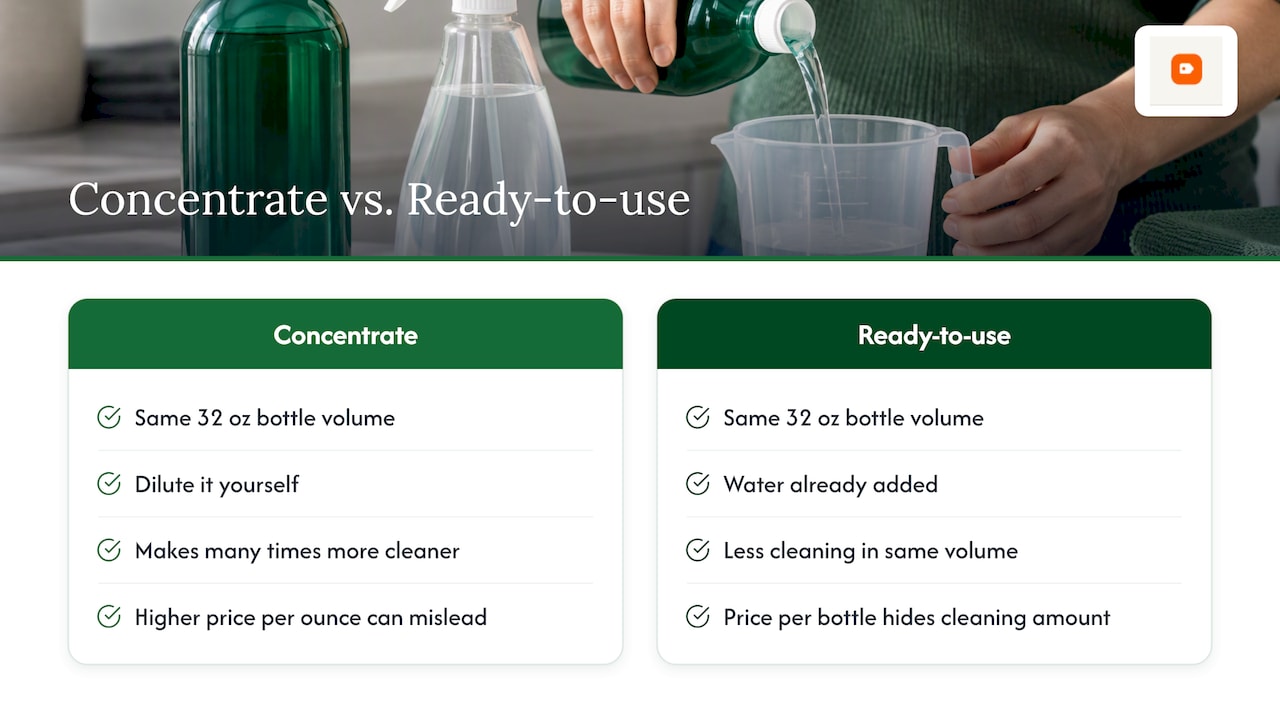
A 32 oz bottle of concentrate and a 32 oz spray bottle of ready-to-use cleaner hold the same volume of liquid but not the same amount of cleaning. The spray is mostly water that someone already added and shipped to you. The concentrate is the part you dilute yourself, so the same bottle makes many times more finished cleaner.
That is why comparing the two by price per bottle, or even price per ounce of what is in the bottle, tells you almost nothing. The comparison that matters is price per ounce of finished, ready-to-use solution, and then price per task. This is the same idea we use across the site for price per mL: get everything onto one unit before you decide anything.
A cleaning-products supplier, Brulin, makes the same point in its purchasing guidance: a concentrate's higher price per ounce can be misleading, because dilution produces far more usable solution than a ready-to-use product delivers (Brulin on dilution rates and operating costs).
The formula, step by step
You need three numbers from the bottle and one from your own habits.
- Price of the container.
- Size of the container, in ounces (or gallons).
- Dilution ratio from the label, such as 1:16 or 1:64.
- Amount used per task, in ounces of finished solution.
Then:
Step 1. Find the yield. Multiply the container size by the dilution ratio plus one. A ratio of 1:128 means one part concentrate and 128 parts water, so the total is 129 parts. Hillyard, a professional cleaning-chemicals provider, defines yield exactly this way, using the 1:128 case with a total yield of container size × 129 (How to Calculate Cost per Diluted Gallon).
Step 2. Divide price by yield. That is your cost per finished ounce (or gallon).
Step 3. Multiply by what you use. Cost per finished ounce × ounces per task = cost per use.
If you want a general version of this for any product you use repeatedly, our cost per use formula guide covers it with three examples and a calculator.
A note on the "+1"
People often forget it. At 1:64 you do not get 64 gallons from one gallon of concentrate, you get 65, because the concentrate itself is part of the finished volume. On a single product the difference is small. On a 1:3 consumer concentrate it is a third of your answer.
Worked example 1: a manufacturer's own chart
Simple Green publishes a U.S. cost-per-usable-gallon chart that applies this conversion across ratios from 1:3 through 1:128. For a concentrate priced at $20 per gallon, the chart lists $0.31 per usable gallon at 1:64 and $0.16 at 1:128 (Simple Green cost-per-usable-gallon chart).
Check it yourself: $20 ÷ 65 parts = $0.31, and $20 ÷ 129 parts = $0.16. The product is identical. Doubling the dilution roughly halves the cost of every finished gallon.
Worked example 2: a very high dilution
Baxter Clean Care shows the same arithmetic on a $12.30-per-gallon product used at 1:256. Treating the finished yield as 257 gallons, $12.30 ÷ 257 comes to about $0.048, or 4.8 cents per diluted gallon (Baxter Clean Care dilution example).
High ratios like this are typical of professional-grade products. Consumer concentrates sold for home use usually dilute far less, so do not assume the cents-per-gallon figures from a janitorial product apply to the bottle in your cart.
Worked example 3: a home bottle, start to finish
The following uses made-up round numbers so you can follow the math. Swap in your own.
- A 32 oz concentrate costs $8.99 and the label says to mix 8 oz per gallon of water, which is a 1:16 style dilution. An EPA-registered label for one such concentrate uses this 8 oz per gallon directive for listed organisms on hard, non-porous surfaces, with a 5-minute contact time (EPA label for Accel Concentrate).
- Using the ratio shortcut: 32 oz × 17 parts = 544 oz of finished cleaner.
- $8.99 ÷ 544 = about $0.0165 per finished ounce.
- Filling a 24 oz spray bottle with the finished solution costs about $0.40.
- A ready-to-use spray at $4.00 for 32 oz costs $0.125 per ounce, so the same 24 oz is $3.00.
That is roughly seven to eight times cheaper for the concentrate in this example, even though the concentrate bottle costs more than twice as much at the register.
The table below shows how the per-ounce cost drops as the ratio rises, holding the same hypothetical $8.99, 32 oz bottle.
| Dilution ratio | Parts of finished solution | Finished ounces from 32 oz | Cost per finished ounce |
|---|---|---|---|
| 1:8 | 9 | 288 | $0.031 |
| 1:16 | 17 | 544 | $0.017 |
| 1:32 | 33 | 1,056 | $0.0085 |
| 1:64 | 65 | 2,080 | $0.0043 |
The prices in this table are illustrative, calculated from the formula above rather than quoted from any product.
Concentrate vs. ready-to-use: the fair comparison
To compare a concentrate with a ready-to-use cleaner, convert both to cost per finished ounce (or per gallon).
- Ready-to-use: shelf price ÷ ounces. Nothing else to do.
- Concentrate: (price ÷ ounces) ÷ (ratio + 1).
Then decide on the task. A glass spray that needs a fine mist and a floor bucket that needs a gallon have very different volumes per use, and the gap in dollars grows with volume. The more you clean, the more the concentrate wins. For a single small bottle used twice a year, the difference is pennies and convenience may reasonably matter more.
Brulin also notes that ready-to-use products move and store more water, while concentrate can cut the quantity purchased and shipped. At home, that translates to fewer trips and less shelf space. If you shop online, our brand index ranks brands by real cost per unit, which makes the first screening step easier.
Turning cost per ounce into cost per use
Cost per finished ounce is a unit price. Cost per use is what you actually pay each time you clean. Lenny's cost-per-clean explainer states it plainly: cost per clean equals the unit rate multiplied by the amount used per clean, and its example uses 0.50 fluid ounce per standard clean (Lenny's Cost per Clean).
That amount-used figure is where most estimates go wrong. A few rough ways to set it:
- Spray bottle refill: the bottle's capacity is your batch size, and the number of refills per month tells you your monthly cost.
- Mop bucket: measure the water you really put in the bucket, not the maximum fill line.
- Direct use: if the label calls for undiluted product on tough spots, count those ounces at the concentrate price per ounce, not the finished price.
Power Hygiene, a U.K. supplier, warns that excess application, such as extra spray or an overfilled bucket, raises costs and can lower efficiency however economical the concentrate looks on paper (Power Hygiene on cost per clean). Measure once, write it on the bottle, and your estimate will hold.
What to check on the label
The math is only as good as the inputs. Four label details change the result.
The dilution ratio, by task
One bottle often lists several ratios. An EPA-registered disinfecting bathroom cleaner label includes a 1:4 product-to-water option for sanitizing hard, non-porous surfaces (EPA label for Comet Disinfecting Bathroom Cleaner). A strong ratio like that costs much more per use than a general-cleaning ratio on the same bottle, so pick the ratio for the job you will actually do.
For a disinfecting claim, follow the label's directions exactly. A Fabuloso label, for example, tells users to dilute ½ cup in a gallon of water for hard, non-food, non-porous surfaces and leave it for at least 5 minutes (EPA label for Sparkling Citrus Fabuloso). The contact time and dilution are what make the claim valid, so never thin a disinfectant further to stretch it.
Container size and units
Ounces, fluid ounces, quarts, gallons and liters all show up. Convert everything to one unit first. Our price per mL guide gives a quick way to do it.
How long the mixed solution lasts
Mixed solution can lose value if you throw it away. Manufacturers state shelf life on the label. For one professional product, the EPA label says the use-dilution stays effective for up to one year when stored in sealed containers and kept free of visible contamination (EPA label for Virex II/256). That is one product's rule, not a general one, so read your own label before you mix a large batch and store it.
Safe dilution, not just cheap dilution
KleanPro Supplies, a U.K. supplier, notes that correct dilution matters for both cost and safety: over-dilution may leave soil behind, while under-dilution wastes chemical and can leave residue or damage surfaces (KleanPro on concentrate vs. ready-to-use). Use a measuring cup or a marked bottle, wear gloves if the label says to, and never mix different cleaners together.
A quick checklist before you buy
- Find the dilution ratio for your most common task, not the best-case number on the front.
- Compute the finished yield and cost per finished ounce.
- Write down how many ounces you use per task.
- Compare against a ready-to-use alternative on the same unit.
- Check whether the label's contact time or storage rule affects how you will use it.
If you buy several kinds of household products, the same method applies to laundry and disinfectants. Our guides on detergent cost per load, pods versus liquid and bleach price per ounce show where the numbers land in those categories.
Specialty concentrates follow the same math too. A café that descales its espresso machine, for instance, compares a steam wand cleaner concentrate by cost per dose rather than by bottle price, using the dose on the label.
Perspective
We built OutletPicks around one belief: the sticker price is the least useful number on the page. A concentrate that costs $9 and makes 17 bottles of cleaner is a different product from a $4 spray, even though both say "32 oz."
That is why we rank products by real cost per unit, whatever the pack size or brand, and recheck retailer prices on a rolling cycle. Our approach is to give you the unit price first and let you decide how much convenience, scent or brand you want to pay for on top of it.
For cleaners, we think the best habit is simple: convert to cost per finished ounce, multiply by what you use, and keep the result next to your shopping list. Once you have done it for one bottle, the rest take a minute.
Alex
See the unit prices side by side
Once you know the formula, the faster route is to let the work be done for you. OutletPicks calculates and ranks products by real cost per unit across Amazon and partner retailers, so you can compare sizes and brands without a spreadsheet. Browse the category index to find household and personal-care products ranked by what they actually cost per ounce, per load or per use.
If you shop for hair and skin products too, the same concentrate logic applies to shampoos and body washes, and our weekly shampoo deals show their unit prices.
FAQ
How do I calculate cost per use for a concentrated cleaner?
Divide the bottle price by the finished yield, which is bottle size times the dilution ratio plus one. Then multiply the result by the ounces of finished solution you use per task. For a $20 gallon at 1:64, that is $20 ÷ 65, or about $0.31 per finished gallon.
Is concentrated cleaner really cheaper than ready-to-use?
Usually, per ounce of finished product, yes, because you are not paying to ship or sell water. The gap grows as the dilution ratio rises and as you clean more often. For a bottle you use rarely, the saving is small, so run the numbers on your own use.
What is a good dilution ratio for household cleaning?
There is no single good ratio, because it depends on the product and the task. One 2026 supplier guide says consumer concentrates typically run from about 1:3 to 1:32, while professional products often reach 1:64 to 1:256 (Cleaning Supply Store guide). Always follow the ratio on your own label.
Can I dilute a concentrate more to save money?
Not beyond the label. Over-diluting can leave soil behind, and a disinfectant diluted past its stated ratio may not do what the label claims. If you want a lower cost per use, choose a product with a higher labeled ratio instead.
Sources
- How to Calculate Cost per Diluted Gallon (Hillyard)
- Simple Green cost-per-usable-gallon chart
- Baxter Clean Care dilution example
- Brulin: How Cleaning Product Dilution Rates Lower Operating Costs
- Lenny's Cost per Clean
- Power Hygiene: What Is Cost Per Clean
- EPA label: Accel Concentrate
- EPA label: Comet Disinfecting Bathroom Cleaner
- EPA label: Sparkling Citrus Fabuloso
- EPA label: Virex II/256
- KleanPro Supplies: Concentrate or Ready to Use
- Cleaning Supply Store: Concentrate All-Purpose Cleaner Cost Per Use