
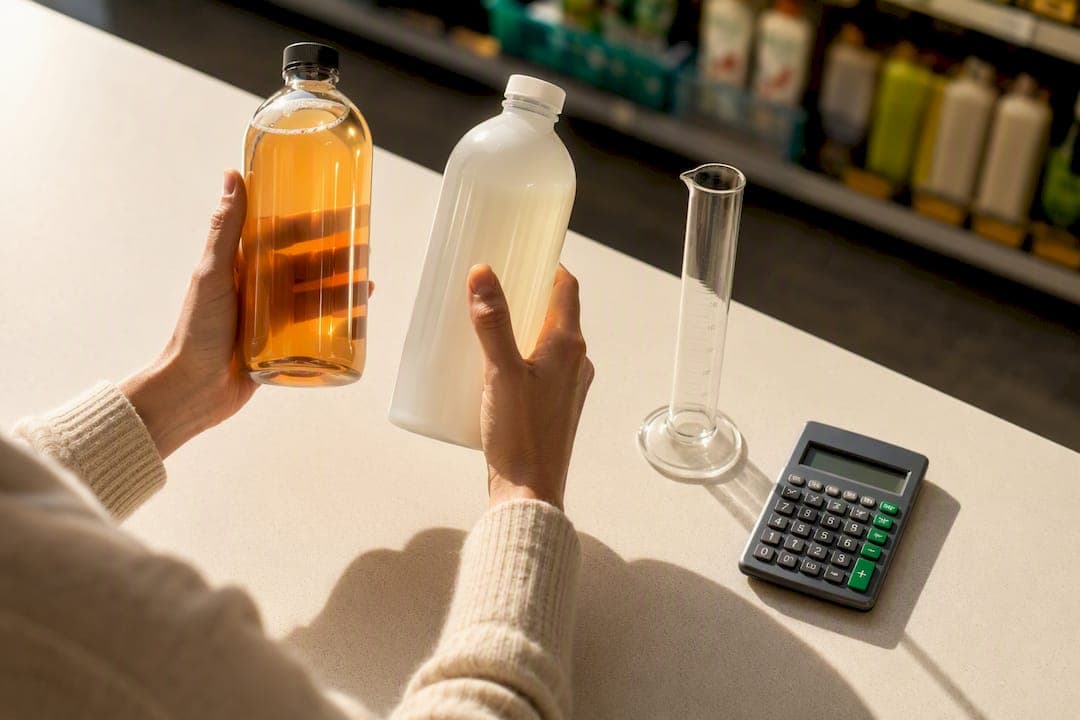
Price per milliliter is the total price of a liquid product divided by its total volume in milliliters, and it's the only number that tells you which bottle is actually cheaper. The formula is simple: Price ÷ Volume (mL) = Price per mL. A $10 bottle with 500 mL costs $0.02 per mL. Various online platforms track this figure across retailers, and both the Federal Trade Commission and NIST publish guidance on how to calculate it correctly.
TL;DR:
- Many shoppers underestimate the importance of converting all volumes to milliliters accurately before calculating the price per mL.
- Using the correct final price, including discounts and taxes, is essential for an accurate comparison, especially with multi-packs.
- Rounding errors from small volume differences or ignoring product degradation can cause the perceived cheapest option to be wrong in practice.
- Relying on inconsistent or outdated shelf labels often leads to miscalculations, emphasizing the benefit of automated online tools.
- Buying in bulk is only cost-effective if you will use the product before it expires or degrades, otherwise smaller packages may be cheaper in real-world terms.
Table of Contents
- How to calculate price per mL step by step
- Converting ounces, liters, and gallons to milliliters
- Common mistakes that wreck your price-per-mL math
- When the bigger bottle isn't actually the better deal
- Quick tools that do the math for you
- Why so many shoppers get this number wrong
- Skip the math with Outletpicks
- Where these numbers come from
- Sources
- FAQ
How to calculate price per mL step by step
The math itself takes ten seconds once you have two numbers: the final price you're paying and the total volume in milliliters. The trouble is that retailers rarely hand you both in the same unit, so the real skill is prepping the numbers before you divide.
Here's the process the FTC recommends for comparing unit prices accurately:
- Find the final price. Use the price you'll actually pay at checkout, after any applicable discount or coupon, not the pre-sale sticker price.
- Convert the volume to milliliters. If the label reads ounces, liters, or gallons, convert everything to mL first so you're comparing apples to apples.
- Multiply for multi-packs. A 3-pack of 250 mL bottles isn't a 250 mL product. It's 750 mL total. Multiply before you divide, every time.
- Divide price by total volume. Price ÷ total mL gives you your cost per mL.
- Sanity-check the result. Round your answer to a clean number and multiply it back by the volume. If it lands close to the price you started with, your math is right.
A worked example: a bottle of dish soap costs $4.99 for 400 mL. Divide $4.99 by 400 and you get $0.0125 per mL. A competing brand costs $7.99 for 700 mL, which works out to about $0.0114 per mL, the cheaper option even though its sticker price is higher. That's the entire point of calculating unit cost instead of trusting the shelf tag.
Pro Tip: Screenshot the price and volume before you leave the aisle. Retailers change prices and sizes often enough that redoing the math from memory later gets you the wrong answer.
Converting ounces, liters, and gallons to milliliters
Every price per mL calculation falls apart if the volume isn't actually in milliliters first. Skipping this step is the single most common reason two shoppers calculate different "cheapest" products from the same shelf.
The core conversions you need, straight from NIST's unit pricing guidance:
- 1 liter (L) = 1,000 mL
- 1 US fluid ounce = 29.5735 mL
- 1 gallon (US) = 3,785 mL
- 1 UK (Imperial) fluid ounce = 28.4131 mL, a different number than the US fl oz, which trips up plenty of shoppers comparing imported products
Rounding to the nearest whole milliliter is fine for everyday comparisons. It only becomes a problem when you're comparing two products with a razor-thin price difference, where a rounding error of a few mL can flip which one actually wins. For quick lookups, some websites keep a standing fl oz to mL conversion page and a mL to fl oz page for the reverse direction.
Common mistakes that wreck your price-per-mL math
Most bad unit price comparisons don't come from bad arithmetic. They come from bad inputs going into otherwise correct arithmetic.
- Mixing units without converting first. Comparing a price tagged "per fl oz" against one tagged "per mL" without converting either one gives you a meaningless comparison.
- Forgetting to multiply multi-packs. A "3 for $12" deal on 200 mL bottles is 600 mL total, not 200 mL. Divide by the wrong number and you'll think the deal is three times more expensive than it is.
- Falling for promotional display tricks. "Now 20% more free!" banners are designed to distract from the fact that the price per mL sometimes barely moved.
Pro Tip: If a shelf tag's per-unit price looks suspiciously round, like exactly $0.10, recalculate it yourself. Store systems occasionally lag behind price changes and display stale unit costs.
When the bigger bottle isn't actually the better deal
Buying the giant bottle feels like the savvy move, and the per-mL math on the shelf often backs that up. But that number assumes you'll use every drop before it goes bad, and for a lot of products, that assumption doesn't hold.
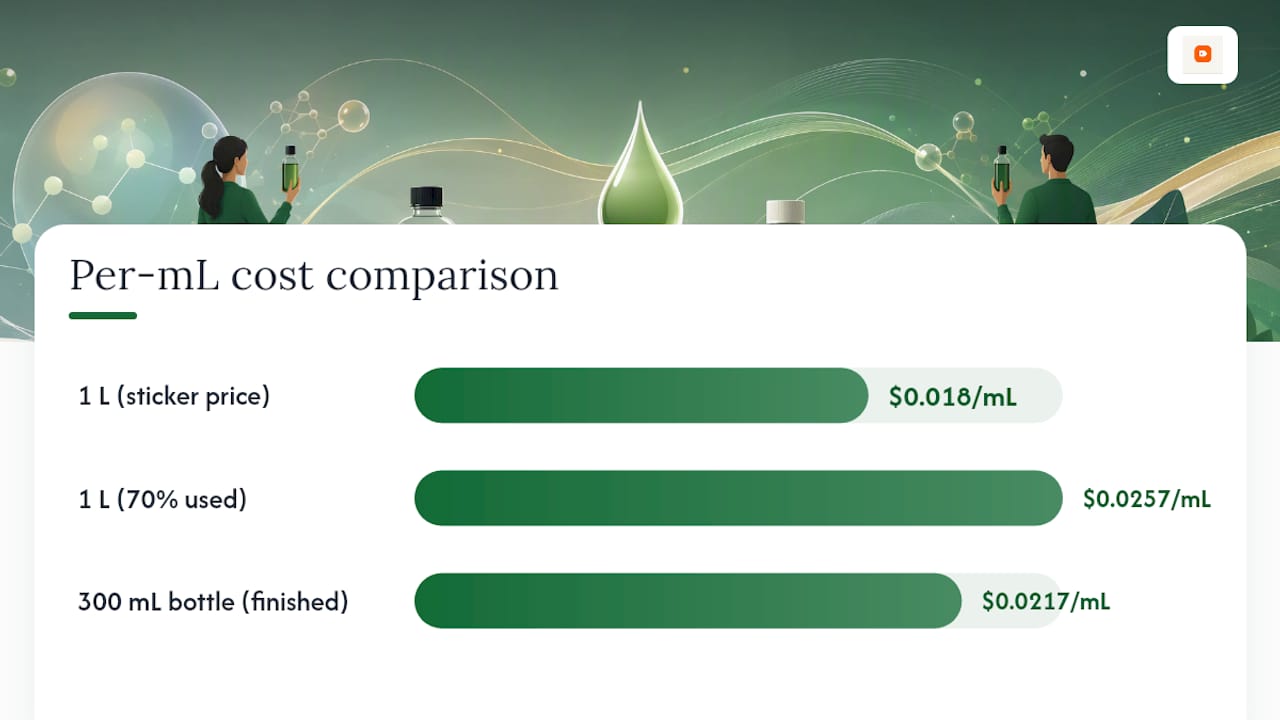
Here's a concrete case: a 1-liter bottle of shampoo costs $18, working out to $0.018 per mL at face value. But if you only use 70% of it before it separates or you switch products, your effective cost jumps to roughly $0.0257 per mL, once you divide $18 by the 700 mL you actually used instead of the 1,000 mL you paid for. A 300 mL bottle at $6.50 comes to $0.0217 per mL, and you're far more likely to finish it. The smaller bottle wins on real-world cost, even though it loses on the sticker math.
A few factors push the true cost above the printed unit price:
- Shelf life and expiration. Natural or preservative-light formulas degrade faster than a family can realistically use them up.
- Storage limitations. A single person doesn't always have room, or need, for a gallon jug of anything.
- Dosing accuracy. Pumps and sprays waste more product than a controlled pour, especially near the bottom of a large container.
- Package fill. Foaming dispensers and aerated lotions often contain less actual product than the container size suggests.
The rule of thumb: buy in bulk when you'll use it up within its shelf life and you have the storage for it. Otherwise, run the waste-adjusted math before assuming bigger equals cheaper. Outletpicks' cost breakdown tables show this pattern repeating across categories well beyond personal care.
Quick tools that do the math for you
You don't need a calculator app open on your phone every time you're standing in an aisle, though it helps. The fastest manual method is a three-step version of the process above: convert every volume to mL, multiply out any multi-pack, then divide price by total mL. That's it.
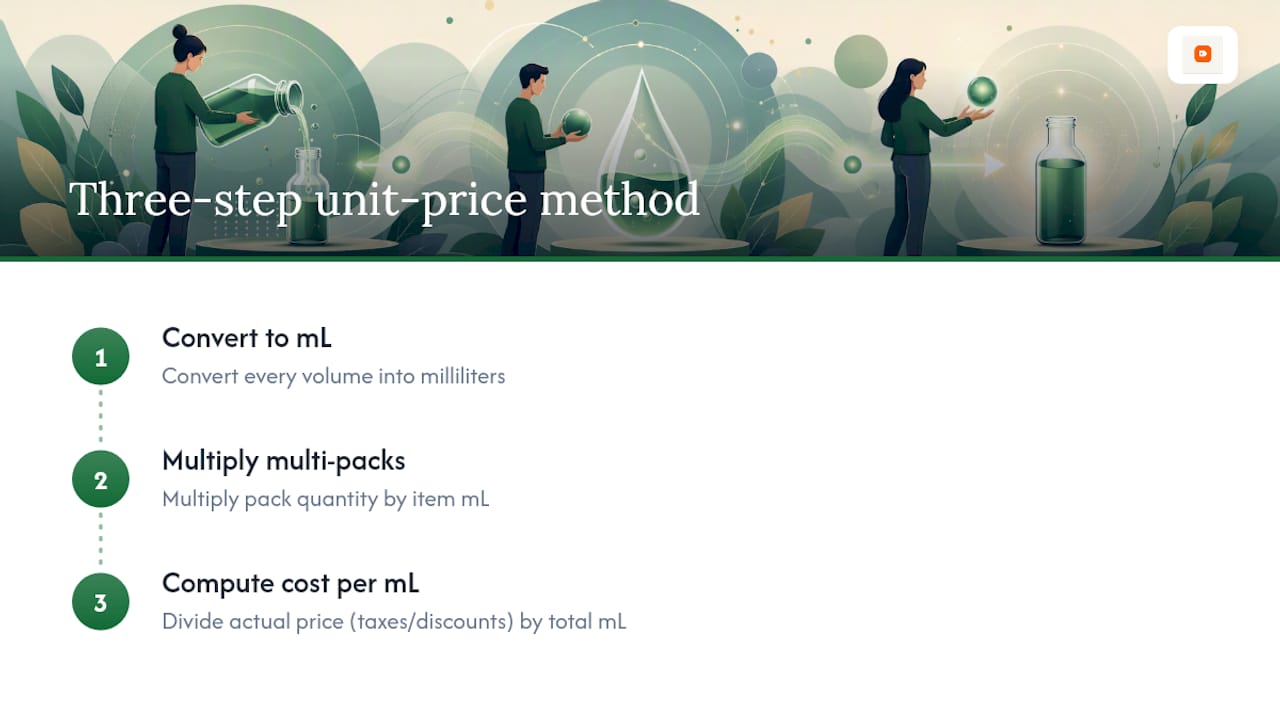
Simple online unit-price tools work the same way behind the scenes: they convert to a base unit, then compute cost per unit automatically so you skip the manual conversion step entirely. The Outletpicks Unit Price Calculator does exactly this, normalizing retailer listings, pack totals, and mixed units into one comparable price per mL figure.
One thing worth remembering with any calculator: plug in the price you'll actually pay, tax and discounts included, if you want the number to reflect your real cost at checkout.
Why so many shoppers get this number wrong
Looking at how often shoppers default to the biggest package or the lowest sticker price, the pattern that stands out is how rarely anyone actually does the division. It's not that the math is hard. It's that unit labels are inconsistent enough to make people give up before they start. Platforms that normalize that mess across retailers, rather than asking each shopper to redo it by hand, can actually change what people buy, as seen with Capital Flow's data analytics solutions.
— Alex
Skip the math with Outletpicks
There are online tools that provide normalized price per mL already calculated and compared across retailers. These resources track real cost per unit, not just sticker prices, across household essentials, personal care, and many other categories, updating data regularly to keep numbers current.
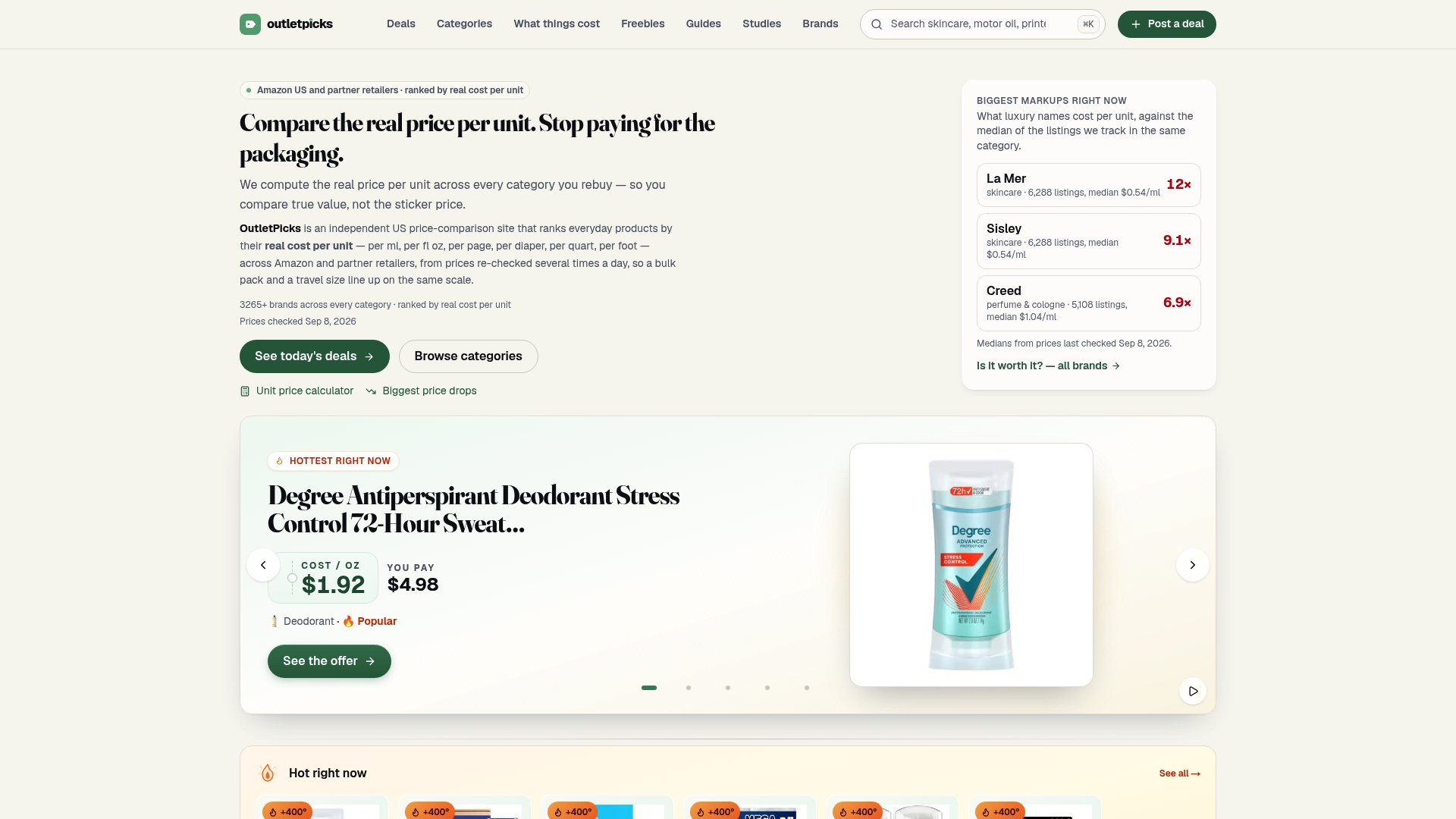
Start with the Unit Price Calculator to run your own comparison in seconds, or browse the what things actually cost per unit tables to see how the same math plays out across categories you shop regularly. If you want the full picture on how the numbers get sourced and normalized, the methodology page walks through it. Either way, the next bottle you pick up is a good place to put it to use.
Where these numbers come from
The unit price formula and the guidance on final-price comparisons come from the FTC's consumer advice on unit pricing. Conversion figures and the warning against mixing mass and volume come from NIST's unit pricing standards. Outletpicks applies both in its ongoing per-unit price tracking across retailers.
FAQ
What is the formula for price per mL?
Price per mL equals the total price divided by the total volume in milliliters, using the final price you pay after any discount.
How do I convert fluid ounces to milliliters?
Multiply the number of US fluid ounces by 29.5735 to get milliliters; a 16.9 fl oz bottle equals 500 mL.
Why is a bigger bottle sometimes more expensive per mL?
If you won't use the whole bottle before it expires or degrades, the wasted portion raises your effective cost per mL above what the label suggests.
Can I convert grams to milliliters using the same math?
Not without knowing the product's density.
Does Outletpicks calculate price per mL automatically?
Yes. The Outletpicks Unit Price Calculator normalizes mixed units and multi-pack pricing into a single comparable price per mL figure.