
A basic 2.7-ounce deodorant stick usually works out to about $0.74 to $1.30 per ounce, while premium aluminum-free sticks in larger sizes run $1.60 to $3.00. Anything much above that range is a brand, scent or format premium, not more deodorant. To find your own number, divide the shelf price by the ounces on the label, then compare that figure across every option you are considering.
This guide shows the math, walks through real-world examples, explains why two sticks at the same shelf price can differ by 25% or more per ounce, and covers the questions shoppers ask most, from how long a stick lasts to what you can carry on a plane.
TL;DR
- Deodorant price per ounce = shelf price divided by net ounces. A typical basic stick lands between roughly $0.74 and $1.30 per ounce; premium natural formulas in larger sizes can reach $3.00.
- Same shelf price does not mean same value: in one published comparison, two sticks both priced at $5.79 cost $1.78 and $2.23 per ounce.
- Format matters. Sprays, travel sizes and aluminum-free formulas tend to cost more per ounce than a standard stick.
- A stick used once a day typically lasts 2 to 3 months, so a slightly higher per-ounce price often adds only pennies per day.
- Sticks have no carry-on size limit with the TSA, but sprays, gels and roll-ons must be 3.4 ounces or less.
Table of Contents
- What deodorant costs per ounce in the US
- How to calculate deodorant price per ounce
- Why package size is not a reliable shortcut
- Why deodorant costs more per ounce in some cases
- How long a stick lasts, and what it costs per day
- Does deodorant need to be 3.4 ounces?
- Our perspective: price the ounce, then price the month
- Find current deodorant prices ranked per unit
- A quick checklist before you buy
- FAQ
- Sources
What deodorant costs per ounce in the US
Shelf prices for deodorant look similar at a glance, but the ounce count behind them varies a lot. Mainstream US retailers price standard 2.7 to 3-ounce sticks between $2.00 and $7.50, a spread of more than three to one for what is functionally the same product. Per ounce, that translates into a range most shoppers can use as a rule of thumb:
| Type of deodorant | Typical price per ounce | Typical size |
|---|---|---|
| Basic stick | about $0.74 to $1.30 | 2.7 oz |
| Premium, aluminum-free or natural stick | about $1.60 to $3.00 | 4 oz and up |
Those figures come from a February 2026 price guide covering US retail, so treat them as a yardstick rather than a promise. Prices shift with sales, coupons and retailer, which is why the best habit is to calculate the number yourself each time you buy.
A few reference points make the range feel real:
- Under about $1.30 per ounce: you are paying for the formula and not much else. This is where store brands and big multipacks tend to sit.
- $1.30 to $2.00 per ounce: common for name-brand sticks bought at regular shelf price.
- Above $2.00 per ounce: you are usually paying for scent, a natural or aluminum-free formula, a smaller size, or a spray or gel format.
None of these tiers is wrong. A deodorant you actually use and like beats a cheaper one that sits in a drawer. The point of the number is to make the trade-off visible.
How to calculate deodorant price per ounce
The formula is one line:
Price per ounce = total price ÷ total ounces
The step that trips people up is making sure both products are in the same unit before you divide. Unit pricing guidance says to convert everything to the same base unit first, so you do not compare ounces to grams or milliliters by accident. Deodorant labels often print both, such as "2.6 oz (73 g)", and it is easy to grab the wrong figure. Use net weight in ounces, not the milliliters or grams if you want an ounce price. If you need to convert, our price-per-ounce formula guide covers the common slips, and our walkthrough on calculating unit price in four steps works for any product.
Worked example: one stick, two sizes
Say you are choosing between two sticks of the same brand and scent:
- A 2.6 oz stick at $4.97: $4.97 ÷ 2.6 = $1.91 per ounce
- A 3.8 oz stick at $6.49: $6.49 ÷ 3.8 = $1.71 per ounce
The larger stick costs $1.52 more on the shelf but is about 10% cheaper per ounce. If you will finish it before the formula goes stale, the bigger one wins. These two prices are illustrative, not current listings.
Worked example: same shelf price, different value
A report on gendered pricing from Texas Standard in May 2024 compared a 3.25-ounce Old Spice stick and a 2.6-ounce Secret stick. Both cost $5.79. The math tells a different story:
- Old Spice: $5.79 ÷ 3.25 = $1.78 per ounce
- Secret: $5.79 ÷ 2.6 = $2.23 per ounce
The shelf tag shows a tie. The unit price shows a gap of $0.45 per ounce, about 25%. That is exactly the kind of difference you will never spot without dividing.
Convert from grams or pounds when you need to
Some labels, especially on imported or natural brands, lead with grams. One ounce is about 28.35 grams, so a 75 g stick is roughly 2.65 ounces. For items sold by weight in larger formats, the ounce price is the pound price divided by 16, which our guide to pound-to-ounce conversion explains. For liquids and sprays labeled in milliliters, the price-per-mL tool does the conversion.
Why package size is not a reliable shortcut
It is tempting to assume the biggest package is always the cheapest per ounce. It often is, but not always. John Talbott of Indiana University's Kelley School of Business told CNN that retailers often highlight unit prices on larger containers to encourage bulk buying, though the bulk option is not always the best bargain.
With deodorant, bulk has two extra catches:
- You might not use it all. A multipack of six sticks is only a deal if you will use all six at the same scent and formula. Switching products halfway through wastes the savings.
- Sizes are not linear. A 1.7 oz "value" stick, a 2.6 oz standard and a 3.8 oz jumbo can each be priced on different logic. Store promotions can make the mid-size cheaper per ounce than the large one.
The same logic applies across personal care. If you shop for fragrance, how bottle size changes value is the same question in a different aisle, and this explainer on perfume bottle sizes shows how the per-unit price moves with the size you pick. The habit is identical: compare cost per unit, never the label.
Why deodorant costs more per ounce in some cases
People search "why is deodorant so expensive" for good reason. Several factors push the per-ounce price up.
Formulation
Aluminum-free and natural formulas typically command higher prices because of sourcing and processing costs compared with standard aluminum-based sticks. If you pay $2.50 per ounce for a natural stick, you are paying for that ingredient list. That can be a reasonable choice, as long as you know the premium.
Format
Compact travel sizes can raise per-unit prices because small production runs cost more per ounce, and sprays are often pricier per ounce than sticks. A 0.5 oz travel stick that looks cheap at $1.50 is $3.00 per ounce, which is higher than almost any full-size stick.
Product targeting
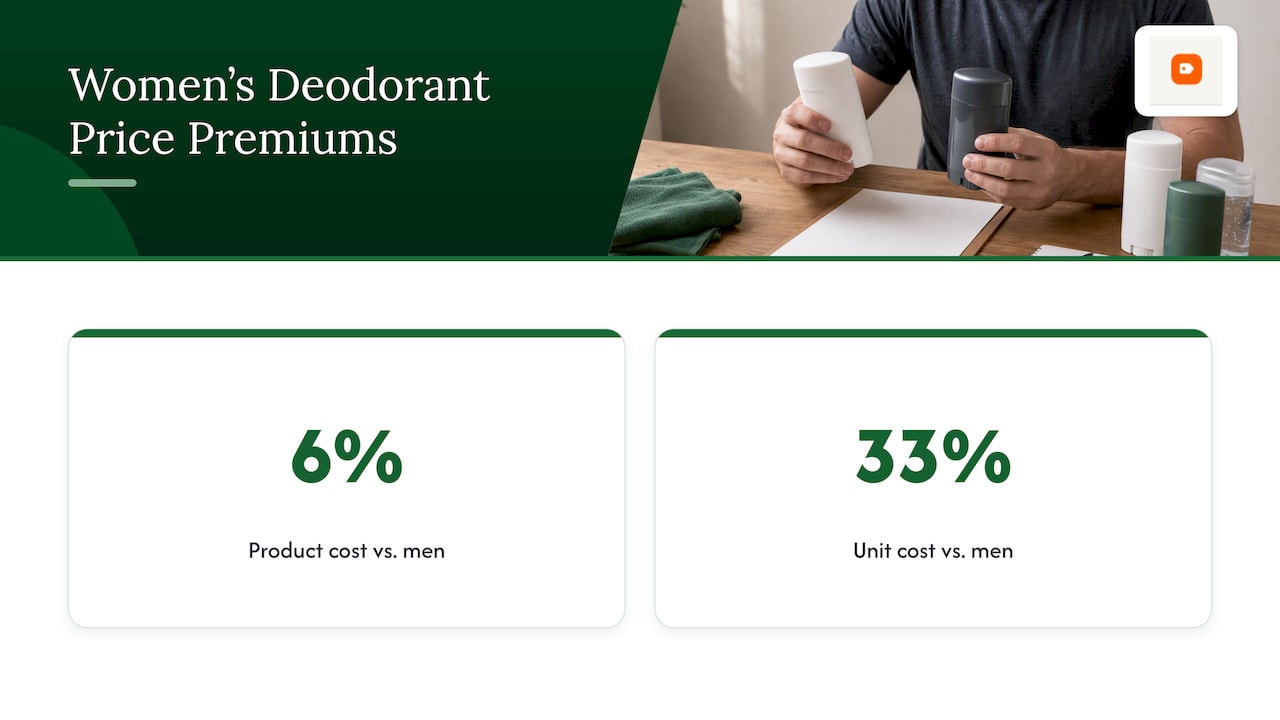
A 2021 paper by Natasha Bhatia, Sarah Moshary and Anna Tuchman, presented at the FTC, used US consumer-packaged-goods data and found that women's deodorant cost 6% more per product and 33% more per unit than men's. The authors point to smaller package sizes for women's products and relatively inelastic demand that lets firms set higher markups. Wholesale prices were not the main driver. The practical lesson: compare unit prices across the men's and women's shelves, since the formulas are often close and the ounce price may not be.
Retailer pricing
Where you shop changes the effective price. Drugstores may show higher sticker prices but offer lower effective costs through stacked digital coupons, weekly sales and rewards programs. Walmart's everyday low price model typically gives a steadier lower price if you do not use coupons. So the answer to "where is it cheapest" depends on whether you will do the coupon work. Always apply the coupon first, then divide.
How long a stick lasts, and what it costs per day
Price per ounce is a good comparison tool, but what you really spend is price per month. Axe says a stick usually lasts 2 to 3 months with once-daily use, and about 1 to 2 months for heavy users. Application frequency and how much you swipe both change that.
Putting that next to the Texas Standard prices, a $5.79 stick that lasts about 2.5 months costs roughly $2.32 a month, or about 8 cents a day. Going from $1.78 to $2.23 per ounce adds only a few cents per day. That means:
- For a single stick, the per-ounce gap matters less than whether you like the scent and it works for you.
- Over a year, a household of four using a stick each could spend a meaningful amount more on a high-ounce-price brand, so the habit pays off at family scale.
- A heavy user who goes through a stick in a month should weigh larger sizes more seriously.
The ounce price tells you which stick is the better value. Your usage tells you how much that value is worth.
Does deodorant need to be 3.4 ounces?
Only in your carry-on, and only for some formats. The TSA says liquids, aerosols, gels, creams and pastes in carry-on bags must be in containers of 3.4 ounces (100 milliliters) or less and fit in a quart-sized bag, while larger containers belong in checked baggage. In practice:
- Solid sticks: not treated as liquids, so any size can go in a carry-on without the quart bag.
- Sprays, gels, roll-ons and soft solids: must meet the 3.4 oz limit in a carry-on.
- Checked bags: spray and aerosol deodorants are typically allowed up to 18 ounces per container, with a total limit of 70 ounces.
If you are unsure about a soft or gel-like stick, one fingertip test is to press it: if it leaves a clear impression or feels gel-like, treat it as a liquid. For a trip, a full-size stick is the cheaper option per ounce than buying a travel size, and it does not count against your liquids bag. Check the TSA page before you fly, since screening rules can change.
Our perspective: price the ounce, then price the month
We built Outletpicks around one idea: the sticker price is the least useful number on the shelf. Deodorant is a clean example. The products are small, similar and bought on repeat, so a few cents of difference per ounce compounds over years, and the packaging makes sizes hard to compare by eye.
Our approach is simple. We rank products by real cost per unit, recheck retailer prices on a rolling cycle, and present them in the same unit regardless of brand or pack size. For deodorant, that means three habits we would suggest to any shopper:
- Divide before you decide. Put every option on the same ounce basis, including multipacks and travel sizes.
- Separate formula from format. If you want aluminum-free, compare it only against other aluminum-free options. If you just want a basic stick, a natural premium is a choice, not a default.
- Keep a target price. Once you know your usual range, say $1.00 to $1.50 per ounce for a basic stick, you can spot a real sale in seconds and stock up only when the number is good.
The goal is not to buy the cheapest stick every time. It is to know what you are paying for, so that when you choose the more expensive option, it is on purpose.
— Alex
Find current deodorant prices ranked per unit
If you would rather skip the arithmetic, our deodorant page for this week lists current deals ranked by actual cost per unit, so the lowest ounce price sits at the top whatever the pack size. To see everything we track in personal care, from body care to skincare and fragrance, browse all our categories or check the brand index to see which brands tend to sit on the cheaper side per unit.
A quick checklist before you buy
- Find the net weight in ounces on the label. Ignore the front-of-pack marketing size.
- Divide the final price, after coupon, by the ounces.
- Compare only like for like: stick with stick, aluminum-free with aluminum-free.
- Check the men's and women's versions of the same brand.
- Ask whether you will finish the pack. A multipack is a deal only if you use it.
- Set a target price per ounce and wait for it if you can.
The same four-step logic works for any grocery or household item, and the guide to comparing unit prices goes into the NIST guidance on how unit prices are meant to be read. If you track other personal care items, our look at conditioner price per ounce applies the same method to another bathroom staple.
FAQ
What is a good price per ounce for deodorant?
For a basic stick, about $0.74 to $1.30 per ounce is a good range based on a February 2026 US price guide. Premium aluminum-free or natural sticks in larger sizes commonly run $1.60 to $3.00 per ounce. Anything above your usual range is worth a second look, especially in small or travel sizes.
How long does a 2.6-ounce deodorant last?
Axe says a stick usually lasts 2 to 3 months with once-daily use, and 1 to 2 months for heavy users. How much you apply each time changes the answer. A stick bought at $5.79 and used for about 2.5 months works out to roughly 8 cents a day.
Why is women's deodorant often more expensive per ounce?
A 2021 study using US retail data found women's deodorant cost 33% more per unit than men's. The authors attribute it to smaller package sizes and demand that is less sensitive to price, which lets firms charge higher markups, not to higher wholesale costs. Comparing unit prices across both shelves shows the gap clearly.
Does deodorant need to be 3.4 oz for a flight?
Only if it is a spray, gel, roll-on or soft solid. The TSA limits those to 3.4 ounces (100 mL) in a quart-sized bag in your carry-on. Solid sticks are not treated as liquids and can be any size in your carry-on.
Sources
- Deodorant Cost Guide 2026, LatestCost
- Toiletry items marketed towards women cost more than men's, Texas Standard
- How To Calculate Unit Price, Shopify
- One product, so many prices, CNN
- Investigating the Pink Tax, Bhatia, Moshary and Tuchman (FTC)
- Comparing Walgreens vs. Other Degree Retailers
- How long does a stick of deo last, Axe
- Liquids, Aerosols, and Gels Rule, TSA
- TSA Liquid Rules 2026: Is it a Liquid or a Solid?
- Is Deodorant a Liquid for TSA?
- Can You Bring Deodorant On a Plane? 2026 TSA Rules