
A good price for everyday conditioner is roughly $0.20 to $0.30 per fluid ounce. Bargain bottles come in under $0.05, and salon brands can pass $1.00 and even $4.00. In October 2026, a 28 fl oz bottle of a mainstream drugstore brand listed at $7.49 works out to about $0.27 per fl oz, while a 9 fl oz salon bottle can cost fifteen times more per ounce. The sticker price alone hides all of this, so divide first and compare second.
This guide shows the math, the current price ranges we found at US retailers, and how to judge value beyond the ounce.
TL;DR
- Price per ounce = bottle price ÷ fluid ounces on the label. A $7.49 bottle of 28 fl oz is about $0.27 per fl oz.
- Retailer listings we checked in October 2026 ranged from about $0.04 to $4.00 per fl oz. Mainstream drugstore bottles in big sizes sit near $0.20 to $0.50.
- A cheaper ounce is not always a cheaper wash. Check how much product you need per use and whether the formula suits your hair.
- Coupons, BOGO deals and multipacks change the effective price, so calculate again at checkout.
Table of Contents
- How to calculate conditioner price per ounce
- What conditioner costs per ounce right now
- Why the cheapest ounce is not always the cheapest wash
- Does a higher price per ounce buy a better conditioner?
- Mind the marketing: size, packaging and gender-targeted pricing
- Seven ways to pay less per ounce
- Our perspective: why we compare by the ounce
- Find current conditioner and hair care deals
- A quick checklist before you buy
- FAQ
- Sources
How to calculate conditioner price per ounce
The formula is one line: divide the total price by the net contents printed on the package.
Price per fl oz = price ÷ fluid ounces
The FDA's cosmetics labeling guide explains that net contents must state the quantity accurately and that fluid ounces (volume) are a different measure from ounces by weight. For a liquid conditioner, use the fluid ounce figure. If a thick mask or solid bar is labeled by weight, compare it only with other products labeled by weight.
Worked examples
- Single bottle. $7.49 for 28 fl oz: 7.49 ÷ 28 = $0.2675, or about $0.27 per fl oz.
- Smaller bottle. $5.00 for 12 fl oz: 5.00 ÷ 12 = about $0.42 per fl oz.
- Multipack. Three 12 fl oz bottles for $18.00: first add the ounces (36 fl oz), then 18.00 ÷ 36 = $0.50 per fl oz. Never divide by the number of bottles alone.
- Shipping. If shipping is charged on the order, add it to the price before dividing. If it is free or you are picking up in store, leave it out.
If a bottle is labeled in milliliters or liters, convert it first. Our fluid ounces to milliliters converter uses 1 fl oz = 29.5735 ml, and the milliliters to fluid ounces converter works the other way. A 400 ml bottle, for instance, holds about 13.5 fl oz. For big European-style sizes, the liters to fluid ounces tool saves you the arithmetic.
What conditioner costs per ounce right now
No authoritative national source we found publishes a single average US price per ounce for hair conditioner. The Bureau of Labor Statistics tracks personal care prices as a whole, including products that have nothing to do with conditioner, so it tells you about the trend in the category, not about your bottle. What we can do is read real retailer listings as of October 18, 2026 and show the spread. These are shelf prices from specific listings, not a national average, and your store, region and promotions will differ.
| Example listing | Size | Listed price | Per fl oz |
|---|---|---|---|
| Dollar-store moisture conditioner | 28 fl oz | $1.25 | about $0.04 |
| TRESemmé Hydrating Moisture Rich | 28 fl oz | $7.49 | $0.27 |
| Dove (selected sale items) | 12 fl oz | $5.00 | $0.42 |
| Aussie, supermarket listing | varies | varies | $0.34 |
| Biolage, supermarket listing | varies | varies | $1.18 |
| Olaplex, supermarket listing | varies | varies | $3.65 |
| Pureology Hydrate | 9 fl oz | about $36 | $4.00 |
The same supermarket page showed 28 fl oz TRESemmé products at $0.24 per fl oz and Dove at $0.47 per fl oz. So within one aisle the spread runs from about a quarter to four dollars per ounce. That is a gap of more than 15 to 1, and the cheapest dollar-store listing is lower still.
What this tells you
- Size drives most of the difference among mainstream brands. A 28 fl oz bottle of a drugstore line costs a fraction per ounce of a 12 fl oz bottle of a similar line.
- Prestige and salon lines charge for the brand and the treatment claims. Whether that is worth it depends on your hair, which we cover below.
- The ultra-cheap end exists, but check the formula. A $0.04 per ounce bottle can be a perfectly good daily rinse-out, or it can leave your hair flat. The unit price cannot tell you which.
Why the cheapest ounce is not always the cheapest wash
Unit price assumes every ounce does the same work. It does not. Wirecutter's testers reported that a quarter-sized amount of TRESemmé Silky Smooth was enough for the effect they wanted. A thinner formula that needs twice as much leaves you paying twice per wash, whatever the label says.
Here is a simple way to check, using an assumption you can replace with your own numbers. Say you use 0.5 fl oz per wash:
- Product A: $0.27 per fl oz, 0.5 fl oz per wash = about $0.14 per wash.
- Product B: $0.20 per fl oz, 1 fl oz per wash = $0.20 per wash.
Product B has the lower unit price and the higher cost per wash. Measure for a week, note when the bottle runs out, and divide the price by the number of washes.
Hair length and thickness matter too. Someone with chin-length fine hair may stretch a bottle for months, while long, thick hair can empty the same bottle in weeks. Nobody can give you one correct amount, so use your own usage rate.
Does a higher price per ounce buy a better conditioner?
Sometimes, not always. Allure's hairstylist source, Devin Toth, explains in a drugstore conditioner roundup that drugstore formulas may use simpler or cheaper ingredients, but that does not make them ineffective, and that a conditioner does not need expensive extras to work. Wirecutter's 2026 testing likewise described TRESemmé Silky Smooth as costing under $10 while outperforming more expensive competitors.
Where paying more can make sense:
- Chemically treated or bleached hair. Damage repair is a real need, and some people find specialized treatments earn their price. Bundled systems from hair-repair makers, such as this tinted and bleached hair care system, are priced as a set, so divide by the total volume of each item before comparing them with a single bottle.
- Scalp sensitivity or fragrance sensitivity. If a cheap formula irritates you, it is not a bargain.
- Ingredient preferences. The Environmental Working Group's 2024 conditioner guide pairs affordability with ingredient-hazard ratings, and notes that high-end conditioners can frequently cost over $50. It is a useful reminder that price per ounce is one criterion among several for shoppers who care about formulation.
Where it rarely does: everyday maintenance for healthy, undamaged hair. There, a well-reviewed drugstore bottle at a low unit price is hard to beat.
Mind the marketing: size, packaging and gender-targeted pricing
Packaging can make a small bottle look generous. A tall, narrow bottle of 8 fl oz can sit next to a squat 12 fl oz one and look the same size. Always read the net contents, not the shape.
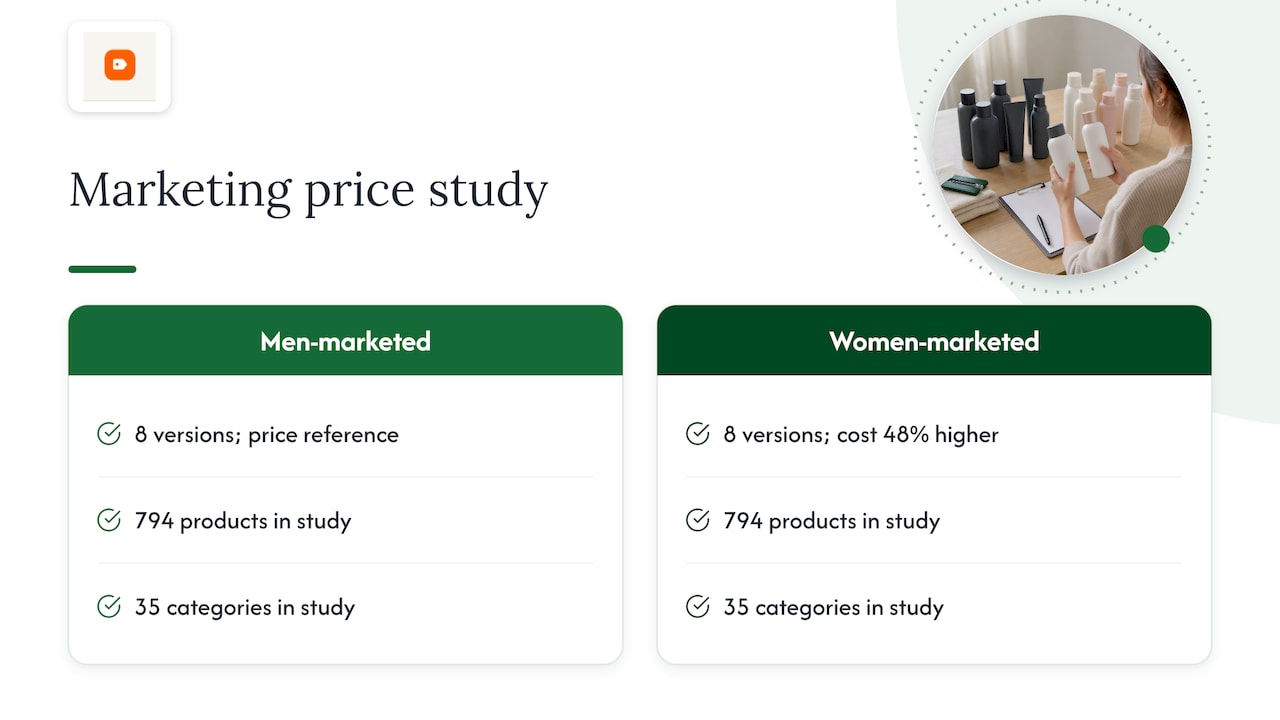
Marketing can also move prices. Consumer Reports, summarizing a New York City study, reported that eight shampoos and conditioners marketed to women cost 48% more than eight men's versions, within a study of 794 products across 35 categories. That is a measured disparity in one study, not proof that every comparable conditioner carries a markup. It does show why comparing formula and size side by side, instead of trusting the label color, can reveal differences branding hides.
We saw a related pattern in our own data: in our perfume study, women's fragrances cost less per bottle and more per milliliter. Smaller packages often look cheaper at the register and cost more per unit. Conditioner follows the same logic.
Seven ways to pay less per ounce
- Buy the bigger bottle if you will finish it. A 28 fl oz or larger bottle is usually where mainstream brands hit their lowest unit price. A bottle you never finish is not a deal, though, so only buy more than you will use in a few months.
- Compare multipacks by total ounces. Use the multipack math above. Some packs are cheaper per ounce than the single bottle, some are not.
- Separate the shelf price from the promo price. A BOGO or coupon changes what you actually pay. The Walgreens conditioner deals page notes that price and inventory may vary between online and in store, and its displayed unit price does not reflect coupon conditions. Write down both numbers.
- Check pickup versus delivery. Fees and minimums shift the effective price. Leave them out only if you do not pay them.
- Try the store-brand version. Retailer brands often use similar formulas at lower unit prices. Test one bottle before stocking up.
- Match the product to your hair, not your friend's. A cheap bottle that does not work gets used up slowly, or thrown out.
- Track prices over a month. Unit prices at the same store can move between weeks. Hair care sales run on a cycle, and a note on your phone beats memory.
If you are also trying to bring down the rest of the household budget, our household essentials price trends analysis compares what US shoppers pay at checkout with consumer price index trends.
Our perspective: why we compare by the ounce
We started OutletPicks because sticker prices mislead. A $9 bottle and a $7 bottle tell you nothing until you know how much is inside. Conditioner is the classic case: bottle sizes range widely, brands use different labeling, and sales muddy the picture further.
Our view is simple. Rank by real cost per unit first, then use quality as a tiebreaker. We would rather you pick a $0.27 per ounce bottle that your hair likes than a $0.04 bottle you abandon after two uses, or a $4.00 bottle for hair that only needs a basic rinse-out. Unit price is the starting line, not the finish line.
Two habits have served shoppers well in our data. First, always write the unit price next to the shelf price, even when you think you know which bottle is cheaper. Second, treat any "deal" as unproven until you have divided it out. We do the dividing for you across categories, and we recheck retailer prices on a rolling cycle so rankings do not go stale. We are also clear about what the number cannot tell you: formula, scent and how much you need per wash are still your call.
— Alex
Find current conditioner and hair care deals
We rank products by real price per unit so you do not have to carry a calculator through the aisle. Browse our hair care deals this week for current listings sorted by cost per unit, or see every category we cover on the categories page. If you want to see how brands stack up against each other, the brand index ranks them by real cost per unit.
For one more angle on bundle pricing, some independent hair brands sell products as sets, such as this plant-based hair product bundle. The same rule applies: add up the ounces in the set and divide the bundle price by that total.
A quick checklist before you buy
- Read the net contents and confirm it is in fluid ounces (or convert it).
- Divide the price by the ounces. Do it again for the pack, not per bottle.
- Subtract the coupon or add the shipping only if they apply to you.
- Estimate the cost per wash from how much you use.
- Check the formula against your hair type and any sensitivities.
- Compare with one store-brand option and one larger size.
If you cook, bake or measure in cups, our fluid ounces to cups converter and cups to fluid ounces tool help you picture how much a bottle holds: 1 cup is 8 fl oz, so a 28 fl oz bottle is 3.5 cups. You can also use the fluid ounces to liters tool for big refill pouches.
FAQ
What is the average price for conditioner?
We did not find an official national average price per ounce for conditioner. Retailer listings we checked in October 2026 ranged from about $0.04 to $4.00 per fl oz, with mainstream drugstore brands in large bottles around $0.24 to $0.47. Treat that as a range of shelf prices, not a statistical average.
How much does a bottle of conditioner cost?
It depends on size and brand. A 28 fl oz drugstore bottle listed at $7.49 in our research, and 12 fl oz Dove bottles were on sale at $5.00. Salon bottles can cost $36 for 9 fl oz. Divide by the fluid ounces to compare bottles fairly.
How do I find the best value conditioner?
Calculate price per fluid ounce, then estimate cost per wash from how much you use. Pick the lowest result among formulas that suit your hair. Wirecutter's 2026 testing found a drugstore option under $10 that beat pricier rivals, so a high price is not a guarantee of results.
Is price per ounce the same for a multipack?
Not necessarily. Add the fluid ounces of every bottle in the pack and divide the pack price by that total. Compare the result with the single-bottle unit price, because some multipacks save money and others do not.
Do coupons and BOGO deals change the price per ounce?
Yes. The unit price shown online often reflects the ordinary price, while a BOGO or coupon lowers what you actually pay. Record the shelf price and the promotional price separately, then recalculate with the deal applied.
Sources
- FDA Cosmetics Labeling Guide
- Bureau of Labor Statistics, personal care CPI
- Dollar Tree same-day delivery conditioner listing
- Walgreens conditioner BOGO deals page
- ShopRite conditioner listings
- Wirecutter: The Best Hair Conditioners of 2026
- Allure: drugstore conditioners
- Consumer Reports: What Is the Pink Tax?
- EWG: Best bang for your buck, conditioner