

Unit price equals total price divided by total quantity. If a pack of soda costs $4.20 and contains several bottles, the unit price is the total price divided by the number of bottles, giving the cost per bottle. Just make sure the quantity is stated in dollars over count, weight, or volume, and convert units first whenever two products list different measurements.
TL;DR:
- Checking unit price is essential when comparing different package sizes, sales, and bulk discounts to ensure you get the best deal per unit.
- Always convert measurements to the same unit family before dividing to accurately compare prices, especially when products are labeled in different measurements.
- Calculating unit price involves dividing the total price by the quantity, using precise figures up to three or four decimal places for high-volume or bulk purchases.
- Rounding discrepancies of less than half a cent per unit usually don't matter, but precise comparison is crucial for large quantities or ongoing bulk purchases.
- Using online tools like outletpicks' calculator can save time and reduce errors by automating conversions and current price comparisons.
Table of Contents
- What does unit price mean, and when should you check it?
- How do you calculate unit price step by step?
- How do you convert units before comparing prices?
- Real examples: per ounce, per pound, and multi-pack pricing
- What unit price doesn't tell you
- How Outletpicks thinks about unit price
- Skip the math with Outletpicks' unit price calculator
- Sources
What does unit price mean, and when should you check it?
Unit price is the cost of one standard unit of a product, whether that unit is an ounce, a pound, a liter, or a single item in a multi-pack. It strips away package size so you're comparing apples to apples instead of comparing a 16 ounce jar to a 24 ounce jar and guessing which one's the better deal. This standardized measure is exactly what Mathwords defines as the quotient of total cost over the number of units.
There are three flavors of unit price you'll run into at the store:
- Per item: cost of one unit in a multi-pack, like $0.35 per can.
- Per weight: cost per ounce, pound, or gram, common for meat, produce, and snacks.
- Per volume: cost per fluid ounce, milliliter, or liter, used for liquids like shampoo, juice, and cleaning supplies.
You want to check unit price any time you're deciding between package sizes, whenever a "family pack" or "bulk size" claims savings, and especially during sales, since a 30% off sticker on a smaller package can still cost more per ounce than the regular-priced jumbo size.
How do you calculate unit price step by step?
The math is the same every time, no matter what you're buying. Here's the process:
- Find the total price. Use the actual price you'd pay, including any sale price, not the list price on the shelf tag.
- Identify the quantity and its unit. Check the label for count, weight, or volume, like "12 count," "16 oz," or "1 liter."
- Convert units if needed. If you're comparing two products with different units (one in ounces, one in pounds), convert them to match before doing any division.
- Divide total price by quantity. That gives you the unit price.
The formula stays constant: unit price = total price ÷ number of units. This four-step process mirrors the approach Shopify recommends for calculating unit price, and it works whether you're doing it in your head, on a receipt, or in a spreadsheet.
If you're tracking prices in Excel or Google Sheets, the formula in a cell looks like this: =A1/B1, where A1 holds the total price and B1 holds the quantity. Drag that formula down a column of groceries and you've got an instant per-unit comparison.
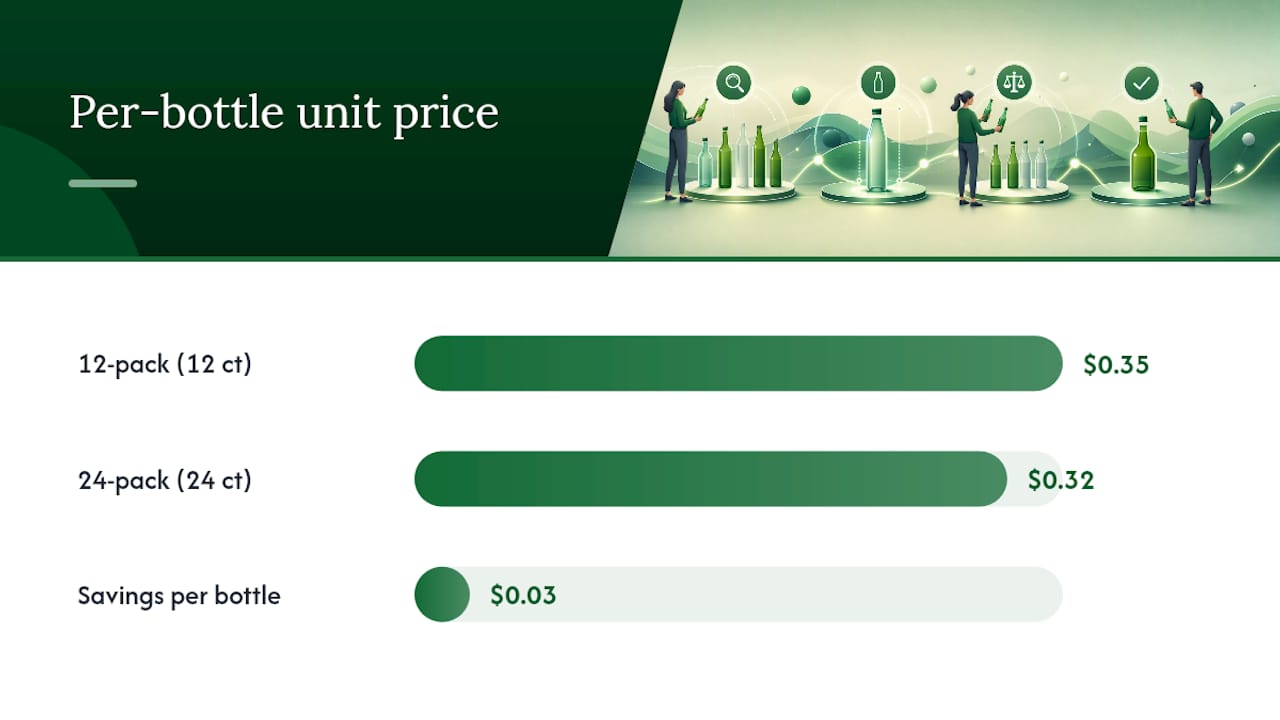
Worked example: a 12 pack of water bottles costs $4.20. Divide $4.20 by 12 and you get $0.35 per bottle. Compare that to a 24 pack priced at $7.68, which comes out to $0.32 per bottle. The larger pack wins by three cents a bottle, small on its own, but it adds up if you're buying water every week.
How do you convert units before comparing prices?
Skipping this step is the single most common way shoppers get tricked into a bad deal. A product labeled in ounces and another labeled in pounds look impossible to compare until you convert one to match the other. The rule is simple: always convert to the same unit family before dividing, whether that's grams versus ounces or milliliters versus fluid ounces.
A few conversions come up constantly in grocery aisles:
- 1 pound = 16 ounces
- 1 fluid ounce = 29.5735 milliliters
- 1 gram = 0.0353 ounces
- 1 milliliter = 0.0338 fluid ounces
Pick whichever unit is easier to work with as your target, usually whatever unit the smaller or more common package already uses, and convert the other product to match. For recipes or portion sizing, it also helps to know that 1 fluid ounce equals 0.125 cups, which comes in handy when comparing cooking oils or liquid ingredients sold in different container styles.
Real examples: per ounce, per pound, and multi-pack pricing
Numbers make this concrete. Here are four situations you'll actually run into at the store:
- Per ounce: A 10 ounce bag of chips costs $3.49, resulting in a unit price of about $0.35 per ounce. Carrying that third decimal place matters, because rounding to $0.35 would make it look identical to a competing bag that's actually $0.354 per ounce.
- Per pound with a conversion: A pack of chicken thighs weighs 24 ounces and costs $8.99. After converting ounces to pounds, the unit price per pound can be calculated by dividing the price by the weight in pounds.
- Multi-pack versus single: A single 20 ounce bottle of soap costs $4.99, resulting in a certain price per ounce. A 3 pack costs $13.49 total for 60 ounces, giving a slightly lower price per ounce. The multi-pack wins, but only by about two and a half cents an ounce.
- Rounding guidance: When the price difference between two options is less than half a cent per unit, it usually doesn't matter which one you buy. Precise per-unit math with three or four decimal places matters most on high-volume purchases like bulk paper towels or laundry detergent, where a tiny per-unit gap multiplies fast.
What unit price doesn't tell you
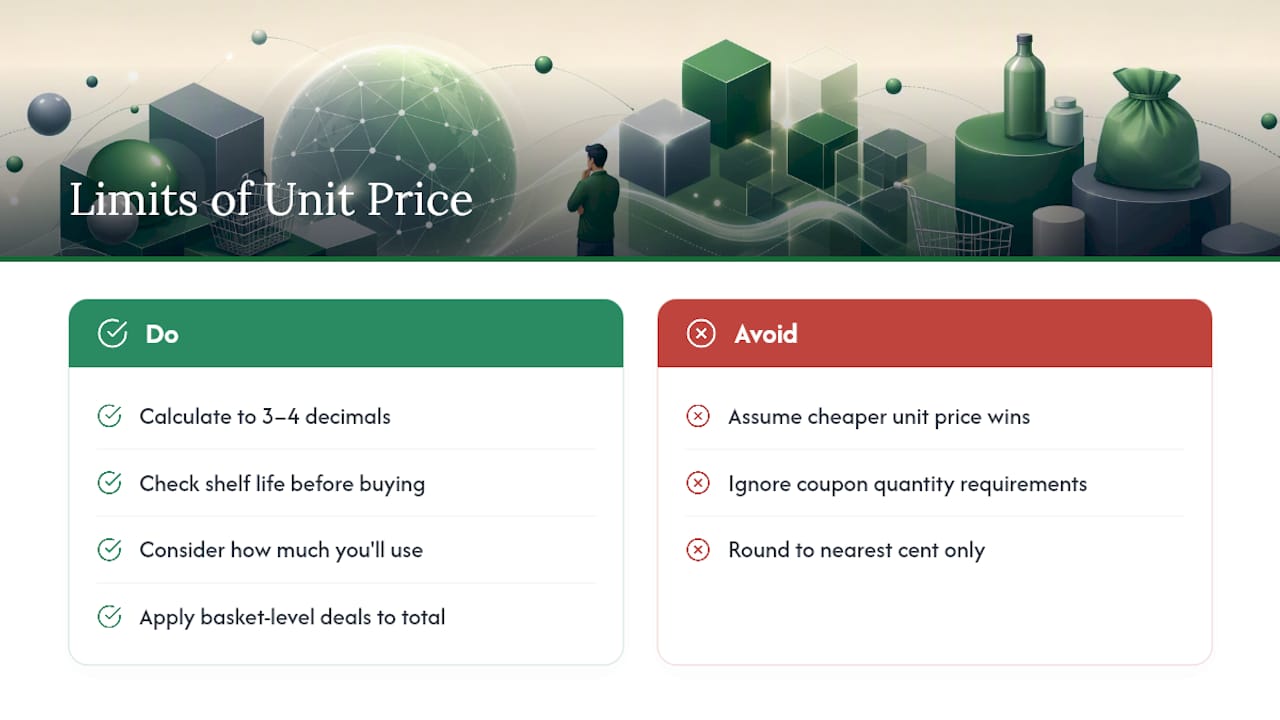
Unit price is a cost metric, not a quality score. It says nothing about ingredient quality, shelf life, or whether you'll actually use the whole package before it expires or spoils. A cheaper per-ounce olive oil that turns rancid before you finish the bottle isn't actually the better deal.
Promotions complicate the math too. A coupon that requires buying three units to get a discount changes your effective unit price only if you actually need three, and store-wide "spend $50, save $10" deals apply at the basket level, not per item, so they don't show up in a straight per-unit comparison at all.
Pro Tip: Always calculate to three or four decimal places for weight and volume comparisons, not two. Rounding to the nearest cent can hide a real difference between two products that looks like a tie but isn't.
How Outletpicks thinks about unit price
A price comparison platform can help because sticker prices alone don't tell you much. Such platforms calculate and rank products by their real price per unit, whether that's per milliliter, per diaper, per page, or per foot of products sold by length.
Prices get rechecked on a rolling cycle across retailer data, so the per-unit numbers you see reflect current pricing rather than a snapshot from months ago. If you want to see this in practice, pull up a category you buy regularly and run a quick comparison across pack sizes.
— Alex
Skip the math with Outletpicks' unit price calculator
Outletpicks is the alternative to doing this math by hand every time you're standing in an aisle trying to compare a 16 ounce jar against a 24 ounce jar on sale. The unit price calculator handles per ounce, per pound, and per count pricing with unit conversions built in, so you never have to convert ounces to pounds in your head while your cart blocks the aisle.
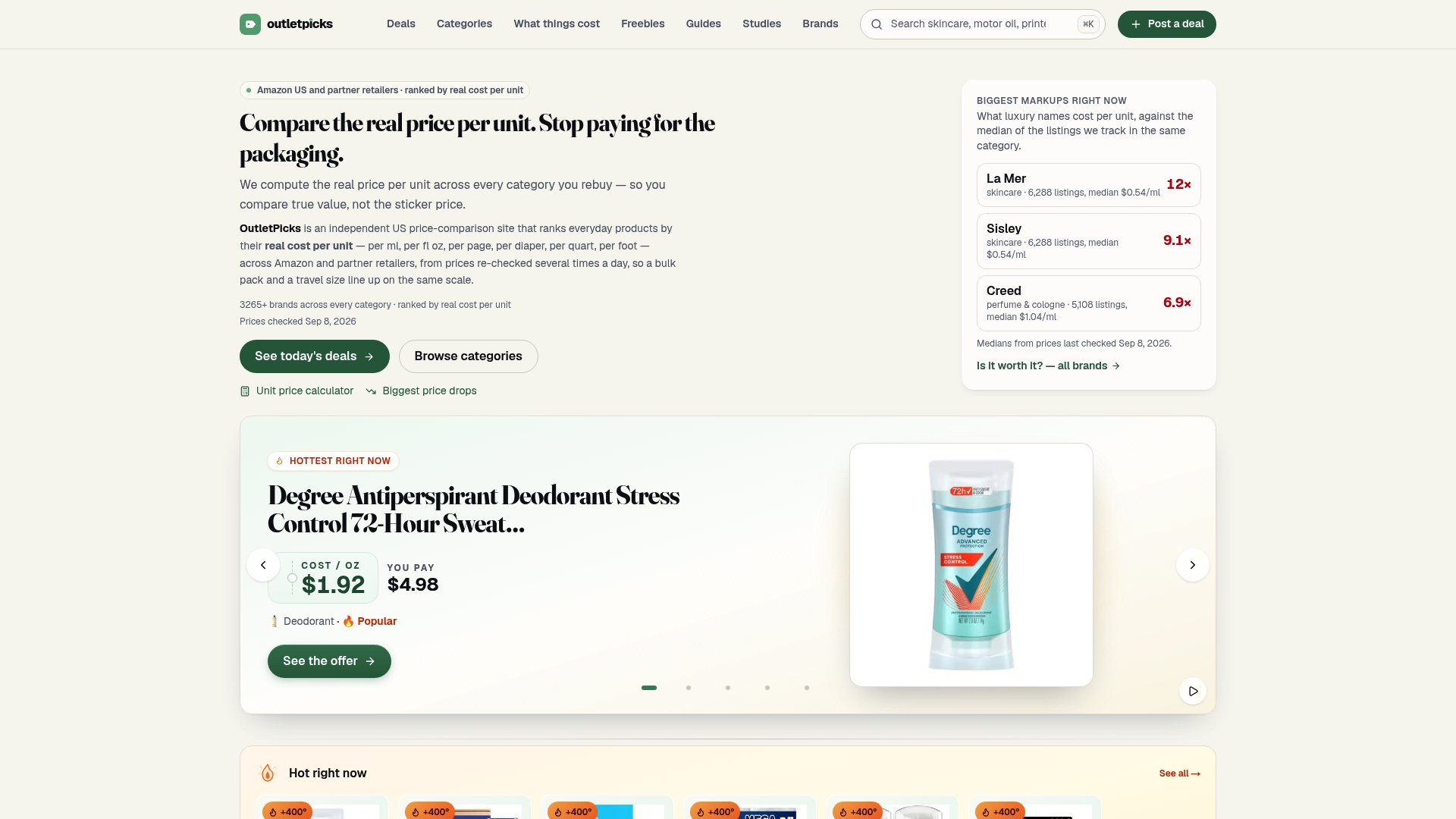
It pulls from rolling retailer price data instead of a one-time snapshot, which means the comparison you're running reflects what things actually cost right now, not last month's sale price. Pair the calculator with the shopping checklists for common categories if you want a head start on which items are worth comparing before you even leave the house. Open the calculator, plug in two products, and see which one actually costs less per unit.
Sources
The math and process in this guide draw from a few consistent, well-established references:
- Unit Price — Definition, Formula & Examples (Mathwords)
- How to calculate unit price (Shopify blog)
- Unit price examples and explanation (Math is Fun)
- Shopify help: unit pricing and conversion guidance