

Contact solution usually costs between about $0.37 and $2.35 per fluid ounce at a single national grocery chain, and the number on the front of the box tells you almost nothing about where in that range you will land. The gap comes from three things: bottle size, multipack versus single bottle, and brand. Divide the shelf price by the total fluid ounces in the package, and you can compare any two products honestly.
This guide shows the real per-ounce ranges we found, the formula with worked examples, and the traps that make a cheap-looking bottle expensive.
TL;DR
- At one major grocery chain, listed contact lens solutions run from $0.37 to $2.35 per fl oz, a spread of more than six times.
- Bigger packs win: the same chain lists a 2-count of 12 fl oz bottles at $0.37 per fl oz against $0.54 for a single 12 fl oz bottle.
- Travel and trial bottles cost the most per ounce. Two-ounce bottles of one popular brand are listed at $2.00 or $2.50 per ounce at a national drugstore.
- To compare, multiply bottles by size for total fluid ounces, then divide the price by that total.
- Never swap solution types to save money without asking your eye care professional.
Table of Contents
- What contact solution costs per ounce in the US
- How to calculate price per ounce
- Why size and pack count change the price
- Does a higher price per ounce mean a better solution?
- What to check before you buy
- Where to look for the lowest price per ounce
- Compare price per unit on OutletPicks
- Common mistakes when comparing solution prices
- FAQ
- Sources
What contact solution costs per ounce in the US
The most useful number is the range. A national grocery chain's contact lens solution listings show prices from $0.37 to $2.35 per fluid ounce. Within that range, the chain's own 12 fl oz store-brand bottle lists at $0.54 per fl oz, and its 2-count pack of 12 fl oz bottles lists at $0.37 per fl oz. The name-brand Opti-Free and Biotrue products on the same listings run from $0.70 to $2.35 per fl oz.
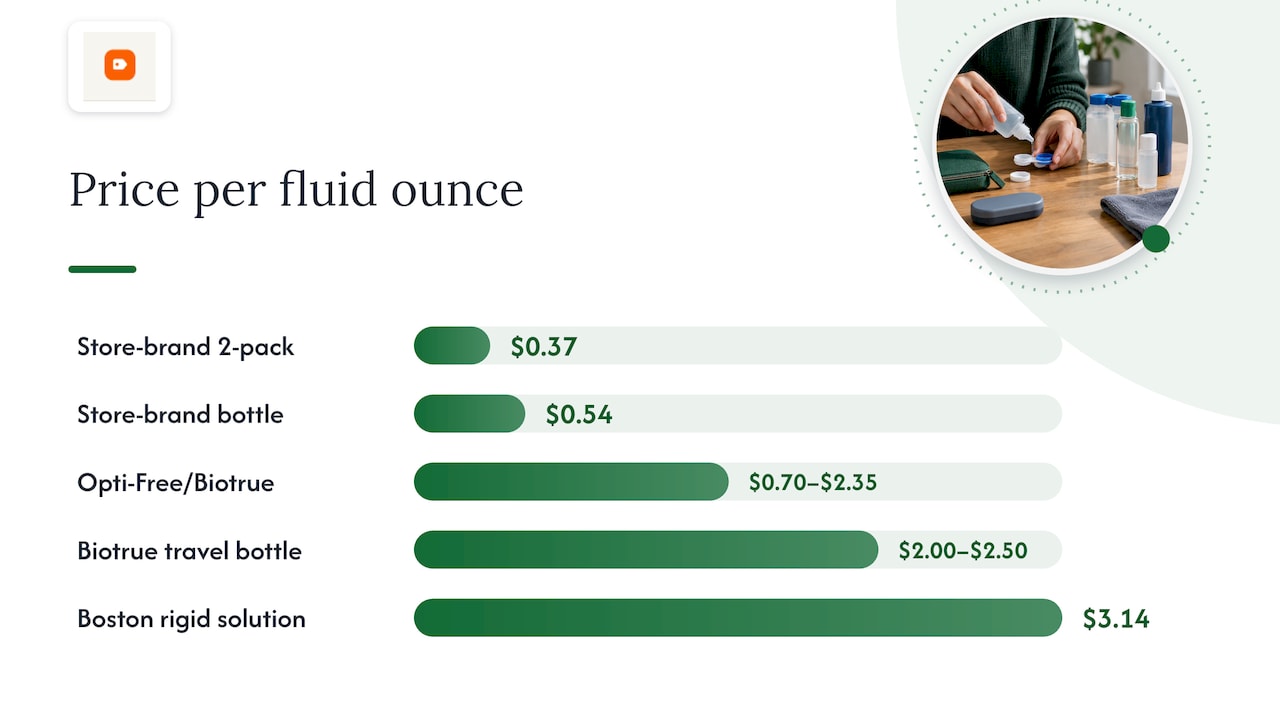
A second set of grocery chain listings for contact lens solution and drops stretches the range further. It runs from $0.71 per fl oz for a 24-fl-oz ReNu multipack to $3.14 per fl oz for 3.5-fl-oz Boston solutions made for rigid gas permeable lenses.
Here is how those figures line up:
| Product type | Per-ounce price in listings we checked |
|---|---|
| 2-count store-brand pack, 12 fl oz each | $0.37 |
| Single 12 fl oz store-brand bottle | $0.54 |
| 24 fl oz ReNu multipack | $0.71 |
| Name-brand Opti-Free and Biotrue (various sizes) | $0.70 to $2.35 |
| 2 fl oz Biotrue travel bottle | $2.00 to $2.50 |
| 3.5 fl oz Boston rigid gas permeable solution | $3.14 |
Prices move with promotions and stock, so treat these as a snapshot of the pattern rather than a price list. The pattern is stable: big packs and store brands at the bottom, small bottles and specialty formulas at the top.
How to calculate price per ounce
The National Institute of Standards and Technology describes unit pricing as the cost per unit of measure, such as an ounce, gram, liter, or milliliter. Its point is that it lets you compare similar products no matter what size the container is. For contact solution, the unit is the fluid ounce.
The formula has two steps:
- Find the total volume. Multiply the number of bottles by the fluid ounces in each one.
- Divide the price by that total. AARP notes that you should use the price after any coupon discounts.
For a deeper walkthrough of the math and the mistakes that skew it, see our price per ounce formula guide.
Worked example: one bottle
Say a 12 fl oz bottle costs $9.99.
$9.99 ÷ 12 fl oz = $0.83 per fl oz.
Worked example: a multipack
A pack holds 2 bottles of 10 fl oz each and costs $14.00.
- Total volume: 2 × 10 = 20 fl oz
- Price per ounce: $14.00 ÷ 20 = $0.70 per fl oz
The order matters. One unit-price guide stresses finding the total volume first. Divide $14.00 by 10 and you get $1.40, which is the price per ounce only if the pack were a single bottle.
Worked example: a travel bottle
A 2 fl oz bottle costs $4.99.
$4.99 ÷ 2 = about $2.50 per fl oz.
That matches what a national drugstore shows for small bottles of a popular brand. The 10 fl oz multipack in the previous example costs about 28% of that per ounce.
Converting units when labels differ
Most US solution is labeled in fluid ounces, but some boxes also show milliliters. Consumer Reports advises converting products to the same unit before you compare. One fluid ounce is 29.5735 mL, so a 10 fl oz bottle is about 296 mL. Use our fluid ounces to milliliters converter or the milliliters to fluid ounces converter when a label gives only one of the two. If you want the same math in metric, our price per mL tool does it in seconds.
Why size and pack count change the price
Per-ounce price falls as the package grows, for a simple reason: the bottle, cap, label, and shipping cost do not scale with the liquid inside. A tiny bottle carries almost all that overhead on very little solution.
The grocery chain's own listings show the effect cleanly. Its single 12 fl oz store-brand bottle is $0.54 per fl oz. Its 2-count pack of the same size is $0.37. On a 24 fl oz purchase, that is:
- 2-count pack: 24 × $0.37 = $8.88
- Two single bottles: 24 × $0.54 = $12.96
The pack saves about $4.08 on the same amount of solution.
Travel sizes are for travel
Small 2 fl oz bottles can reach $2.50 per fl oz, compared with well under a dollar for large packs. Buying one for a flight is reasonable. Buying one every week to keep in a gym bag is the most expensive way to own contact solution. Refill a small travel bottle from your regular bottle if the label of your solution allows it, or keep a single travel size for trips only.
What a full year looks like
Here is an illustration with a made-up usage rate. Suppose you use 12 fl oz a month, or 144 fl oz a year.
| Price per fl oz | Yearly cost for 144 fl oz |
|---|---|
| $0.37 | $53.28 |
| $0.54 | $77.76 |
| $2.35 | $338.40 |
Same volume of liquid, a gap of nearly $285 between the cheapest and priciest listings. Your own usage will differ, but the ratio stays the same. That is why per-ounce price matters more here than for a one-off purchase.
Does a higher price per ounce mean a better solution?
Not automatically. Price per ounce tells you what you pay for volume. It does not tell you whether a formula suits your eyes or your lenses.
Contact solutions are not all the same product. Multipurpose solutions, peroxide systems, saline, and rigid gas permeable solutions are built for different jobs, and the $3.14 per ounce for Boston rigid gas permeable solution reflects a specialty product in a small bottle. Lenses made of different materials, and eyes with different sensitivities, may call for a specific type.
So the right order is:
- Ask your eye care professional which type and which formulas are safe for your lenses.
- Shortlist every bottle that meets that requirement.
- Pick the lowest price per ounce among them.
If your eye doctor names a specific brand or type, follow that. If you have redness, stinging, or discomfort after changing solutions, stop and call them before you try anything else. Do not switch from one solution type to another, or top off old solution in your case, just to save money.
What to check before you buy
Unit prices only help if the inputs are right. A few quick checks:
- Match the label to the product in your hand. Shelf tags for smaller or different versions can lead you to a wrong comparison.
- Make sure it is fluid volume. Contact solution is sold by fluid ounces, not weight. Mixing the two skews the result.
- Count the bottles. "2 pack" and "2 count" mean the total is double the size printed on one bottle.
- Check what is included. Some bottles ship with a lens case, which adds a little value but also changes the price you divide.
- Use the final price. If a coupon or subscription discount applies, use the price after the discount.
- Think about how much you will use. A huge pack is only cheaper if you finish it before you need a new one. Solution you cannot use is not a saving, so follow the discard guidance on your bottle.
We keep a set of shopping checklists priced per unit that you can reuse for other household items too.
Where to look for the lowest price per ounce
The consistent winners in the listings we checked were:
- Store brands in multipacks. The lowest figure we found, $0.37 per fl oz, was a store-brand 2-count pack.
- Large multipacks of familiar brands. The 24 fl oz ReNu multipack lists at $0.71 per fl oz, well below most single-bottle name-brand prices.
- Mid-size bottles over small ones. Moving from a 2 fl oz bottle to even a 10 fl oz bottle usually cuts the per-ounce price sharply.
Store brands and name brands often carry similar multipurpose labels, but confirm that the formula is right for your lenses with your eye care professional before you move to a different one.
Places to look include grocery chains, drugstores, mass retailers, and online stores. Prices and pack sizes differ from one to the next, and a bottle that is cheapest in one place can be mid-pack in another, which is why comparing per ounce across sellers beats comparing sticker prices.
Our perspective
We built OutletPicks around a simple belief: the sticker price is the least useful number on a package. Contact solution is a textbook case. A $20 box can be a better deal than a $6 bottle, and a $5 bottle can be far worse than both once you divide by the actual fluid ounces.
That is why we rank products by real cost per unit, whether that is per milliliter, per diaper, per page, or per ounce. We recheck retailer prices on a rolling cycle, so the numbers you see are current rather than stale. We also explain the nuances behind the numbers, such as why pack count and size drive the gap, in guides like our price per ounce formula walkthrough.
Our advice for contact solution: get your solution type from your eye care professional, then let per-ounce math pick the winner among the products that qualify. You keep your eyes safe and your budget intact.
Alex
Compare price per unit on OutletPicks
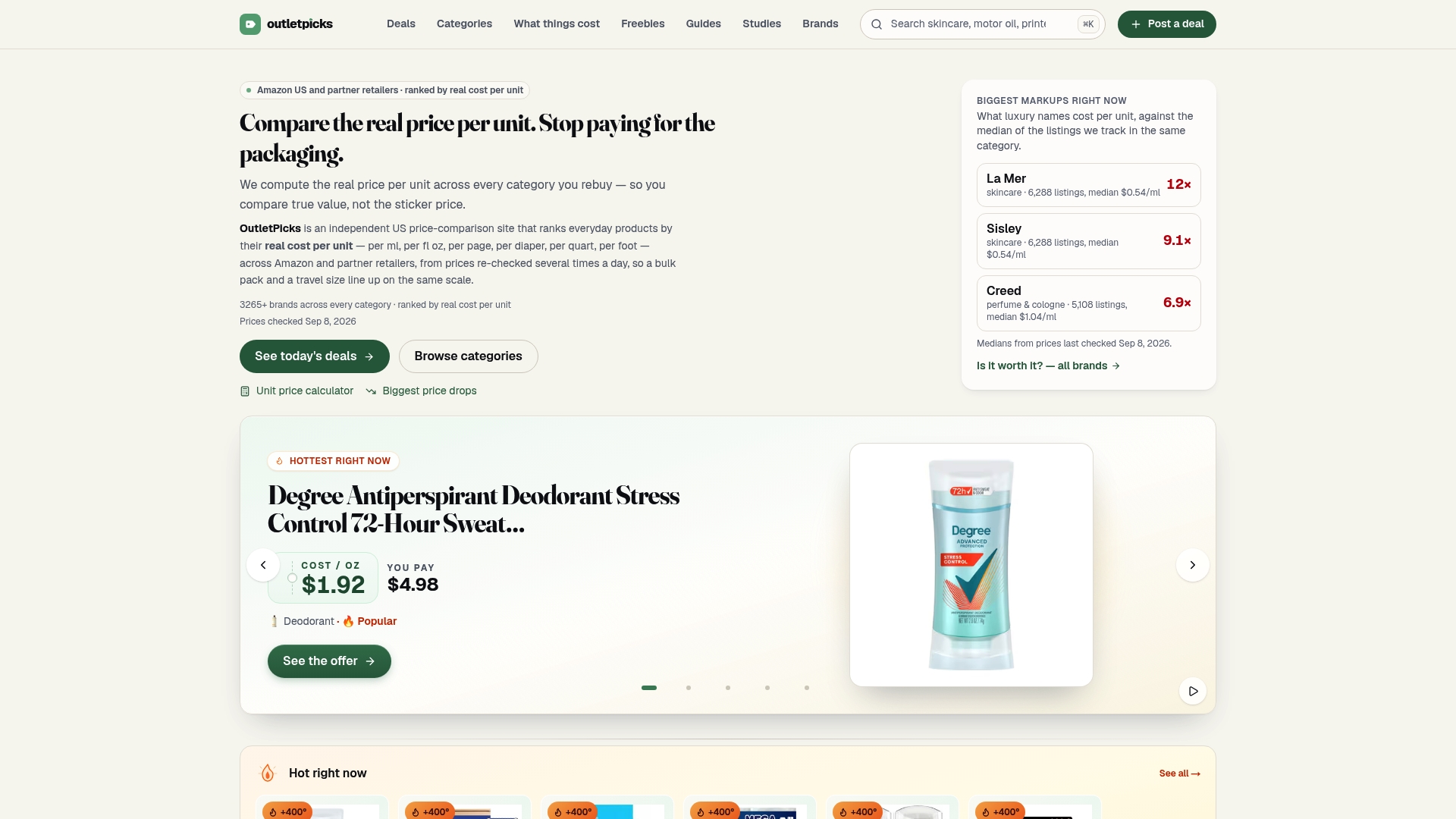
Per-ounce math is simple for one product and tedious for twenty. OutletPicks does it for you across Amazon and partner retailers, ranking products by their real cost per unit so pack size and brand stop hiding the price. Browse our product categories to see how it works for skincare, baby care, cables, and more, or explore the brand index ranked by real cost per unit.
If you run a site of your own, our price-per-unit widgets let you embed the same figures.
Common mistakes when comparing solution prices
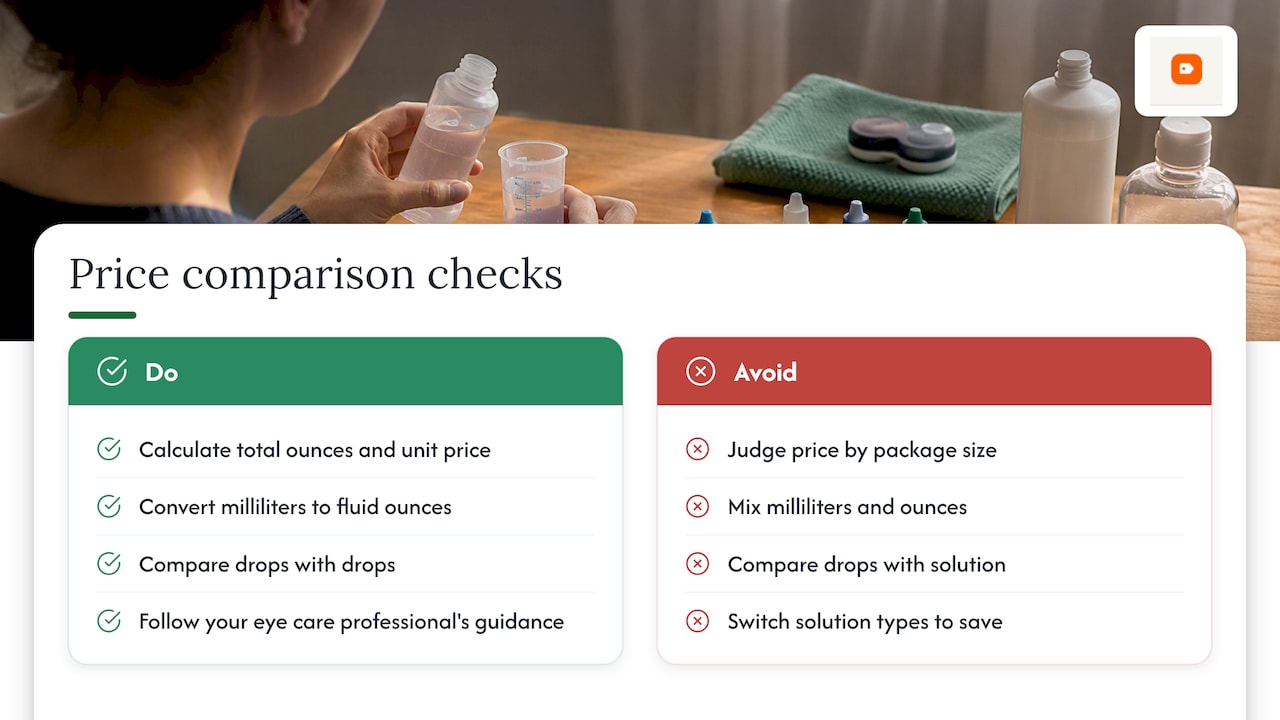
Comparing a 2-pack to a single bottle without doing the multiplication. Always compute total fluid ounces first.
Judging by the biggest bottle. A 12 fl oz bottle is not always cheaper per ounce than two 10 fl oz bottles in a pack. Do the division.
Forgetting that milliliters and ounces are different. A 300 mL bottle is about 10.1 fl oz. A quick conversion with our fluid ounces to liters tool or the milliliter tools above keeps you honest.
Counting rewetting drops as solution. Drops are a separate product with a very different per-ounce price. Compare drops with drops and solution with solution.
Letting savings tempt you into a different type. A cheaper peroxide system or multipurpose bottle is only a saving if your eye care professional says it fits you.
The Shopify editorial team calls unit-based measurement a true apples-to-apples comparison between packages of different quantities. That only works when every package is measured in the same unit and the quantities are read correctly.
FAQ
What is a good price per ounce for contact solution?
In the grocery chain listings we checked, anything near $0.37 to $0.55 per fl oz was at the low end, mostly store-brand and multipack products. Name-brand products ran from about $0.70 up to $2.35 per fl oz. Anything above $2 per ounce is usually a travel or specialty size.
Is it cheaper to buy contact solution in a multipack?
Usually, yes. One chain's 2-count pack of 12 fl oz bottles lists at $0.37 per fl oz, while its single 12 fl oz bottle lists at $0.54. Confirm by multiplying bottles by size and dividing the pack price by the total.
Why are travel-size contact solution bottles so expensive per ounce?
Small bottles carry packaging and handling costs on very little liquid. Two-ounce bottles of a popular brand are listed at $2.00 to $2.50 per ounce at a national drugstore, several times the price of large packs. They make sense for trips, not for everyday use.
Can I switch to a cheaper contact solution?
Only after checking with your eye care professional. Solutions differ in type and formula, and the right one depends on your lenses and your eyes. Once you know which types are safe for you, choose the lowest price per ounce among them.
Sources
- Grocery chain contact lens solution listings
- Grocery chain contact lens solution and drops listings
- Drugstore Biotrue contact lens solution listings
- Drugstore Bausch and Lomb multipurpose solution listings
- NIST: Uniform unit pricing tools for consumers
- Consumer Reports: Use unit pricing to save money
- AARP: Find supermarket savings with unit pricing
- How to compare unit prices when pack sizes differ
- Shopify: How to calculate unit price