
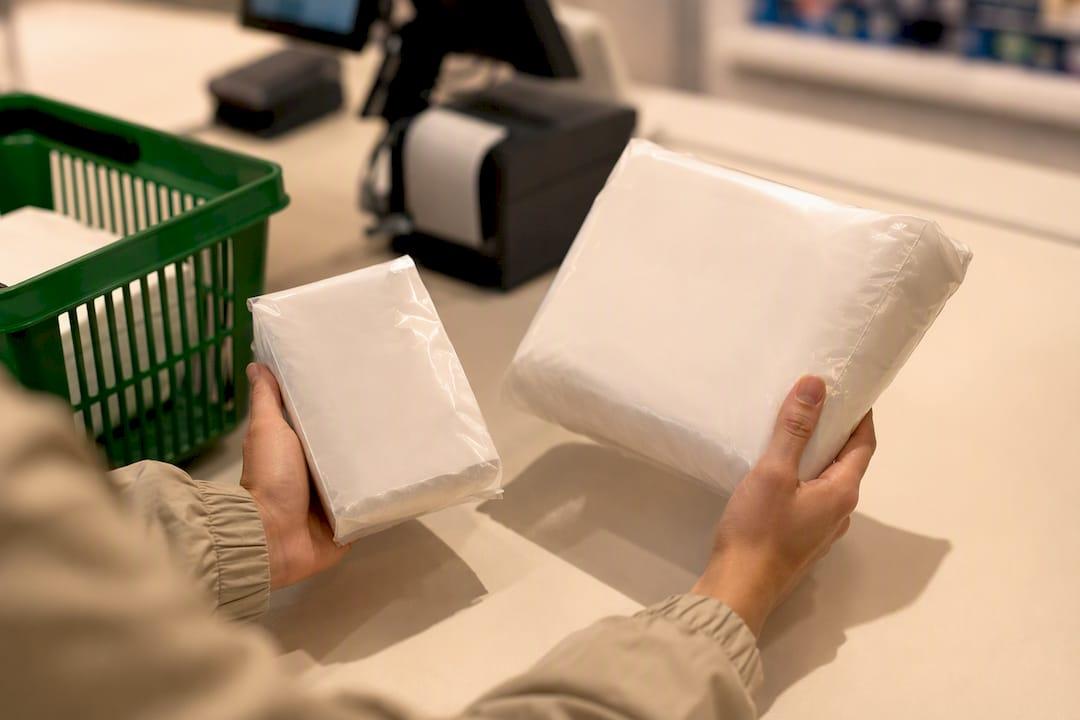
Unit price wins almost every time you're trying to find the cheapest option that actually meets your needs. Sale price only tells you how much has been knocked off the sticker; unit price tells you the true cost per ounce, per item, or per milliliter, which is the number that determines whether you're getting a deal or just a smaller amount of it. The one exception: when you're out of a product tonight, urgency and your wallet's cash-on-hand can outrank the math. Otherwise, run the quick calculations below before you trust any "SALE" tag.
TL;DR:
- Comparing unit prices is essential because they reveal the true cost per measure, which often contradicts sale or sticker prices that can be misleading.
- To accurately compare products, ensure all quantities are converted to the same units before dividing total price by quantity to find the per-unit cost.
- Multi-packs and bulk sizes often have higher total prices but lower per-unit costs, but shrinking package sizes for the same price can increase the actual unit price.
- Sale prices can be deceptive if larger packages or multi-buy deals have higher unit prices than smaller or single items, especially when framed by discounts rather than true unit cost.
- Using platforms like OutletPicks automates real-time unit price comparisons across categories, helping shoppers avoid common traps and find genuine value.
Table of Contents
- Unit Price vs. Sale Price: What Each One Actually Tells You
- How to Calculate Unit Price (And Not Get Fooled by the Math)
- When a Sale Price Can Mislead You
- Worked Examples: How the Math Plays Out in Real Aisles
- How OutletPicks Calculates Real Cost Per Unit
- When It's Fine to Ignore the Cheaper Unit Price
- Skip the Math With Real-Time Unit Price Comparisons
- Sources
- FAQ
Unit Price vs. Sale Price: What Each One Actually Tells You
Unit price is the cost of a product broken down to a standard measurement, like $0.12 per ounce or $0.25 per diaper. It strips away pack size, brand marketing, and bundle deals to answer one question: how much are you paying for the actual stuff inside the package? Sale price, sometimes called the retail or discounted price, is simply what you pay at checkout after any markdown, coupon, or promotion is applied to the regular price.
Both numbers matter, but they answer different questions. Sale price answers "how much is this costing me right now compared to what it used to cost?" Unit price answers "is this actually a good deal compared to my other options?" You need the second answer far more often than the first.
Retailers are required in many states to post unit price on shelf tags, usually in small print just below or beside the total price, and the practice traces back to consumer protection rules dating to the 1970s, as Rutgers Cooperative Extension explains in its unit pricing guide. Online, unit price shows up less consistently. Some retailers list it automatically; others bury it or skip it entirely, which is part of why comparison tools have become necessary rather than optional.
A few things to keep straight when you're reading either number:
- Unit price is always expressed per a fixed measure: per ounce, per pound, per count, per sheet, per milliliter.
- Sale price reflects a discount off a specific package, not a comparison across packages.
- The two brands or sizes you're comparing must use the same unit basis, or the comparison is meaningless.
- A sale price can drop while the unit price rises, if the package shrinks along with the price.
That last point trips up more shoppers than any other. A price tag reduction feels like savings even when the amount of product you're getting has quietly gotten smaller.
How to Calculate Unit Price (And Not Get Fooled by the Math)
The formula is simple enough to do in your head with a little practice: unit price = total price ÷ quantity. A $4.99 bottle of shampoo containing 12 ounces comes out to about $0.42 per ounce. A $6.49 bottle at 20 ounces comes out to about $0.32 per ounce, which makes it the better buy even though it costs more upfront.
Follow this sequence every time you're comparing two products:
- Check the net quantity, not the container size. Look at the fine print on the label (ounces, count, milliliters), not how big the bottle looks on the shelf.
- Convert to matching units if one package lists ounces and the other lists milliliters, or one lists count and the other lists weight.
- Divide total price by quantity for each option to get a true per-unit figure.
- Compare the two unit prices directly. Whichever is lower wins, regardless of the sticker price or pack size.
For multi-packs, divide by the count, not the box. A 24-pack of paper towels at $19.99 comes out to about $0.83 per roll. A single roll at $1.29 is worse value on a per-roll basis, even though it looks cheaper sitting on the shelf next to the big box.
Pro Tip: Watch net weight closely on familiar products you buy often. Manufacturers sometimes shrink the package while keeping the price and box size nearly identical, a practice widely known as shrinkflation. If a "family size" bag of chips suddenly weighs half an ounce less than it did last year, your unit price just went up even though nothing on the shelf tag changed.
When a Sale Price Can Mislead You
Retailers know that bigger packaging looks like a better deal, and that visual assumption is exactly what "buy more, save more" displays are built to exploit. A 64-ounce bottle of laundry detergent marked "Save $2" can carry a higher unit price than the 32-ounce bottle sitting right next to it, especially if the smaller size is also on promotion. Framing the price as a discount amount, rather than a cost per unit, is precisely what makes shoppers focus on the wrong number. Research from the Walton College at the University of Arkansas found that showing cost per unit sharpens price focus far more effectively than showing quantity per dollar, which is one reason unit price labels tend to steer people toward genuinely better value.
A few common traps to watch for:
- Comparing a "2-for-$10" multi-buy deal against a single unit priced at $4.50, without checking whether the multi-buy actually lowers the per-item cost.
- Assuming a store brand and a name brand use the same unit basis, when one is priced per ounce and the other per fluid ounce or per count.
- Trusting a percentage-off sticker ("30% off!") without checking what the original per-unit price actually was.
The payoff for catching these traps is real. Research on consumer usage of unit pricing found that shoppers who actively use unit price labels save an average of 17 to 18% on the products they check, though those savings shrink over time as people get lazier about reading the fine print. That's not a rounding error. That's the difference between a genuinely full cart and a genuinely full cart plus a tank of gas.
Worked Examples: How the Math Plays Out in Real Aisles
1. Single unit vs. bulk size. A 15-ounce jar of peanut butter at $3.49 comes out to $0.23 per ounce. A 40-ounce jar at $8.99 comes out to $0.22 per ounce. The bulk size wins, but barely, meaning if you won't finish 40 ounces before it goes stale, the smaller jar might be the smarter overall choice even at a slightly higher unit price.
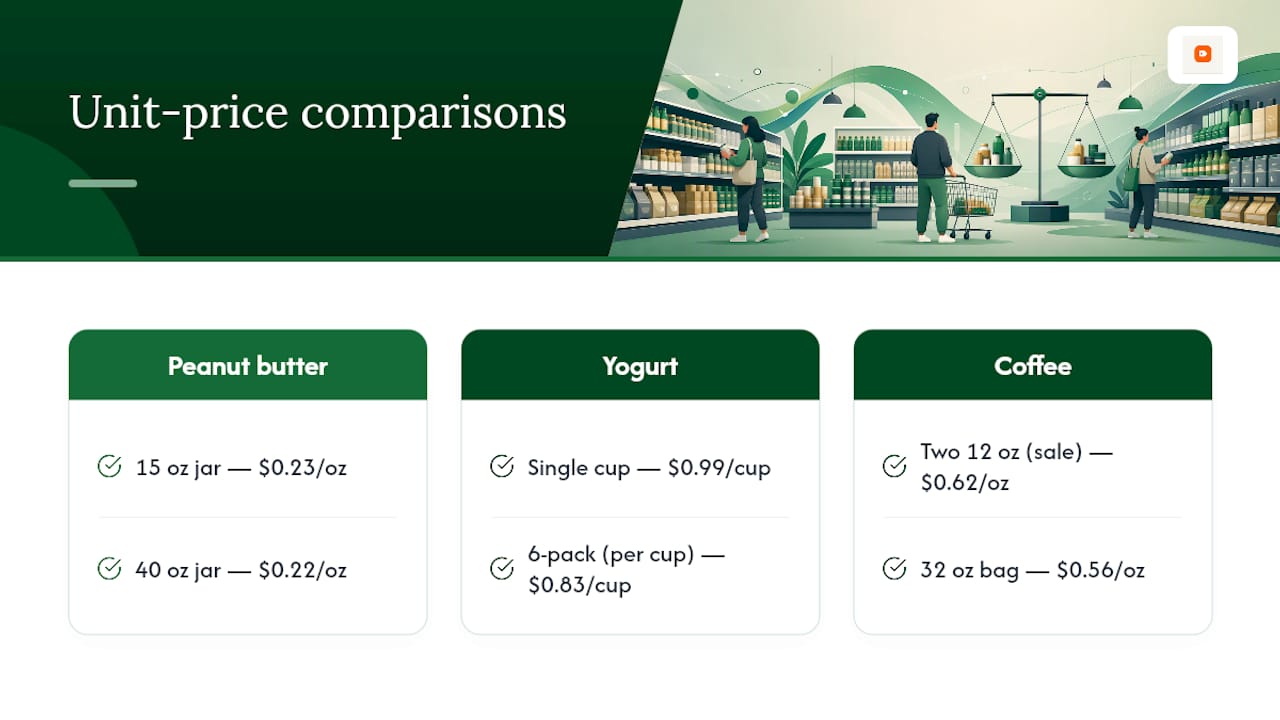
2. Multi-pack vs. singles. A 6-pack of yogurt cups at $4.99 works out to about $0.83 per cup. A single cup of the same brand at $0.99 is worse per-cup value, but if you only eat yogurt occasionally and the rest would spoil, the single cup avoids waste that erases any unit-price advantage.
3. The sale tag that loses anyway. A "Buy 1 Get 1 50% Off" deal on two 12-ounce bags of coffee, each normally $9.99, brings the effective price to $14.99 for 24 ounces, or about $0.62 per ounce. A competing 32-ounce bag at $17.99 comes out to about $0.56 per ounce, cheaper per ounce despite carrying no sale tag at all.
A fast mental shortcut works for most in-aisle decisions: if one package holds twice the quantity of another, multiply the smaller package's unit price by two and compare it to the larger package's total price. If the larger package costs less than that number, it's the better deal. This scaling trick is faster than converting units from scratch every time you're standing in an aisle trying to do math before your phone dies. For a deeper look at how this plays out across dozens of household categories, OutletPicks' cost-per-unit index tracks real examples across common products.
How OutletPicks Calculates Real Cost Per Unit
Some platforms normalize pricing down to a consistent measure for each category, whether that's per milliliter for skincare, per diaper for baby care, per page for printer supplies, or per foot for cables. Prices get rechecked on a rolling cycle across retailers, so the unit price you see reflects current listings rather than a snapshot from months ago.
Where this matters most:
- Personal care and fragrance, where bottle size varies wildly between brands and the sticker price alone tells you almost nothing.
- Baby care, where diaper counts and sizes shift constantly and per-diaper cost is the only number that stays comparable.
- Household basics, where multi-packs and "value size" labeling routinely obscure the real per-unit cost.
The full breakdown of how prices get sourced and normalized lives on OutletPicks' methodology page, and the store comparison page shows which retailers tend to run cheaper on a per-unit basis across categories.
When It's Fine to Ignore the Cheaper Unit Price
Unit price should decide most routine purchases, but not all of them. If a product is perishable and you'll toss half of it, if you need it in the next hour and only one store is open, or if a specific brand is the only one your kid or pet will actually use, those constraints matter more than a few cents per ounce. The right sequence is: check unit price first, then apply your real-life filters. Math should set the baseline, not override common sense.
Skip the Math With Real-Time Unit Price Comparisons
There are other ways to hunt for value: scanning shelf tags, running numbers on your phone's calculator app, or trusting a percentage-off sticker and hoping it holds up. All three work, in theory, but they eat time and every one of them requires you to already know the formula and remember to use it standing in a crowded aisle. Outletpicks does that math automatically, ranking products across categories like skincare, hair care, fragrance, baby care, and pet food by their actual cost per unit rather than their sticker price, and rechecking retailer data on a rolling basis so the numbers stay current.
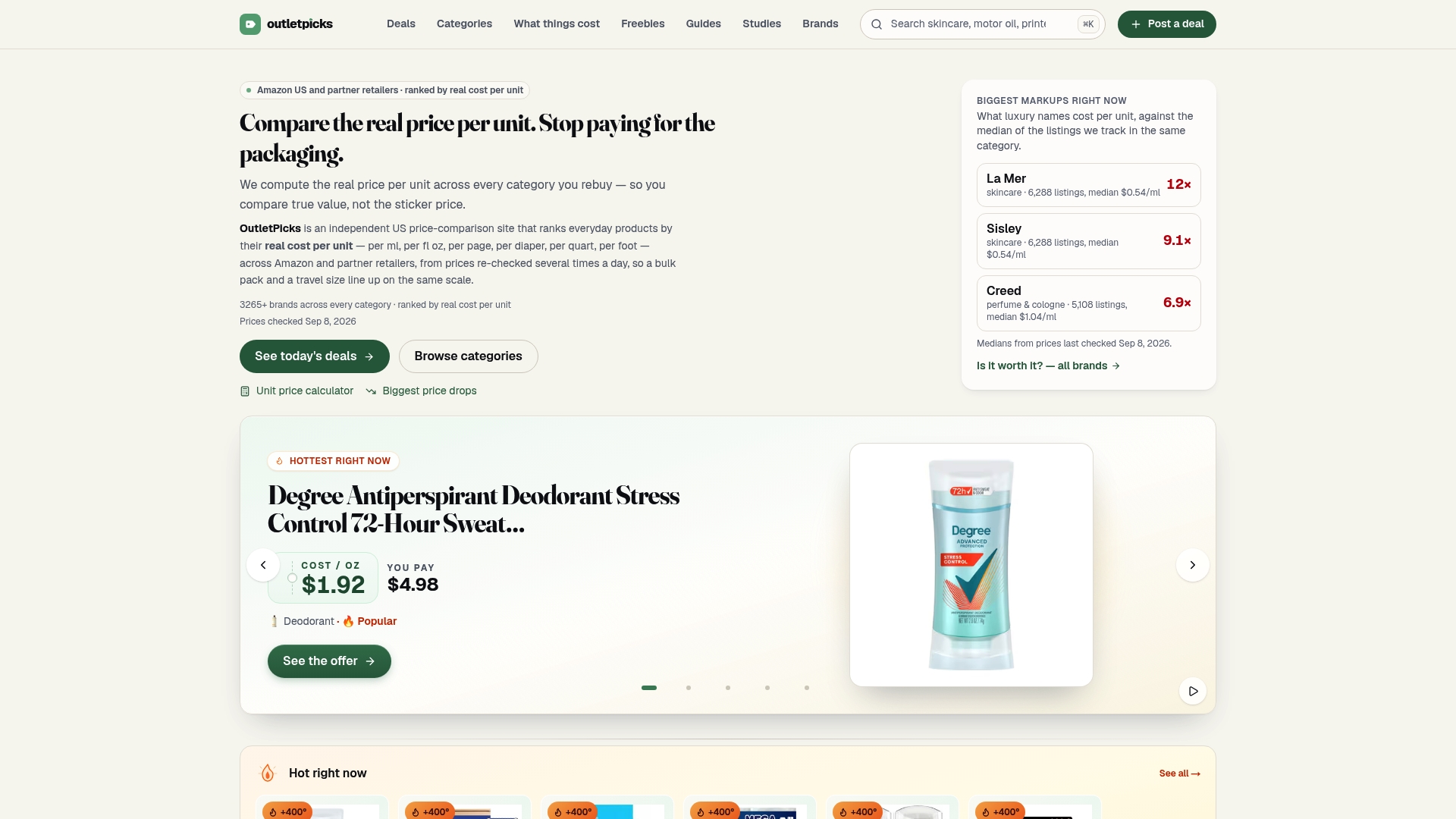
If you're comparing brands within a category, the brand index ranked by real cost per unit is the fastest way to see which name brand or store brand actually wins on a per-unit basis, regardless of pack size. Pull up the category you're shopping for before your next grocery run and see what the real cost per unit says, not what the shelf tag wants you to believe.
Sources
The savings figures and framing research cited above come from a consumer usage study on unit pricing, an MIT study on online versus in-store price parity, a Stanford-hosted paper on platform design and price transparency, and pricing research from the Walton College. Each backs a specific claim made earlier in this article, not a general impression.
FAQ
What's the Difference Between Unit Cost and Price?
Unit cost, or unit price, is the price of a product divided by its quantity, expressed as a rate like dollars per ounce or dollars per count. The regular "price" you see on a shelf tag is just the total cost of that specific package, with no adjustment for size or quantity.
Should I Look at Unit Price or Retail Price When Shopping?
Unit price should be your primary filter, since it tells you the true cost per measure regardless of pack size or brand. Retail price, sometimes called sale price, matters mainly when you need to know your total spend at checkout or how much has been discounted from the regular price.
What Is the Difference Between Unit Price and Amount?
Unit price is a rate: cost divided by a fixed quantity, like dollars per ounce. Amount usually refers to either the total quantity in a package (12 ounces, 24 count) or the total dollar figure you pay, neither of which tells you whether that quantity is a good value on its own.
What Is the Difference Between Price and Sale Price?
Price, or regular price, is the standard cost of an item before any discount. Sale price is the reduced amount charged during a promotion, coupon event, or markdown, and neither number reflects whether the product is a good value until you calculate the unit price.
Does OutletPicks Show Unit Price for Sale Items?
Yes. OutletPicks calculates real cost per unit across categories including skincare, baby care, and fragrance, updating prices on a rolling basis so shoppers can see whether a sale-tagged item actually beats its full-price competitors on a per-unit basis.