

Usually the refill wins, but not every time. The reliable way to know is to compare price per ounce, then price per wash. A big liquid refill can cost less than a third of what you pay per ounce for a small pump bottle. A pricey "eco" refill can cost more per ounce than the bottle it is meant to replace. This guide shows you the numbers we found, the formula to check any pair of products, and the mistakes that eat the savings.
TL;DR
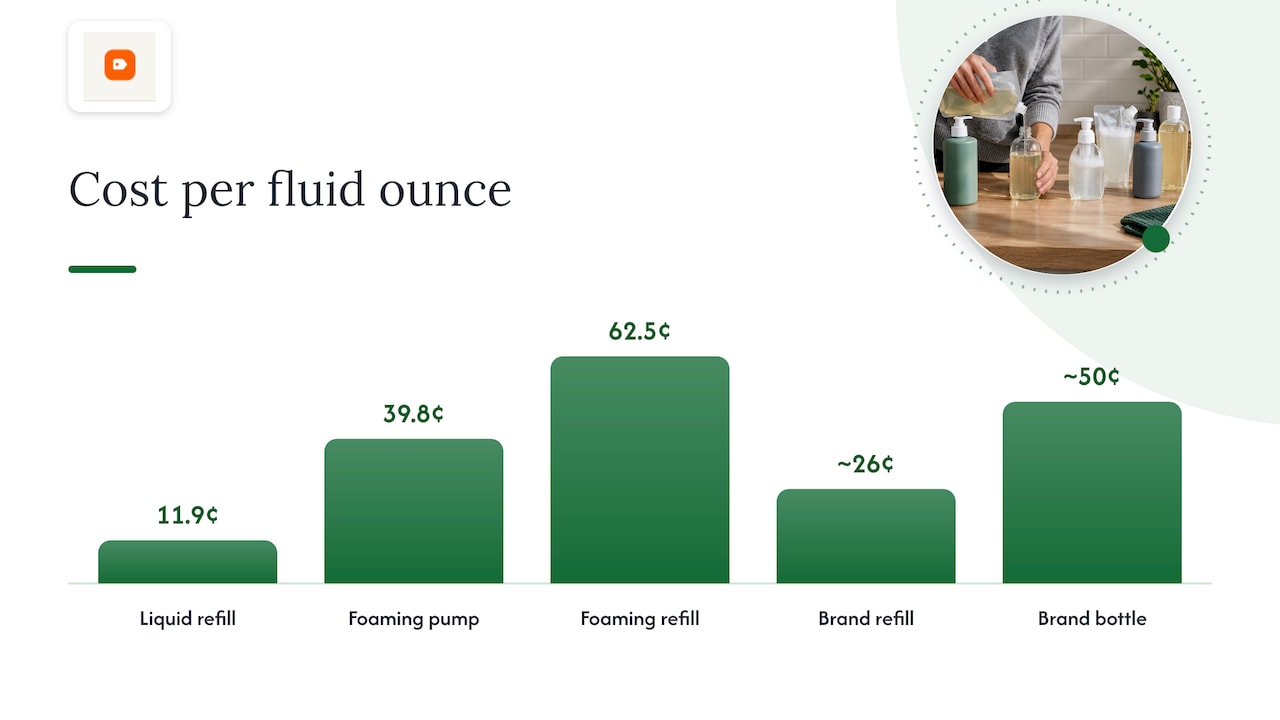
- Large refill jugs of ordinary hand soap often cost 50% to 70% less per ounce than small pump bottles. A 50 fl oz refill at 11.9¢ per fl oz, against a 10 oz foaming pump at 39.8¢, is one example.
- Refill is not automatically cheaper. A 28 fl oz foaming refill at $17.50 works out to 62.5¢ per fl oz, which is more than the 10 oz pump bottle of the same type.
- Compare per ounce first, then per wash. A foaming dispenser uses less soap per wash, so the dose matters as much as the price.
- Dilute soap only when the label says to. Diluting a regular soap can weaken its preservative system.
- Bar soap can beat both options on cost per wash, though it is a different habit.
Table of Contents
- The short answer in numbers
- Why a refill is usually cheaper
- When the refill loses
- Compare per wash, not per bottle
- Can you put regular soap in a foaming dispenser?
- Does bar soap save money?
- How to check any pair in two minutes
- Don't pay for luxury where a store brand will do
- Our view
- See current soap prices per unit
- FAQ
- Sources
The short answer in numbers
Here are the prices we gathered in 2026, converted to cost per fluid ounce so they compare directly. Cents per ounce are the only fair yardstick when bottle sizes differ, which is exactly what unit pricing is for: UK government guidance describes it as a way to compare similar products sold in different pack sizes. The principle is the same in US stores.
| Product | Size | Price | Cost per fl oz |
|---|---|---|---|
| Liquid hand soap refill, aloe scent | 50 fl oz | $5.97 | 11.9¢ |
| Foaming hand soap pump, sea minerals | 10 oz | $3.98 | 39.8¢ |
| Foaming hand soap refill, violet and lavender | 28 fl oz | $17.50 | 62.5¢ |
| Foaming soap refill vs. small bottle, one brand | refill vs. small bottle | not listed | about 26¢ vs. about 50¢ |
The last row is the pattern most people expect: a refill at roughly half the per-ounce price of the small bottle. The first three rows show how wide the spread is. The cheap liquid refill costs about 70% less per ounce than the foaming pump. The 28 oz foaming refill costs about 57% more per ounce than that same pump bottle.
The 62.5¢ figure is the one to remember. A refill label does not guarantee a discount. It guarantees a different package.
Why a refill is usually cheaper
A refill removes the parts you already own: the pump, the bottle and much of the branding. What you pay for is mostly soap. A larger container also spreads shipping, filling and shelf costs over more ounces.
Dial makes the same argument for its own line. It says its 52-ounce refill fills almost seven of its 7.5-ounce pumps and gives a better cost per ounce than buying several single pumps. That claim is the brand's own, but the arithmetic is easy to check: 52 divided by 7.5 is about 6.9 bottles.
A worked example
Say your household goes through one 10 oz pump every three weeks. That is about 17 bottles a year, or 170 oz.
- At 39.8¢ per oz, 170 oz costs about $67.66.
- At 11.9¢ per oz, the same 170 oz costs about $20.23.
- The difference is about $47 a year for one sink.
The two prices above come from different products (a foaming pump and a liquid refill), so treat the example as a ceiling for what a cheap liquid refill can save, not a promise. Run the same sum with your own prices. A household with three or four sinks and a kitchen can multiply that gap.
When the refill loses
The per-ounce price is only the first test. These are the cases where the savings shrink or vanish.
The refill is priced like a premium product
The 28 oz foaming refill above is the clear example. A scented, design-led refill from a premium brand can cost more per ounce than a mass-market bottle. In one 2025 write-up, refill-store soaps ran 50¢ to 60¢ per ounce, while the mass-market liquid soap the author compared them to was 22¢ per ounce. Refill stores sell a different promise, less packaging and often a different formula, and you should shop them for that reason rather than for price.
The fill size is smaller than the original
Check how much soap the refill actually holds. One comparison guide warns that a smaller fill than the original cancels part of the discount. If the bottle holds 12 oz and the pouch holds 9 oz, you must compare per ounce, not per package.
A refillable system needs many refills to pay off
Some beauty and household brands sell a durable case plus cartridges. The same guide notes that if break-even takes three or more refills, most people never reach it. The formula is simple:
Break-even refills = extra upfront cost of the reusable case ÷ saving per refill
For example, if the case costs $12 more than a regular bottle and each refill saves $3, you need four refills before you are ahead. If you tend to switch scents or brands, you may never get there.
Habits and mess
Pouring soap into a pump can spill, and containers need cleaning. A practical comparison of refills and new bottles says that price per ounce and user friction both belong in the calculation. Refills pay off for households that refill consistently. If empty bottles pile up under the sink while a new one gets opened, you have paid for both.
Compare per wash, not per bottle
If you use a foaming dispenser, per-ounce price is not the end of the story. Foam pumps dispense a smaller dose of liquid per push, because air does most of the volume work. The cost that matters is cost per wash.
The formula is:
- Washes per refill = refill volume in mL ÷ dose per pump
- Cost per wash = refill price ÷ washes per refill
A bathroom supplies comparison used this method and found $0.0063 per foam wash against $0.0052 per liquid wash in its example. Foam was not automatically cheaper, because the refill sizes, prices and measured doses differed.
Dose can swing the result the other way, too. A commercial soap maker's white paper works through a 1,000 mL refill. At 0.75 mL per foaming wash it yields 1,333 washes. The same volume of liquid at 1.0 to 1.5 mL per wash yields 1,000 to 667. With an illustrative $8 refill price, that is about $0.006 per foam wash against $0.008 to $0.012 per liquid wash. In that example foam is 25% to 50% cheaper per wash.
Dose varies by dispenser. A manufacturer calculator for commercial restrooms assumes 0.5 mL for one foam dispenser and 0.9 mL for liquid and other foam units. Do not assume every foam pump delivers the same savings. If you want a real answer for your home, push the pump into a measuring spoon a few times and note the volume.
Quick per-wash example
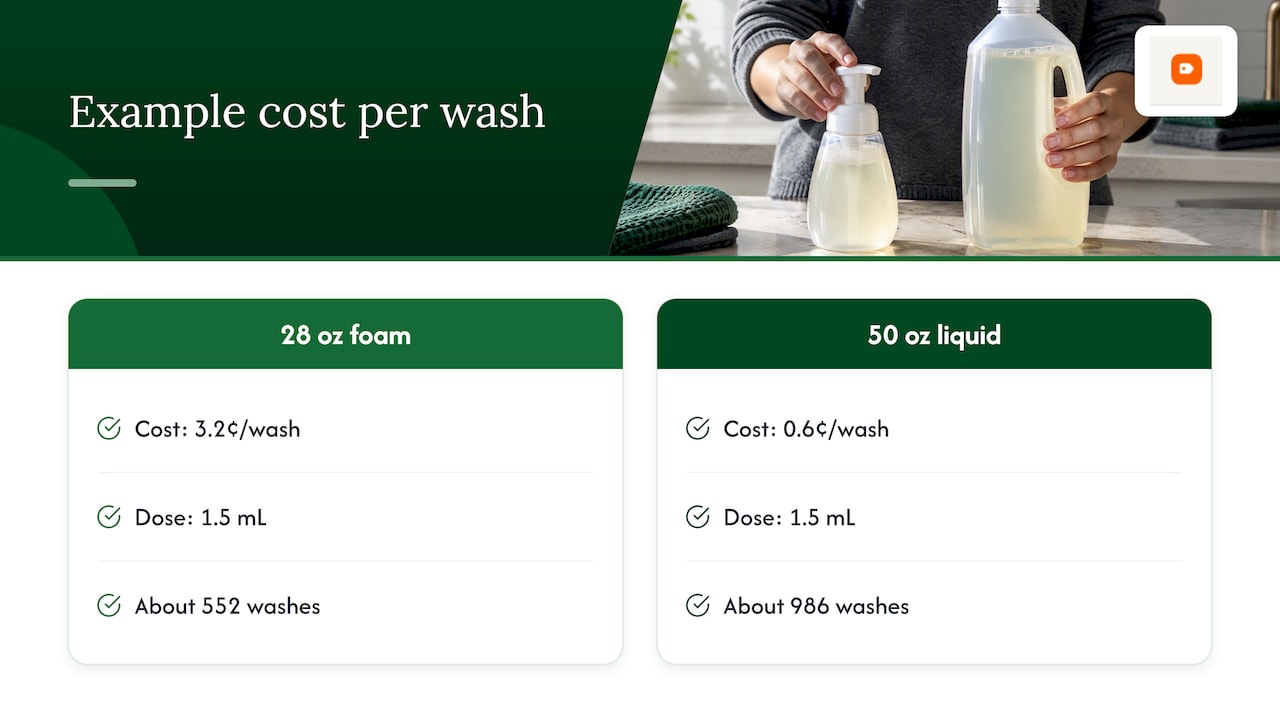
A 28 oz refill is about 828 mL. If your foam pump delivers roughly 0.75 mL a push and you use two pushes, each wash uses 1.5 mL, so one refill gives about 552 washes. At $17.50 that is about 3.2¢ per wash. A 50 oz liquid refill (about 1,479 mL) at $5.97 with a 1.5 mL dose gives about 986 washes, or about 0.6¢ per wash. These doses are example numbers, not measurements, but they show why the price per ounce difference dominates once the gap is large.
Can you put regular soap in a foaming dispenser?
Many shoppers try this to stretch a cheap liquid refill. One online tip suggests diluting liquid soap about 3:1 to bring the cost to about a quarter of a foaming refill. Before you do, know what the experts say.
The American Cleaning Institute advises not diluting hand soap unless it is a concentrated product meant for added water, and following the label. It warns that dilution can reduce effectiveness, disrupt the preservative system and raise the risk of contamination.
There are products designed for this. Dr. Bronner's says its concentrated castile soap can go in a manual foaming dispenser at 1 part soap to 3 parts water. It recommends mixing only what you will use within two weeks to a month, since the product lacks harsh preservatives. Distilled-water dilutions may last up to six months. A maker of touchless dispensers suggests testing a mix of about 20% liquid soap and 80% water, adjusting as needed, and avoiding creamy soaps that separate.
The dispenser matters, too. Bradley's soap guidance gives a general liquid-soap range of 100 to 2,500 centipoise and a pH range of 6.5 to 8.5. Soap that is too thick or too corrosive can clog or damage valves.
The safe route: dilute only soaps labeled for it, mix small batches, use clean water and wash the dispenser between batches. Otherwise, buy a refill made for foam.
Does bar soap save money?
Often, yes. A McGill University science office compared the two and reported about 2.3 grams of liquid soap versus 0.35 grams of bar soap per hand wash, concluding that liquid handwashing costs roughly ten times as much. That is one comparison, not a test of every US refill or foam system. Still, if cost per wash is your only goal, a plain bar is hard to beat. It needs a dish that drains, and some households prefer a pump for kids or shared bathrooms.
How to check any pair in two minutes
- Find the unit price. Use the shelf tag, or divide the price by the total fluid ounces.
- Convert to the same unit. Do not compare mL with oz by eye. Our guide on how to compare unit prices walks through the steps, and the unit price calculator guide covers the sums.
- Check for multiples and coupons. A "3-pack" can be cheaper per ounce than the jug, so recalculate with the discount.
- Add the dose. For foam, divide by washes, not ounces.
- Count your habits. If you will refill every time, the refill wins. If not, a bottle you actually use is cheaper than a jug you do not.
Want practice? Our daily games, Packle and Bulkle, ask you to spot the cheapest pack per unit, which trains the same instinct.
Don't pay for luxury where a store brand will do
Price per ounce also hides a different question: is the soap itself worth it? Consumer Reports notes that shoppers can skip luxury soaps and get comparable cleaning from $5 store-brand alternatives. Pair a store-brand refill with a pump you already own and you usually land at the low end of the table above.
Refill containers also only help the environment if you keep using them. Consumer Reports says reusable and refillable containers reduce impact only when consumers reuse them rather than throw them away.
Our view
We built OutletPicks because the sticker price is the least useful number on a shelf. A $3.98 bottle and a $5.97 jug look close until you divide by ounces and the jug turns out to cost less than a third as much per ounce.
The same habit protects you from the opposite trap. A refill pouch with a green label and a premium price can cost more than the bottle it replaces. We rank products by real cost per unit, regardless of pack size or brand, so you can see both cases side by side and decide with data rather than packaging.
For soap, our advice is simple: compare per ounce, measure your own dose if you use foam, and buy the biggest size you will really finish. We keep prices updated on a rolling cycle so the comparison stays current.
Alex
See current soap prices per unit
We track cost per unit across everyday categories so you do not have to do the division at the shelf. Start with this week's dish soap deals, browse skincare on sale or shampoo on sale, or see which makers deliver the lowest price per unit in our brand index.
You can also open the full list of categories we rank, from body care and baby care to cables and cameras, and use our shopping checklists to price your whole basket per unit.
FAQ
Is it cheaper to buy refills or new bottles of hand soap?
Usually refills, often by half or more per ounce, as with a 50 fl oz liquid refill at 11.9¢ per fl oz against a 10 oz foaming pump at 39.8¢. But a premium refill can cost more per ounce than a mass-market bottle, so divide the price by the ounces before you buy.
Can I refill my foaming soap dispenser with regular soap?
Only if the soap is thin enough and the label allows dilution. The American Cleaning Institute advises against diluting soap that is not designed for it, because it can weaken preservation and cleaning. A concentrated soap made for foaming, or a refill made for foam pumps, is the safer choice.
How do I calculate cost per wash?
Divide the refill volume in mL by the dose per pump to get washes per refill. Then divide the refill price by that number. Measure your own pump dose, since dispensers range from about 0.5 mL to 1.5 mL or more per use.
Does bar soap save money?
In one university comparison, bar soap used far less product per wash than liquid, and the liquid cost about ten times as much. It is not a direct test of every refill or foam system, but bar soap is often the cheapest per wash if you are happy with it.
Sources
- Unit pricing: information for consumers, GOV.UK
- Foaming Hand Soap vs. Refill
- Refillery Explained: The Eco-Friendly Way To Shop Without Waste
- 5 Reasons to Use Refillable Soap at Home, Dial
- Refill or New Packaging: Which Really Costs Less
- Refill Hand Soap vs New Bottles
- Foam vs. Liquid Hand Soap: Cost Per Wash, Not Per Bottle
- Restroom Budget Control, foam white paper
- B-823 Cost Savings Calculator, Bobrick
- Ask ACI: Hand Soap Dilution, American Cleaning Institute
- Can I use a pump dispenser with the Pure-Castile Magic Soap?
- How do I make my own foaming hand soap, Better Living
- Soap Recommendations and Dispenser Maintenance, Bradley
- Liquid or Bar? Soapy Tales, McGill Office for Science and Society
- 4 Best Store-Brand Hand Soaps, Consumer Reports
- Cleancult Household Cleaners Review, Consumer Reports