

Price per foot comes down to two formulas: divide the total price by square footage to get price per square foot, or divide it by length to get price per linear foot. Use square footage for area-based items like flooring or roofing, and linear feet for runs like trim, fencing, or cable. A calculator can run either formula once you have clean numbers.
TL;DR:
- Use square feet for area based items such as flooring and roofing, but use linear feet for runs like trim, fencing, gutters, or cable.
- Compare only quotes with matching scope: materials, labor, preparation, waste, taxes, and exclusions must align; separate fixed charges such as delivery before dividing.
- New single family homes had a 2023 national median of $154.70 per square foot, versus $146.64 in the South and $220.95 in the Northeast.
- For cornered runs, measure and add each straight segment; convert inches to feet, and never compare square foot rates with linear foot rates.
Table of Contents
- Square foot vs. linear foot: what each one measures
- How to calculate price per square foot step by step
- How to calculate price per linear foot step by step
- How to normalize quotes before comparing price per foot
- Worked examples for property, flooring, and trim pricing
- Unit conversions and mistakes that throw off your math
- Why unit-price clarity matters more than the sticker number
- Try the OutletPicks price-per-square-foot calculator
- FAQ
- Sources
Square foot vs. linear foot: what each one measures
A square foot measures area. You get it by multiplying length by width, so a room measuring 12 feet by 12 feet covers 144 square feet, not 12. A linear foot measures a single straight run with no width involved: 72 inches of baseboard equals 6 linear feet, full stop.
Mixing up the two is a common error in cost-per-foot math. Before you divide anything, confirm which one your quote or listing actually uses.
- Square foot: length × width, used for flooring, roofing, siding, and property size.
- Linear foot: a straight measured run, used for trim, fencing, gutters, and cable.
- Conversions to keep handy: 12 inches = 1 foot, and 1 foot = 0.3048 meters.
- Runs with corners: measure each straight segment separately, then add them together.
How to calculate price per square foot step by step
Getting to an accurate price per square foot takes three checks before you touch a calculator.
- Confirm the total price. Decide whether you're using the sale price, a full contractor quote, or a material-only cost, since mixing these produces numbers that look comparable but aren't.
- Confirm the square footage. Check what's included in that figure: finished space only, or finished plus garage and porch.
- Divide the total by the square footage. A $300,000 home with 1,500 finished square feet comes out to $300,000 ÷ 1,500 = $200 per square foot.
The national median price per square foot for new single-family homes was $154.70 in 2023, with regional medians ranging from $146.64 in the South to $220.95 in the Northeast, according to Census Bureau housing data. That spread shows why a flat dollar figure means little without regional context: $200 per square foot reads as high against a Southern median but closer to typical in the Northeast.
How to calculate price per linear foot step by step
Linear foot pricing follows the same logic but swaps area for length, which matters for anything sold by the run: fencing, gutters, pipe, or trim.
- Confirm what the length covers. Material-only pricing and fully installed pricing produce very different per-foot numbers, so match the quote to the comparison you're making.
- Measure by summing straight runs. Treat each wall or segment separately and add them, since a corner changes direction but doesn't cancel out footage, as the linear foot measurement guide notes.
- Divide price by total linear feet. A $240 installed trim quote for 40 feet of run works out to $240 ÷ 40 = $6 per linear foot.
Watch for quotes that silently switch units between line items. A fence bid priced per linear foot for materials but per square foot for a privacy screen section needs to be split apart before you compare it to anything else.
How to normalize quotes before comparing price per foot
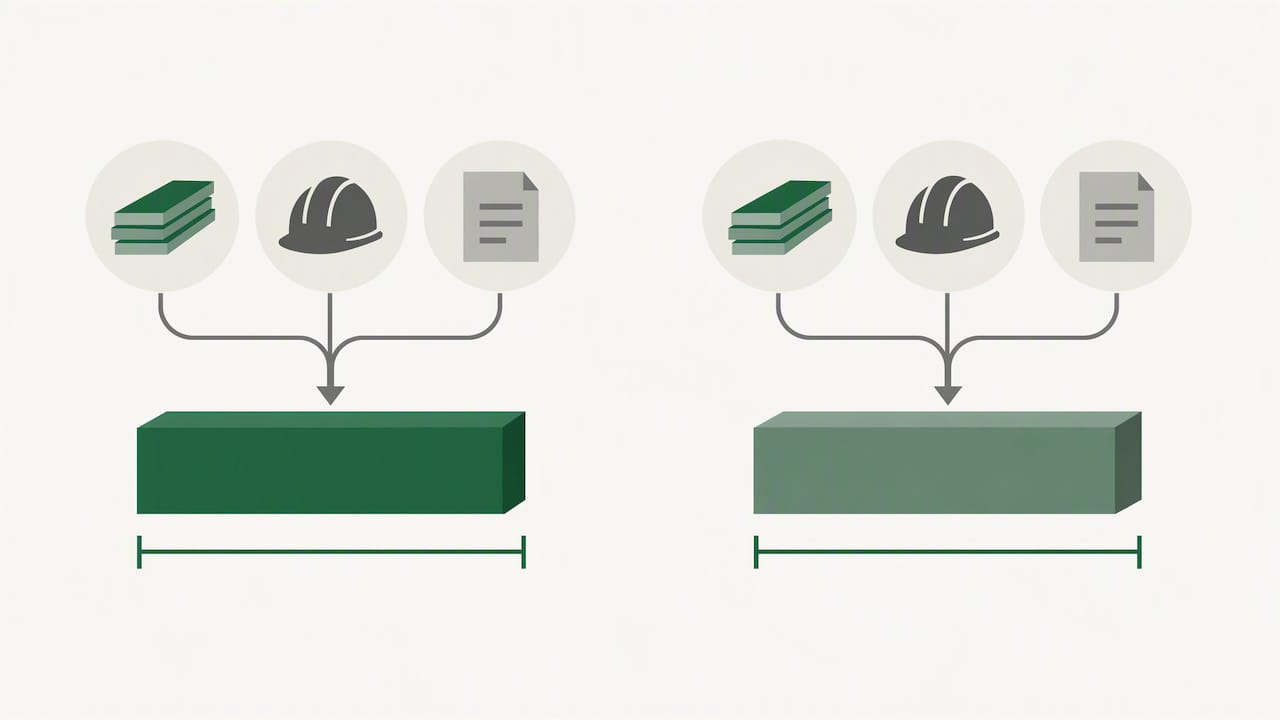
A headline $/ft number is only useful when every quote you're comparing covers the same scope. Before dividing anything, run through what's actually included.
- Materials and labor: check whether both quotes bundle labor or price it separately.
- Prep work: demolition, subfloor repair, or site grading can be buried in one quote and billed separately in another.
- Waste allowance: installers may add extra material, which inflates the total you're dividing.
- Delivery, accessories, and disposal: these fixed costs can distort a per-foot rate if they're not isolated first.
- Taxes and exclusions: confirm whether tax is already included in the quoted total.
Fixed fees deserve special handling. A $75 delivery charge on a small job skews the per-foot rate far more than the same charge on a large one, so separating fixed costs from the per-unit rate before dividing keeps the comparison honest. A $/ft figure built from a material-only quote may look better than one built from an installed quote, even when the underlying materials cost the same.
Pro Tip: Ask every contractor for a one-line breakdown of materials, labor, and fixed fees before you calculate anything, so you're dividing the same kind of total each time.
Worked examples for property, flooring, and trim pricing
These three examples cover the most common price-per-foot questions readers run into.
- Property price per square foot: a $310,000 sale on a 1,600-square-foot home gives $310,000 ÷ 1,600 = $193.75 per square foot, which lands close to the West region's 2023 median of $195.38.
- Installed flooring per square foot: a $4,200 quote covering materials, labor, and a 10% waste allowance for a 300-square-foot room gives $4,200 ÷ 300 = $14 per square foot installed.
- Baseboard trim per linear foot: summing four wall segments of 12, 10, 12, and 10 feet gives 44 linear feet; a $264 installed quote gives $264 ÷ 44 = $6 per linear foot.
Each example follows the same sequence: settle the total, settle the denominator, then divide. The arithmetic never changes, only the inputs do.
Unit conversions and mistakes that throw off your math
Most price-per-foot errors trace back to a unit mismatch rather than bad math.
- Mixing linear and square units: dividing a square-foot price by a linear measurement (or the reverse) produces a number that looks plausible but means nothing.
- Forgetting to convert inches: convert inches to decimal feet before multiplying, since 12 inches is 1 foot exactly and partial inches need decimal conversion.
- Comparing list price to sale price: a listing price and a closed sale price are not interchangeable inputs.
- Ignoring fixed fees and waste: a quote that excludes delivery or waste allowance can undercut one that includes them.
- Forcing volume into area units: concrete material may be bought by volume, while labor may be priced by area, so don't convert a volume-based material cost into a linear or square rate without separating it from labor.
Why unit-price clarity matters more than the sticker number
Most people treat price per foot as a single universal yardstick, but it only works when you control for scope first. A $6 per linear foot trim quote and a $6 per linear foot quote from a different contractor can represent completely different jobs if one includes installation and the other doesn't. The number is only as honest as the inputs behind it.
At OutletPicks, we compare products by their real cost per unit, whether that unit is a milliliter, a diaper, or a foot. Manual math works fine for a single quick comparison. A calculator earns its keep when you're checking several quotes at once and want to avoid a unit slip.
— Alex
Try the OutletPicks price-per-square-foot calculator
Running the math by hand works for a one-off comparison, but checking several quotes or listings gets error-prone fast. Our price-per-square-foot calculator helps with the calculation.

- Use the calculator to normalize quotes side by side before you commit to a contractor or compare listings.
- Browse our cost-per-foot formula breakdown for a deeper look at subtracting fixed fees from a quoted total.
- Check our categories page to compare real cost per unit across everyday products beyond construction and real estate.
Start with one quote you already have in hand, run it through the calculator, and see how the per-foot rate shifts once fixed fees are pulled out.
FAQ
How do I calculate the price per foot?
Divide the total price by the relevant measurement: use square footage for area items like flooring and linear feet for runs like trim or fencing. Confirm first whether your total is material-only or fully installed, since that changes the result significantly.
How much is a LF?
LF stands for linear foot, a measurement of straight-line length equal to 12 inches, with no width factored in, according to the linear foot definition. For runs with corners, measure each straight segment and add them together rather than measuring diagonally.
How much sq ft is 12x12?
A 12 foot by 12 foot space covers 144 square feet, found by multiplying length by width. This is a common point of confusion since 12x12 is sometimes mistaken for 12 square feet.
What is considered a good price per square foot?
There's no single good number since it depends heavily on region: the 2023 national median for new single-family homes was $154.70 per square foot, ranging from $146.64 in the South to $220.95 in the Northeast. A price below the relevant regional median may be worth investigating, but scope and condition still need to match before comparing.