
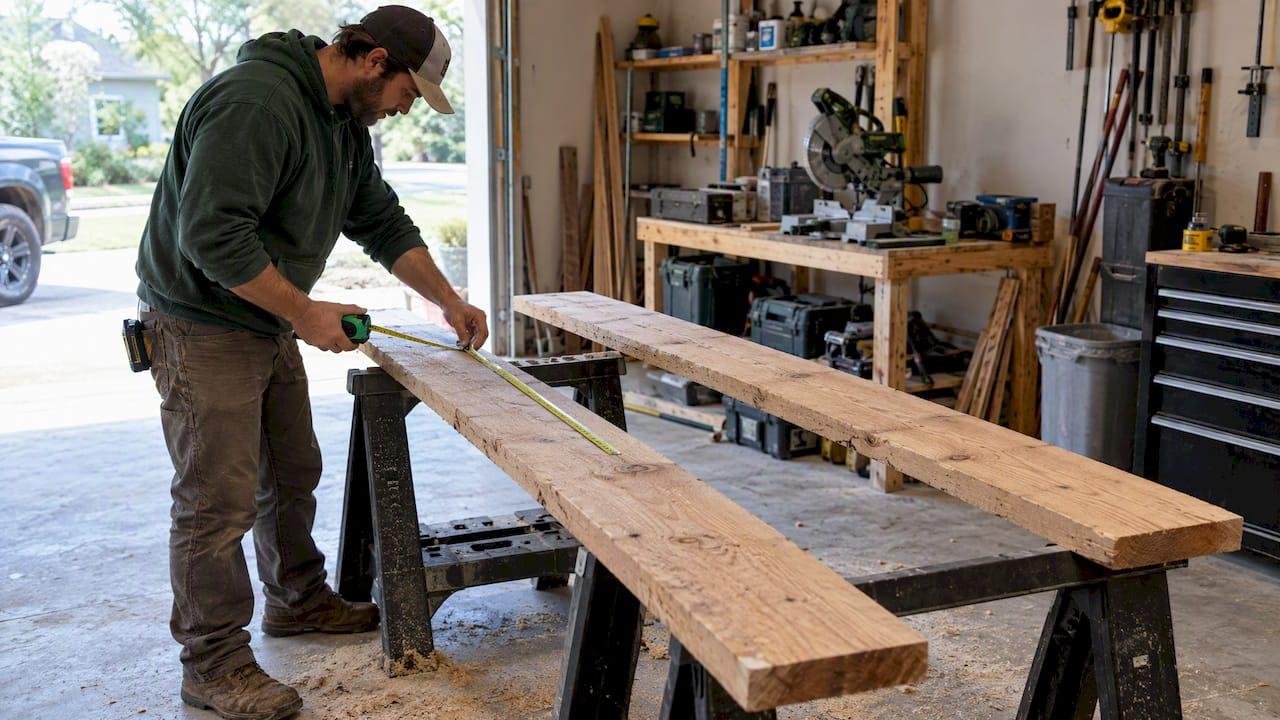
Cost per foot equals total cost divided by total length in feet. This covers the material price itself, not necessarily the full project cost, since fixed fees, labor, and waste often sit outside the basic number. Before you divide anything, convert every measurement to feet, or the result will be meaningless.
TL;DR:
- Comparing unit prices requires converting all measurements to feet using the fixed international foot of 0.3048 meters to ensure accuracy.
- Bulk purchases often save only a small amount per foot, so always calculate both options before assuming larger packages are cheaper.
- Fixed fees like mobilization, permits, and freight should be subtracted from the total cost before dividing to find a fair cost per foot.
- Waste allowances of around 10 percent must be added to the installed length for fencing or decking, then used in the per-foot calculation.
- For drilling projects, the industry-specific formula accounts for rig time costs and drilling depth, making it more accurate than total cost over length.
Table of Contents
- What price per foot means and unit basics
- Step-by-step formula and worked examples for retail materials
- How to convert quotes into a fair cost-per-foot comparison
- Drilling cost-per-foot: the specialist formula and worked example
- Unit-conversion checklist and quick reference
- How OutletPicks applies unit-normalized pricing
- When the simple cost-per-foot is enough and when to get a full estimate
- Use OutletPicks calculators to run per-foot comparisons
- FAQ
- Sources
What price per foot means and unit basics
Price per foot is a unit rate: it tells you what one foot of a material, cable, or drilled hole actually costs, so you can compare two listings fairly even when they come in different lengths or packaging. Contractors use it to quote lumber and fencing, retailers use it to price cable and trim, and drilling estimators use a variant of it to track rig economics.
The catch is unit consistency. A board priced per yard and a board priced per foot cannot be compared until both numbers live in the same unit.
- Convert yards to feet by multiplying by 3.
- Convert inches to feet by dividing by 12.
- Convert meters to feet using the NIST conversion factor of 3.280839895 feet per meter.
- Convert centimeters to feet by first converting to meters, then applying the same multiplier.
NIST defines the international foot as exactly 0.3048 meters. That single figure is the anchor for every conversion above, and it is also why the old U.S. survey foot, a slightly different historical unit, no longer belongs in modern calculations.
Step-by-step formula and worked examples for retail materials
The formula in math form is straightforward:
- Identify the total cost of the item or quote.
- Identify the total length in feet (convert first if needed).
- Divide total cost by total length to get cost per foot.
That's it. The arithmetic gets useful once you start comparing options.
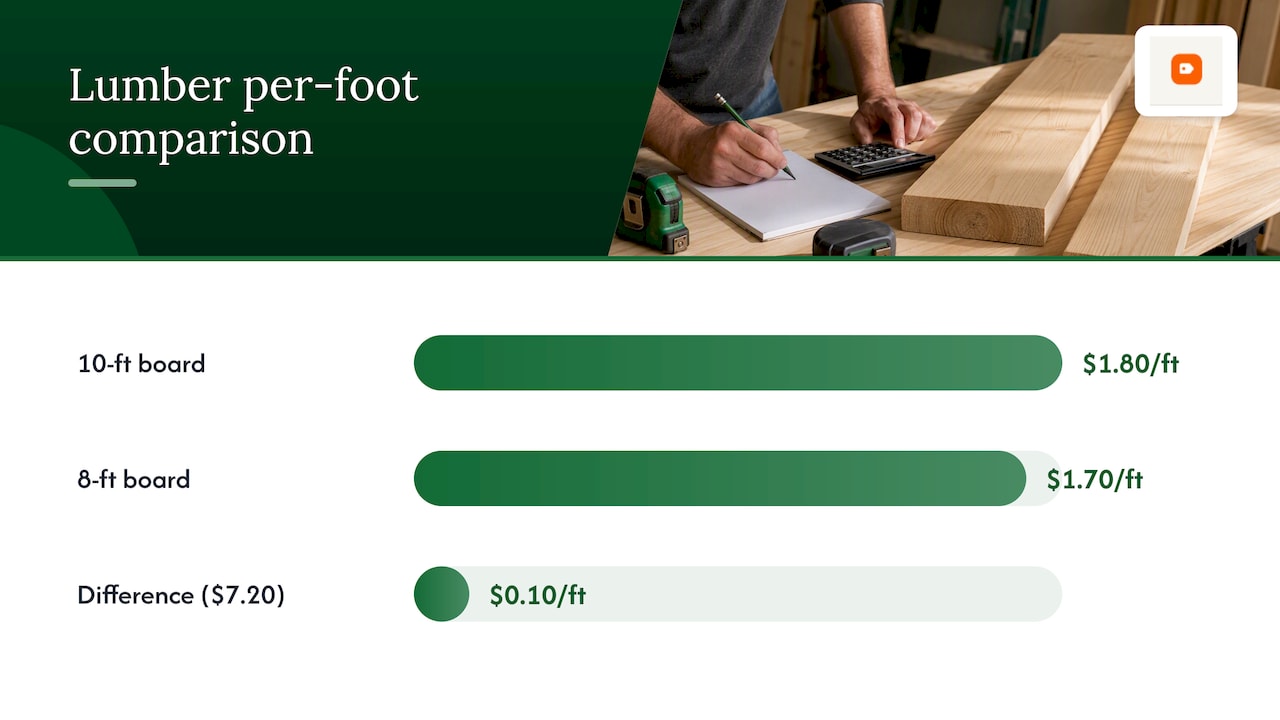
Lumber example. A 10-foot board costs $18.00, which works out to $1.80 per foot. An 8-foot board of the same grade costs $13.60, or $1.70 per foot. The shorter board is cheaper per foot by $0.10, so buying three 8-foot boards instead of three 10-foot boards saves $0.30 per foot across the project, or $7.20 total over 24 feet of material.
Fencing example. A 100-foot roll of chain-link fencing costs $215, or about $2.15 per foot. A 50-foot roll from the same brand costs $115, or about $2.30 per foot. The larger roll wins by $0.15 per foot, which adds up to $15 saved over a 100-foot fence line.
Cable example. A 250-foot spool of 12-gauge wire costs $87.50 (approximately $0.35 per foot), while a 500-foot spool costs $160 (about $0.32 per foot). Buying the larger spool saves $0.03 per foot, or $15 across 500 feet, assuming you will actually use that much.
- Always compute both options before assuming bulk is cheaper.
- Multiply the per-foot difference by your actual project length, not the package length, to see the real savings.
How to convert quotes into a fair cost-per-foot comparison
Plenty of real-world quotes bundle in charges that have nothing to do with length. Before dividing, check for:
- Mobilization or trip fees that apply once, regardless of job size.
- Permit costs tied to the project, not the footage.
- Packaging or freight charges added on top of material cost.
- Sales tax, which can shift the comparison between vendors in different states.
Suppose a contractor quotes $1,200 for 150 feet of fence installation, including a flat $200 mobilization fee. Subtract the fee first: $1,200 minus $200 leaves $1,000 for materials and labor, or $6.67 per foot, not $8.00 per foot. That $1.33 difference matters most on small jobs, where fixed fees make up a larger share of the total.
Stock length and installed length are not the same thing either. A 10 percent waste allowance is typical for fencing and decking due to cuts and trim loss, so budgeting on stock length alone tends to undercount what you'll actually spend. Measure the installed run, add your expected waste percentage, then calculate the per-foot rate on that adjusted figure.
Pro Tip: Subtract fixed fees before dividing, or spread them across your expected total footage so a small job doesn't look artificially expensive per foot.
Drilling cost-per-foot: the specialist formula and worked example
Drilling projects don't scale the same way lumber does. Rig time is billed by the hour or day regardless of how fast the bit advances, so a simple total-cost-over-length calculation misses the real driver of expense. The industry formula accounts for that:
CT = (B + CR (t + T)) ÷ F
- B is bit cost, the price of the drill bit itself.
- CR is rig cost per hour, the day rate converted to an hourly figure.
- t is drilling time in hours, how long the bit is actually cutting.
- T is round-trip time in hours, the time spent pulling and replacing equipment.
- F is footage drilled, the total depth achieved.
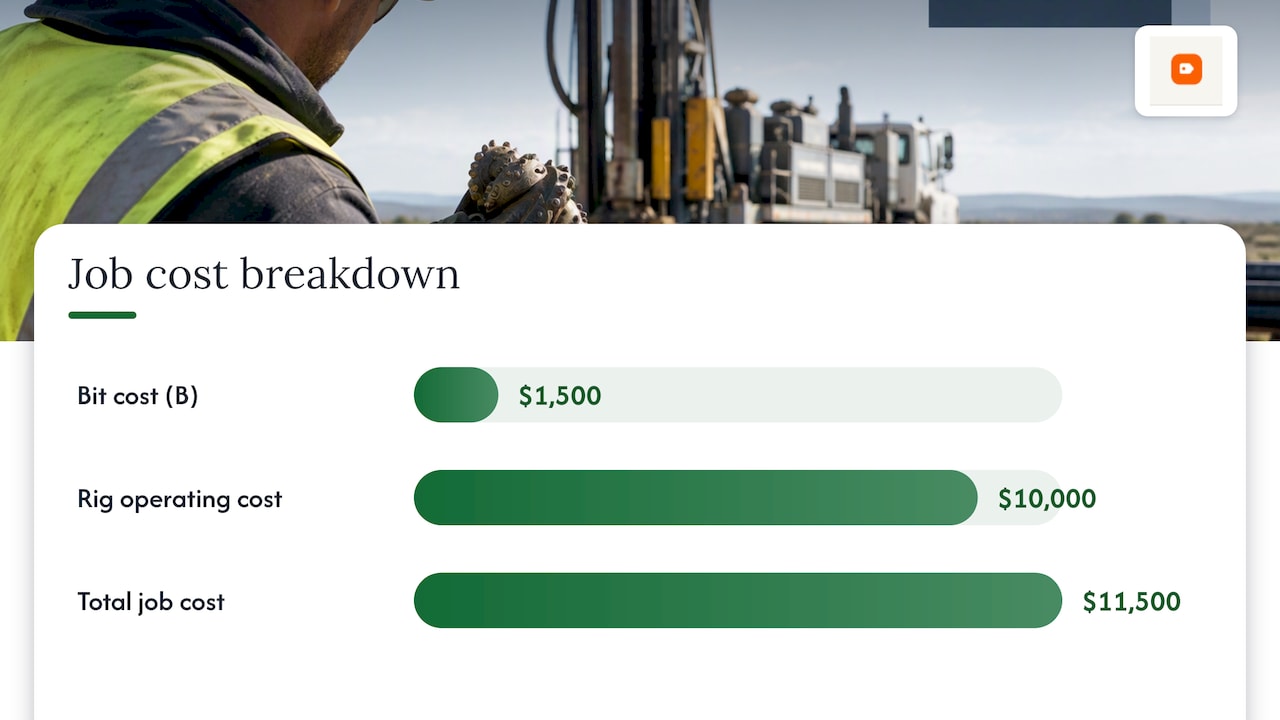
Say a bit costs $1,500, the rig runs $400 per hour, drilling time is 20 hours, round-trip time is 5 hours, and the crew drills 2,000 feet. That gives CT = ($1,500 + $400 × (20 + 5)) ÷ 2,000 = ($1,500 + $10,000) ÷ 2,000 = $5.75 per foot.
| Variable | Sample value |
|---|---|
| Bit cost (B) | $1,500 |
| Rig cost per hour (CR) | $400 |
| Drilling time (t) | 20 hours |
| Round-trip time (T) | 5 hours |
| Footage drilled (F) | 2,000 feet |
| Cost per foot (CT) | $5.75 |
Rig day rates vary by rig class and horsepower, and onshore rates typically run lower than offshore rates, so this formula is a starting point rather than a finished budget. For an active project, confirm actual day rates and scheduling with the drilling contractor rather than relying on general assumptions.
Unit-conversion checklist and quick reference
One rule covers almost every mistake: convert every length to feet using the official factor before you divide anything.
The international foot is fixed at 0.3048 meters, and that is the value every conversion above relies on. The older U.S. survey foot, a very slightly different unit once used in land surveying, was officially deprecated by NIST in favor of this international definition, so there's no reason to use anything else for everyday cost calculations.
How OutletPicks applies unit-normalized pricing
We built our tools around exactly this kind of math, because a sticker price without a unit rate hides more than it reveals. Our Unit Price Calculator takes two differently packaged listings, say a 250-foot cable spool and a 500-foot spool, and converts both to a per-foot price automatically. Our Price Per Square Foot Calculator does the same for area-based materials like flooring or sheet goods, including basic waste and rate adjustments.
- Unit Price Calculator: converts any pack size into a comparable per-foot, per-ounce, or per-count rate.
- Price Per Square Foot Calculator: handles area pricing, waste percentages, and quote comparisons side by side.
We update prices regularly, so the per-foot comparisons you see reflect recent listings rather than a one-time snapshot.
When the simple cost-per-foot is enough and when to get a full estimate
The basic formula works fine for small retail buys and quick vendor checks, where you're mainly comparing two packaging options at the shelf or online. It starts to break down for large installations, regulated drilling projects, or jobs with heavy logistics, where fixed fees, crew time, and scheduling drive more of the total than the raw material length does. For anything past a quick comparison, run the numbers through a calculator first, then request a detailed estimate from the vendor or contractor before committing.
Use OutletPicks calculators to run per-foot comparisons
We normalize unit prices across retailers so you can see the real per-foot cost before you buy, not just the number printed on the label. Our Unit Price Calculator handles cable, lumber, and fencing comparisons directly, and our Price Per Square Foot Calculator does the same for area-based materials.

- Pull up a listing, enter the price and length, and get an instant per-foot rate.
- Compare two package sizes side by side before adding anything to cart.
Prices update on a rolling cycle, so the comparison reflects what retailers are actually charging right now. Start at our categories page to browse normalized pricing across materials and everyday goods.
FAQ
How do I calculate average price per square foot?
Divide the total property or material cost by the livable or usable square footage. For example, a $300,000 property with 1,500 square feet works out to about $200 per square foot, using livable area only rather than total lot size.
What is a reasonable price per square foot?
A reasonable price depends heavily on material, region, and market conditions, so there's no single figure that applies everywhere. The more useful approach is comparing several quotes for the same scope using the same square footage basis, since that reveals which price is actually competitive.
How much should I charge or budget per linear foot?
Linear foot pricing depends on the material and labor involved, and it should be calculated as total cost divided by total length in feet, with fixed fees like mobilization removed first. Waste allowances, typically around 10 percent for materials like fencing or decking, should be added to the installed length before dividing — understanding how material choice shapes your renovation cost can help budget these variations accurately.
How do I calculate cost per front foot?
Front foot pricing follows the same core formula, total cost divided by the frontage length in feet, but it's commonly used for land or utility assessments where only the frontage dimension matters rather than full area. Convert any non-foot measurements first, using the standard conversion of 1 foot equals 0.3048 meters, before running the calculation.