
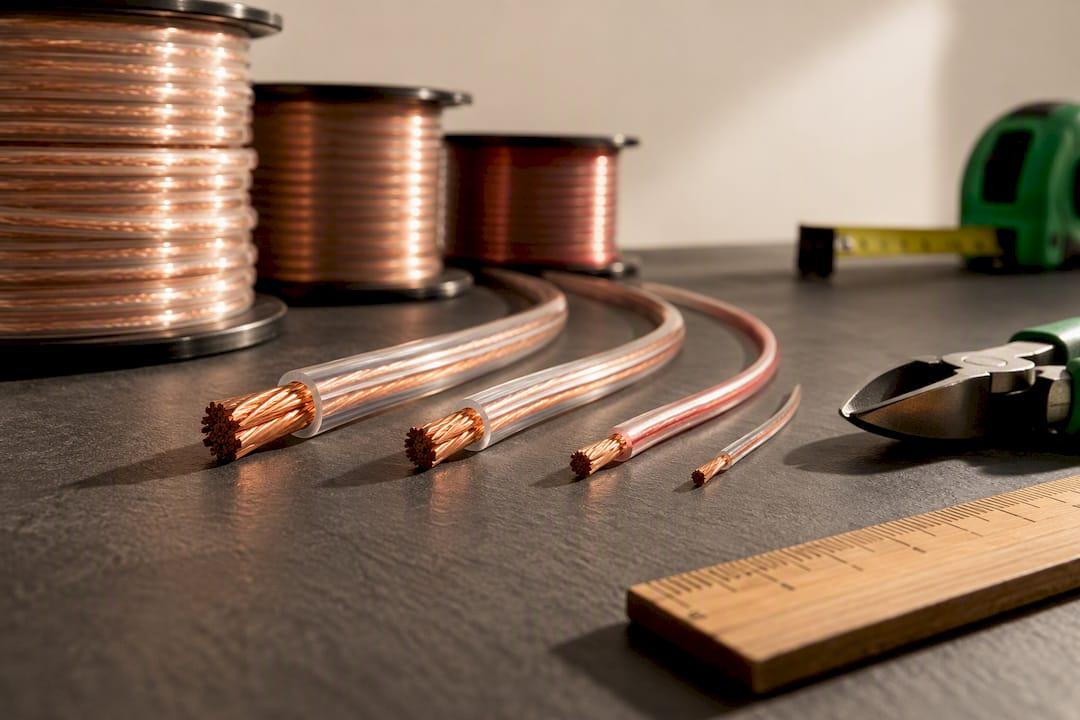
Most speaker wire runs between $0.20 and $1.85 per foot depending on gauge, with thicker 12 AWG wire costing more than thin 18 AWG wire. For runs under 50 feet with typical bookshelf or floor speakers, 16 AWG wire priced around $0.30 to $0.50 per foot hits the best balance of cost and performance. Switch to 12 or 14 AWG only when a run exceeds 50 feet or you're powering a high-current amplifier.
TL;DR:
- Longer runs over 50 feet or high-current amplifier use require thicker 12 or 14 AWG wire for optimal performance.
- Bulk spools offer lower per-foot costs compared to individual retail cuts, especially for runs exceeding 100 feet.
- Price differences are mainly driven by gauge, conductor material, construction, and branding, with oxygen-free copper and shielded construction costing more.
- Always normalize prices to the true cost per foot, including shipping and termination fees, before comparing retailer options.
- The choice of wire gauge and jacket rating is more critical for code compliance and safety than for sound quality in typical home setups.
Table of Contents
- How Much Does Speaker Wire Cost Per Foot by Gauge?
- What Makes Speaker Wire Prices Vary So Much?
- How Do You Calculate Total Speaker Wire Cost for a Room?
- How OutletPicks Compares Real Per-Foot Speaker Wire Prices
- When Is It Worth Paying More Than the Lowest Per-Foot Price?
- Find the True Cost Per Foot Before You Buy
- Sources
- FAQ
- When Does the Extra Cost Actually Make Sense?
How Much Does Speaker Wire Cost Per Foot by Gauge?
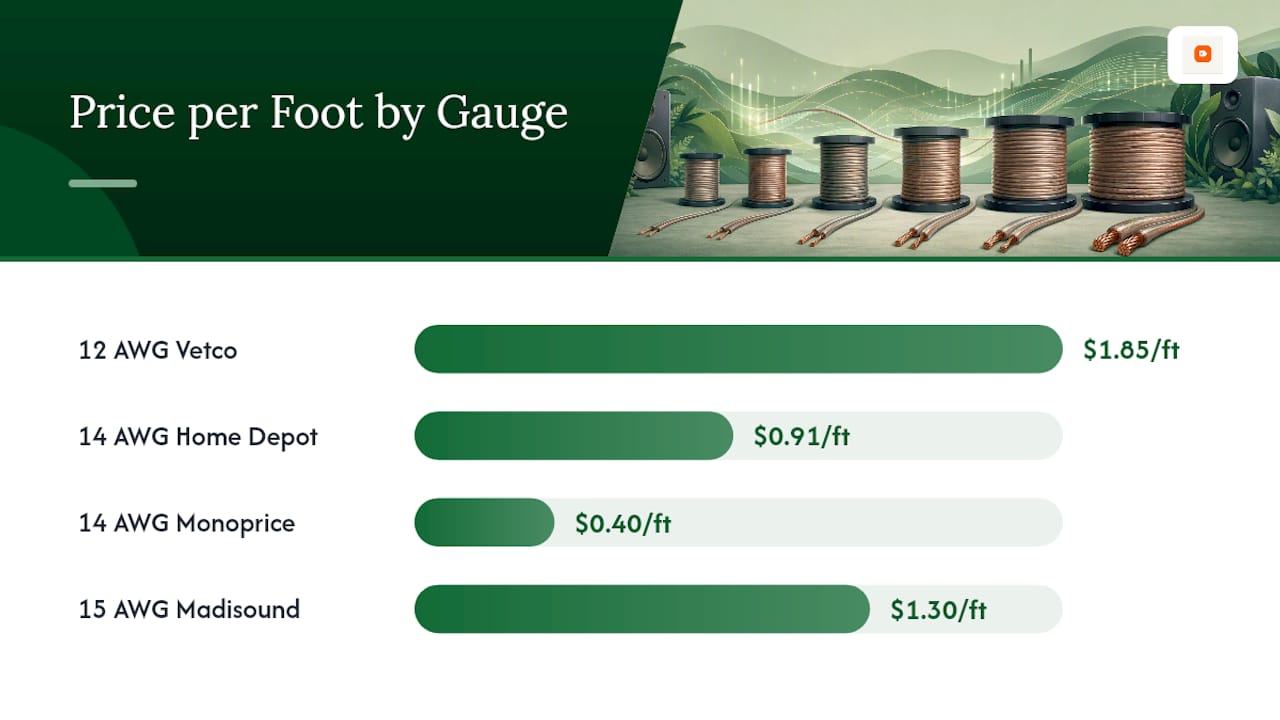
Real per-foot prices vary more than most buyers expect, and the gauge number tells you most of the story. Lower AWG numbers mean thicker copper, and thicker copper costs more to manufacture, so price climbs as the gauge number drops.
Here's what actual retailers and specialty sellers charge, based on current per-foot and bulk listings:
| Gauge | Example retailer | Price per foot | Notes |
|---|---|---|---|
| 12 AWG | Vetco | around $1.85 | Sold by the foot, standard 2-conductor copper |
| 14 AWG | Home Depot (Southwire) | around $0.91 | Per-foot in-store pricing, order limits apply |
| 14 AWG | Monoprice | around $0.40 | 100 ft spool at $39.99, CL2 rated |
| 15 AWG | Madisound (Supra) | around $1.30 | Audiophile-branded, oxygen-free copper |
Notice the gap between the two 14 AWG rows. Home Depot's per-foot Southwire listing runs more than double Monoprice's spool price for the same gauge, because buying a 100-foot spool spreads the cost differently than a true per-foot retail cut. Volume pricing tiers push the effective per-foot rate down the more you buy, which is why a 500-foot spool almost always beats a 25-foot cut on cost per foot.
One catch worth knowing before you order: per-foot retail listings often carry minimum and maximum order limits. Home Depot's Southwire listing, for example, caps orders at a set range of feet, so you can't just buy the exact 37 feet you measured. Check the limits before you plan a run down to the exact foot.
What Makes Speaker Wire Prices Vary So Much?
Two wires can look identical on a spool and cost wildly different amounts per foot. The difference almost always traces back to four things: gauge, conductor material, construction, and branding.
Wire gauge (AWG) drives the baseline cost. Lower AWG numbers mean more copper by volume, and more copper means a higher raw-material cost baked into every foot. Thicker gauge also matters more as distance increases, since resistance builds up over long runs and can quietly rob your amplifier of clean power.
Conductor type changes the math again. Standard copper is the baseline. Copper-clad aluminum (CCA) runs cheaper per foot but carries higher resistance and matters less for short runs. Oxygen-free copper (OFC) and silver-plated conductors, common in audiophile lines like Supra, push per-foot prices up because of tighter purity standards and marketing positioning.
Construction and ratings add their own premium:
- Stranded copper costs more than solid-core for the same gauge, since braiding fine strands takes extra manufacturing steps.
- CL2 or CL3 in-wall fire ratings, required for wire run inside walls or ceilings, add a real cost bump over standard jacket wire.
- Shielded or braided jackets, marketed for noise rejection, sit at the top of the price range.
- Pre-terminated ends (banana plugs, spades) add labor cost on top of the raw wire price.
What Hi‑Fi's buying guidance backs up the spending logic here: the outlet recommends putting roughly 10% of your total system cost into cables, and warns that a genuinely underpowered cable can bottleneck an otherwise good system.
How Do You Calculate Total Speaker Wire Cost for a Room?
Turning a per-foot price into an actual budget takes five steps, and most people skip the waste calculation, which is the one that bites them later.
- Measure the straight-line distance from your amplifier or receiver to each speaker, following the actual path along baseboards or through walls, not a diagonal guess.
- Add 10% to 15% to that number for slack, bends around corners, and connector clearance.
- Round up to the next sold length. If a retailer sells in 5-foot or 25-foot increments, round to whatever the store actually offers.
- Multiply your rounded total feet by the advertised price per foot.
- Repeat per speaker, then add every run together for your full project total.
Here's the math on two common setups:
| Setup | Total feet needed | Rate per foot | Total cost |
|---|---|---|---|
| Stereo pair, runs each | 44 ft (with waste) | $0.40 | $17.60 |
| 5.1 surround, mixed run lengths | 150 ft (with waste) | $0.91 | $136 |
A 5.1 system with long rear-channel runs adds up fast at retail per-foot pricing, which is exactly where spool pricing starts winning. Once your total climbs past 100 feet, a bulk spool at a lower per-foot rate almost always beats buying by the exact foot at retail, even after you account for wire you won't use. Just remember the order limits mentioned earlier. Some per-foot listings won't sell you less than 6 feet or more than 150 feet in a single order, so plan around those caps before you check out.
How OutletPicks Compares Real Per-Foot Speaker Wire Prices
Spool pricing, per-foot retail listings, and audiophile bulk pricing all use different math to arrive at a number, which makes side-by-side comparison genuinely hard without doing the division yourself. OutletPicks normalizes every listing down to true cost per foot, so a 100-foot spool and a 12-foot custom cut land on the same scale.
The workflow is simple: normalize every price to its per-foot rate, add in shipping and any termination fees the seller charges, then compare across volume tiers to see where the price actually breaks lower.
Run the math on two real listings. Monoprice's 100 ft 14 AWG spool comes to about $0.40 per foot at $39.99 total. The Home Depot per-foot Southwire listing runs about $0.91 per foot. Buy 44 feet, and that gap is the difference between $17.60 and roughly $40.
- Normalize every listing to price per foot before comparing anything else.
- Add shipping cost and any per-order fees back into the total before judging which deal wins.
- Check volume tiers. A 500-foot spool almost always drops the per-foot rate further than a 100-foot one.
Pro Tip: Before you commit to the lowest advertised per-foot number, check the seller's minimum order and any termination fee for pre-cut ends. A slightly higher per-foot price with no minimum can beat a cheaper rate that forces you to buy 150 feet you don't need.
When Is It Worth Paying More Than the Lowest Per-Foot Price?
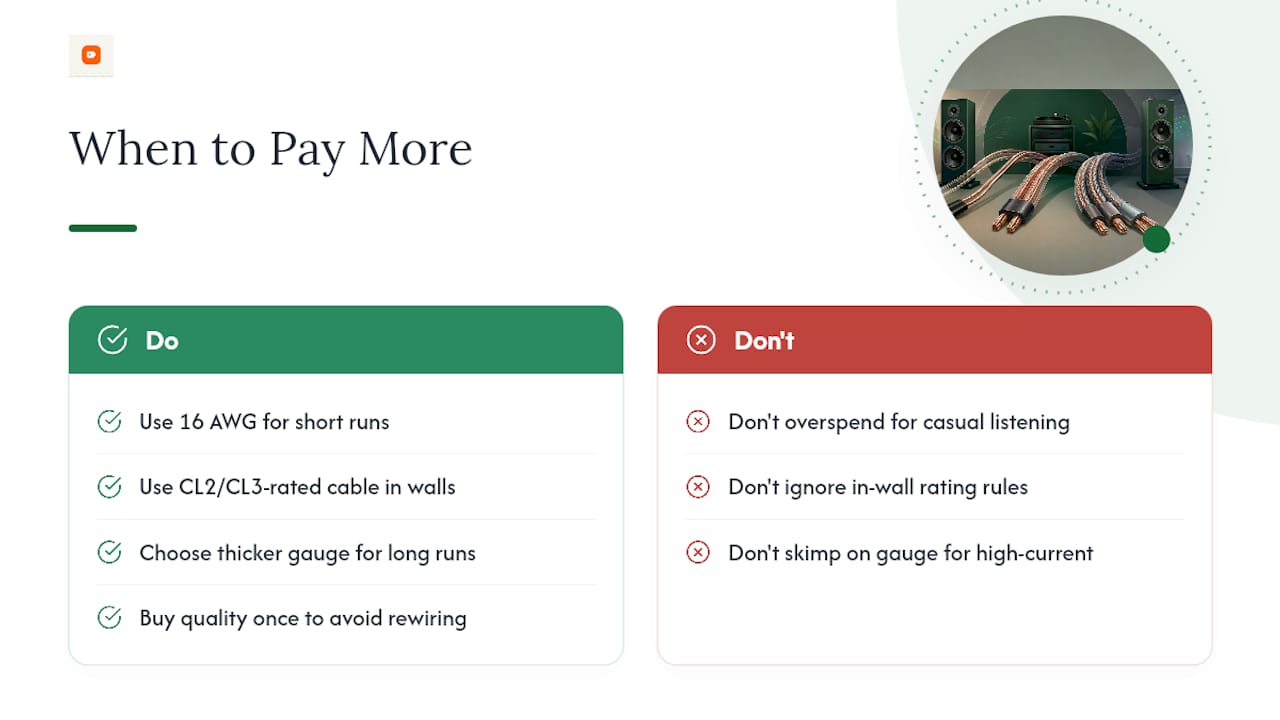
A casual listener running a 15-foot bookshelf setup doesn't need $1.85-per-foot wire. Standard 16 AWG copper at retail pricing does the job with room to spare.
Installers running wire inside walls need CL2 or CL3 rated jacket regardless of price, since that's a code requirement in most residential work, not a preference. Audiophiles chasing long runs or high-current amplifiers get a real, measurable benefit from thicker gauge and higher-purity copper. As What Hi‑Fi's Kashfia Kabir notes, a well-built cable within your budget protects system performance without demanding you overspend. Buy the better cable once, and you skip re-wiring later.
Find the True Cost Per Foot Before You Buy
Some price comparison platforms focus on the idea that the sticker price rarely tells you the real cost. Speaker wire is a perfect example, since a 100-foot spool, a 25-foot cut, and a bulk audiophile listing all use different math to reach their advertised number.

Instead of comparing raw prices across five browser tabs, run the numbers through OutletPicks' category comparison pages, where cables and other everyday products get ranked by real cost per unit rather than sticker price alone. Prices get rechecked on a rolling basis, so the per-foot rate you see reflects current retailer listings, not a snapshot from months ago. If you want the methodology behind how OutletPicks builds these comparisons, the studies hub walks through the same per-unit approach applied across other categories. Start with the categories page, pull up cables, and see which listing actually wins on cost per foot before you check out anywhere.
Sources
- Best speaker cables 2026: our 4 expert picks for every budget | What Hi‑Fi?
- Audiophile Speaker Wire | OFC & Silver Cables
FAQ
How much does speaker wire cost?
Most speaker wire runs $0.20 to $1.85 per foot depending on gauge and conductor type. Thin 18 AWG wire sits at the low end, while thick 12 AWG or audiophile-branded Supra wire from Madisound sits near the top.
How much does a foot of wire cost?
A single foot of standard 14 AWG speaker wire typically costs between $0.40 and $0.91, depending on whether you buy a bulk spool or a per-foot retail cut. Monoprice's 100 ft spool prices out around $0.40 per foot, while Home Depot's per-foot Southwire listing runs about $0.91.
What is the price of 100 feet of 16 gauge speaker wire?
Pricing for 16 AWG generally falls below 14 AWG rates, often landing in the $0.30 to $0.50 per foot range at retail, which puts 100 feet around $50 depending on the seller and packaging. Spool pricing on a 100-foot roll usually beats buying the same length cut to order.
How much should I charge per foot of wire for a labor job?
That depends on your local labor rates and isn't something a retail price guide can set for you, but installers typically price the wire itself at the per-foot retail or spool rate and add labor separately rather than marking up the cable itself. For your own material budgeting, OutletPicks' category pages can help you find the lowest true per-foot cost before you factor in labor.
When Does the Extra Cost Actually Make Sense?
— Alex
Everyone wants the lowest per-foot number, but the wire itself is rarely where a home system falls apart. Thin gauge over a short run to a pair of bookshelf speakers performs fine at $0.30 a foot, no upgrade needed. The mistake I see is buyers who assume more expensive automatically means better sound, when it's really about matching gauge to distance and matching jacket rating to where the wire lives. In-wall runs need CL2 or CL3 rated jacket. That's not optional, and it's not about audio quality at all. It's code. Outside of that one hard requirement, the honest advice is to buy the cheapest wire that's thick enough for your run length, put your real money into the receiver or speakers where it actually changes what you hear, and stop treating cable price as a proxy for system quality.