
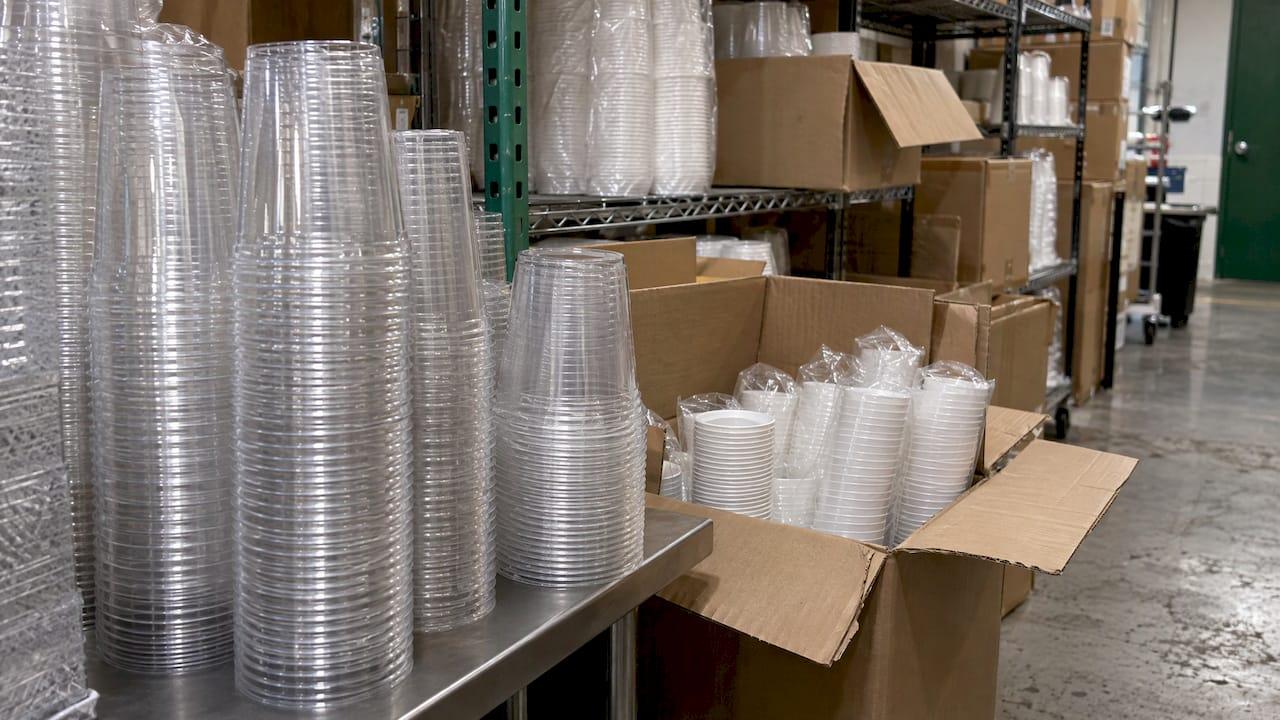
Most disposable plastic cups cost between about $0.03 and $0.37 each, depending on material, size, pack count and whether a lid is included. Bulk cases of thin cups sit at the cheap end. Small retail packs of thick, clear cups sit at the expensive end. The sticker price on the pack tells you almost nothing until you divide it by the number of cups.
This guide shows real listed prices per cup, explains why the same style of cup can cost three times as much in a different pack, and gives you a simple way to compare any two packs in under a minute.
TL;DR
- A standard plastic cup runs roughly $0.02 to $0.15 in bulk, and $0.25 or more in retail packs.
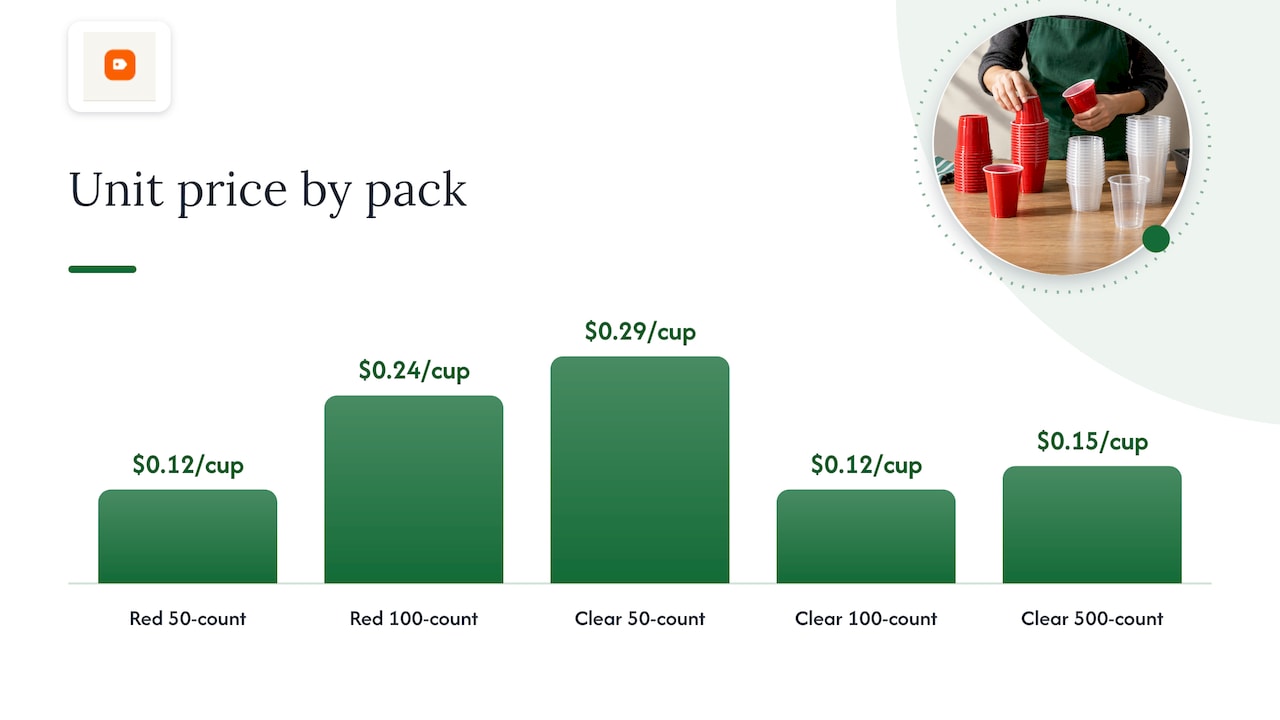
- Pack size matters more than brand: one retailer's clear cups run $0.29 each in a 50-pack and $0.12 each in a 100-pack.
- Cups with lids should be priced per cup-and-lid set, not per piece.
- Divide the total price by the cup count, then compare. Our unit price calculator does it for you.
- Buy the biggest pack only if you will use it and have room to store it.
Table of Contents
- What one plastic cup costs in the US
- Real price-per-cup examples
- How pack size changes the price per cup
- Cups with lids: count sets, not pieces
- How to compare any two cup packs
- Is a bigger pack worth it?
- Where the cheapest cups usually are
- Compare packs without the math
- FAQ
- Sources
What one plastic cup costs in the US
A typical range for a standard disposable cup is $0.02 to $0.15 per unit when bought in bulk, while retail packs often push the price to $0.25 or higher, according to a cost guide on plastic cups. That gap is the whole story of this topic: the cup itself is cheap, and what you pay for is mostly packaging, pack size and where you buy.
Material sets the baseline. The same guide breaks it down like this:
| Material | Bulk price per cup | Retail price per cup |
|---|---|---|
| Thin polypropylene (PP) | $0.02 to $0.04 | $0.05 to $0.08 |
| Heavy-duty PET | $0.06 to $0.12 | $0.15 to $0.25 |
| Polystyrene (clear, hard) | $0.08 to $0.15 | $0.20 to $0.35 |
These are ranges, not quotes. Real listings land inside and sometimes outside them, as the examples below show.
Real price-per-cup examples
Here are listings from major US sellers, converted to price per cup. Prices change, so treat these as a snapshot of how the math works rather than a shopping list. For current numbers, check the live listing.
Party cups in the 9 to 18 oz range
- Red 18 oz party cups, 50 count, at $5.92: about $0.12 per cup.
- Clear 9 oz party cups, 50 count, at $5.12 on the same page: about $0.10 per cup.
- Store-brand 18 fl oz party cups, 50 count, at $4.28: about $0.086 per cup.
- Hefty 16 oz assorted-color party cups, 400 per carton, at $84.83: about $0.21 per cup.
Notice that the cheapest 18 oz cup is a store brand in a 50-pack, and the most expensive is a name-brand cup in a 400-count carton. A bigger pack did not mean a cheaper cup there. Brand and cup thickness mattered more.
Small portion cups
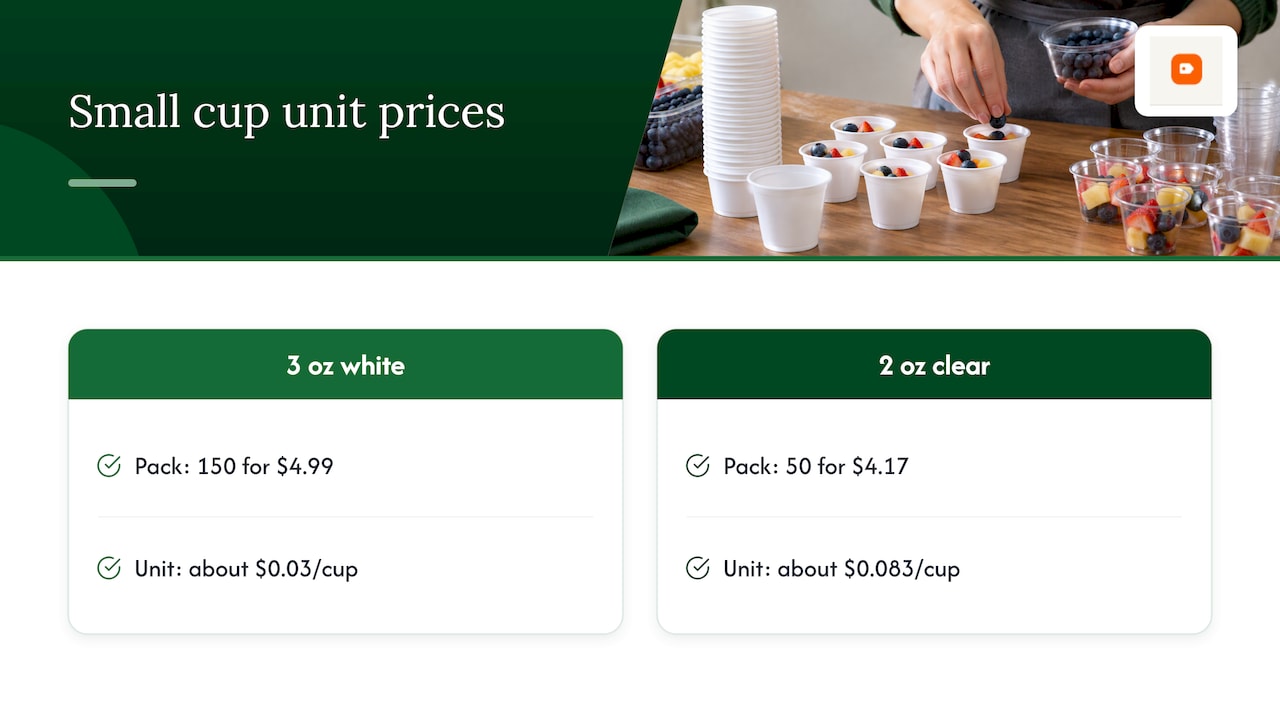
Tiny cups follow the same math. A 3 oz white cup in a 150-count pack at $4.99 works out to about $0.03 per cup. A 2 oz clear cup in a 50-count pack at $4.17 is about $0.083 each. Smaller does not automatically mean cheaper per cup: the 50-count pack is the issue, not the ounces.
Clear drink cups for iced coffee and smoothies
Clear PET cups cost more per cup in small packs and drop sharply in cases:
| Cup | Pack | Listed price | Per cup |
|---|---|---|---|
| 12 oz clear PET cold cup | 50 | $5.49 | about $0.11 |
| 9 oz tall clear PET cold cup | 50 | $6.19 | about $0.12 |
| 20 oz clear PET cold cup | 600 | $39.49 | about $0.07 |
| 16 fl oz UltraClear PET cup | 50 | $18.64 | about $0.37 |
The 20 oz case cup is nearly the cheapest in the table despite being the largest. The 16 fl oz cup at $0.37 is more than five times its price per cup. Same category, wildly different value.
Compostable cups
Compostable cold cups cost more. A 24 oz PLA compostable cold cup in a 1,000-count case at $208.99 comes to about $0.21 per cup. That listing describes the cups as commercially compostable, NSF certified and USDA certified biobased, with a temperature tolerance of 40 to 105 degrees Fahrenheit, so they are meant for cold drinks only.
How pack size changes the price per cup
The same cup can have a very different unit price depending on the pack. Two examples from the research:
- A retailer's red 18 oz cups list at $5.92 for 50, or about $0.12 each, while a separate 100-count listing of red 18 oz cups shows $23.90, about $0.24 each. The bigger pack cost twice as much per cup.
- On one office-supply page, clear cups are $14.29 for 50, or $0.29 per cup, $11.59 for 100 ($0.12 per cup), and $76.89 for a 500-carton ($0.15 per cup).
The second example is a good lesson. The 100-pack beat the 500-carton, and the 50-pack was by far the worst. If you had only compared "cheap box" against "expensive carton," you would have picked wrong. Only the per-cup number tells you.
There is also a general pattern worth knowing: a standard commercial case usually holds 500 to 1,000 cups, bundled in sleeves of 50, and buying at that volume is the most reliable way to get the lowest price. A value pack at a big-box store is rarely as cheap per cup as a case from a restaurant supply warehouse. For a deeper look at when bigger packs pay off across categories, see our piece on when bulk beats single packs.
Cups with lids: count sets, not pieces
When lids are included, the price per cup rises, and the way the pack is described can mislead. A pack with 100 cups, 100 lids and 100 sleeves serves 100 drinks, not 300. Always divide by the number of usable cup-and-lid sets.
A store-brand example: 16 fl oz cups with strawless sip lids, 25 sets, at $4.96, comes to about $0.20 per set. The lids are described as leak-resistant and made for drinking without a straw.
Two more habits help with lids:
- Check lid compatibility. Some cups fit a standard lid size, which lets you mix and match cups and lids from the same family. Confirm this on the listing before buying cups and lids separately.
- Read ounces as approximate. Seller pages note that stated ounces are an approximate maximum capacity based on an industry standard size, not a serving measure. A 20 oz cup may have a practical fill capacity of about 18 oz, as one case listing spells out. If you are comparing by ounces of drink, keep that in mind.
How to compare any two cup packs
The method is the same for a birthday party and a cafe. It takes four steps.
- Find the real count. Look for the number of cups, not the number of sleeves or packs. A 2-pack of 25-count sleeves is 50 cups.
- Divide price by count. $11.59 for 100 cups is $0.1159 per cup. Round only at the end.
- Add delivery and tax. For a delivered-cost comparison, add shipping and tax to the price, then divide by the usable count. A free-shipping pack and a cheaper pack with shipping can switch places.
- Match the cup. Compare the same material and rough size. A thin PP party cup and a heavy PET clear cup are different products even when both say 16 oz.
The idea of putting every pack on the same footing is not unique to cups. It is why unit price is the number we care about, and why per-cup math beats the package sticker in everything from coffee to paper goods. A reusable pod versus single-use comparison makes the same point for coffee: the cost of one serving tells you more than the cost of the box.
A worked example
Suppose you need cups for a graduation party with about 80 guests, and each guest may use two cups. That is 160 cups.
- Option A: three 50-count packs of 18 oz party cups at $5.92 each is $17.76 for 150 cups, about $0.118 each. You are 10 short, so add a fourth pack: $23.68 for 200 cups, with 40 left over.
- Option B: a 100-count pack at $11.59 plus a second 100-count pack is $23.18 for 200 cups, about $0.116 each.
The totals are nearly identical, so the tie-breaker is cup quality and leftover use, not price. The point is that you only see this by working in cups, not boxes.
Is a bigger pack worth it?
A larger pack often lowers the cost per cup, but not always, as the 500-carton example showed. It also ties up storage space and cash. If you are trying a new cup style, lid fit or serving routine, start with a smaller pack and scale up once the trial matches your expected usage.
For events, buy to your headcount plus a modest cushion. For a cafe, bakery or home business, a case of 500 to 1,000 cups usually makes sense once you know your weekly use. If your shopping spans many everyday items, our what things cost per unit table shows how this kind of pack math plays out across categories.
Custom printing is a different price tier. It adds a setup fee plus roughly $0.05 to $0.15 per cup, so a $0.07 cup can become a $0.12 to $0.22 cup once your logo is on it.
Where the cheapest cups usually are
From the listings above, a few patterns hold:
- Store-brand party cups in 50-count packs land near $0.09 to $0.12 per cup.
- Restaurant supply cases of 500 to 1,000 clear PET cups can fall near $0.07 per cup.
- Dollar-store cups can look cheap on the shelf. One 16 oz translucent cup listing is $1.50, which is $0.09 per ounce, but the page does not give a pack count, so you need the count on the package before you can know the price per cup.
- Premium clear cups in small packs and compostable cups sit at $0.20 and up.
You can see how different store types stack up on our stores page, and browse the product groups we price on our categories page.
Our take: price the cup, not the box
We built OutletPicks on one belief: the sticker price is the least useful number on a package. A 50-count pack and a 500-count carton cannot be compared until both are turned into cost per cup, per diaper, per page or per foot.
Cups prove the point better than almost anything. In the listings above, a bigger pack was cheaper per cup in some cases and more expensive in others. Material, brand and lids changed the answer more than size did. Only a normalized number cuts through that.
That is why we calculate and rank products by real cost per unit, regardless of pack size or brand, and recheck prices on a rolling cycle. When you shop for anything sold in multiples, do the division first, then decide. You can read how we do it in our methodology.
Alex
Compare packs without the math
Doing the division by hand works for two packs. It gets tedious with six. Our unit price calculator takes a price and a count and gives you the cost per unit, so you can line up different cup packs side by side.
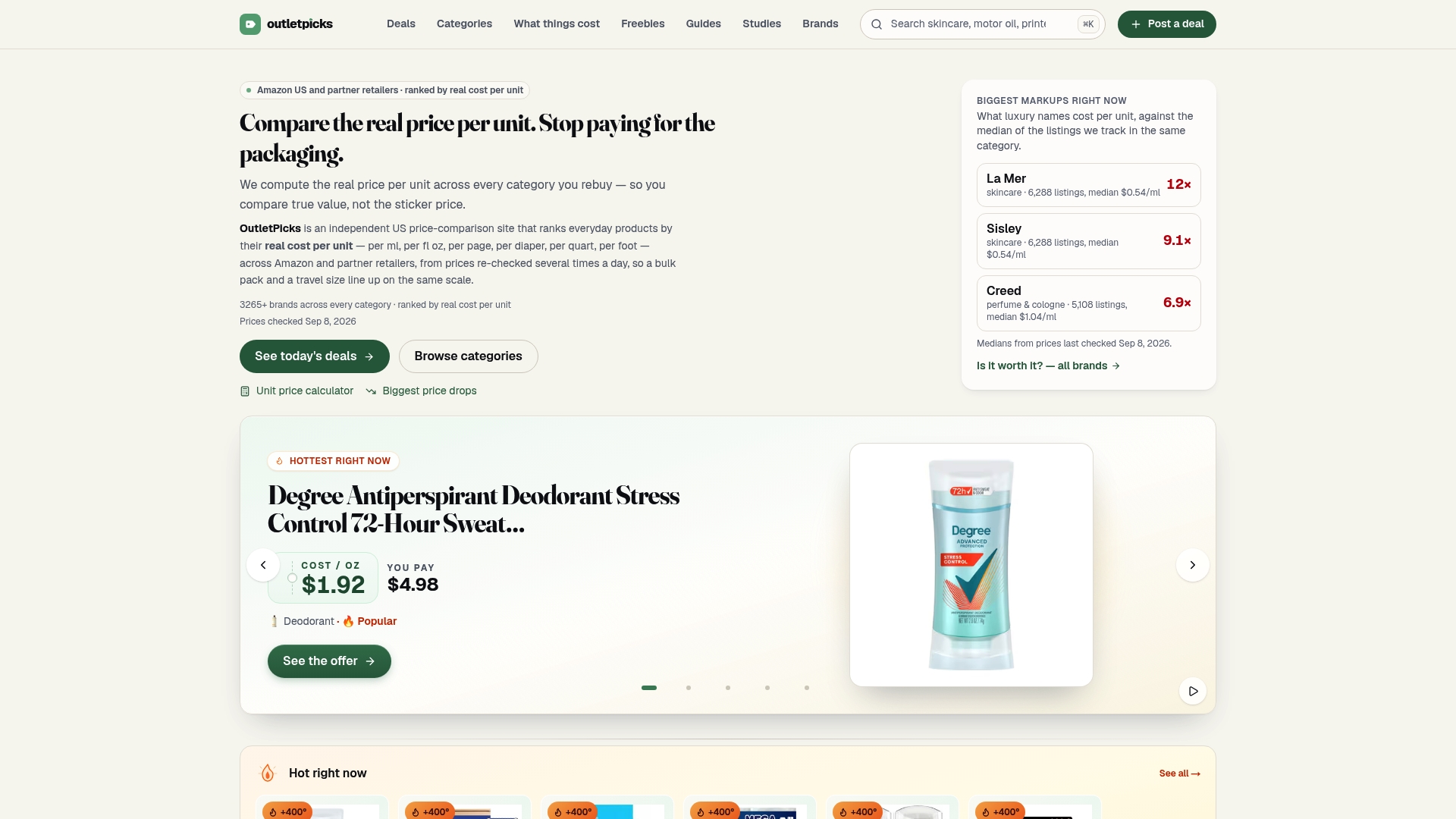
For everyday categories beyond cups, browse OutletPicks to see products ranked by real cost per unit across Amazon and partner retailers. If you like a quick challenge, try our daily Packle game and see if you can spot the cheapest pack per unit.
FAQ
How much does one plastic cup cost?
In bulk, a standard plastic cup typically costs about $0.02 to $0.15. In retail packs it often costs $0.25 or more. Real listings we reviewed ranged from about $0.03 for a 3 oz cup to $0.37 for a premium 16 fl oz clear cup.
Is it cheaper to buy plastic cups in bulk?
Usually, but not always. Cases of 500 to 1,000 cups tend to give the lowest price per cup. Still, one office-supply listing priced a 100-pack at $0.12 per cup and a 500-carton at $0.15, so always divide price by count before assuming the bigger pack wins.
How do I calculate price per cup?
Divide the total price by the number of cups in the pack. For cups with lids, divide by the number of cup-and-lid sets, not the number of pieces. If you want a true delivered cost, add shipping and tax first.
Why are clear plastic cups more expensive than party cups?
Clear cups are often made from heavier PET or polystyrene, which carry higher price ranges than thin polypropylene. The same price guide puts thin PP at $0.02 to $0.04 in bulk and polystyrene at $0.08 to $0.15. Lids and compostable materials push the price up further.
Sources
- How Much Do Plastic Cups Cost?
- White disposable cups, 3 oz, 150 count
- Translucent plastic cups, 16 oz
- Clear plastic disposable cups
- Clear disposable plastic cups, 2 oz, 50 count
- 18 fl oz everyday party cups, 50 count
- Hefty Easy Grip party cups, 16 oz
- 20 oz clear PET cold cups, 600 per case
- 24 oz PLA compostable cold cups
- 9 oz tall clear PET cold cups
- 12 oz clear PET cold cups
- Reusable pod versus single-use comparison