
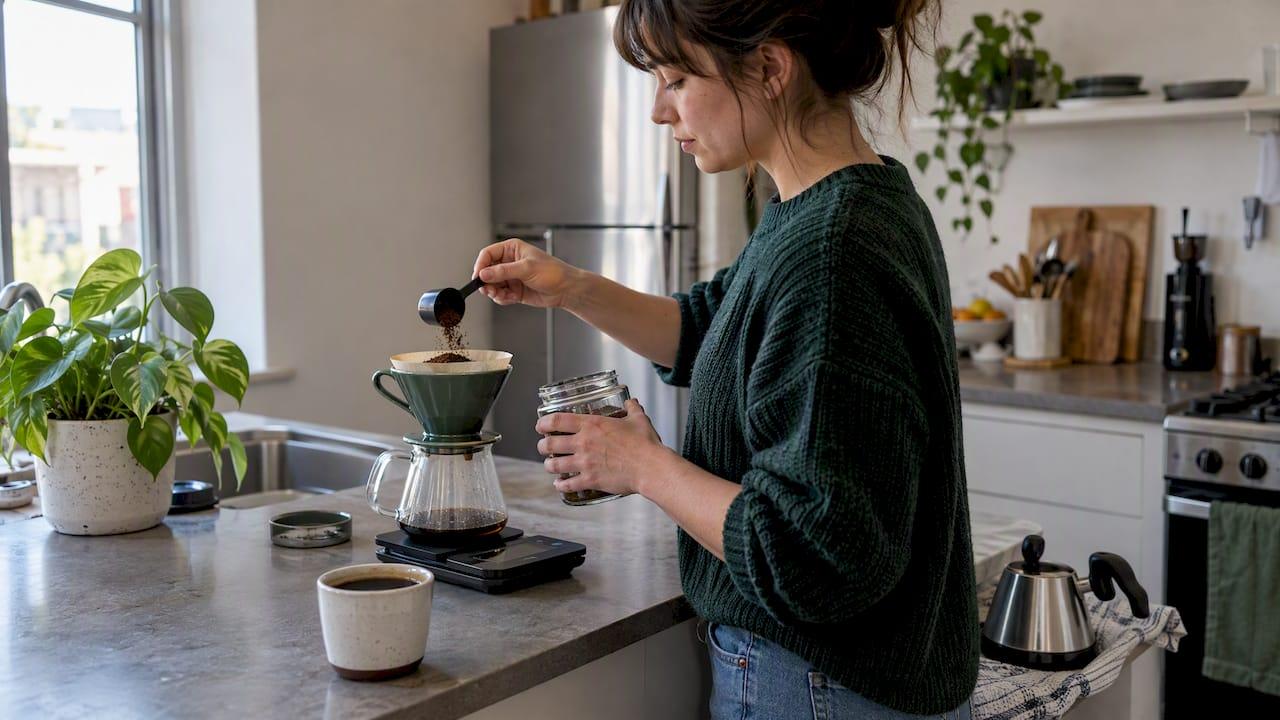
A plain home-brewed cup of coffee typically costs between $0.30 and $0.50 in ingredients alone, and the number that moves the most is the dose: how many grams of coffee you use. Using the BLS retail price series as a benchmark and Specialty Coffee Association guidance on brew ratios, this guide builds your real per-cup number from the ground up rather than quoting a vague average.
TL;DR:
- The average cafe drip coffee price is around $3.27, leading to potential savings of over $1,000 annually for one to three cups brewed at home daily.
- Small habits like weighing doses and shopping by cost per gram significantly reduce expenses without sacrificing quality.
Table of Contents
- Quick cost-per-cup calculator example using the BLS benchmark
- Ingredient and overhead breakdown for a full per-cup cost
- Method-by-method cost comparison: drip, pour-over, French press, espresso, cold brew, and pods
- Step-by-step: calculate your own cost per cup
- How home brewing compares to cafe prices and annual savings
- Practical ways to lower your cost per cup
- How OutletPicks calculates cost-per-unit for everyday products
- What actually matters when you calculate coffee cost
- Run your own coffee cost numbers
- Sources
- FAQ
Quick cost-per-cup calculator example using the BLS benchmark
As of July 2026, the U.S. city-average retail price for ground roast coffee was $9.317 per pound, which works out to about $0.0205 per gram. That single figure is the base of every calculation below. Multiply it by your dose and you get the coffee-only cost per cup, before filters, water, electricity or milk.
- 15 g dose: $9.317 ÷ 453.6 × 15 ≈ $0.31 per cup
- 18 g dose: $9.317 ÷ 453.6 × 18 ≈ $0.37 per cup
- 21 g dose: $9.317 ÷ 453.6 × 21 ≈ $0.43 per cup
Those numbers cover the beans only. Electricity, filters and milk add a few cents more, which the next section breaks down line by line. You can rerun this math for your own bag price and dose with the Coffee Ratio Calculator.
Ingredient and overhead breakdown for a full per-cup cost
The coffee itself is only one line. A full accounting adds consumables and a small slice of overhead, and most of it is cents, not dollars.
Start by converting your bag price into a per-gram figure: divide the price by the bag's weight in grams (use this pounds to grams reference if your bag is labeled in pounds, or ounces to grams if it's labeled in ounces). Then add:
- Filters: paper filters typically run a few cents each for drip or pour-over.
- Water: effectively negligible per cup from a municipal tap.
- Milk or sweeteners: anywhere from nothing (black coffee) to $0.20 or more for a latte-style pour.
- Equipment amortization: purchase price divided by expected lifetime cups, which can be a fraction of a cent for a cheap drip machine or several cents for an espresso machine used lightly.
- Waste: grounds and occasional spilled or dumped brews, usually a small percentage of the batch.
A residential kWh runs about $0.197 in the July 2026 BLS regional data, so a drip machine drawing roughly 0.05 kWh per brew cycle adds about $0.01 per pot. For a deeper walkthrough of converting appliance wattage into a per-use cost, the same logic used for a refrigerator's running cost applies directly to coffee makers.
Method-by-method cost comparison: drip, pour-over, French press, espresso, cold brew, and pods
Brewing method changes the dose, and dose changes the price, more than almost any other factor. Holding a roughly 12 oz serving as the reference point:
- Drip and pour-over typically use 15 to 18 g per cup, landing in the $0.31 to $0.37 range for coffee alone, plus a filter and a cent or two of electricity for drip.
- French press often calls for a slightly coarser, heavier dose around 18 to 21 g, putting ingredient cost near $0.37 to $0.43, with no filter cost and no electricity.
- Espresso uses a concentrated 18 to 21 g dose for a shot, so the ingredient cost lands near $0.37 to $0.43, but the machine itself carries a high upfront price that only amortizes cheaply at high daily volume.
- Cold brew uses a much higher coffee-to-water ratio steeped over hours, which raises the grams used per serving and pushes ingredient cost toward the higher end of the range.
- Pods carry a separate, higher per-cup price because you're paying for packaging and convenience on top of the coffee itself, often well above the per-gram cost of bulk beans.
Delish's method-by-method breakdown found per-cup ingredient costs ranging from about $0.23 to $0.60 depending on brew method and dose, a useful precedent though it used an older price benchmark than the July 2026 figure used here.
| Method | Typical dose | Ingredient cost (approx.) | Main cost driver |
|---|---|---|---|
| Drip | 15-18 g | $0.31-$0.37 | Filter, small electricity draw |
| Pour-over | 15-18 g | $0.31-$0.37 | Filter |
| French press | 18-21 g | $0.37-$0.43 | Dose only, no filter |
| Espresso | 18-21 g | $0.37-$0.43 | High upfront machine cost |
| Cold brew | Higher ratio | Upper end of range | Larger coffee-to-water ratio |
| Pods | Fixed per pod | Highest of all methods | Packaging and convenience premium |
Step-by-step: calculate your own cost per cup
The core formula stays the same no matter what beans or machine you use: (bag price ÷ bag weight in grams) × grams used = coffee ingredient cost per cup. Add consumables and overhead on top: plus water, plus a filter if used, plus (appliance kWh × your electricity rate), plus (equipment price ÷ expected cups), plus a small allowance for waste.
- Budget beans template: a $7 bulk bag at 900 g works out to about $0.0078 per gram, so an 18 g cup costs roughly $0.14 in coffee alone.
- Typical specialty bag template: a $16 bag at 340 g (12 oz) is about $0.047 per gram, putting an 18 g cup near $0.85 before extras.
- Pod scenario template: take your pack price divided by pod count, since each pod is a fixed-dose, fixed-cost unit regardless of how many grams of actual coffee it contains.
Plug your own numbers into the Coffee Ratio Calculator to skip the manual math.
How home brewing compares to cafe prices and annual savings
Cafe drip coffee runs around $3.27 on average according to Toast POS pricing data, a figure that bundles far more than beans.
- Labor, rent, and service are baked into that menu price, which is why it can't be compared directly to a home ingredient cost of $0.31 to $0.43.
- One cup a day at home versus cafe saves roughly $2.84 to $2.96 daily, or somewhere near $1,000 to $1,080 a year.
- Two cups a day roughly doubles that gap, and three cups a day roughly triples it, since the per-cup savings compound with volume.
The comparison only holds if you're comparing black coffee to black coffee. Add cafe-style milk drinks on one side and the gap narrows.
Practical ways to lower your cost per cup
Small habits move the needle more than switching brands. A kitchen scale is the cheapest upgrade available: the Specialty Coffee Association's research on brew ratios shows that ratio controls strength directly, so cutting your dose to save money just makes weaker coffee rather than cheaper coffee at the same quality.
- Shop by cost per gram, not bag price, since a bigger bag at a higher sticker price is often cheaper per cup.
- Weigh your dose instead of eyeballing a scoop, for consistent taste and a consistent budget.
- Consider refillable pods or bulk pod alternatives if convenience matters more than switching methods entirely, as comparisons between pods and whole beans lay out.
- Run a payback calculation before buying a pricier brewer: divide the machine's cost by your expected per-cup savings versus pods to see how many months it takes to break even.
Pro Tip: Weigh one week of your actual coffee use on a kitchen scale before you buy in bulk. It tells you your real dose, which is the only number that makes any cost comparison accurate.
How OutletPicks calculates cost-per-unit for everyday products
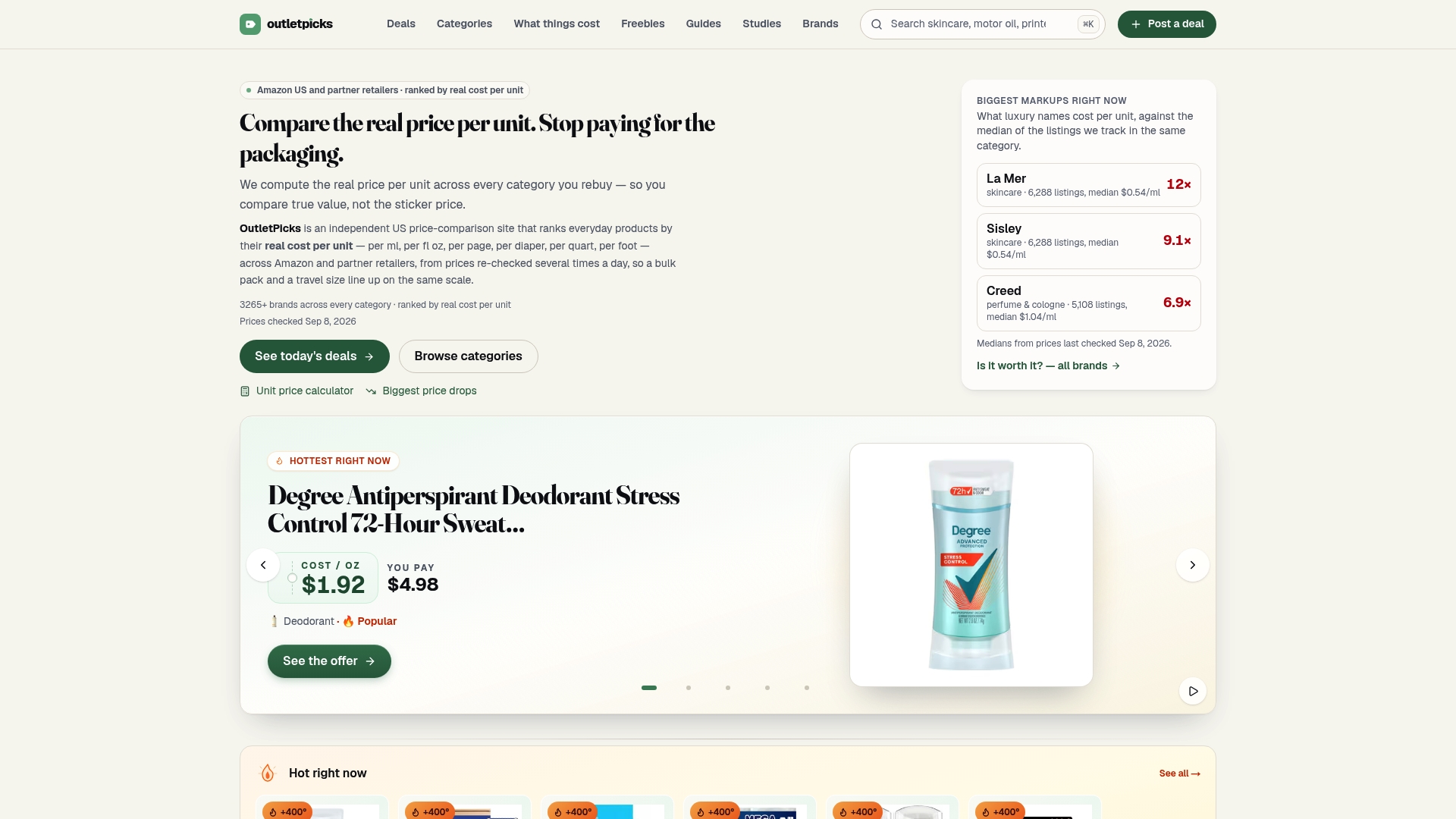
OutletPicks builds its per-unit rankings the same way this guide builds a per-cup number: take the total price, divide by the real unit (grams, milliliters, diapers, pages), and update the inputs on a rolling cycle rather than relying on a one-time snapshot.
- Conversion tools for pounds to grams and ounces to grams handle the unit math automatically.
- Figures throughout this guide draw on the BLS retail price series, SCA brewing guidance, and published retail pricing, refreshed as new data becomes available.
What actually matters when you calculate coffee cost
Most advice on coffee spending treats the whole topic as an average, a single number meant to cover every bag, every method, and every household.
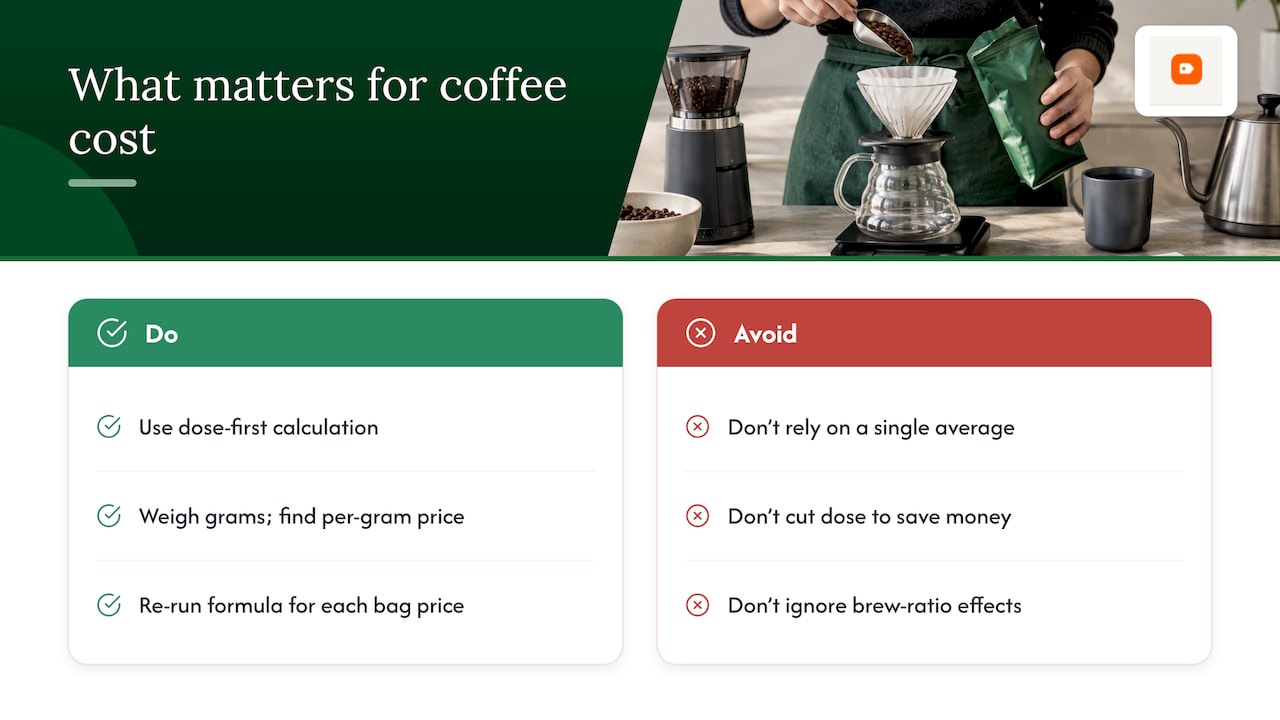
The more useful habit is dose-first thinking: know your grams, know your per-gram price, and multiply. Everything else, the filters, the kWh, the equipment depreciation, is a rounding error next to that one variable. Readers chasing the cheapest possible cup often cut dose to save money, which the SCA's own research on brew ratio shows just produces weaker coffee at a worse price-to-satisfaction trade, not a genuinely cheaper one.
If you take one thing from this guide, make it the formula, not the range. A range goes stale the moment coffee prices move. A formula you can rerun with this month's bag price and your own scale never does.
— Alex
Run your own coffee cost numbers
OutletPicks built the Coffee Ratio Calculator to turn bag price, bag weight, and your dose into an exact per-cup figure, using the same math walked through above.
- Enter your bag's price and weight along with your preferred dose to get an instant per-cup cost.
- Compare that figure against bulk, specialty, and pod pricing to see which option actually fits your budget.
- Browse the brand index ranked by real cost per unit if you're shopping for cheaper beans by the gram rather than by the bag.
Sources
- Average Price: Coffee, 100%, Ground Roast, All Sizes (APU0000717311)
- How Much Does Your Cup Of Coffee Really Cost? — Delish
- How strong is the coffee you're cupping? — Specialty Coffee Association
- How much is a cup of coffee? — Toast (POS)
- Average Retail Food and Energy Prices, U.S. and Midwest Region — BLS
FAQ
How much is 1 cup of coffee?
A home-brewed cup typically costs $0.30 to $0.50 in ingredients, depending on dose and brew method. Using the July 2026 BLS benchmark, an 18 g cup costs about $0.37 in coffee alone before filters or electricity.
How much is 1 cup of coffee at Starbucks?
Chain and independent cafe pricing varies by location, drink size, and add-ins, so there's no single fixed number that applies everywhere. For a general cafe benchmark, Toast POS data puts average drip coffee menu pricing around $3.27, which includes labor and overhead, not just the coffee itself.
How much does a 12 oz cup of coffee cost?
At home, a 12 oz cup brewed with an 18 to 21 g dose costs roughly $0.37 to $0.43 in coffee alone, based on the BLS per-pound benchmark. Add a filter, a few cents of electricity, and any milk to get your full per-cup figure.
How much does a cup of coffee cost on average in the US?
Home-brewed black coffee typically runs $0.30 to $0.50 per cup in ingredients, while a cafe-bought cup averages closer to $3.27 according to Toast POS pricing data. The gap comes from labor, rent, and service costs baked into the cafe price rather than differences in the coffee itself.