
The cheapest parchment paper per foot is usually a big store-brand roll, and in the listings we checked it came to about 6 cents per linear foot. Name-brand rolls ran from about 8 to 10 cents per foot. Small specialty rolls ran 30 cents or more. Price per foot only works when rolls share a width, though. To compare any two boxes honestly, convert both to price per square foot. This guide gives the formula, worked examples and the checks that tell you whether a deal is real.
TL;DR
- Price per linear foot is the price divided by the roll length in feet. It is only fair between rolls of the same width.
- Price per square foot is the better yardstick: price divided by length times width (in feet). It works across widths, and it works for precut sheets too.
- In the listings we checked, rolls ran from about 6 cents to about 30 cents per linear foot. The gap is large enough to matter if you bake weekly.
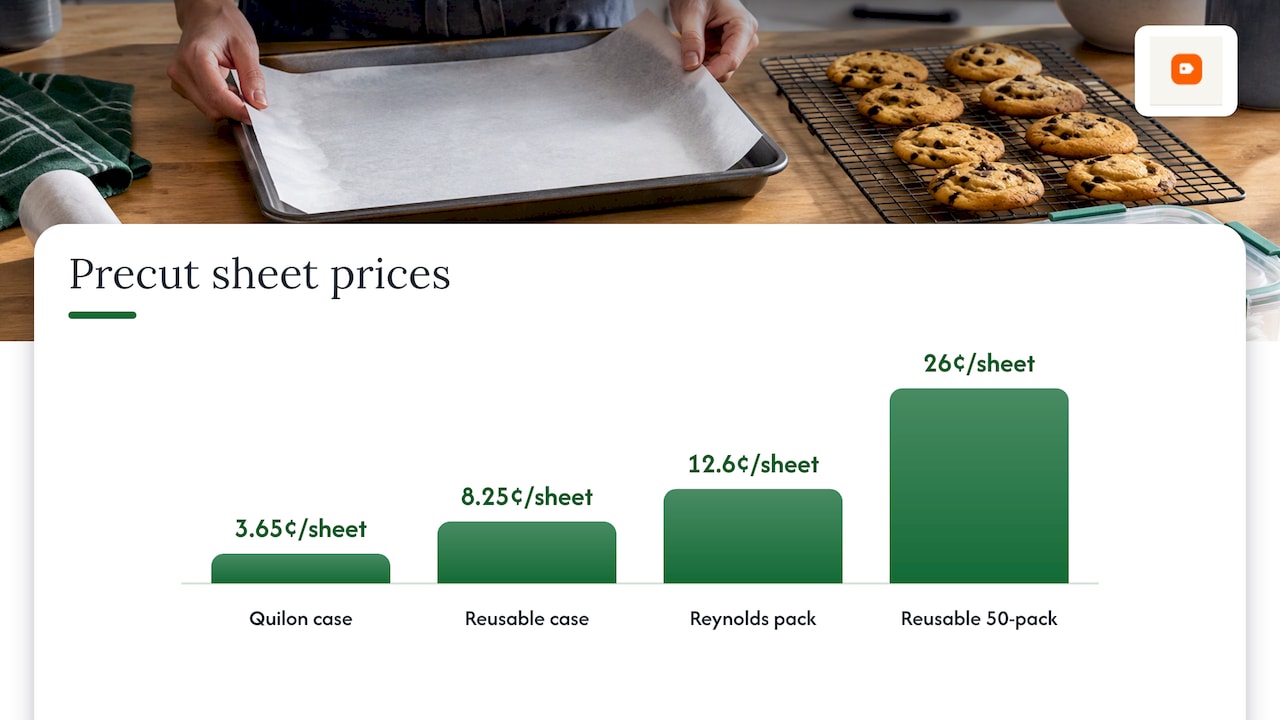
- Sheet count, sheet size and pack size change the unit price a lot. The same liner can cost 3.65 cents or 26 cents per sheet depending on the pack.
- A cheaper roll that tears, curls or leaves grease behind is not cheaper. Check heat rating and release as well as the unit price.
Table of Contents
- How to calculate parchment paper price per foot
- What popular rolls cost per foot
- When the listing hides the width
- Rolls versus precut sheets
- How to tell if a parchment deal is genuinely cheaper
- What else decides value besides the price per foot
- Our perspective
- See real cost per unit across categories
- FAQ
- Sources
How to calculate parchment paper price per foot
The math takes about ten seconds once you know where to find two numbers on the box: the roll length in feet and the width in inches.
Price per linear foot = price ÷ length in feet.
A $3.59 roll that is 45 feet long costs $3.59 ÷ 45 = about 8 cents per foot.
Price per square foot = price ÷ (length in feet × width in inches ÷ 12).
Square feet is usually printed on the box as "sq ft", so often you only divide the price by that number. If the box does not print it, multiply length by width in inches and divide by 12.
Why bother with the second formula? Linear feet count length and ignore width. A 15-inch roll gives you more paper per foot than a 12-inch roll, so the 15-inch roll looks pricier per foot while it may be the better buy. Square-foot price accounts for both length and width, while linear-foot price accounts only for length, as paper-industry price guides also note. The same logic runs through everything we publish: normalize first, then compare. Our piece on why a price per foot needs context shows how a headline number misleads when the denominator differs.
A quick worked example
Take two rolls:
- Roll A: $3.59, 45 feet by 12 inches. That is 45 square feet, so about 8.0 cents per linear foot and 8.0 cents per square foot.
- Roll B: $4.14, 40 feet by 15 inches. That is 50 square feet, so about 10.4 cents per linear foot but 8.3 cents per square foot.
By linear foot, Roll B looks about 30 percent more expensive. By square foot, the gap shrinks to a few percent, and if your pan is wide, Roll B may waste less paper. That is the whole reason to compute both.
What popular rolls cost per foot
The table below uses listings we reviewed. Retail prices move constantly, so treat the figures as a snapshot of the method, not a price guarantee. The cents are our own arithmetic from each listed price and size.
| Roll | Listed price | Size | Per linear foot | Per square foot |
|---|---|---|---|---|
| Reynolds Kitchens Unbleached | $3.59 | 45 ft × 12 in (45 sq ft) | about 8.0¢ | about 8.0¢ |
| Reynolds Stay Flat with SmartGrid | $4.14 | 40 ft × 15 in (50 sq ft) | about 10.4¢ | about 8.3¢ |
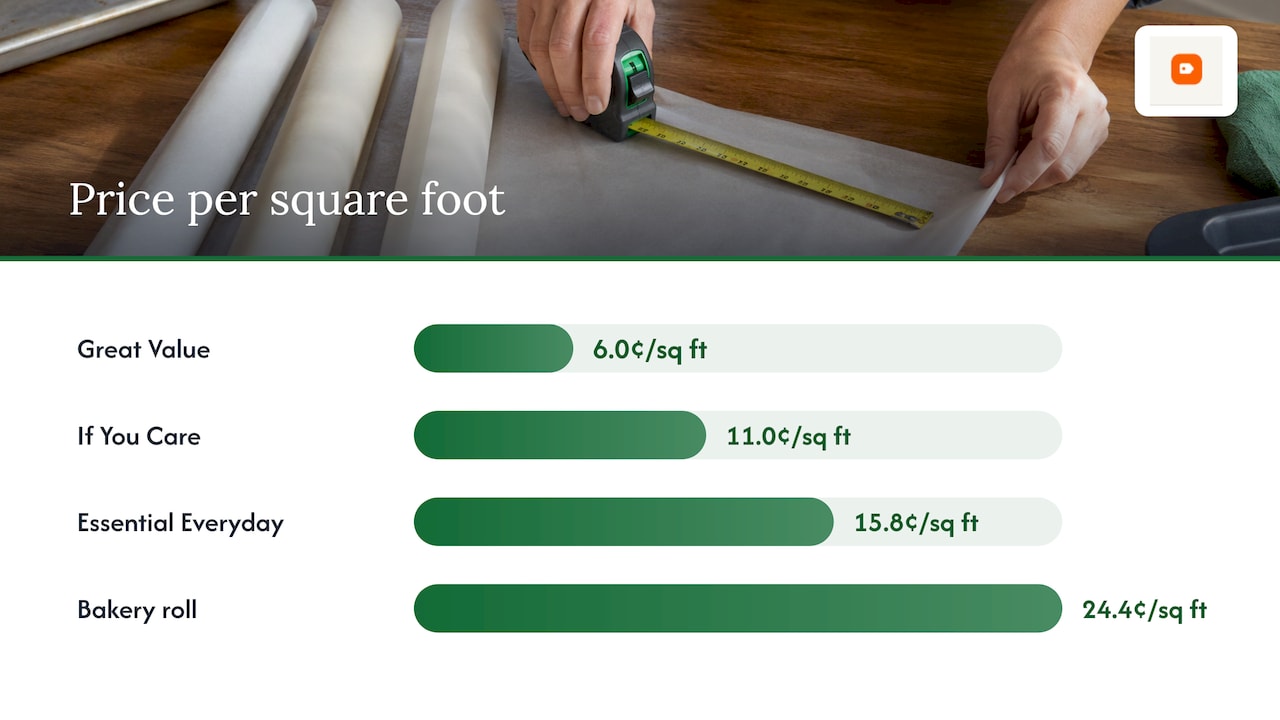
| Great Value | $3 | 50 ft × 15 in (50 sq ft) | about 6.0¢ | about 6.0¢ |
| Wilton | $11 | 15 in roll (60.5 sq ft) | n/a | about 18.2¢ |
A few things stand out.
First, a 15-inch roll that is 50 feet long has exactly 50 square feet only because 15 inches is 1.25 feet, so the square-foot number and the linear-foot number are not interchangeable. Notice that the Great Value roll shows the same 6.0 cents on both measures: the listing calls it 50 square feet on a 50-foot roll, so check the arithmetic against the box if you buy it.
Second, the premium end of the market can cost two to three times as much per square foot as a basic roll. Small-batch bakery supply shops sit at the top: one 33-foot by 14 7/8-inch roll listed at $9.99 with 41 square feet, which works out to about 30.3 cents per linear foot and 24.4 cents per square foot.
Third, going bigger is not always the cheaper path per foot. A long unbleached roll from If You Care lists 70 square feet at $7.69, about 11.0 cents per square foot. The brand says competing brands commonly offer 30 to 45 square feet, so it is a larger roll at a mid-range unit price.
Store brands are often competitive too. An Essential Everyday roll has 30 square feet and was listed at $4.75 at one grocer, which is about 15.8 cents per square foot. That is higher than the 45- and 50-foot rolls above, because a short roll spreads the price over less paper.
When the listing hides the width
Some pages show a unit price but not the roll's dimensions. A PaperChef listing shows $3.88 for 50 square feet and displays 7.8 cents per square foot. That is enough for a square-foot comparison. It is not enough for a per-foot one, because the width and length are not stated. When that happens, compare on square feet and leave linear feet out.
Rolls versus precut sheets
Precut sheets change the question. Instead of price per foot, you want price per sheet, and then price per square foot to compare against rolls.
- Multiply the sheet's width by its height in inches, and divide by 144 to get square feet per sheet.
- Divide the pack price by the number of sheets.
- Divide that per-sheet price by the square feet per sheet.
A standard half-sheet pan liner is 12 by 16 inches, so each sheet is 192 square inches, or about 1.33 square feet.
The spread between packs is wide. One restaurant-supply listing for 12-by-16-inch quilon liners was $36.49 per case of 1,000, or 3.65 cents a sheet, about 2.7 cents per square foot. A reusable chromium-free liner of the same size was $82.49 per case of 1,000, or 8.25 cents each. The same liner in a 50-pack was $12.99, or 26 cents each. Same product, more than three times the unit price, purely because of pack size.
On the consumer side, 30 pre-cut Reynolds sheets at 10.75 by 13.75 inches were listed at $3.79. That is about 12.6 cents a sheet and roughly 12.3 cents per square foot. So a household buying small boxes of sheets pays more per square foot than with a basic roll. In return you skip cutting and curling. The listing says the sheets are non-stick, oven-safe to 425°F and reusable up to three times in one baking session, and the manufacturer's page says they are designed to fit most baking pans without cutting or folding.
A fair rule: if you bake on the same pan size every week, precut sheets save time and waste. If you roast, wrap, line cake tins and cut odd shapes, a roll is more flexible, and a roll is nearly always cheaper per square foot at home scale. Slow, long bakes, like the dry-baked treats in this look at rusk versus biscotti baking, tend to use the same tray over and over, which is where a precut size can earn its place.
How to tell if a parchment deal is genuinely cheaper
A "sale" tag tells you nothing until you convert it. Use this short routine before you click buy:
- Find the real square footage. Use the printed sq ft, or compute it from length and width. Ignore "count" claims on rolls.
- Divide price by square feet. Write the cents down. Anything under about 8 cents is on the low end of what we saw. Over about 15 cents needs a reason.
- Compare same-format only. Do not set a roll against a 1,000-sheet case without converting both to square feet.
- Check the multipack math. A two-pack at a higher shelf price can still cost fewer cents per square foot. A bulk bag with fewer sheets than you think does the opposite.
- Look at the date and the seller. Third-party listings can change pack contents. Recalculate if the size changes.
- Account for waste. If a 15-inch roll is too wide for your 12-inch pan, you trim off paper you paid for. Match width to the pan you use.
The same step-by-step approach applies to other paper goods. If you want to see it applied to something else you buy by the roll, our guides on how many paper towels are in a roll and how many sheets are in a ream of paper walk through the same method, and mega roll versus regular roll shows why the label size is not the cost.
What else decides value besides the price per foot
The cheapest cents-per-foot figure assumes every roll performs the same. They do not. Consumer Reports' parchment tests looked at release, oil seepage and reuse across 10 brands, and most left an oily mess, so brand-to-brand differences are real. A roll that lets food release cleanly, keeps grease off the pan and survives a second batch can beat a rival that is a cent or two cheaper.
Heat rating
Maximum temperature varies by product. The Spruce Eats lists Wilton at 400°F, If You Care at 428°F, Great Value at 420°F and Baker's Signature at 450°F. If you roast at 425°F or higher, read the box before you pick the cheapest roll. Never use parchment near a broiler element or an open flame.
Bleached or unbleached
The same review says bleached and unbleached parchment both work for baking and cooking, so the choice is up to you. Do not pay extra for color alone. Base the decision on your own preference, and on the heat rating and per-square-foot price.
Width and pan fit
A 15-inch roll is sized for half-sheet pans, according to the same guide. A 12-inch roll suits smaller pans and cake rounds. Pick the width that matches your most-used pan, then compare only rolls of that width on per-foot price.
Cutters and packaging
Some large rolls include a slide cutter. A cutter box matters if you hate wrestling a curled roll, but it should not change the math. Calculate on the paper, and treat convenience as a tie-breaker.
Our perspective
We built OutletPicks around one idea: the sticker price tells you very little until it is divided by what you actually get. Parchment paper is a perfect example. A box can say 30 square feet or 260, a count of sheets or a length in feet, and a bold "deal" badge says nothing about any of that.
Our approach is to normalize first and compare second. For parchment that means cents per square foot, with cents per linear foot as a quick check when widths match. We recheck retailer prices on a rolling cycle, because the best unit price this week is not guaranteed to be the best next month. We would rather show you a ranked list on the same scale than a pile of banners.
Our advice: write down your pan width, pick the format that fits how you bake, and let the unit price break ties. A few cents a foot adds up across a year of Sunday trays and holiday cookies.
Alex
See real cost per unit across categories
If you like seeing prices on one scale, OutletPicks ranks everyday products by real cost per unit, including per milliliter, per diaper, per page and per foot. We compare listings from Amazon and partner retailers so pack size and brand do not hide the real cost.
Browse the OutletPicks categories to see how unit-price rankings work, or start from the OutletPicks homepage and search the product you are about to buy.
FAQ
Is price per foot or price per square foot better for parchment paper?
Price per square foot is better because it counts both length and width. Price per linear foot is fine when the rolls you compare are the same width. For precut sheets, price per square foot is the only way to compare them against a roll.
How many square feet is a standard parchment paper roll?
There is no single standard. In the listings we reviewed, rolls ranged from 30 square feet to 60.5 square feet for typical supermarket sizes, and a baking-supply roll reached 260 square feet. Always read the printed sq ft rather than assuming.
Are precut parchment sheets worth the extra cost?
Often yes, for people who bake on the same pan size every week, because sheets lie flat and need no trimming. Per square foot they usually cost more than a basic roll in small packs, so compare the cents before you decide. Larger packs bring the unit price down sharply.
What temperature can parchment paper handle?
It depends on the product. Heat ratings in one major review ranged from 400°F to 450°F across popular brands, so check the box against your recipe. Keep parchment away from direct flame and broiler elements.
Sources
- Paper price calculators: MSF price to linear foot
- Reynolds Kitchens Unbleached Parchment Paper Roll, 45 sq ft (Amazon)
- Reynolds Stay Flat Parchment Paper Roll (Instacart)
- The Best Parchment Paper for Any Kitchen Task (The Spruce Eats)
- Parchment Paper Roll 33' x 14 7/8"
- If You Care Parchment Baking Paper
- Essential Everyday Parchment Paper, 30 Square Feet
- Half Size Quilon Parchment Pan Liners, 1,000/Case
- Bagcraft EcoCraft Bake 'N' Reuse 12" x 16" liners, case
- Bagcraft EcoCraft Bake 'N' Reuse 12" x 16" liners, 50-pack
- Reynolds Kitchens Pop-Up Parchment Paper Sheets, 30ct (Amazon)
- Parchment Pop-Up Sheets (Reynolds Brands)
- 4 Best Parchment Papers, Tested by Our Experts (Consumer Reports)