
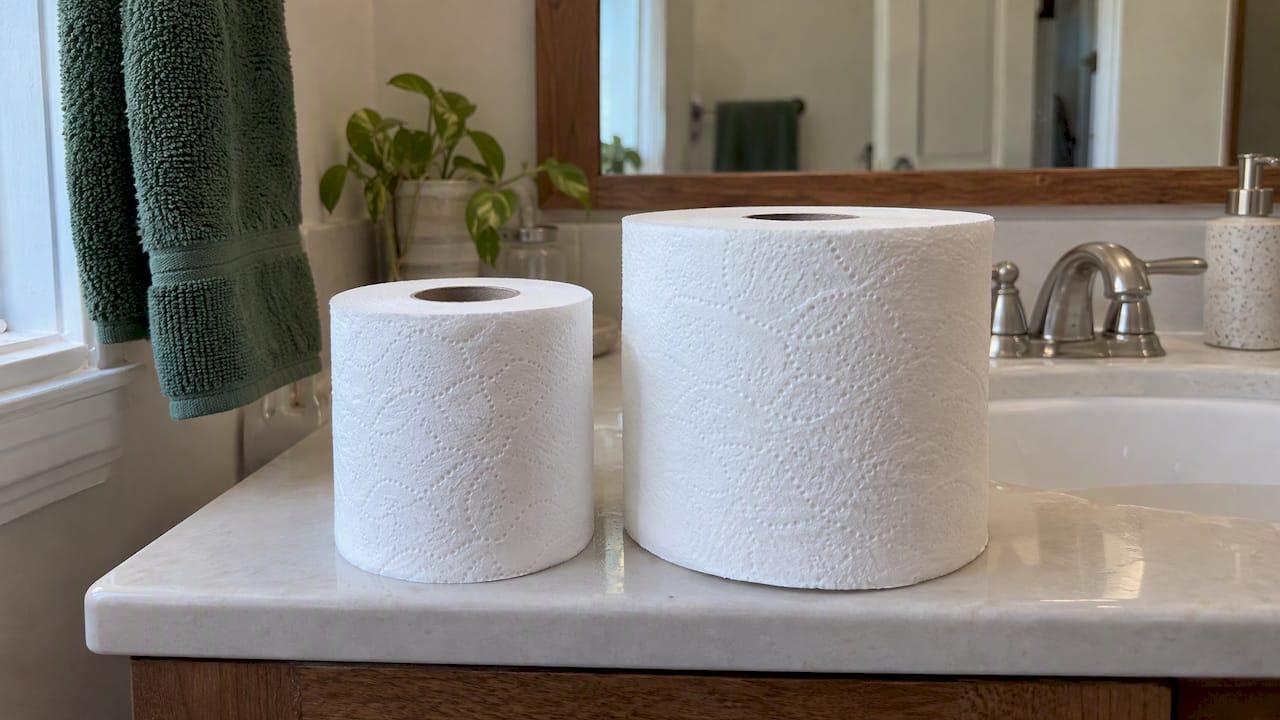
Mega rolls cut down how often you change the roll, but they do not automatically give you better value or a better fit. The only way to know which one wins is to compare sheet counts or linear feet and cost per sheet, not the label on the package. Regular rolls fit almost any holder without fuss; mega rolls sometimes do not, and that gap matters more than the marketing claim does.
TL;DR:
- Regular rolls typically contain 200 to 500 sheets, while mega rolls contain 224 to 370, so compare sheet counts or footage within the same ply.
- Measure enclosed holders and spindle clearance: regular rolls are about 4 to 5 inches across, while mega rolls often reach 5 to 6 inches.
- The example mega pack costs $0.005 per sheet, versus $0.0023 for regular rolls, showing that package price and size labels can mislead.
- Consumer Reports found Angel Soft Mega rolls fell from 429 to 320 sheets while prices held steady or rose, so recheck counts on current packages.
- Older plumbing and low flow toilets call for checking septic performance; thick paper can contribute to clogs despite a septic safe label.
Table of Contents
- How sheet count and length differ between mega and regular rolls
- Will a mega roll actually fit your holder?
- Why cost per sheet beats the price tag on the package
- Practical fixes for fit, storage, and buyer's remorse
- Quick decision checklist: mega or regular for your home
- Measure by usable units, not marketing claims
- Check your real cost per sheet before you buy in bulk
- FAQ
- Sources
How sheet count and length differ between mega and regular rolls
The basic comparison starts with two numbers: how many sheets are on the roll, and how long the roll actually is once you unravel it. Regular rolls typically run from about 200 to 500 sheets, translating to roughly 65 to 150 feet depending on the brand and sheet size. Mega rolls commonly land between 224 and 370 sheets, or about 73 to 124 feet, according to spec comparisons from Top Source Hygiene. Those ranges overlap, which is the part shoppers tend to miss.
A roll's total length depends on sheet count multiplied by individual sheet length, so two rolls with the same sheet count can still differ in usable paper if their sheets are cut shorter. Ply count changes the math too: a two-ply roll uses two layers per sheet, so a thicker roll with fewer, longer sheets can still deliver less linear footage than a thinner one with more sheets.
A brand's own undersized baseline roll is usually the basis for comparison, not a competitor's regular roll or any fixed industry standard.
A few habits make the comparison reliable:
- Always check total sheet count per roll, printed on the wrapper or the package, not the multiplier.
- Convert to linear feet when sheet counts are unclear, using sheet length times sheet count.
- Compare rolls within the same ply count, since a 2-ply sheet is not equivalent to a 1-ply sheet.
If you want a shortcut for this math, our toilet paper calculator converts sheet counts and pack sizes into comparable numbers automatically.
Will a mega roll actually fit your holder?
Size on the shelf does not always translate to size in your bathroom. Regular rolls typically measure about 4 to 5 inches in outer diameter, while mega rolls often reach 5 to 6 inches, based on specification data from Top Source Hygiene. That extra inch or two is exactly what jams in a recessed or enclosed holder.
Core diameter matters just as much as outer diameter, even though it gets less attention. Home rolls typically use a core with an inner diameter of 1.5 to 1.75 inches, and a larger core eats into usable paper even when the outer diameter looks generous. A wider core on an otherwise similar-sized roll means less actual tissue wound around it, not more.
Before buying a pack of mega rolls, run through these checks:
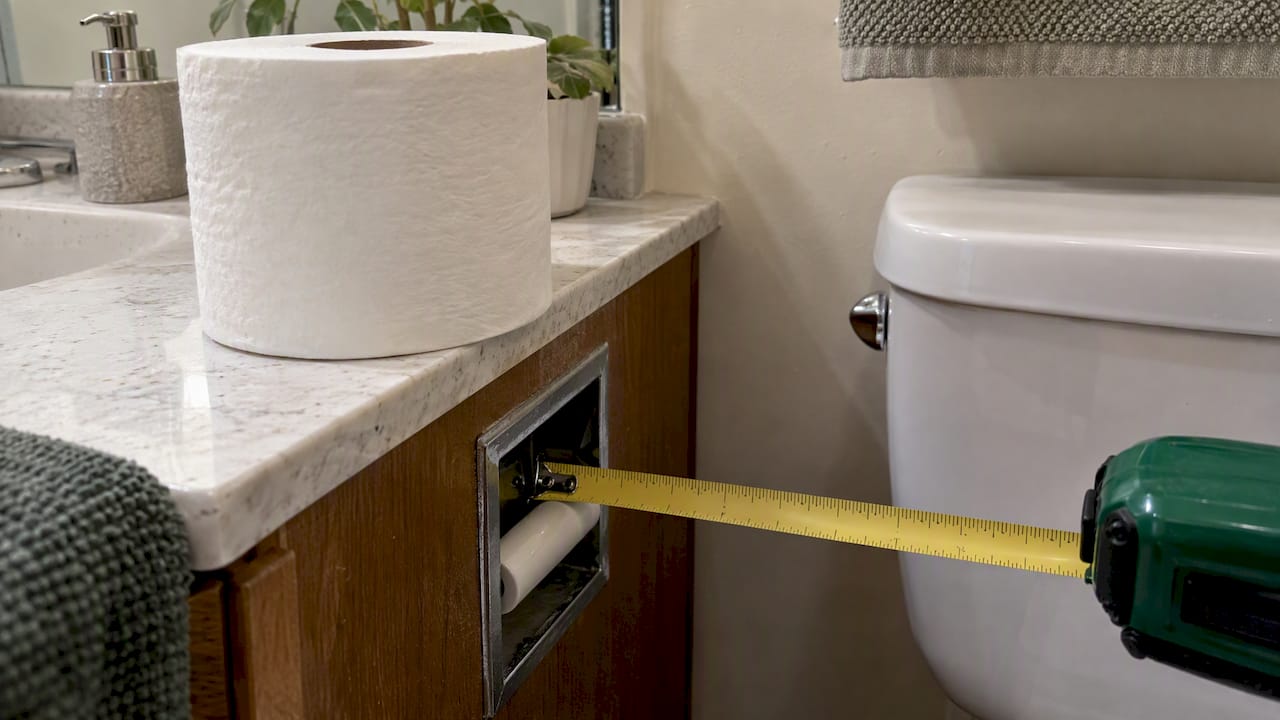
- Measure the horizontal clearance inside your holder from wall to wall.
- Measure the spindle length and confirm it extends far enough to hold a wider roll without binding.
- Check whether your holder is enclosed (a cabinet or recessed niche) or open-ended, since enclosed designs are far less forgiving of extra width.
Spindles mounted close to a wall or cabinet edge create friction against a wider roll, which makes it drag or stop turning smoothly. This is the single most common complaint with mega roll upgrades in older bathrooms.
Pro Tip: Measure your holder's clearance with a tape measure before you buy a 12-pack of mega rolls. A half-inch of extra clearance is the difference between a smooth fit and a roll that scrapes the cabinet every time you pull a sheet.
Why cost per sheet beats the price tag on the package
The sticker price on a pack tells you almost nothing by itself. What matters is cost per sheet, or cost per linear foot if you want to account for sheet size differences too. The formula is simple: total pack price divided by sheets per roll, divided again by rolls per pack.
Say a 12-pack of mega rolls costs $18.00 and each roll has 300 sheets. That is $18.00 divided by (300 times 12), or 3,600 total sheets, which works out to exactly $0.005 per sheet, or half a cent. Run the same math on a 24-pack of regular rolls priced at $14.00 with 250 sheets each: $14.00 divided by (250 times 24), or 6,000 sheets, comes out to about $0.0023 per sheet. The regular pack wins on paper even though the mega pack looked like the better deal at checkout.
A documented pattern makes this comparison even more important: Consumer Reports found that Angel Soft Mega rolls shrank from 429 to 320 sheets per roll over time, while prices held steady or rose. That kind of shrinkflation quietly raises the real cost per sheet without any change to the package size or price tag, which is exactly why relying on the label is risky.
A few checks protect you from this:
- Compare sheet counts printed on the current package against what you remember buying last time, since counts change without notice.
- Check roll weight when it is listed, since a lighter roll at the same sheet count usually means thinner sheets.
- Treat any "new and improved" claim on packaging as a prompt to recheck the sheet count, not as a reason to skip it.
Our deep dive into shrinkflation walks through how widespread these quiet reductions have become across household paper products.
Practical fixes for fit, storage, and buyer's remorse
Most mega roll complaints trace back to skipping a five-minute measurement before buying. Before you commit to a bulk pack, check three things: the outer diameter clearance inside your holder, the gap between the spindle and the nearest wall or cabinet wall, and whether your holder is fixed in a recessed slot or mounted on an open arm.
If a mega roll is too wide for an existing holder, you have options short of replacing the whole fixture:
- Remove any flange or end cap on the spindle if your holder has one, which sometimes buys the needed clearance.
- Swap to an open-ended, wall-mounted holder instead of a recessed or cabinet-style one, since open designs tolerate a wider range of roll sizes.
- Stick with regular rolls in enclosed cabinets or built-in niches where a half-inch of extra diameter has nowhere to go.
Storage is the other half of the decision and can be eased by learning more about bath sheet vs bath towel sizing trade-offs. A 12-pack of mega rolls takes up real shelf or closet space, and that bulk is only worth it if you have somewhere to put it. Smaller packs cost slightly more per sheet in many cases, but they make sense in small bathrooms, apartments, or anywhere storage space is tighter than your budget.
Pro Tip: If storage is tight, buy one mega pack to test fit and usage speed before switching your whole household over. It is a lot cheaper than discovering a 24-pack does not fit in your linen closet.
Quick decision checklist: mega or regular for your home
Use this as a fast gut check before you load up the cart.
- If you want fewer trips to restock and your holder has generous clearance, lean toward mega rolls.
- If your holder is enclosed, tight, or close to a wall, or if storage space is limited, pick regular rolls instead.
- If cost per sheet is your main concern, run the numbers yourself or use a unit-price calculator before comparing packs side by side.
- If your home has older plumbing or low-flow toilets, check how a given paper performs for septic safety before assuming thicker always means better, since plumbers note that denser plies can contribute to clogs in sensitive systems even when labeled safe.
None of these choices are permanent. Buying one pack to test fit and flow costs less than committing to a year's supply of the wrong format.
Measure by usable units, not marketing claims
The toilet paper aisle rewards shoppers who ignore the front of the package. A "mega" label means nothing standardized across brands, and a roll that looks twice as big can deliver fewer usable sheets than a plain regular roll sitting next to it. We built our approach around cost per unit for exactly this reason: pack size and branding tell you very little until you divide price by sheets or feet.
Before your next bulk purchase, check sheet count, roll weight, and linear footage rather than trusting the multiplier on the wrapper.
— Alex
Check your real cost per sheet before you buy in bulk
We built our toilet paper calculator to do the math you just read about in seconds, cost per sheet, cost per linear foot, and normalized comparisons across different ply counts and sheet sizes. No more guessing whether this week's mega pack is actually cheaper than last month's regular rolls.
- Enter pack price, roll count, and sheets per roll to get your real cost per sheet instantly.
- Compare multiple packs side by side without doing the division by hand.
- Check our brand index for pre-calculated unit prices across toilet paper and other household essentials.
Run your numbers before your next bulk order and see which pack actually costs less per sheet.
FAQ
What are the differences between Cottonelle Mega and Family Mega rolls?
Mega and Family Mega naming conventions vary by brand and generally describe different sheet counts and roll diameters within the same product line, with Family Mega typically sized between regular and Mega. Always check the printed sheet count on the package rather than relying on the size name, since labeling is not standardized across brands or even within one brand's own lineup.
What does most of the world use instead of toilet paper?
Toilet paper is far from universal, and many regions rely on water-based cleaning methods such as bidets or handheld sprayers instead. This is a cultural and infrastructure difference rather than a product comparison, so it does not affect how you should evaluate mega versus regular rolls for a household that already uses toilet paper.
How long is a regular roll of toilet paper?
Regular rolls typically run about 65 to 150 feet, depending on the brand, sheet count, and ply, according to roll specification data from Top Source Hygiene. The exact length depends on both the number of sheets and how long each individual sheet is cut.
Why do some plumbers caution against certain thick toilet papers?
Plumbers note that thicker, denser plies can be labeled septic-safe yet still contribute to clogs in older plumbing systems or with low-flow toilets, according to guidance from Len The Plumber. Households with aging pipes or low-flow fixtures are often better off choosing thinner, faster-dissolving paper even if it feels less plush.
Sources
- Toilet Paper Roll Size Comparison: Mega Rolls vs GSM
- Best Toilet Paper Buying Guide - Consumer Reports
- Is Charmin toilet paper septic safe? — Len The Plumber