
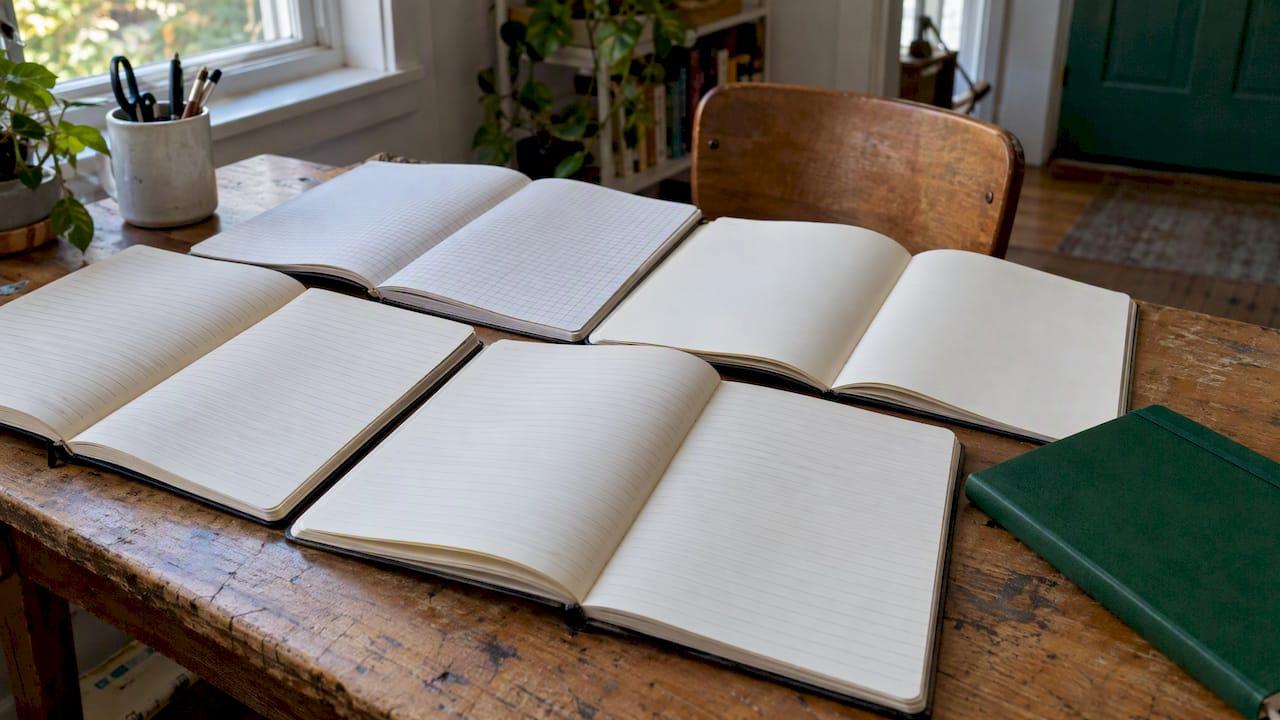
To find a notebook's price per page, divide its price by the number of pages you can actually write on. A notebook sold as "100 sheets" has 200 writable sides, so a $2.59 notebook costs about 1.3 cents per page, not 2.6. Get that one step wrong and every comparison after it is off by half.
This guide shows the formula, the sheet-versus-page trap, real US price examples, and the checks that tell you whether a low number is a bargain or a false economy.
TL;DR
- Price per page = price ÷ usable pages. Subtract blank covers, title pages, pockets and back matter first.
- One sheet has two sides. A 100-sheet notebook is 200 pages if both sides are usable, and many listings use "sheets" and "pages" loosely.
- Retail prices vary widely by store: the same pile of loose-leaf can cost under a cent a sheet or nearly three cents.
- A lower price per page only wins if the paper handles your pen. If ink bleeds through, you pay for half the pages.
Table of Contents
- The formula, with a worked example
- Sheets, pages and sides: the trap in the page count
- What notebooks really cost per page in the US
- Pack size, paper size and ruling
- Why the cheapest notebook can cost more
- Checklist before you call it a deal
- Our perspective
- Compare price per unit across categories
- Worked comparison: three buying scenarios
- Common mistakes
- FAQ
- Sources
The formula, with a worked example
The calculation is simple. What trips people up is the denominator.
Price per usable page = notebook price ÷ usable pages
Start from the listed count, then remove what you will not write on. Wirecutter's notebook testing is a good reference for how reviewers think about this: the count that matters is the pages you will really use, not the number printed on the cover. Blank covers, title pages, pockets and unusable back matter all come off. Multiply the result by 100 if you prefer cents per page.
Here is a worked example with a classic composition notebook. A Staples composition notebook listing showed a price of $2.59 for 100 sheets at the time we checked. Prices move, so treat it as an illustration.
| Step | Result |
|---|---|
| Price | $2.59 |
| Sheets | 100 |
| Writable sides (2 per sheet) | 200 |
| Price per sheet | about 2.6¢ |
| Price per page (side) | about 1.3¢ |
| Price per page if you only use one side | about 2.6¢ |
The same notebook is 1.3 cents or 2.6 cents per page depending on one decision about how you write. That is why we publish unit prices rather than sticker prices: the unit has to be defined before the comparison means anything.
Sheets, pages and sides: the trap in the page count
A sheet is one physical piece of paper. A page is one side of it. So 100 pages equal 50 sheets, as Valenna's explanation of notebook page counts puts it: for a double-sided interior, each printed side counts as a page.
The trouble is that retailers do not always use the words the same way. The same composition-notebook listing says "100 sheets" in its title and "100 pages" in its description. Another notebook might say "100 pages" and mean 50 sheets. When you see a count, ask which one it is.
Three quick tests:
- Check the title and the spec table. If they disagree, assume the more conservative number until you can verify.
- Look at the thickness. A 100-sheet composition book is noticeably thick. A thin spiral labeled "100 pages" is likely 50 sheets.
- Search the answer in the description. Many listings spell out "100 sheets (200 pages)".
If you want the same discipline applied to other paper goods, our guide to how many sheets are in a ream of paper shows how a simple count turns into a cost per sheet.
What notebooks really cost per page in the US
Notebook prices cover a huge range. At the budget end, back-to-school paper is almost free per page. At the premium end, a single page can cost ten times as much.
Budget school paper
CBS News's back-to-school price check compared the same kind of item across three retailers. Run the numbers on what it reported:
| Retailer | Sheets | Price | Per sheet |
|---|---|---|---|
| Walmart | 150 | 84¢ | about 0.56¢ |
| Dollar Tree | 200 | $1.00 | 0.5¢ |
| Target | 100 | $2.79 | about 2.79¢ |
The cheapest and most expensive options differ by more than five times per sheet. The product category is the same. Only the store and pack changed. Per-sheet prices like these are exactly what a sticker price hides.
Mid-range and premium notebooks
Wirecutter's picks ranged from roughly $10 to $40 and averaged 11 cents per page at the time of its review. That is around ten times the cost of the budget composition book above. You are paying for paper that resists bleeding, stitched or lay-flat binding, and covers that survive a bag.
So a sensible range to hold in mind: roughly 0.5 to 3 cents per page for school-grade paper, and around a dime or more for premium notebooks. Where your pick falls matters less than whether it fits the job.
Pack size, paper size and ruling
Price per page treats every page as equal. They are not.
Page size
An 8.5 x 11 inch page holds about 1.5 times the writing area of a 5.5 x 8.5 inch page. If you compare a pocket notebook with a letter-size pad on price per page alone, the pocket notebook looks worse than it is on a per-inch basis, or the other way round if you only need a few lines. Check the exact dimensions of the product. Our paper sizes guide lists Letter, Legal, 11 x 17 and A4 in inches and millimeters so you can compare like with like.
A useful second metric is price per square inch of writing surface: multiply page width by height, multiply by usable pages, then divide the price by that total.
Ruling
Wide rule and college rule change how much you can fit on a page, not how many pages you get. Ruling spacing matters for your handwriting. Wirecutter notes most of its picks use 7 mm ruling, while one uses 6 mm, which can fit more lines for small handwriting but feels cramped for larger writing. If you write large, narrower ruling gives you fewer words per page than the numbers suggest.
Pack size
Multi-packs usually lower the per-notebook price, but not always, and bigger is not automatically cheaper per page. Divide the pack price by total usable pages across the whole pack. Our piece on when bulk beats single packs walks through that logic with a Staples example. Also keep in mind that 12 notepads you never finish cost more than 3 you do.
Loose paper and pads
Legal pads and notepads are often sold by the dozen, so the listing shows a pad or pack price rather than a per-page number. Staples's wide-ruled 50-sheet pad dozen is a good example. Multiply sheets per pad by pads per pack, then divide. Note that pads are usually single-sided in practice, since you tear off the sheet, so count one side per sheet unless you write on both.
Why the cheapest notebook can cost more
A low price per page assumes every page is usable. That is not always true.
Paper quality decides whether both sides of a page work. Wirecutter tested for bleeding, feathering, ghosting and smudging, and found these traits determine whether both sides of a page are practically usable. It specifically notes that some Moleskine notebooks cost more per page, and that ink shows through so easily that you may effectively use only one side.
That is the key correction. If ink shows through on the back, divide the price by sheets, not sides. The "cheap" notebook that is 1.3 cents per page becomes 2.6 cents per page, and it also looks messy.
Here is how to adjust in practice:
| Paper behavior with your pen | Pages to count |
|---|---|
| No show-through, no bleed | Both sides (2 per sheet) |
| Slight ghosting, readable on the back | Both sides, but expect lower enjoyment |
| Bleeds or feathers | One side (1 per sheet) |
The fix is simple: test the paper with your actual pen. A pencil or ballpoint will pass on almost any budget paper. A fountain pen or a wet gel pen may not.
Checklist before you call it a deal
Before choosing the notebook with the lowest number, run through these:
- Is the page count sheets or pages? Confirm in the description.
- What is the page size? Compare square inches if sizes differ.
- Is the ruling right for your handwriting? Narrow rule costs you words per page if you write large.
- Can you write on both sides with your pen? If not, double the per-page figure.
- How much of the book is not paper? Covers, pockets, dividers and index pages do not count.
- Will you finish it? A 200-sheet notebook is not a bargain if half of it stays blank.
- Does the binding matter? Spiral bindings let you tear pages out without damaging the book. Sewn bindings lay flat but cannot lose pages.
If the notebook passes all seven and also has the lowest cost per usable page, it is your pick.
Our perspective
We built OutletPicks on one idea: the sticker price tells you what leaves your wallet today, not what you pay for the thing you actually use. Notebooks are a perfect example. The same logic we apply to diapers, printer ink and toilet paper applies here: pick the unit that matches use, then divide.
For notebooks, that unit is a usable page. Our view is that a shopper should compute two numbers, not one: the nominal price per page, and the price per page after a real-world adjustment for your pen and your handwriting. When the two are close, buy the cheaper one and stop thinking about it. When they are far apart, the paper is telling you something, and a slightly pricier notebook usually wins.
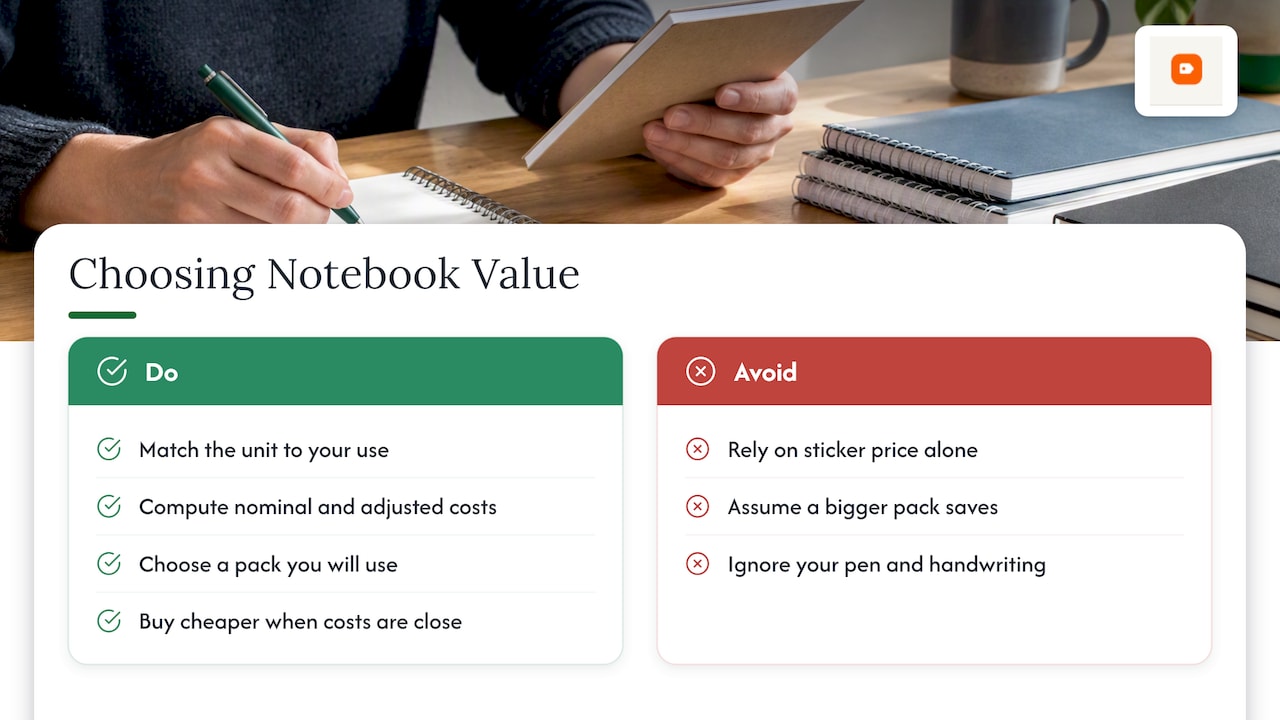
We also think pack sizes are where most overspending happens. A bigger pack looks efficient, but only if you use it. The best value is the lowest cost per page that you will actually write on before the notebook ends up in a drawer.
The same spirit is behind our printer cost per page calculator, where the cheap printer often turns out to be the expensive one to run.
— Alex
Compare price per unit across categories
Notebooks are one corner of everyday shopping. At OutletPicks we rank products by what a unit really costs, whether that unit is a page, a milliliter or a diaper, and we recheck retailer prices on a rolling cycle so the numbers stay current. If you are stocking up on paper for the office or school, start with copy paper on sale this week, then browse our full list of categories to see the same unit-price approach applied to everything else on your list.
We do not sell the products ourselves. We link to the retailers carrying them, so you can check the current listing before you buy.
Worked comparison: three buying scenarios
Numbers get clearer with a scenario. These use the formula and the example prices above.
Scenario 1: a student who writes with a ballpoint. A 100-sheet composition book at $2.59 costs about 1.3 cents per side. Ballpoint does not bleed on basic paper, so counting both sides is fair. This is a sensible budget buy.
Scenario 2: a fountain-pen user. The same book may show through. If you only use one side, you are at 2.6 cents per page. A premium notebook at 11 cents per page that takes ink on both sides is more expensive, but if the budget notebook makes your writing unreadable, the cheaper one has no value at all. Compare on the pages you would actually keep.
Scenario 3: a teacher buying in bulk. Loose-leaf or pads at around half a cent per sheet, as in the 150-sheet and 200-sheet examples above, are far cheaper than a single pack at nearly three cents per sheet. Here the difference over a few hundred sheets is real money, and the pack-size check matters more than paper quality.
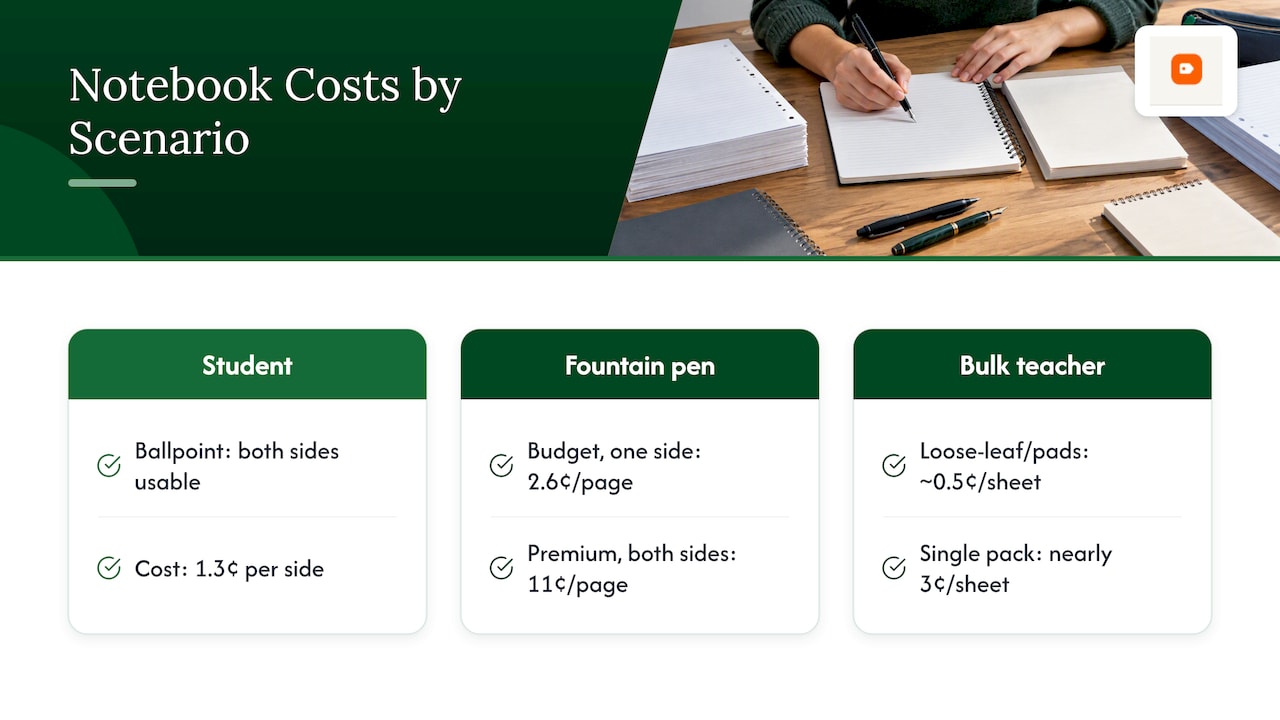
In all three, the winning move is the same: define the unit, count what you will use, then divide.
Common mistakes
- Comparing a pad to a notebook. Pads are often single-sided in use, notebooks double-sided.
- Trusting a "per notebook" price in a multipack. That figure hides page count entirely. A 70-sheet notebook and a 100-sheet notebook can show the same per-notebook price.
- Ignoring the cover. Hardcover notebooks may include non-writing pages. Subtract them.
- Judging only by price. The lowest unit price on paper that fails your pen is the worst value on the shelf.
FAQ
How do I calculate a notebook's price per page?
Divide the price by the number of usable pages. Count two pages for every sheet if both sides work for your pen, and subtract covers, title pages and pockets. Multiply by 100 to get cents per page.
Does a notebook's page count include both sides of each sheet?
Usually yes: for a double-sided interior, each printed side is a page, so 100 pages equal 50 sheets, according to Valenna. But some listings say "sheets" and "pages" interchangeably, so check the description before you divide.
Is a 100-sheet notebook 200 pages?
Yes, if both sides of each sheet are used, 100 sheets make 200 pages. If ink bleeds through and you only write on one side, you have 100 usable pages. Always confirm whether the listing means sheets or pages.
What is a good price per page for a notebook?
School-grade paper often lands between about half a cent and three cents per sheet, based on CBS News's back-to-school price check. Premium notebooks reviewed by Wirecutter averaged 11 cents per page. A good price is the lowest one on paper that works with your pen.
Sources
- The 11 Best Notebooks and Notepads, Wirecutter
- Do Notebook Page Counts Include the Covers? Valenna
- A look at back-to-school prices at three major retailers, CBS News
- Staples Composition Notebook, 9.75 x 7.5, Wide Ruled, 100 Sheets
- Staples Notepads, 8.5 x 11, Wide Ruled, 50 Sheets, Dozen