
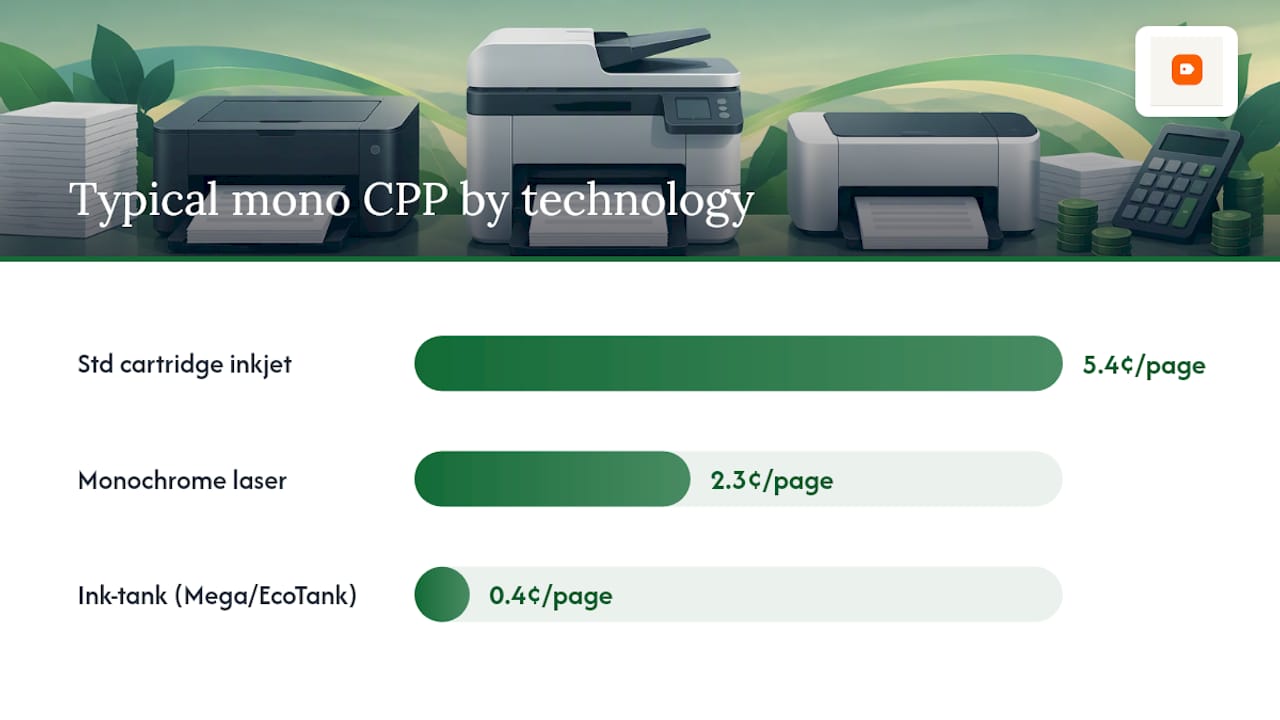
Most standard inkjet printers run about 5.4 cents per mono page, monochrome laser printers average around 2.3 cents, and ink-tank models can drop to roughly 0.4 cents, according to an aggregated cost index. If you print more than a couple of hundred pages a month, a laser or ink-tank printer will almost always beat a cartridge-based inkjet on total cost. Check current cartridge and printer prices on OutletPicks before you buy, since sticker prices shift often.
TL;DR:
- Monochrome laser and ink-tank printers significantly lower the true cost per page compared to traditional cartridge inkjets, especially at higher printing volumes.
- Cost per page calculations should include toner or ink, paper, and maintenance costs, and be adjusted for actual density of printing beyond 5% page coverage.
- Laser and ink-tank models are more cost-effective for frequent printing over 500 pages monthly, while light users may find cheaper cartridge inkjet printers more economical overall.
- Using high-yield cartridges, duplex printing, and bulk paper purchases can reduce ongoing printing costs without sacrificing quality.
- Retail prices fluctuate, so comparing per-unit costs across multiple retailers and checking real market prices prevents overpaying for printer supplies.
Table of Contents
- What cost per page means and how to calculate it
- Printer technologies compared by typical cost per page
- Real-world examples and worked calculations
- Factors that raise or lower your true cost per page
- Practical ways to lower your cost per page
- Cost per unit can be calculated by normalizing retailer prices into consistent per-unit figures, whether per milliliter, per diaper, or per printed page, and rechecking those prices regularly to keep comparisons current. That matters for printing costs specifically, since cartridge prices and bundle deals shift often across retailers.
- Find the lowest cost-per-page printer supplies right now
- Sources
- FAQ
What cost per page means and how to calculate it
Cost per page, or CPP, is the amount you spend on ink or toner (and, for a full picture, paper) to print one page. Manufacturers rate cartridge yields using a standardized test pattern set at 5% page coverage, a baseline defined by ISO yield-testing standards. That means a cartridge's advertised yield assumes light text pages, not photos or dense graphics, and the ISO documentation itself notes that yield is only one input into total CPP, not a full cost measurement.
The basic formula looks like this:
- Divide the cartridge price by its rated page yield to get the ink or toner cost per page.
- Add your paper cost per sheet, calculated from the price of a ream divided by its sheet count.
- Add an amortized share of maintenance costs, such as drums or fusers, if your printer uses them.
Say a toner cartridge costs $70 and is rated for 3,000 pages. That's about 2.3 cents per page in toner alone. Add paper at roughly half a cent per sheet, and you land near 2.8 cents per page before maintenance. The PaperCut cost calculator guide recommends folding in paper and maintenance from the start, since ink or toner alone understates what you'll actually spend over a year.
A rated yield only holds at 5% page coverage. Print denser documents or photos regularly, and your real cost per page will run higher than the number on the box, per ISO's yield-testing framework.
Printer technologies compared by typical cost per page
Printer technology is the single biggest lever on your long-run cost per page, more than brand or model within a category. The Cost-to-Print Index aggregates retail pricing across many models and reports these mono medians:
- Standard cartridge inkjet printers average around 5.4 cents per page, the highest of the three main technologies.
- Monochrome laser printers average about 2.3 cents per page, making them the strongest choice for high-volume text printing.
- Ink-tank systems, the MegaTank and EcoTank style refillable models, average closer to 0.4 cents per page for mono output.
Color tells a different story. Ink-tank systems often deliver color CPP in the range of roughly 0.3 to 0.6 cents per page for standard documents, competitive with or better than monochrome laser, according to the same index data. That makes ink-tank printers unusually strong for anyone printing color regularly, not just occasional photos.
The trade-off is upfront hardware cost. Laser printers and ink-tank models both cost more to buy than a basic cartridge inkjet, but they earn that back through cheaper consumables. A household printing under 50 pages a month may never recoup a pricier printer's higher purchase cost, while an office printing 500 pages a month recoups it within months. Match the technology to your volume: light, occasional printing favors cheap hardware and accepts a higher CPP, while regular printing favors paying more upfront for a lower per-page cost.
Real-world examples and worked calculations
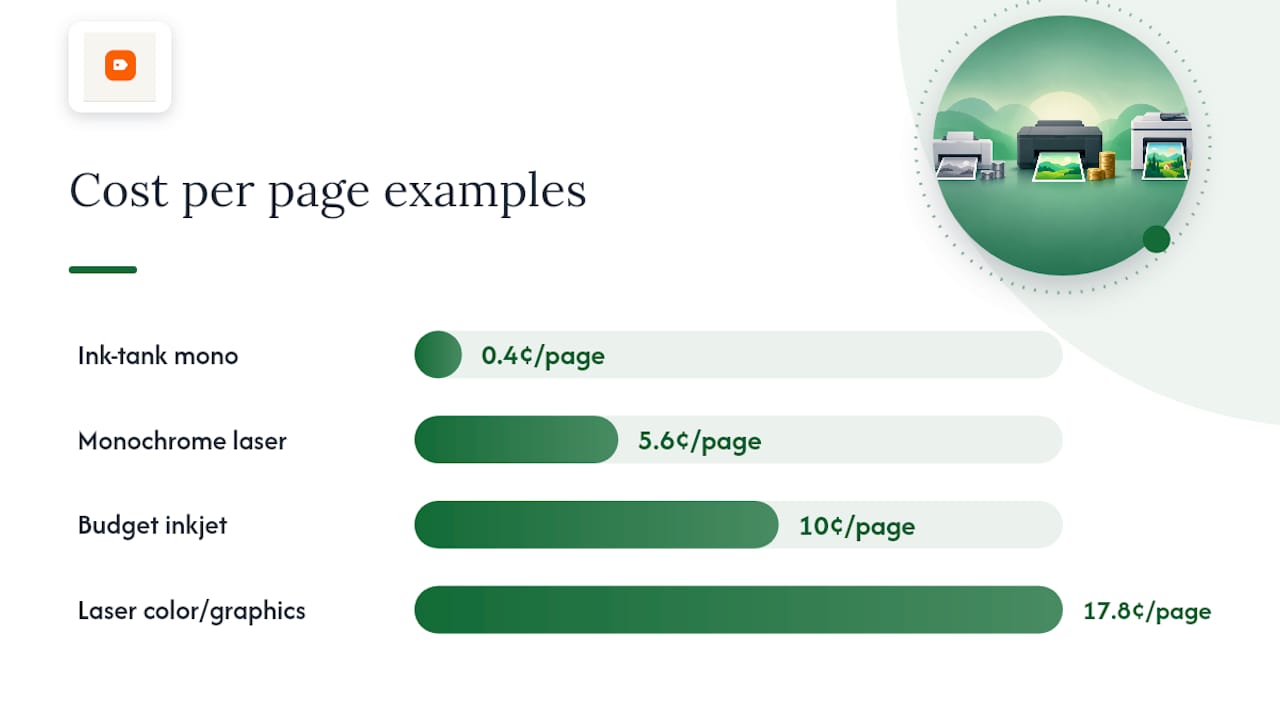
Published test data makes the technology gap concrete. Consumer Reports measured the Brother MFC-L2760DW monochrome laser printer at about 5.6 cents per black text page, based on a tested cartridge yield of roughly 1,094 pages and a sample cartridge price of $61. That's higher than the index's laser median, a reminder that individual models vary even within a technology category, and that color or graphics pages on the same machine ran about 17.8 cents.
For a budget inkjet example, assume a cartridge priced at $25 rated for 250 pages, a common configuration for entry-level models. That works out to 10 cents per page in ink alone, well above both the inkjet median and the laser figures above, illustrating why low-yield starter cartridges are expensive per page even when the printer itself is cheap.
For an ink-tank example, using the index's aggregate mono median of about 0.4 cents per page, printing 500 pages a month costs around $2 in ink.
For model-specific cartridge pricing and longevity, OutletPicks breaks down printer ink cost per page by brand.
Factors that raise or lower your true cost per page
Cartridge price and yield are only part of the equation. Several other inputs quietly push your real CPP above the number printed on the box.
- Coverage percentage matters most: yields are rated at 5% coverage, so dense text, bold fonts, or graphics push actual ink use and cost well above the rated figure.
- Paper quality changes your per-sheet cost noticeably. Heavier or coated stock can cost several times more per sheet than standard copy paper.
- Maintenance parts like laser printer drums and fusers need periodic replacement, and amortizing that expense over the unit's lifetime adds a real, if often overlooked, per-page cost, per PaperCut's cost breakdown.
- Infrequent printing raises effective cost per page too, since cartridges can dry out or clog between uses, wasting ink on cleaning cycles rather than pages.
Check OutletPicks' paper weight chart if you're unsure how a given stock's weight affects both cost and print quality.
Pro Tip: Calculate your CPP twice, once at 5% coverage and once at your actual average coverage, so you're not blindsided by a bill that's double the estimate.
Practical ways to lower your cost per page
Cutting cost per page doesn't require sacrificing print quality, just smarter choices about hardware and habits.
- Buy high-yield or XL cartridges instead of standard ones. They cost more upfront but usually deliver a lower cost per page once you divide price by yield.
- Switch to an ink-tank printer if you print color documents often. The math favors tank systems clearly once volume climbs.
- Choose monochrome laser for heavy text printing. It remains the most reliable low-cost option for offices and students printing mostly black text.
- Print in duplex mode and use draft or eco settings for internal documents to stretch every cartridge further.
- Buy paper in bulk reams rather than small packs. Use OutletPicks' guide on how many sheets are in a ream to compare true per-sheet pricing.
Pro Tip: Before buying any printer, look up the total cost of one replacement cartridge or toner set divided by its rated yield. That single number predicts your ongoing cost better than the printer's price tag.
Cost per unit can be calculated by normalizing retailer prices into consistent per-unit figures, whether per milliliter, per diaper, or per printed page, and rechecking those prices regularly to keep comparisons current. That matters for printing costs specifically, since cartridge prices and bundle deals shift often across retailers.
As the author of this guide, I built the calculations above using published yield data and cost indices so readers can apply the same formula to their own printer model. OutletPicks publishes similar cost breakdowns across categories, including printer ink and paper cost analyses, so you can compare a specific cartridge or ream against current retail pricing rather than relying on outdated averages. The reference hub collects the charts and calculators for readers who want to run their own numbers.
— Alex
Find the lowest cost-per-page printer supplies right now
Sticker prices on cartridges and toner change constantly, and the model with the cheapest listed price isn't always the one with the lowest real cost per page. OutletPicks normalizes retailer prices across Amazon and partner sites so you can compare true per-unit cost instead of guessing from a shelf tag.
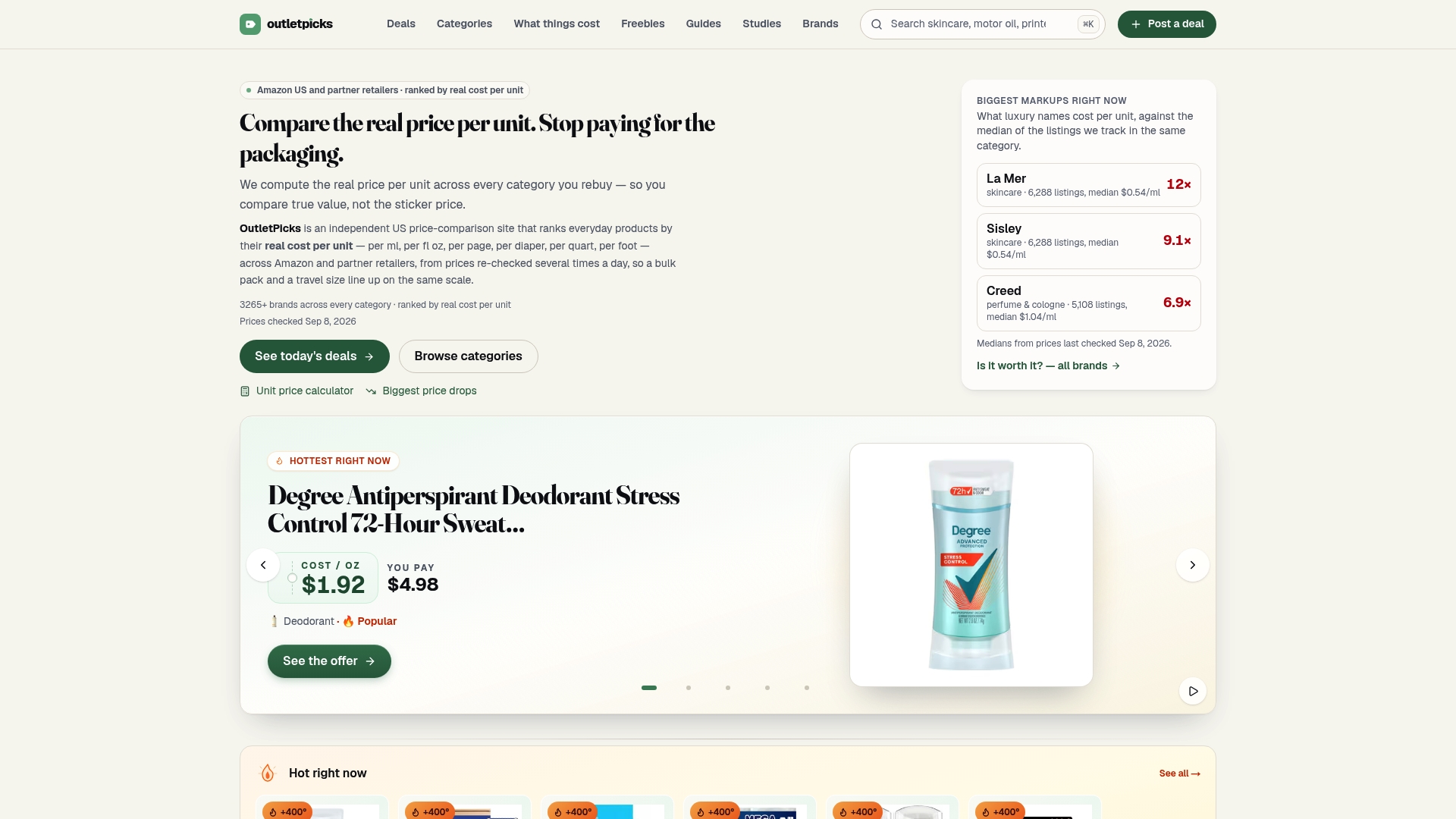
On the OutletPicks categories page, you'll find:
- Live, regularly rechecked pricing across multiple retailers for the same product.
- Per-unit breakdowns that let you compare pack sizes and brands on equal footing.
- A way to double-check any cartridge price against current market listings before you buy.
Run your own comparison before your next cartridge purchase. Prices move fast, and the printer aisle is one of the easiest places to overpay without noticing.
Sources
- Brother MFC-L2760DW Printer Review - Consumer Reports
- ISO standard on cartridge/toner yield measurement
- Estimating your printing cost per page — PaperCut
FAQ
What is the average cost of printer paper per page?
Standard copy paper typically costs a fraction of a cent per sheet when bought in bulk reams, though exact pricing depends on brand and weight. PaperCut's guide recommends adding this per-sheet figure to your ink or toner cost for a complete cost-per-page number.
How much does a home printer cost per page?
For home use, a standard cartridge inkjet averages around 5.4 cents per mono page, while ink-tank models can run closer to 0.4 cents, based on an aggregated cost index. Actual cost depends heavily on print volume and page coverage, since low-yield starter cartridges push costs much higher.
How much do you charge for printing per page?
Pricing for printing services varies by provider and isn't governed by a single published standard, so there's no universal per-page rate to cite. Businesses typically build their price around their own ink or toner cost per page, plus paper, maintenance, and a margin.
How much should I charge per page for printing?
There's no fixed industry rate for this, since it depends on your printer's actual cost per page, including cartridge yield, paper, and amortized maintenance. Calculating your own CPP first, using the formula outlined above, gives you a defensible baseline before setting any price.