

A 200 mg ibuprofen tablet can cost about 2 cents at one store and more than 20 cents at another, for the same active ingredient. Store-brand bottles of 100 tablets list at roughly $2.18 to $2.19, which is about 2.2 cents per tablet. Small boxes of name-brand tablets can run ten times that. The only way to see the gap is to divide the pack price by the tablet count, and that is the whole method this guide teaches.
TL;DR
- Store-brand 200 mg ibuprofen in 100-count bottles was listed at $2.18 at Walmart and $2.19 at Kroger, about 2 cents a tablet.
- Name-brand tablets in the same 200 mg strength were listed at 11 to 12 cents a tablet in 100-count bottles, and 21 cents in a 24-count box.
- Price per tablet = pack price divided by tablet count. Compare tablets of the same strength, or compare price per 100 mg.
- Pack size, store brand versus national brand, and sales are the three biggest levers on what you pay.
- Prices move weekly, so check a live per-unit ranking before you buy.
Table of Contents
- The short answer: cents, not dollars
- How to calculate the price per ibuprofen tablet
- Why the same pill costs so different amounts
- Prescription-strength ibuprofen and what pharmacies pay
- A repeatable way to buy ibuprofen cheaply
- Why a price per unit beats a sticker price
- Promo: see ibuprofen and other essentials ranked per unit
- Perspective: what we see in unit prices
- FAQ
- Sources
The short answer: cents, not dollars
Ibuprofen is a low-cost generic drug, and the over-the-counter 200 mg tablet is sold by nearly every store in America. The price of one tablet is therefore measured in cents. What changes it is the strength, the number of tablets in the bottle, the retailer, and whether you buy over the counter or on a prescription.
Here is what listed shelf prices in the United States looked like in 2026, from the retailers' own product pages.
| Product (200 mg tablets) | Pack | Listed price | Per tablet |
|---|---|---|---|
| Equate store brand, Walmart | 100 | $2.18 | 2.2 cents |
| Kroger store brand | 100 | $2.19 | 2 cents |
| Kroger, Advil | 100 | $10.99 | 11 cents |
| Walgreens store brand | 100 | $9.99 | 10 cents |
| Walgreens, Advil | 100 | $12.49 | 12 cents |
| ShopRite, Advil (on sale) | 24 | $4.99 | 21 cents |
These are snapshots of listings, not a promise of what the shelf says today. Retail prices change with promotions, and the Walgreens page itself notes that online and in-store prices may vary. What lasts is the pattern: the same-strength tablet can cost five to ten times more depending on where you stand and which box you grab.
How to calculate the price per ibuprofen tablet
The math takes ten seconds, and it is the same for every pill, capsule or caplet.
- Find the tablet count on the label. Look for "100 ct" or "100 count". Ignore "value pack" language and look at the number.
- Divide the price by the count. A $5 bottle with 100 tablets works out to $0.05 a tablet, or 5 cents.
- Check the strength. Over-the-counter ibuprofen is commonly sold as 200 mg tablets. A 400 mg tablet carries twice the ibuprofen, so a 400 mg tablet at 8 cents is not more expensive than a 200 mg tablet at 5 cents. Compare per 100 mg to see it clearly.
- Compare per 100 mg when strengths differ. Divide the per-tablet price by the milligrams, then multiply by 100.
- Subtract any sale or coupon before dividing. A buy-one-get-one half-off deal lowers the effective price of the second bottle, so work the total through the same division.
A worked example
Say you need roughly 1,000 mg of ibuprofen across a week, which is five 200 mg tablets. At the Walmart store-brand price of $2.18 for 100, one tablet costs about 2.2 cents, so five tablets cost about 11 cents. At Walgreens' listed $12.49 for 100 Advil tablets, one tablet costs about 12.5 cents, so five tablets cost about 62 cents. The medicine is the same active ingredient in the same strength. The difference is mostly the label on the bottle and the store.
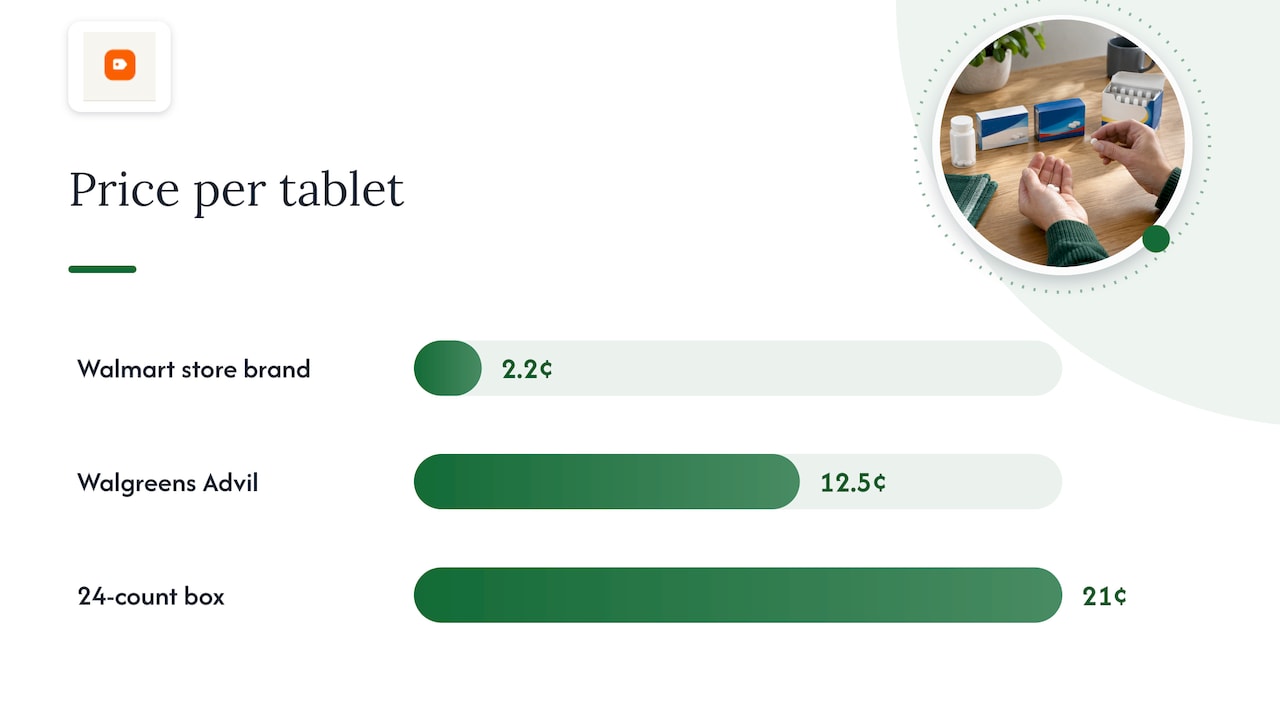
The tablet count is the number most shoppers skip. A 24-count box at $4.99 looks cheap next to a $10.99 bottle, yet it costs about 21 cents a tablet against 11 cents. Our free unit price calculator does this division for price per count, per ounce and per pound, so you can check a pack in the aisle.
Why the same pill costs so different amounts
Store brand versus national brand
Store-brand ibuprofen carries the same active ingredient as the national brand, and it sits at the low end of the price range. An IndexBox report from May 2026 on the US pain and fever market finds ultra-value private-label products typically priced 30 to 50% below comparable national brands. The shelf listings above run wider than that, from roughly 2 cents to 12 cents depending on store, which shows how much the pricing strategy of each retailer matters. When a retailer prices its own brand aggressively, the gap against a national brand can be far bigger than 50%.
We measured this pattern across many categories in our study of generic versus name brand prices. Pain relief is one of the clearest cases because the active ingredient and strength are printed on every box and are easy to match.
Pack size
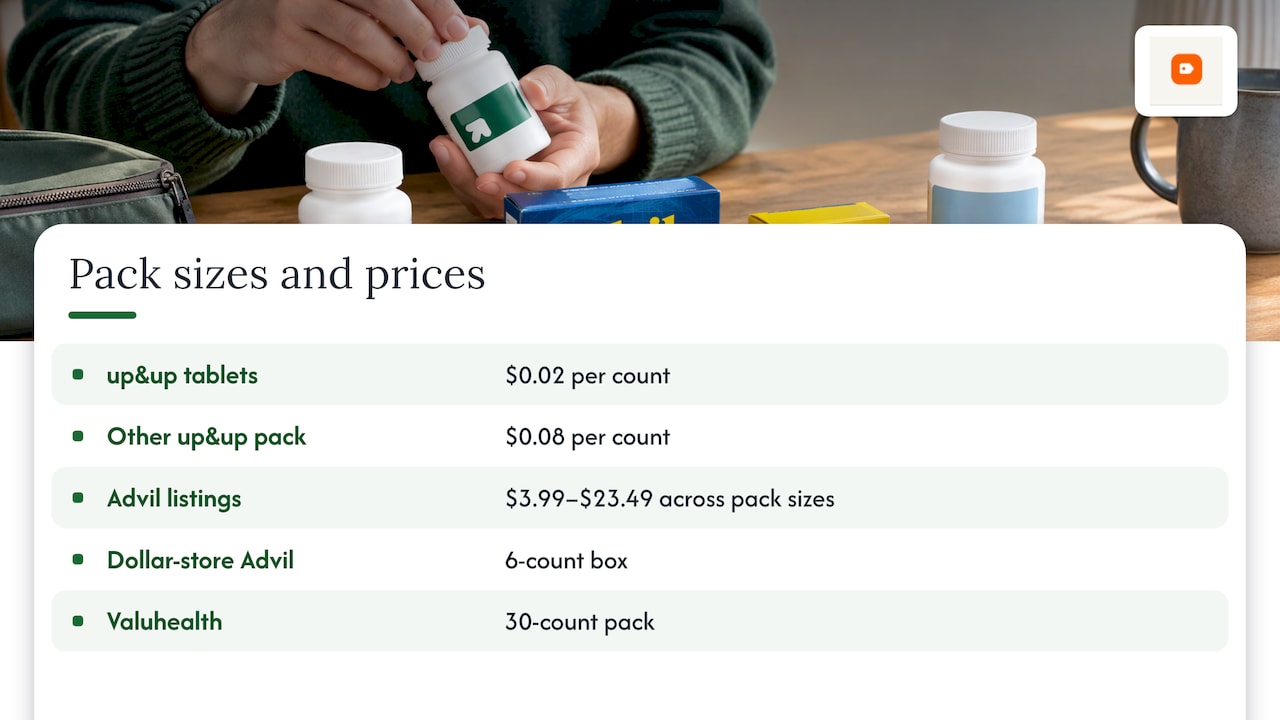
Larger bottles usually carry a lower price per tablet, but not always. Target's ibuprofen listings show up&up tablets at $0.02 per count and a different up&up pack at $0.08 per count, and its Advil tablets range from $3.99 to $23.49 across pack sizes. At a dollar store, Advil 200 mg comes in 6-count boxes and Valuhealth ibuprofen in 30-count packs. A small box is convenient for a purse or a gym bag, and the per-tablet price reflects that convenience. Buying a big bottle for home and a small box for travel is a common way to split the difference.
Premium formulas
Liquid gels, rapid-release, gastro-resistant and combination formulas are sold as extras. The same IndexBox report says these products command a 40 to 60% premium over basic tablet formats. If you are comparing, first decide the formula you want, then compare within it.
Sales and deals
The report also estimates that 30 to 40% of branded unit volume sells on deal, through discounts, buy-one-get-one offers and loyalty pricing. So the sticker price of a name brand often is not the price people pay. Walgreens, for example, lists a $3.50-off coupon on Advil 100-count and a buy-one-get-one 50% off offer on its own brand. Run the division with the sale price, because a deal can move a name brand much closer to a store brand, though a store brand often still wins.
Prescription-strength ibuprofen and what pharmacies pay
If your doctor prescribed 400, 600 or 800 mg tablets, the price you see comes from a different system. Prescription pricing depends on your insurance, the pharmacy and discount programs. Prices that pharmacies pay are published as a benchmark, and a benchmark is not what shows up on your receipt.
A few reference points show how low the underlying cost is:
- A pharmacy-reference page synced to the FDA directory in November 2026 reports an acquisition cost of about $0.0375 per tablet for Dr. Reddy's 400 mg ibuprofen, which is $3.75 per 100 tablets. The same page shows Medicare Part D plans paying $0.1000 per tablet in the second quarter of 2026, and Medicaid paying $0.2541 per tablet over the trailing 12 months. Each figure measures a different payer, so none of them is the counter price.
- NADAC pricing data lists ibuprofen from $0.03 to $0.15 per unit, including Advil 200 mg at $0.1081 per unit and generic 800 mg tablets at $0.0735 to $0.0765 per unit.
NADAC is the National Average Drug Acquisition Cost, a survey-based figure for what retail pharmacies pay to buy a drug. A pharmacy adds a dispensing fee and margin, and your insurance copay may be a flat amount regardless of the pill's cost. If you have a prescription, ask your pharmacist or prescriber what a cash price for the generic would be and compare it with your copay. Prescription ibuprofen should be taken exactly as your prescriber directs.
For over-the-counter use, read the Drug Facts label for the dose and the maximum for a day. People with stomach ulcers, kidney disease, heart disease or high blood pressure, people who are pregnant, and people taking blood thinners should ask a doctor or pharmacist before using ibuprofen.
A repeatable way to buy ibuprofen cheaply
- Pick the strength and the form. For most households that is 200 mg coated tablets. Compare like with like.
- Gather three or four prices. Include a warehouse or discount grocer, a drugstore, a big-box retailer and a grocery chain.
- Divide each price by its count. Write down cents per tablet.
- Apply sales and coupons. Redo the division with the sale price.
- Match the pack to your use. If a household goes through a bottle in a few months, the big bottle is the cheaper route. Check the expiration date on the label before you buy a large one.
- Use health savings money where it applies. Walmart and Kroger list their 100-count store-brand bottles as HSA/FSA eligible, and Kroger's page notes to keep your receipt if your program requires reimbursement.
To skip steps 2 to 4, you can look at our weekly list of pain relievers on sale, which ranks listings by real cost per unit. The wider tablets page does the same for tablet products. If you want to see how stores stack up for everyday items in general, our store comparison prices them per unit too, and our Aldi versus Walmart breakdown shows the method on a full basket.
Why a price per unit beats a sticker price
A shelf tag shows the price of the bottle. It says nothing about what you get inside. Two bottles at the same price can hold 50 or 200 tablets, and two bottles with the same count can sit at very different prices. That is why unit pricing is the one habit that protects you in every aisle, not only in the pain-relief section.
The habit also travels. The same division works for a diaper, a ream of paper or a foot of cable. If you enjoy the practice, our daily game Bulkle asks which pack is cheapest per unit, and it sharpens the instinct quickly.
Promo: see ibuprofen and other essentials ranked per unit
OutletPicks is an independent US price comparison site that ranks everyday products by their real cost per unit, such as per milliliter, per diaper, per page or per foot. It compares prices across Amazon and partner retailers and rechecks retailer data on a rolling cycle, so the cheapest pack floats to the top whatever the pack size or brand.
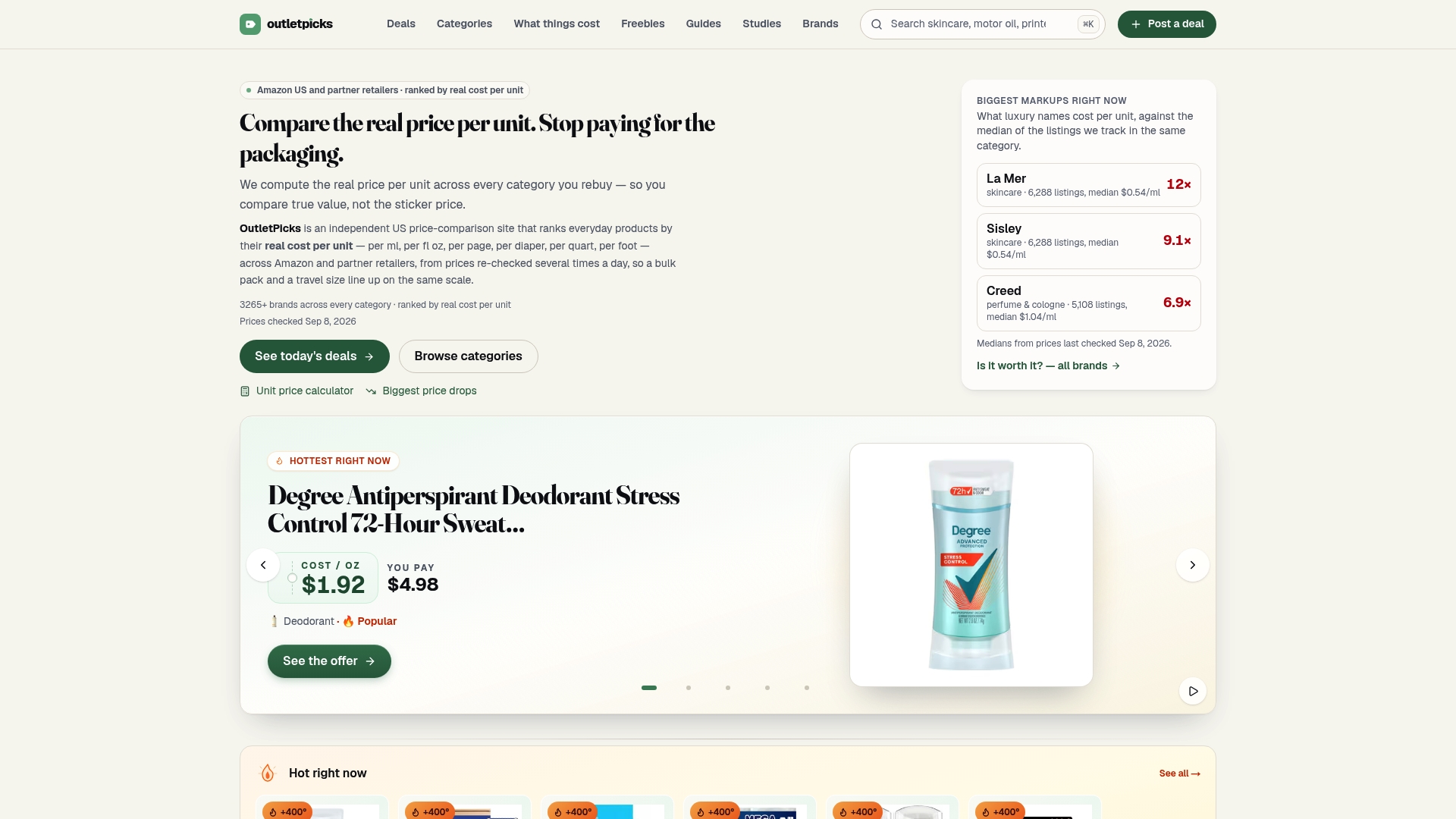
Start with the pain relievers on sale this week, or browse the full OutletPicks homepage to see the categories we rank, from skincare and baby care to cables, cameras and printers.
Perspective: what we see in unit prices
We built OutletPicks around one idea: the sticker price is the least useful number on a product page. Ibuprofen shows it better than almost anything. The active ingredient is identical, the strength is printed on the box, and the price per tablet still swings by a factor of ten.
When you rank products by real cost per unit, three things become obvious quickly. Pack size changes the answer more than the brand does. Store brands tend to land at the low end of the range. And a sale can reshuffle the ranking within a week, which is why we recheck retailer data on a rolling cycle and update prices daily.
Our advice is simple. Decide the strength, divide the price by the count, and compare in cents. Then let a ranked list do the repetitive part for you. The same method works for diapers, hair care, cables and every other category on our site, and it is the reason we publish the numbers rather than the opinions.
Alex
FAQ
How much is one ibuprofen tablet?
For a 200 mg over-the-counter tablet, store-brand bottles of 100 were listed at about 2 cents a tablet in 2026, while name-brand tablets were listed at 11 to 12 cents in 100-count bottles and about 21 cents in a 24-count box. Prescription tablets of 400 to 800 mg are priced through insurance and pharmacy systems, so the cash and copay prices differ from the shelf figures.
How do I work out the cost per pill?
Divide the total price by the number of tablets in the bottle. A $5 bottle with 100 tablets is about 5 cents a tablet. If strengths differ, divide again by the milligrams and multiply by 100 to get a price per 100 mg. You can run it through the unit price calculator.
Is the name brand worth the extra cost?
The store brand and the name brand list the same active ingredient in the same strength, and the price gap is usually the biggest difference between them. The easiest comparison is on cost per tablet, and our generic versus name brand study shows how wide that gap runs across categories. If you prefer a particular tablet coating or formula, compare within that formula.
Why is a prescription ibuprofen price different from the shelf price?
Prescription prices depend on your insurance plan, the pharmacy's dispensing fee and margin, and who pays. Reference prices such as NADAC show what pharmacies pay, not what you pay. Ask your pharmacist for the cash price of the generic and compare it with your copay.
Sources
- Kroger: Ibuprofen Coated Tablets 200 mg, 100 ct
- Kroger: pain relief tablet listings
- Walgreens: ibuprofen listings
- Target: ibuprofen tablets
- ShopRite: Advil Coated Tablets 200 mg, 24 count
- Dollar Tree: pain and fever
- HelloPharmacist: Ibuprofen 400 mg tablet, NDC 55111-0682-01
- NADAC Intelligence: ibuprofen prices
- IndexBox: Pain and Fever Market in the United States