
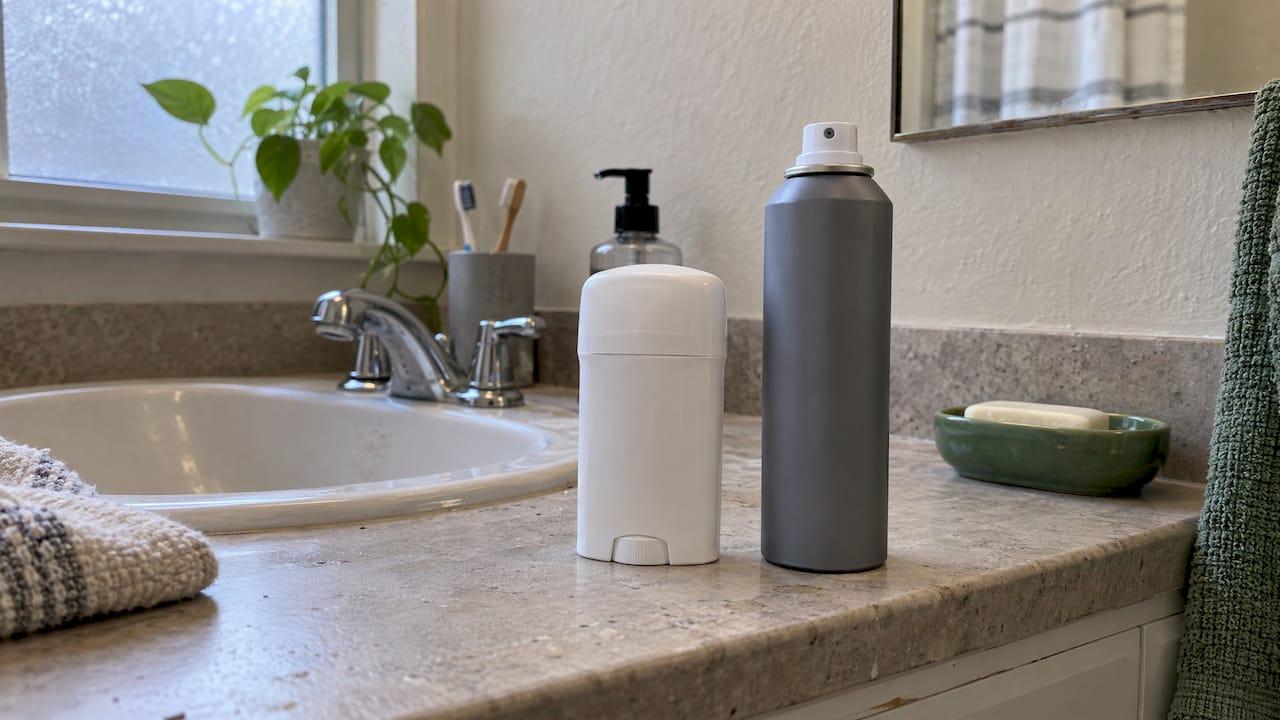
For most people, a stick is the better everyday buy: it goes on where you want it, tends to last longer, and is easier on skin that reacts to alcohol. Spray wins on speed, a light feel and less residue on clothes. The sticker price won't tell you which one costs less. Only cost per ounce, and then cost per use, will. At OutletPicks we rank everyday products by real cost per unit, so this guide compares the two formats on performance and on what each really costs you over a month.
TL;DR
- Stick: precise, close-to-skin coverage that tends to last longer, and a good fit if you dislike aerosol or alcohol-heavy formulas.
- Spray: fast to apply, dries quickly and leaves less visible residue, but needs ventilation and a careful hand on freshly shaved skin.
- Staining: yellow marks come from aluminum mixing with sweat, not from the format alone, so check the ingredient list as well as the shape.
- Travel: a stick passes airport security without limits, while a spray has to be 3.4 oz or smaller in your liquids bag.
- Value: compare price per ounce first, then estimate how many weeks each container lasts you.
Table of Contents
- The short answer: how stick and spray differ
- Which lasts longer on your skin?
- Skin comfort: sensitive skin and shaving
- Stains on clothes: stick, spray, or the ingredient?
- Application, drying time and safe use
- Flying with deodorant: the 3-1-1 rule
- What each format really costs
- How to choose: a quick decision guide
- Our perspective
- Compare deodorant prices by the ounce
- FAQ
- Sources
The short answer: how stick and spray differ
A deodorant stick is a solid you swipe across the skin. A spray is a liquid or powder suspension pushed out by a propellant, which is the pressurized gas that forces the product out of the can. Both can come as plain deodorant, which targets odor, or as antiperspirant, which uses aluminum-based compounds to reduce sweat. The format matters less than that distinction, but it still changes how the product feels, how long it seems to last and how much you spend.
Here is the comparison at a glance:
| What you care about | Stick | Spray |
|---|---|---|
| Application | Precise, close to the skin | Wide and fast, no contact |
| Feel | Thicker layer, can feel tacky | Light, cool, dries quickly |
| Staying power | Generally longer-lasting | Good for a quick refresh |
| Sensitive or shaved skin | Often gentler | Alcohol can sting |
| Clothing marks | More visible residue | Less residue |
| Air travel | No limit on size | 3.4 oz or less in the liquids bag |
| Container life | Often lasts longer per ounce | Empties faster per ounce |
The rest of this guide explains each row and then turns it into dollars.
Which lasts longer on your skin?
Sticks usually get the edge. A dermatologist quoted by The Established explains that a stick's formula stays on the skin instead of dispersing into the air, so its active ingredients keep working longer. Beauty World News makes a related point: sticks tend to carry a higher concentration of actives such as aluminum compounds than sprays or roll-ons do.
That said, staying power depends on more than the shape of the container. Whether the product is an antiperspirant or a plain deodorant, how much you sweat, the heat and your activity level all play a part. A well-made spray can carry a hard workout: a 2026 tested roundup from Verywell Fit found one dry-spray antiperspirant kept testers fresh through HIIT sessions in humid weather.
A practical way to choose:
- If you need to get through a long workday or a sticky commute with one application, start with a stick.
- If you want a midday refresh or a post-gym top-up, a spray is faster, and you can keep one in a gym bag.
- If you sweat heavily, look at the label for antiperspirant, whichever format you pick.
Dermatologist Dr. Garshick, quoted in that same Verywell Fit roundup, sums up the format question as completely up to personal preference, with the product that feels easy and pleasant to use as the one you will actually wear every day. That is a fair rule: the best deodorant is the one you reapply on time.
Skin comfort: sensitive skin and shaving
Irritation is where the two formats differ most. NBC Select reports that sprays often contain alcohol or similar ingredients that can bother sensitive skin or skin that has just been shaved. A dermatologist quoted there says the same about alcohol in sprays and freshly shaved underarms. Today reports that some dermatologists advise steering clear of aerosol sprays because the propellants can be irritating.
So if your underarms sting after shaving, here is a sensible routine:
- Shave in the evening and apply deodorant the next morning, so the skin has time to settle.
- Choose a fragrance-free stick, since fragrance is a common trigger of cosmetic reactions.
- If you prefer spray, hold it at arm's length, keep the burst short and let it dry fully before dressing.
- If redness, burning or a rash keeps coming back, stop using the product and see a dermatologist or your doctor.
An important health note on aluminum: if you have kidney disease, check with your doctor before using an antiperspirant, because US antiperspirant labels carry that instruction. For everyone else, the format you choose does not change that label guidance.
Stains on clothes: stick, spray, or the ingredient?
Both formats can mark fabric, but not for the same reason people assume. NBC Select explains that yellow staining happens when sweat minerals mix with aluminum in deodorants and antiperspirants. Dr. Gmyrek, a dermatologist quoted there, says any product with aluminum can stain because aluminum compounds bond with sweat. In other words, the ingredient drives the yellow stain, and the format drives the white residue.
- Stick: the thicker layer can rub off as white streaks on a dark shirt if you don't let it dry.
- Spray: it generally leaves less residue, though overspray can settle on nearby fabric.
- Yellow pit stains on white shirts: look for aluminum-free formulas if they bother you, and expect that stronger sweat control tends to bring more staining risk.
A quick habit helps with either format: apply a thin layer to clean, dry skin and wait until it is dry before you dress. Most white-stripe problems come from putting on too much, not from the format.
Application, drying time and safe use
A stick takes a little longer to settle but goes exactly where you put it. Two or three swipes per underarm is usually enough, and heavy layering is what causes tackiness. Because you press it on, it also works well on a small area, such as the edge of the underarm where hair meets skin.
A spray covers more ground in less time, and you never touch the product. Hold the can several inches from your skin, spray for a couple of seconds and give it a moment to dry. Use it in a ventilated space: sprays make a mist that you can breathe in, and Beauty World News notes that inhaling aerosols is a drawback of the format, especially in small rooms such as a bathroom with the fan off.
A few safe-use basics for aerosol cans:
- Keep them away from flames and heat sources, and never leave one in a hot parked car.
- Spray away from your face and eyes, and avoid spraying near children or pets.
- Don't spray on broken or irritated skin.
If odor lingers even after a fresh application, fabric may be the culprit. Odor can settle in clothing and underwear as well as skin, and preventing underwear odor is a useful complement to any deodorant routine.
Flying with deodorant: the 3-1-1 rule
The 3-1-1 rule is the airport liquids limit: containers of 3.4 oz (100 mL) or less, all in one quart-sized clear bag, one bag per passenger. It applies to spray deodorant, not to a solid stick. The TSA's deodorant page says aerosol deodorant is allowed in a carry-on only at 3.4 oz or less per container. In checked bags, it sets limits of 70 oz total and 18 oz per container, and the release button must be capped so it can't go off by accident. A 2026 TSA guide notes that solid stick deodorant has no such restriction.
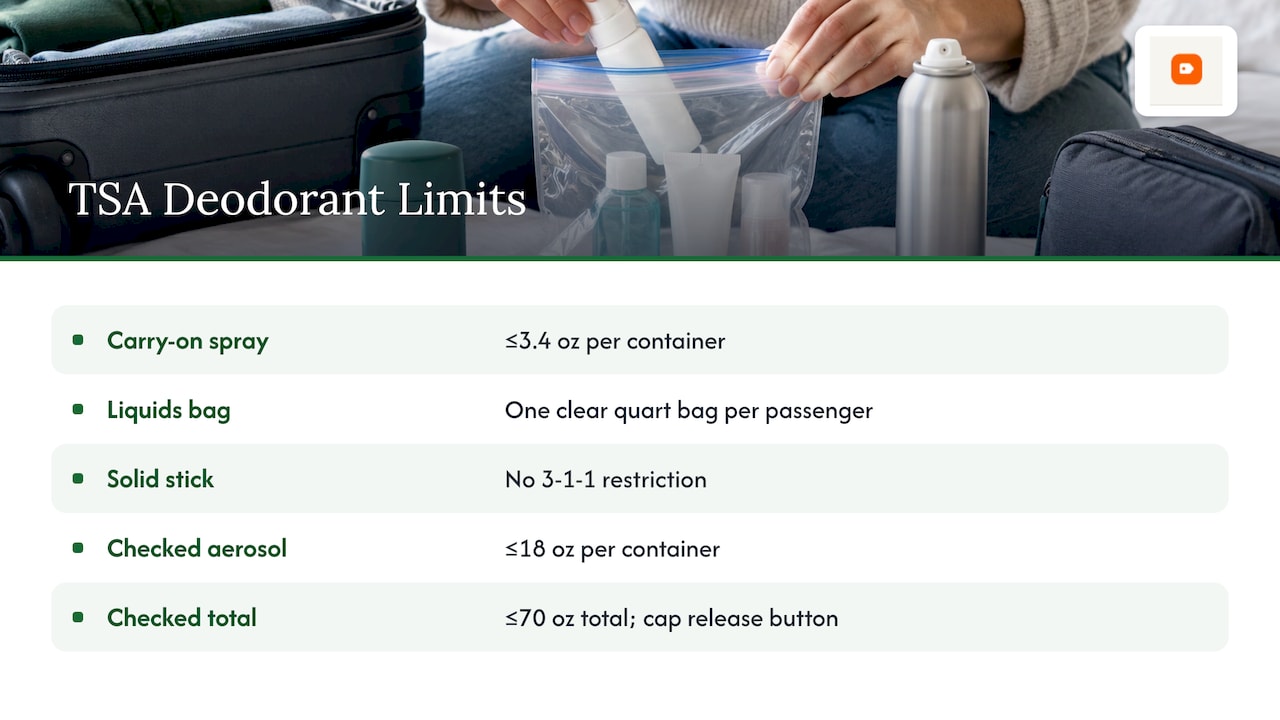
For frequent travelers, that makes a stick the simplest carry-on choice. If you prefer spray, buy a travel-size can and put it in your liquids bag.
What each format really costs
This is where most comparison articles stop, and where the money is. Two deodorants with the same shelf price can have very different costs, because containers differ in size and because you use different amounts of each.
Step 1: price per ounce. Divide the price by the ounces on the label. It is the only fair way to compare a small stick with a large can. Our guide to deodorant price per ounce explains what counts as a good price this year.
Step 2: price per use. Per ounce is only half the story, because a spray often empties faster than its size suggests. Estimate how many weeks a container lasts you, then divide the price by those weeks.
Here is a hypothetical example to show the math (these are not real product prices):
| Stick | Spray | |
|---|---|---|
| Price | $5.00 | $7.00 |
| Size | 2.6 oz | 5 oz |
| Price per ounce | $1.92 | $1.40 |
| Weeks it lasts you | 9 | 4 |
| Cost per week | $0.56 | $1.75 |
In that example the spray looks cheaper per ounce but costs three times as much per week, because the can empties faster. Your own numbers will differ, and the same example could swing the other way if a spray lasts you much longer than you expect. The method is the point: price per ounce first, then weeks of use.
Step 3: watch for multipacks and sale cycles. Twin packs and three-packs can drop the per-ounce price sharply, and deodorant goes on sale often. Our weekly deodorant deals page shows what is discounted and ranks it by price per unit.
A few things that skew price comparisons:
- Antiperspirant vs deodorant: the two are priced differently, so compare like with like.
- Travel sizes: they are nearly always the most expensive per ounce.
- Scent and "skin-friendly" labels: these add to the price without changing the format math.
- Pack counts: a three-pack that looks pricey can be the cheapest per ounce.
How to choose: a quick decision guide
Pick a stick if you:
- want one application to carry you through a full day
- have sensitive skin or shave often
- fly regularly with only a carry-on
- like to control exactly where the product goes
Pick a spray if you:
- want something quick, light and dry within seconds
- dislike any residue on your clothes
- need a refresh in a gym bag or office drawer
- have a well-ventilated place to apply it
If you are still undecided, buy the smaller or lower-priced version of each, then track how long each one lasts. That gives you your own cost per week, which beats any general rule.
Our perspective
Shoppers tend to treat deodorant as a scent and brand choice, then get surprised at how quickly one container disappears and another keeps going. The sticker price hides that. Two products can sit side by side on a shelf at the same price and have very different costs once you divide by ounces and by weeks of use.
That is why we rank everyday products by real cost per unit, regardless of pack size or brand. For deodorant, the useful question is not stick or spray in the abstract. It is which format gives you the lowest cost per ounce, and then the lowest cost per use, in the pack that suits you.
Compare formats with the same yardstick, check the price per ounce, and let your own habits tell you how long a container lasts. The cheaper choice is usually clear after that.
Alex
Compare deodorant prices by the ounce
OutletPicks compares prices across Amazon and partner retailers and ranks products by actual cost per unit, so a stick and a spray sit on the same scale. Our retailer data is rechecked on a rolling cycle, so you see where the value really is without doing the arithmetic yourself. Browse deodorant and personal care in our product categories, or see which brands rank best in the brand index.
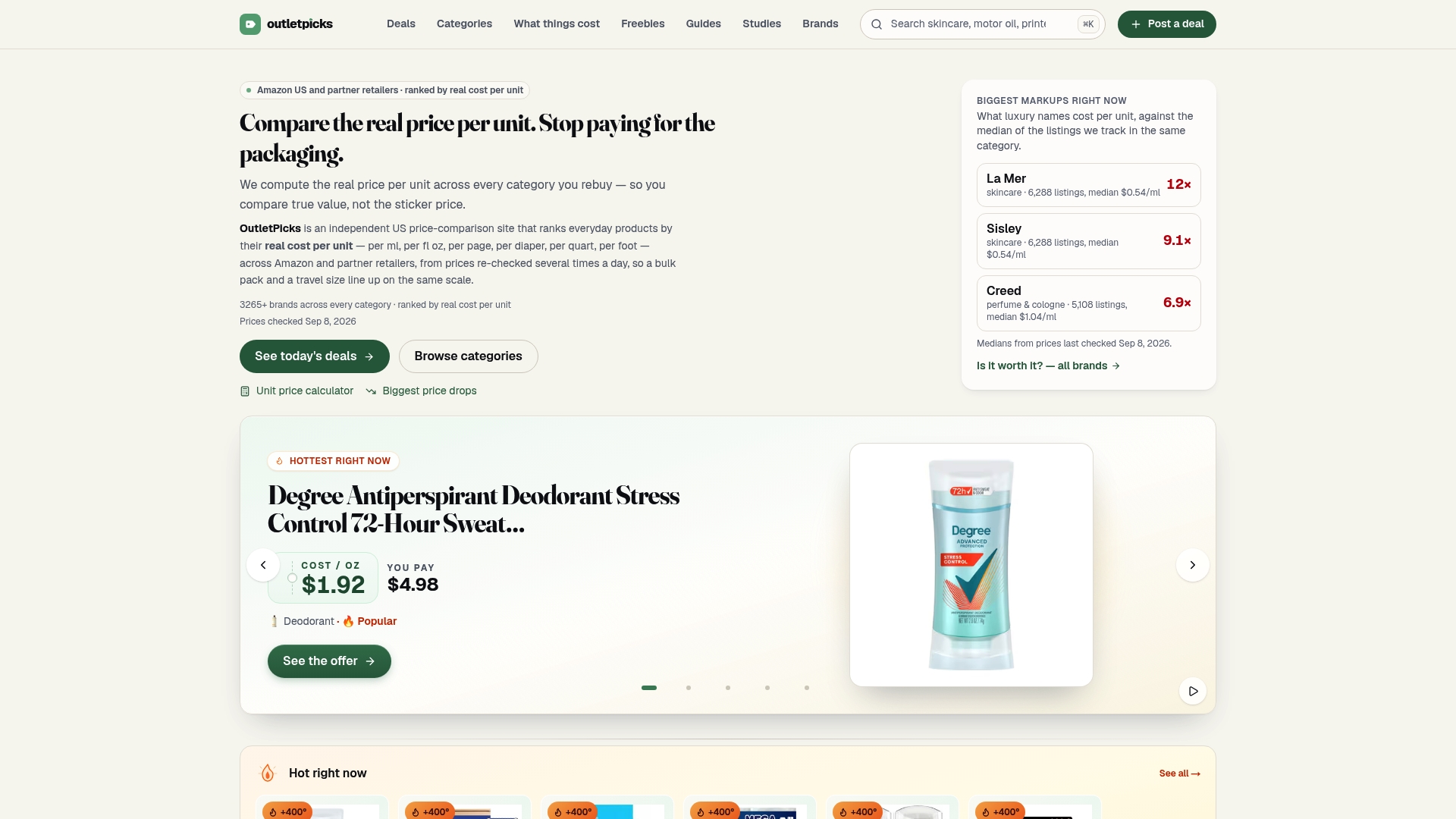
If you buy scented products as well, our studies and data show the same cost-per-unit method applied to other everyday items.
FAQ
Is spray deodorant worse for you than stick?
Not necessarily, but sprays come with more things to manage. Some dermatologists, as reported by Today, advise avoiding aerosols because propellants can irritate skin. Spray can also be inhaled, so use it in a ventilated room. If your skin is sensitive, a fragrance-free stick is the simpler route.
Do stick deodorants last longer than spray?
Generally yes. Sticks keep their formula on the skin and often carry a higher concentration of active ingredients, which is why sources such as Beauty World News say they tend to last longer. Heat, humidity, activity and body chemistry change the result for each person.
Does the 3-1-1 rule apply to deodorant?
It applies to spray and aerosol deodorant. In a carry-on, the container must be 3.4 oz (100 mL) or smaller and fit in your quart-sized liquids bag, per the TSA. A solid stick is not restricted.
Which is better for avoiding yellow stains?
The ingredient matters more than the format. Aluminum compounds bond with sweat and cause yellowing, according to NBC Select. Spray generally leaves less white residue, while an aluminum-free product lowers the risk of yellow marks.
Sources
- Deodorant vs. Antiperspirant: Which Is Healthier? (Today)
- Is deodorant stick better than spray? (The Established)
- Deodorant Stick, Roll-On, Spray: Which Lasts Longer? (Beauty World News)
- The 10 Best Deodorants for Women of 2026, Tested (Verywell Fit)
- 15 Best Deodorants and Antiperspirants of 2026 (NBC Select)
- Deodorant (aerosol) (Transportation Security Administration)
- TSA Carry-On Rules: Everything You Can and Cannot Bring