
Unit price is the final cost of a product divided by however much of it you can actually use, whether that's ounces, milliliters, loads, or sheets. The single move that matters is comparing that number, not the sticker price, across every option before you buy. Include coupons, shipping, and taxes in the numerator, and a price comparison tool can help run that math for you. Recheck it whenever a promotion changes the deal.
TL;DR:
- Comparing the final out-of-pocket cost divided by usable units helps identify the truly cheaper product, especially when packaging sizes vary significantly.
- Adjusting for waste and concentration, such as only using part of a bulk item or accounting for product strength, is essential for accurate unit price calculations.
- Shipping, membership fees, and return risk must be included in the total cost, as they can overturn apparent savings suggested by shelf tags.
- Using online calculators and keeping a note on your phone greatly speeds up accurate unit price comparisons during shopping.
- Running the math regularly can reveal substantial savings over time, sometimes adding up to over 150 dollars annually for just a handful of staples.
Table of Contents
- What Is Unit Pricing and Why Does It Matter?
- How Do You Calculate the True Unit Price?
- What Mistakes Change Which Product Is Actually Cheaper?
- What Do Worked Unit Price Examples Look Like?
- What Tools Help You Calculate Unit Price Faster?
- How Much Do Small Unit Price Wins Add Up To?
- OutletPicks: Unit Price Tools Built for This Exact Problem
- A Habit Worth Adopting Before Your Next Grocery Run
- Sources
What Is Unit Pricing and Why Does It Matter?
Unit pricing converts any product into a common denominator, cost per ounce, per serving, per count, so a 12 pack and a 24 pack of the same item become directly comparable. Without that conversion, a shopper is just guessing based on which box looks like the better deal. Extension programs that teach household budgeting have relied on per-ounce comparison math for decades because sticker price alone hides so much.
The trap is simple: bigger packages usually cost more upfront, so a $14.99 jumbo bottle looks worse than a $4.99 small one at first glance. Divide each by its actual quantity, though, and the jumbo bottle often wins by a wide margin. Multipacks make this worse. A "3 for $10" promo sounds like a deal until you realize a single unit was already on sale for $3.10.
You should run this math every time you shop for household staples, anything sold in bulk, and concentrated products like detergent or juice concentrate. Those three categories hide the biggest price traps because package size varies so much between brands and retailers.
How Do You Calculate the True Unit Price?
The formula is straightforward: unit price = final out-of-pocket cost ÷ usable units. Every word in that sentence matters, especially "final" and "usable," because both get skipped constantly.
Here's the process, step by step:
- Find the final price. Start with the listed price, then subtract any coupon or promo code value, add shipping if it applies, and add sales tax if your state charges it on that item.
- Confirm the quantity. Check the label for ounces, milliliters, count, or loads, not just "large" or "family size," which are marketing terms with no fixed meaning.
- Adjust for what you'll realistically use. A gallon of milk you'll pour half of down the drain isn't really a gallon's worth of value.
- Divide final cost by usable quantity. That number is your real unit price.
- Repeat for every option before deciding. A reliable comparison workflow always runs final price, quantity, and waste adjustment for each candidate, not just the one that looks cheapest.
Concentrated products need one more layer of thinking. A bottle of laundry detergent might be 100 fluid ounces, but if it's double concentrated, it delivers twice the loads per ounce of a standard formula. Comparing by usable loads rather than bottle volume is the only way to price these correctly.
Unit mismatches trip up a lot of shoppers too. If one product lists grams and another lists ounces, convert before you divide. Keep a grams-to-ounces reference or a pounds-to-ounces reference handy, because comparing 500 grams to 16 ounces without converting will give you a wrong answer that feels right.
What Mistakes Change Which Product Is Actually Cheaper?
The usable-unit trap catches more shoppers than any other mistake. A 5-pound bag of spinach at a lower per-ounce price is worthless if half of it turns to mush before you eat it. The adjusted usable quantity is your labeled quantity multiplied by how much you'll genuinely use, not the number printed on the package.

Bundled "bonus" items deserve the same skepticism. If a bundle throws in a travel-size item you'll never open, assign it a value of $0 and recalculate the unit price based only on what you'll use. Federal price-guidance principles back this same conservative approach: don't let a free-sounding extra distort your math.
A few more traps worth flagging:
- Shipping costs and membership fees (think warehouse club dues) belong in your final-cost number, not off to the side.
- Return risk matters. A "deal" you're likely to send back isn't a deal.
- Store-brand unit price sometimes loses to name-brand when you factor in concentration, durability, or performance differences that actually change how much you use per application.
Pro Tip: Retail shelf tags with pre-printed unit prices are a solid starting point, but they rarely include your specific coupon, membership discount, or shipping cost, so treat them as a first draft, not a final answer.
What Do Worked Unit Price Examples Look Like?
Canned soup is the easiest place to start. A 10.5-ounce can at $1.89 works out to $0.18 per ounce. A 15-ounce can at $2.49 comes out to $0.166 per ounce, the better buy, assuming you'll eat the whole can and there's no coupon skewing either price.
Paper towels reward a per-sheet approach instead of per-roll:
The store brand wins here, even though its total price sits in the middle.
Laundry detergent needs the loads adjustment mentioned earlier:
- Bottle A: 100 fl oz, $12.99, standard concentration, 50 loads → $0.26 per load.
- Bottle B: 64 fl oz, $10.99, double concentration, 64 loads → $0.17 per load.
Bottle B looks smaller and pricier per ounce but wins decisively per load.
Now the adjusted example where bulk loses: a 5-pound bag of shredded cheese at $14.99 beats a 1-pound bag at $4.29 per raw ounce math. But if you'll only use 2 pounds before the rest molds, your real cost per usable ounce on the bulk bag jumps well past the small bag's price.
What Tools Help You Calculate Unit Price Faster?
Doing this math by hand for every grocery run gets old fast, which is exactly why calculators exist. A unit price calculator that accepts total price and quantity will spit out cost per unit and, often, percent savings between two options, which beats mental math when you're standing in an aisle or comparing tabs online.
For a lightweight system, keep a running note on your phone with these fields:
- Item name and size
- Final price after discounts
- Shipping cost, if any
- Usable units (adjusted for waste)
- Computed unit price
- Date checked
Trust a printed or listed unit price only when you're certain it already reflects your actual final cost. The moment a coupon, membership fee, or shipping charge enters the picture, recompute it yourself.
How Much Do Small Unit Price Wins Add Up To?
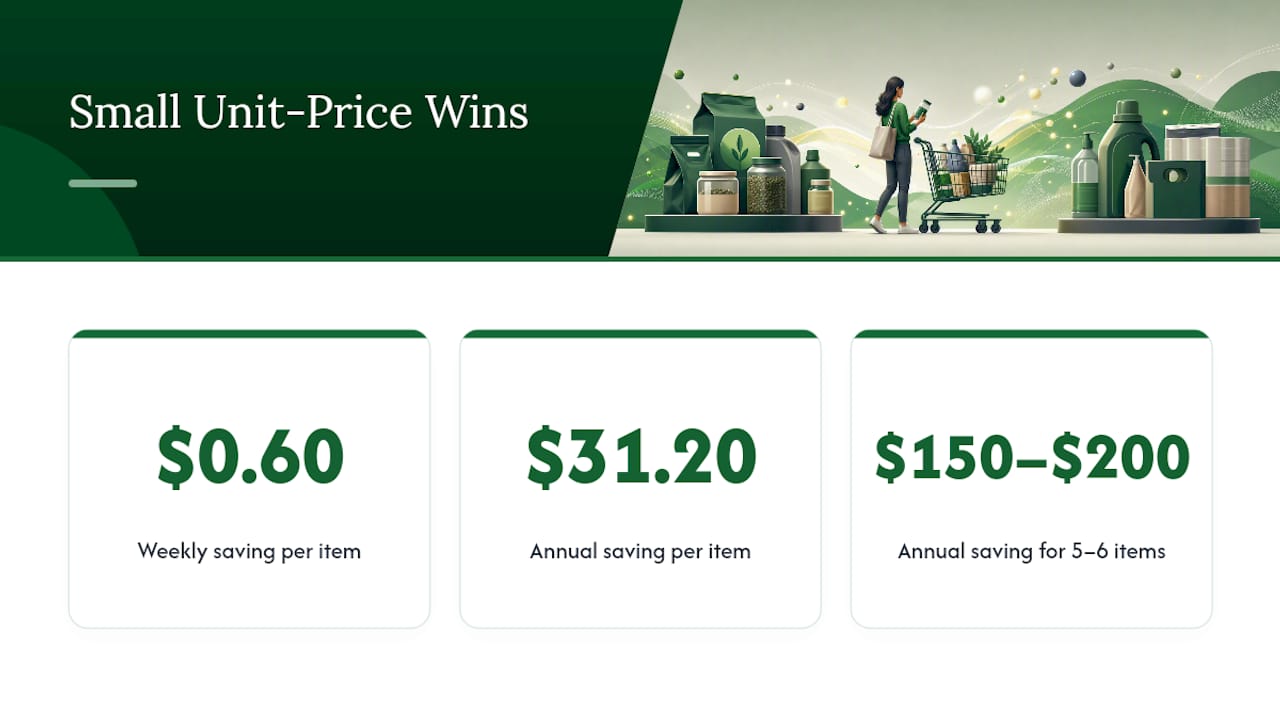
Swapping one overpriced staple for a lower unit-price version that saves just $0.60 a week comes out to $31.20 in savings over a year. That's one item. Track five or six frequently bought staples the same way and the annual number climbs into real territory, often past $150 to $200 depending on your household size and shopping frequency.
Run a quick five-item test this week: pick your most-bought staples, compute unit price on each, and see what a smarter pick saves. Recalculate whenever prices shift or a new coupon shows up, since a great deal today can flip by next month.
OutletPicks: Unit Price Tools Built for This Exact Problem
Outletpicks exists because doing this math by hand, item by item, retailer by retailer, isn't realistic for a full cart of groceries and household goods. The unit price calculator takes your price and quantity inputs and returns cost per ounce, per count, or per load instantly, and it's built to handle the final-cost and usable-unit adjustments this article just walked through.
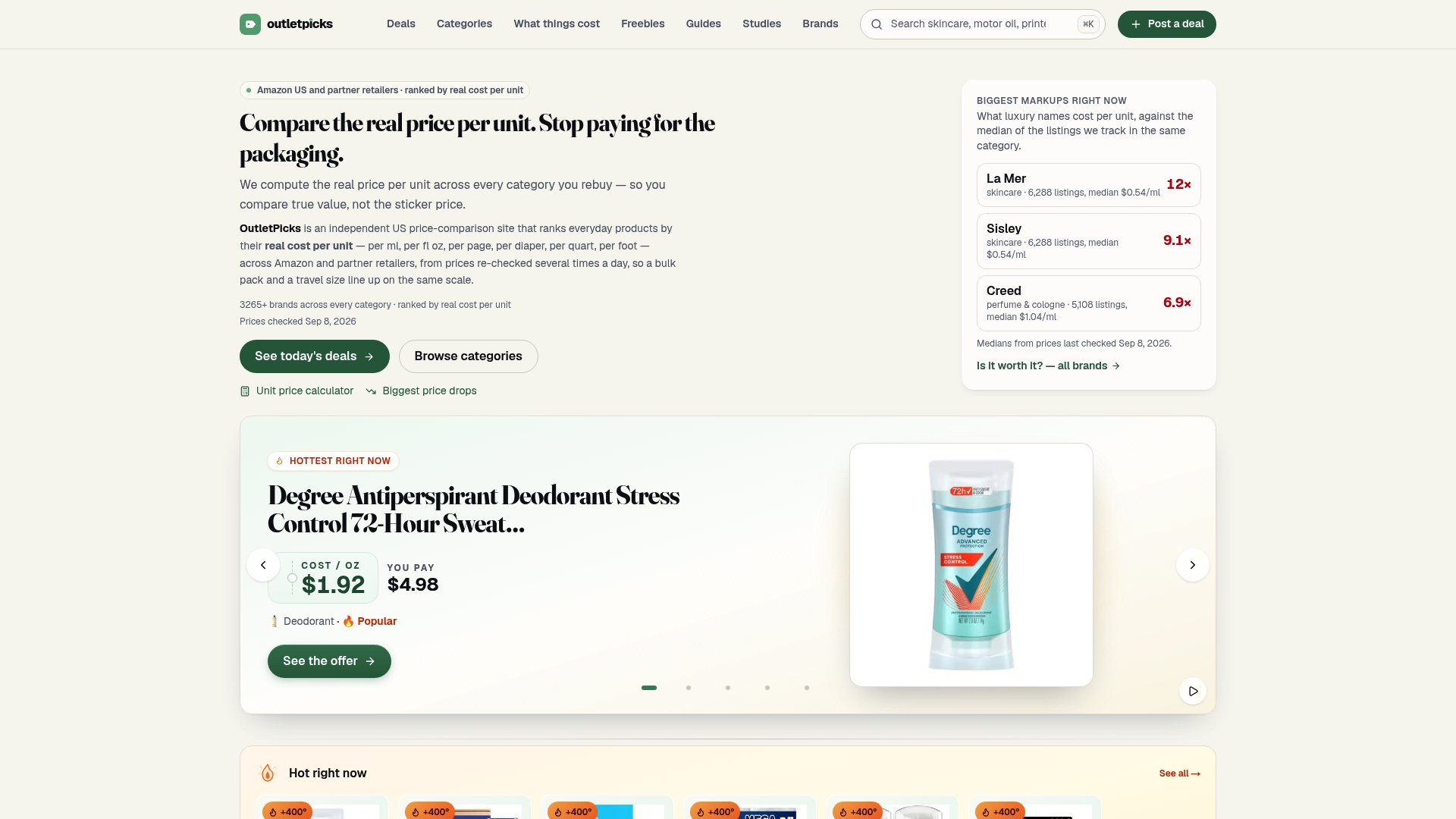
Beyond the calculator, Outletpicks maintains category tables that rank products by real cost per unit across Amazon and partner retailers, rechecked on a rolling cycle so the numbers don't go stale. Before your next bulk purchase, run it through OutletPicks and see whether the bigger size actually wins once shipping and realistic usage are factored in.
A Habit Worth Adopting Before Your Next Grocery Run
Keep the phone note running, check OutletPicks before any bulk purchase, and always ask whether you'll realistically use the whole package before spoilage sets in. Try it on your next five purchases and see what the numbers tell you.
— Alex