

A stock-up price is the rock-bottom cost an item hits during its typical 12-week sales cycle, and it's your cue to act. When a staple you use regularly drops to that level, buy a 3-month supply; if the discount is unusually steep, stretch to 6 months. Confirm the deal is real by checking unit price and comparing it against your own price book, not the shelf tag's claimed savings.
TL;DR:
- Most staple items follow a 12-week promotional cycle, with the true stock-up price being their historical lowest point.
- Accurate unit price comparison, subtracting coupons beforehand, is essential to avoid overbuying and misjudging deals.
- Seasonality influences sale timing, with condiments and baking supplies hitting lows at predictable times, aiding forecasted shopping.
- Regularly updating your grocery price book ensures you don’t rely on outdated lows, especially during inflationary periods.
- Buying large quantities on sale makes sense primarily for shelf-stable items with space and shelf life, not perishable goods or overly bulky products.
Table of Contents
- What Makes a Price a "Stock-Up Price"
- How to Calculate Unit Price the Right Way
- When Do Different Grocery Categories Actually Go on Sale?
- How Do You Build and Maintain a Grocery Price Book?
- Shopping Strategy: Store Rotation, Special Trips, and Skipping Sales
- Sample Stock-Up Price Targets to Calibrate Your Own List
- How OutletPicks Speeds Up the Math
- Adapting Stock-Up Pricing to Online Shopping and Digital Coupons
- How Inflation Changes Your Stock-Up Price Targets
- Prioritizing Pantry Space by Perishability and Storage Limits
- Common Mistakes That Undermine a Stock-Up Strategy
- Why a Price Book Beats Chasing Sales
- Put the Math to Work: OutletPicks' Calculator and Checklists
- Sources
- FAQ
What Makes a Price a "Stock-Up Price"
Grocery prices don't wander randomly. Most center-store staples, canned goods, cereal, pasta, condiments, cleaning supplies, cycle through a promotional pattern that repeats roughly every 12 weeks. An item goes on sale, sits at regular price for a stretch, then hits a promotional low again about three months later. That low point, the price the item reliably returns to, is its stock-up price.
Here's why the number matters more than the percentage off. A "30% off" sticker sounds good, but if the regular price was already inflated before the markdown, you're not actually at the historical low. A true stock-up price is the floor: the price you've seen the item hit before, or close to it. When you spot that floor, the math is simple. Buy enough to last until the next expected cycle, about 3 months, so you're never forced to pay full price in between. If the sale goes noticeably deeper than the usual floor (say, a clearance event or a manufacturer's coupon stacked on a sale), it's worth extending to a 6-month supply instead.
This cycle logic works best for shelf-stable goods: canned vegetables, rice, pasta, paper products, toiletries, laundry detergent. It breaks down for perishables. Fresh produce, dairy, and bread don't follow a 12-week promotional rhythm; they follow harvest seasons, supply shocks, and shelf life measured in days, not months. Trying to "stock up" on fresh spinach at a stock-up price is a good way to end up composting half of it.
How to Calculate Unit Price the Right Way
The sticker price tells you almost nothing. A 12-pack of paper towels for $9.99 might look cheaper than a 6-pack for $5.99, until you check the sheet count and discover the smaller pack actually costs less per sheet. Unit pricing solves this by reducing every product to the same basic question: what does one usable unit actually cost?
The formula is straightforward: final price after coupons ÷ usable units = unit price. "Usable units" is the part people skip, and it's where most price comparisons go wrong.
- Ounces: A 32 oz jar of peanut butter at $4.99 with a $1 coupon costs $3.99 total, or about 12.5 cents per ounce.
- Count: A 100 count bottle of vitamins at $12.00 runs 12 cents per pill; a 60 count bottle at $8.00 runs 13.3 cents per pill, so the bigger bottle wins even though it costs more upfront.
- Sheets: Paper towels priced by roll count are misleading if the sheet count per roll varies. Convert to total sheets, or better yet, square footage, before comparing brands.
- Pounds: Bagged goods like rice, flour, or dog food should always be compared on a per-pound basis, not per bag, since bag sizes shift constantly between brands.
Three mistakes wreck this calculation almost every time. First, shoppers forget to subtract the coupon before dividing, which inflates the perceived savings and leads to overbuying. Second, they compare products using mismatched units, sheets versus rolls, ounces versus milliliters, which makes an expensive item look cheap. Third is the bulk trap: assuming the bigger package is automatically the better deal without actually converting to usable units, when warehouse-size packages sometimes carry a worse per-unit cost than a mid-size option on sale.
Pro Tip: Keep a phone calculator app open while you shop. Thirty seconds of division per item is the difference between a real stock-up price and a marketing trick.
When Do Different Grocery Categories Actually Go on Sale?
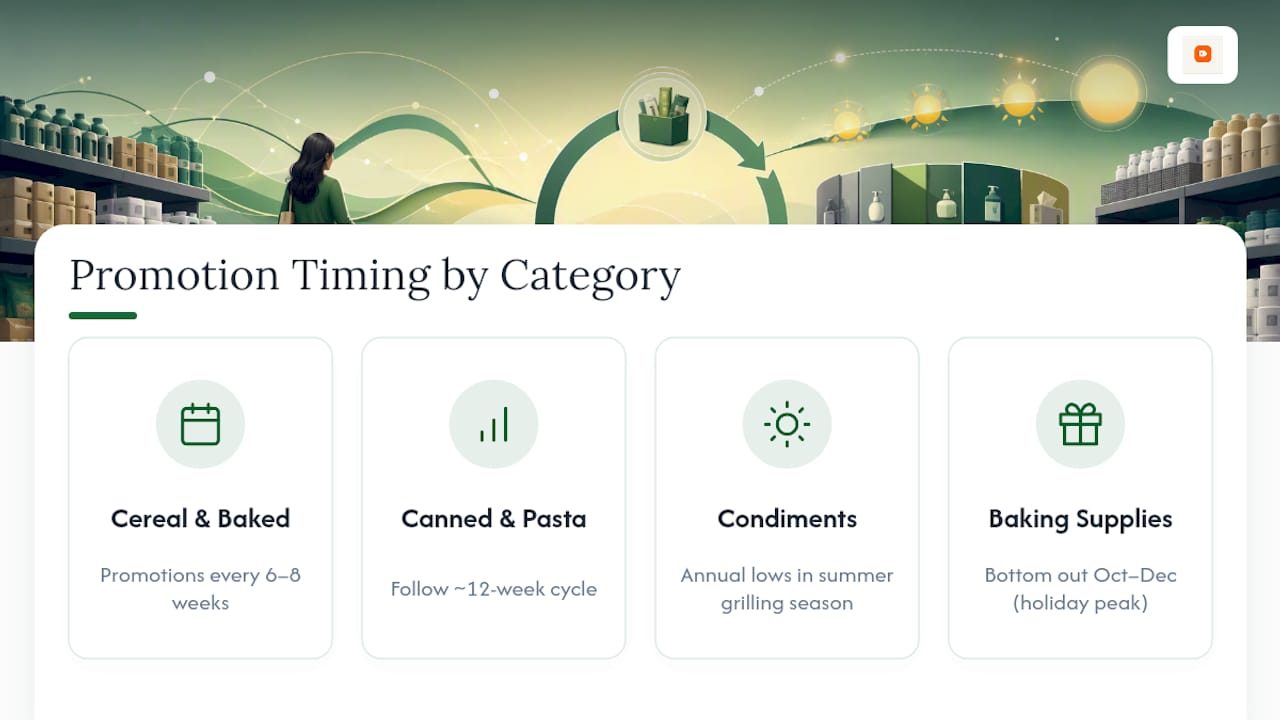
The 12-week rolling cycle is the baseline, but it isn't universal. Cereal and baked goods often run on tighter windows, sometimes closer to 6 to 8 weeks, because manufacturers push promotions more aggressively in categories with heavy private-label competition. Canned goods and pasta tend to track closer to the full 12-week rhythm.
Seasonality layers on top of the cycle. Condiments like ketchup, barbecue sauce, and salad dressing routinely hit their annual low during summer grilling season, when retailers compete hard for cookout traffic. Baking supplies, flour, sugar, chocolate chips, canned pumpkin, follow the opposite pattern, bottoming out between October and December as holiday baking demand peaks and stores use these items as loss leaders to pull in foot traffic. OutletPicks tracks which categories bottom out in which months in its cheapest month to buy breakdown, which is worth cross-referencing before you assume a sale is a real low.
The practical move is to add expected sale windows directly into your price book instead of treating every markdown as a surprise. If you know paper towels tend to bottom out in late spring and again around Black Friday, you can hold off buying at regular price in February and wait. Tracking dates this way turns your price book from a passive log into a forecasting tool, and it's the single biggest upgrade most shoppers skip.
How Do You Build and Maintain a Grocery Price Book?
A grocery price book is a simple record, a notebook, spreadsheet, or app, that tracks what you actually pay for the items you buy regularly. Without one, "that's a great price" is a guess. With one, it's a fact you can check in five seconds.
Six fields cover almost everything you need:
- Item name and brand (be specific: store brand vs. name brand are different line items).
- Package size (in the actual usable unit: ounces, count, sheets).
- Unit price (calculated after any coupon or discount).
- Date of purchase or price check.
- Store name.
- Coupon or discount type used, so you know if the price is repeatable or a one-time fluke.
Once you have a few months of entries, set three thresholds for each item. The stock-up price is your recorded (or reasonably expected) rock-bottom, the number that triggers the 3-month or 6-month buy.
Before you commit to a big purchase, run the numbers. A price-book calculator that compares regular price, current sale price, and your best recorded price can estimate how many weeks a purchase will cover and how much you're actually saving versus buying at regular price over the same period. That estimate matters more than the discount percentage on the shelf tag.
Pro Tip: Before buying six months of anything, check your pantry's actual storage limits and the product's shelf life. A stock-up price on canned tomatoes is worthless if you don't have shelf space and half of them expire before you get through them.
Shopping Strategy: Store Rotation, Special Trips, and Skipping Sales
A price book only pays off if it changes how you shop. Three habits make the difference between tracking prices and acting on them.
- Rotate stores on a schedule. Different chains run promotional cycles on different weeks, and pairing a fixed rotation with your price book means you catch more stock-up windows without shopping every store every week.
- Reserve special trips for multi-item hauls. Driving across town for one discounted item rarely pencils out once you count gas and time. Wait until three or four items on your watchlist hit stock-up price at the same store, then make the trip worth it.
- Trust your recorded numbers over the shelf tag. A yellow "SALE" sign means nothing if the price is still above what you've paid before. Your price book, not the store's signage, is the buy signal.
- Know when a low unit price still isn't a good buy. If your pantry is full, if the item has a short shelf life, or if the "deal" is a lower-quality private label you won't actually use, skip it regardless of how good the per-unit number looks.
This is the part most stockpiling advice skips: a genuinely low unit price on something you'll never finish, or don't have room for, isn't savings. It's clutter with a receipt attached.
Sample Stock-Up Price Targets to Calibrate Your Own List
These example ranges are illustrative starting points, pulled from patterns seen across published stock-up price lists and general market observation, not a guarantee for your local stores. Treat them as a rough benchmark to calibrate against, then replace every figure with your own price-book data once you've tracked a few cycles.
Convert every one of these to a real unit price before trusting it. A "$2.00 shampoo" is meaningless without knowing the bottle size, and prices vary by region, so use OutletPicks's ready-made unit-priced checklists as a faster way to build your own calibrated list instead of starting from a blank page.
How OutletPicks Speeds Up the Math
Manually calculating unit price for every item on a shopping list is tedious, so OutletPicks built the shortcut. The unit price calculator handles price per ounce, per pound, or per count instantly, and the what things cost tables show normalized per-unit pricing across categories, continuously rechecked across Amazon and partner retailers. The workflow: check the OutletPicks index for a category, compare that figure against your own price book's recorded best price, then decide your buy quantity based on which number is actually lower.
Adapting Stock-Up Pricing to Online Shopping and Digital Coupons
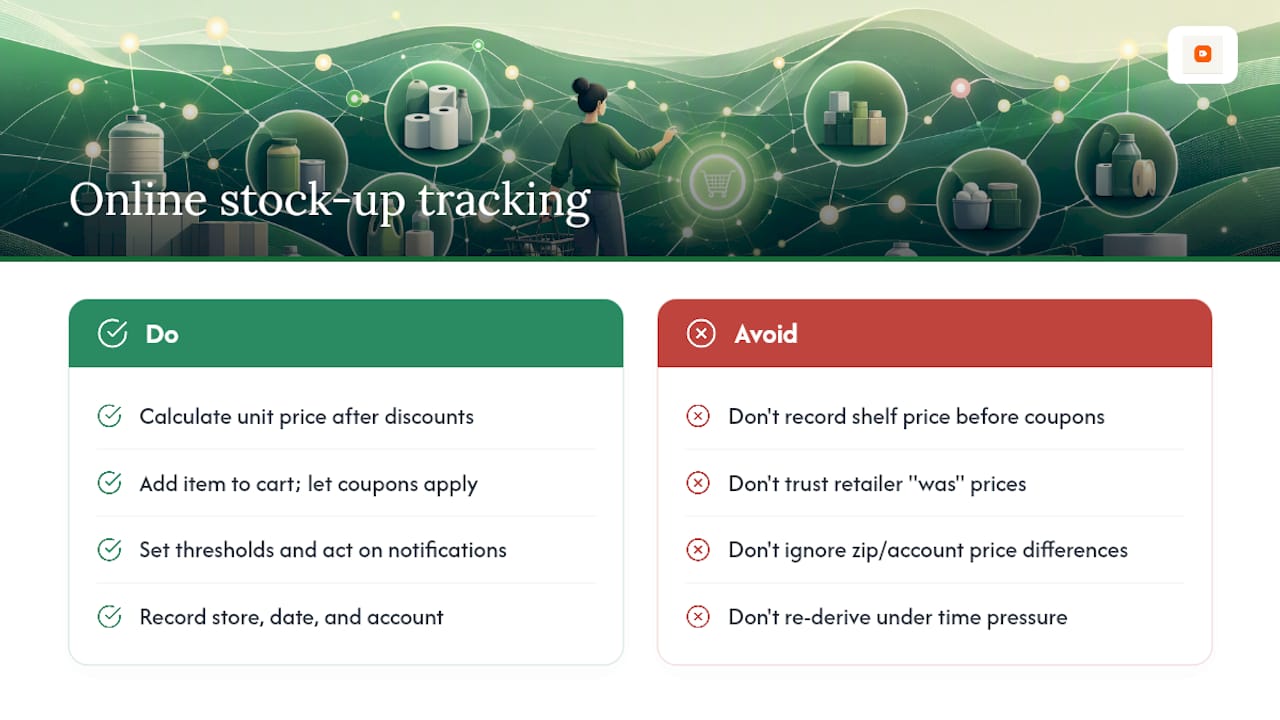
Online grocery shopping and digital coupons complicate the classic stock-up model, mostly because prices update more often and promotions stack in ways paper coupons never did. The core method still holds: calculate unit price after every discount, then compare it to your recorded low. What changes is the tracking.
Digital coupons often apply automatically at checkout rather than at the shelf, so the "sale price" you see browsing isn't always the price you'll pay. Add items to your cart and let coupons apply before recording the final unit price in your price book. Retailer apps also run flash promotions that expire in hours, which rewards having your thresholds already set. If you know your stock-up price for laundry detergent is $0.12 per load, you can act the moment an app notification hits that number instead of re-deriving it under time pressure.
Online price history also works in your favor if you use it. Some retailer apps and browser tools show 30 or 90-day price history on a product page, functioning like a built-in price book for that one item. Cross-reference that history against your own records rather than trusting it blindly, since retailers sometimes inflate a "was" price right before a sale to make the discount look bigger. And because online prices can vary by zip code or fulfillment center, keep tracking store and date fields even for digital purchases. A stock-up price you found online last month may not repeat at the same account next time.
How Inflation Changes Your Stock-Up Price Targets
Inflation doesn't invalidate the stock-up price concept, but it does mean your targets need refreshing more often than they used to. A price book entry from two years ago may no longer reflect a realistic floor if input costs, packaging, transportation, have shifted the entire category upward. Treating an outdated "best price" as your buy signal means you'll wait indefinitely for a sale that no longer exists at that level.
The fix is simple discipline: revisit your recorded stock-up prices every few months rather than assuming they're permanent. If an item hasn't touched its old recorded low in two full 12-week cycles, that old number is probably stale, and you should reset the threshold based on the lowest price you've actually seen recently, not the lowest you remember from a year ago.
This also means the gap between "regular price" and "stock-up price" can shrink during periods of high inflation, since retailers have less margin to discount deeply. A 10% dip might be the best available deal in a tough pricing environment, even though it would have looked unimpressive during a period of flatter prices. Rather than chasing a fixed percentage off, keep comparing against your own rolling price history. That's the one number inflation can't distort, because it reflects what you actually paid, not what a retailer claims you're saving.
Prioritizing Pantry Space by Perishability and Storage Limits
Not every item deserves the same stock-up treatment, and storage space is usually the real constraint, not budget. Rank your watchlist by shelf life first. Canned goods, rice, pasta, and most cleaning products last a year or more, making them safe bets for a full 6-month supply when the price is right. Items with shorter windows, cereal, crackers, anything with natural oils that can turn rancid, are better capped at 3 months even at a great price, since staleness erases the savings.
Storage capacity should shape your quantity decisions as much as price does. A studio apartment with one kitchen cabinet can't accommodate the same stock-up quantities as a house with a basement pantry. Prioritize compact, high-use items first: toothpaste, canned tomatoes, pasta, over bulky low-frequency items that eat shelf space for months, like a giant tub of a specialty ingredient you use twice a year.
A rough hierarchy that works for most households: shelf-stable staples you use weekly get top priority for stock-up buying, since the volume justifies the space. Occasional-use items only get stocked up when the discount is exceptional, since tying up storage for something you touch twice a year rarely pays off. And anything perishable, dairy, fresh produce, most bread, sits outside the stock-up framework entirely and should be bought at need, regardless of price.
Common Mistakes That Undermine a Stock-Up Strategy
The most frequent error is buying based on the percentage discount instead of the actual unit price. A "40% off" sign feels like a deal, but if the regular price was quietly raised beforehand, the unit price might still be above your recorded stock-up threshold.
A close second: forgetting to subtract coupon value before calculating unit price, which inflates perceived savings and leads directly to overbuying items you don't need at the volume you bought them. Mixing usable units is another common trap, comparing rolls to rolls instead of sheets to sheets, or ounces to milliliters without converting, which makes an inferior deal look like the better one.
Beyond the math, the biggest strategic mistake is stocking up on volume without checking storage and shelf life first. A stock-up price on a perishable or bulky item that outlives its usefulness before you finish it isn't a win. And finally, many shoppers never update their price book after the first few entries, so their "stock-up price" reference becomes outdated as inflation or seasonal shifts move the real floor. A price book only works if it's a living document, not a one-time list.
Why a Price Book Beats Chasing Sales
Chasing every sale sign burns time and often saves nothing. A household that tracks even 15 to 20 staples in a price book and buys strictly at stock-up thresholds routinely trims real money off a monthly grocery bill, simply by refusing to pay regular price for items with a known, recorded low. Start small: five items this week, tracked honestly, beats a sprawling list you abandon by March.
— Alex
Put the Math to Work: OutletPicks' Calculator and Checklists
Outletpicks turns the unit-price math this whole guide walks through into a five-second lookup instead of a napkin calculation in the cereal aisle. Every price on the site is normalized to real cost per unit, per ounce, per count, per sheet, and rechecked on a rolling cycle across Amazon and partner retailers, so you're comparing today's actual floor, not a stale "was" price.
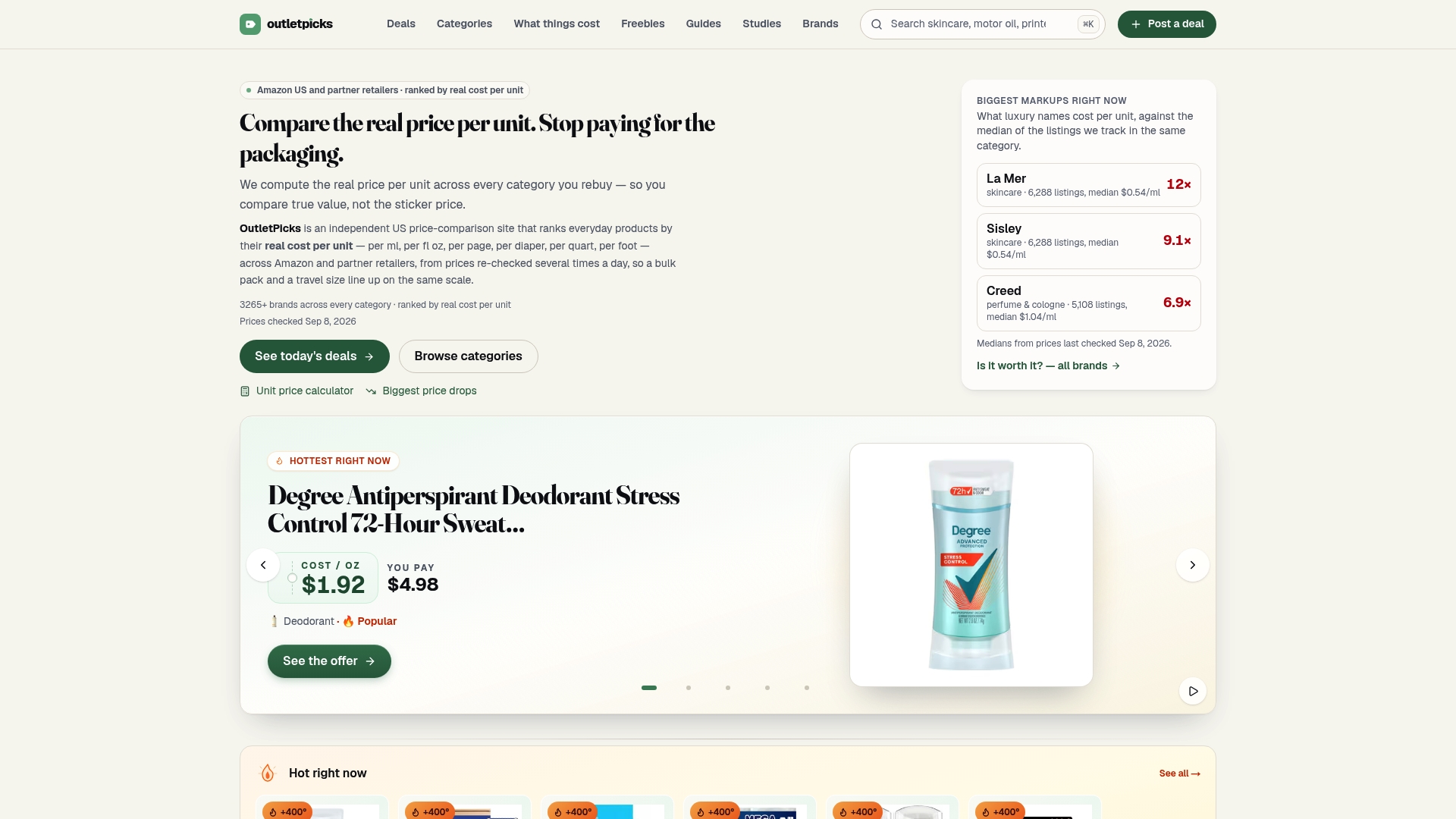
Try it on one item from your own list right now: pull up the unit price calculator, enter the package size and current price, and see whether it clears your stock-up threshold before you buy. If you'd rather start with a ready-made reference, save the what things cost tables or grab a set of pre-built shopping checklists to calibrate your own price book faster than building one from scratch.
Sources
This guide draws on the 12-week stockpiling cycle framework, unit pricing fundamentals, and grocery price book methodology for tracking historical lows. For hands-on calculation, the grocery price book calculator estimates weeks covered and savings before you buy.
- Grocery stockpiling: the how and the when — The Dollar Stretcher
- Unit pricing — University of Minnesota Real Life, Good Food
- How to make a grocery price book to save at the supermarket — MoneyCrashers
- Grocery price book calculator — Toolkit Shelf
FAQ
What are people stockpiling now?
Shoppers are currently focused on shelf-stable staples most sensitive to price swings: canned goods, pasta, rice, paper products, and cleaning supplies, categories where a stock-up price at the right cycle protects against near-term increases.
How much are groceries expected to go up in 2026?
Specific forecast figures vary by category and region, and no single reliable number covers the whole grocery basket, so track your own price book rather than relying on a blanket inflation estimate for planning purchases.
What should I stockpile before tariffs?
Prioritize categories most exposed to import costs, packaged goods, personal care items, and household paper products, and buy at your recorded stock-up price rather than reacting to tariff headlines with panic buying.
What is stock up?
Stocking up means buying a multi-month supply, typically 3 months, or 6 months for unusually deep discounts, of a shelf-stable item once it hits its recorded rock-bottom price within its typical sales cycle.
How do I know if a sale price is really a stock-up price?
Compare the current unit price against your price book's recorded best price and regular price; if it matches or beats your historical low, and the item is shelf-stable, it qualifies as a genuine stock-up price rather than a routine markdown.