
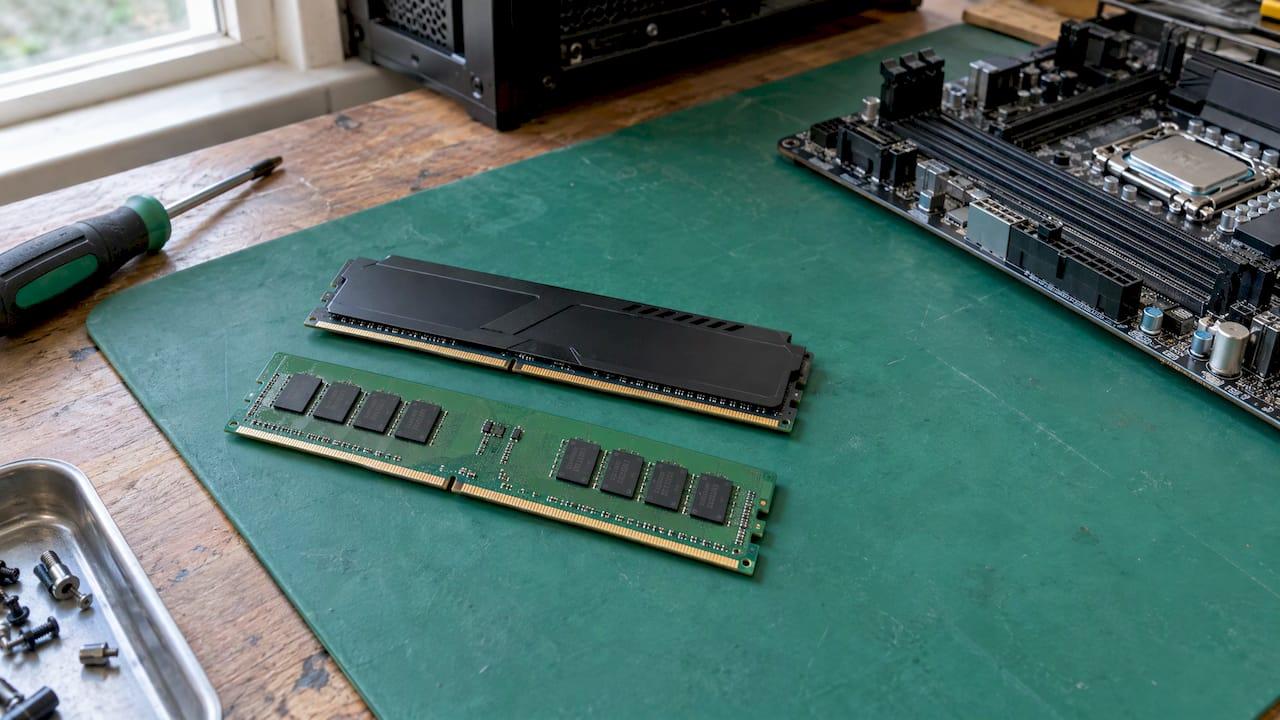
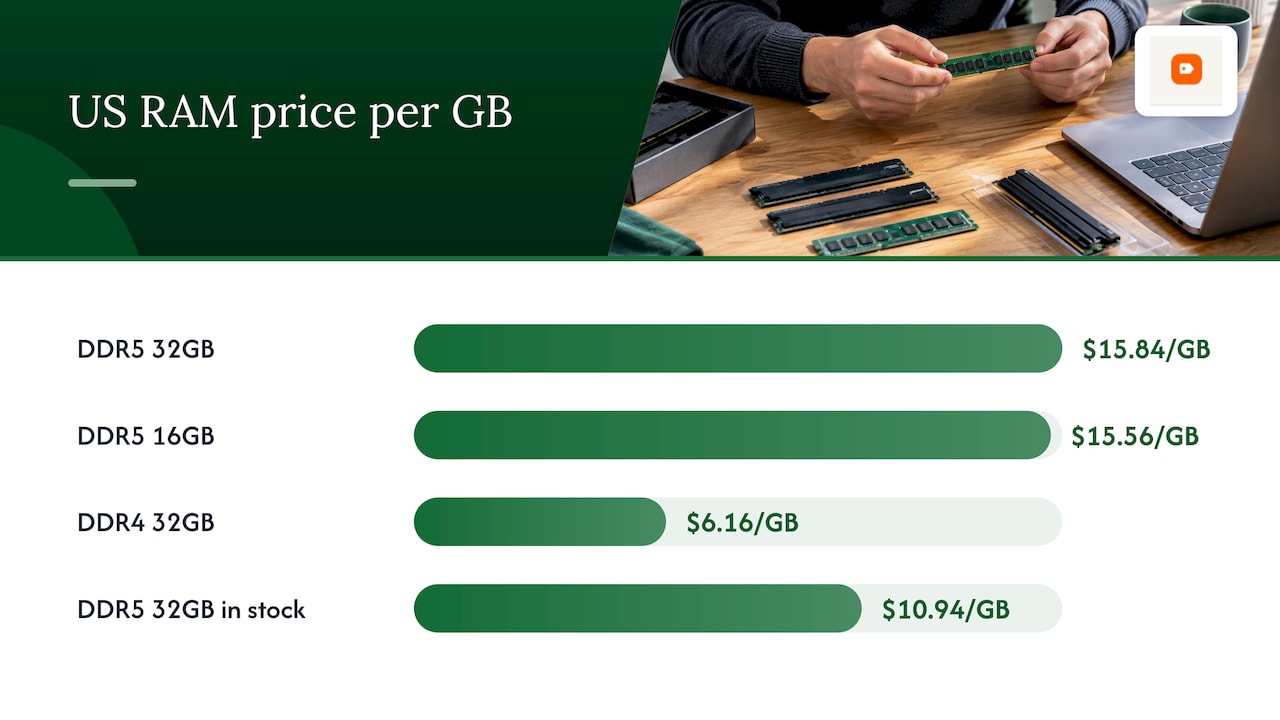
RAM costs far more per gigabyte than it did a year ago, and the gap between DDR4 and DDR5 is wide. On November 11, 2026, Tom's Hardware's US price tracker listed the lowest price for a DDR5-5600 32GB kit at $507, which works out to $15.84 per GB. A DDR4-3200 32GB kit was $197, or $6.16 per GB. The only number that tells you whether a kit is a good buy is price divided by total gigabytes, so we rank memory that way at OutletPicks, and this guide shows you how to do it yourself.
TL;DR
- Price per GB equals the kit's price divided by its total capacity. A $120 kit of 2×16GB is $120 ÷ 32 = $3.75 per GB.
- Using Tom's Hardware's November 11, 2026 lowest US prices, DDR5-5600 32GB came to $15.84 per GB and DDR4-3200 32GB to $6.16 per GB.
- Prices swing day to day, and good deals sell out. Treat any per-GB figure as a snapshot with a date on it.
- Compare only like with like: same DDR generation, form factor, speed and capacity layout.
- Our RAM on sale this week page lists RAM deals so you can compare them on a price-per-unit basis.
Table of Contents
- How to calculate RAM price per GB
- What RAM costs per GB in the US right now
- DDR5 vs DDR4 on price per GB
- Why price per GB varies between kits
- How to compare RAM kits fairly
- Where to find RAM prices already worked out per GB
- Our view: stop reading the sticker, start reading the unit price
- Check this week's RAM prices
- FAQ
- Sources
How to calculate RAM price per GB
The formula takes one line: price per GB = kit price ÷ total kit capacity in gigabytes.
The total is where people slip. A kit is sold as a set of sticks, and the listing often names the size of one stick. Add up every stick in the box. A "2×16GB" kit is 32GB in total. A "4×8GB" kit is also 32GB. A single 32GB stick is 32GB too, but it is a different product, because it leaves you with two free slots.
Here are three worked examples, using the format a shopper meets most often.
| Listing | Total capacity | Price | Price per GB |
|---|---|---|---|
| DDR4, 2×16GB kit | 32GB | $120 | $3.75 |
| DDR5, 2×16GB kit | 32GB | $350 | $10.94 |
| DDR5, 1×16GB stick | 16GB | $249 | $15.56 |
The first row is an illustration of the arithmetic. The second and third use figures from the November 11, 2026 tracker: a conventional 32GB (2×16GB) DDR5 kit starting at $350 when in stock, and a 16GB DDR5-5600 kit at $249.
Two habits keep the math honest:
- Use the checkout total, not the sticker price. Shipping and tax change the true cost. Compare the same basis for every option.
- Round at the end. Divide first, then round to the cent. A $0.10 difference per GB is $3.20 on a 32GB kit.
What RAM costs per GB in the US right now
The prices below are a snapshot, not a standing benchmark. RAM prices move with supply, and the tracker itself notes that they fluctuate significantly from day to day with limited availability. We did the division on the lowest US prices Tom's Hardware reported on November 11, 2026.
| Kit | Lowest price reported | Price per GB | Lowest-ever price tracked | Per GB at that low |
|---|---|---|---|---|
| DDR5-5600, 32GB | $507 | $15.84 | $279 | $8.72 |
| DDR5-5600, 16GB | $249 | $15.56 | $199 | $12.44 |
| DDR4-3200, 32GB | $197 | $6.16 | $193 | $6.03 |
Three things stand out.
DDR5 is the expensive one. At those prices, a DDR5 32GB kit costs about two and a half times as much per gigabyte as a DDR4 32GB kit. If your motherboard takes DDR4, that is a strong reason to stay on it for now.
DDR4 is close to its floor, DDR5 is not. The DDR4 kit sat only a few dollars above its lowest-ever tracked price. The DDR5 32GB kit was well above its low of $279, which would have been under $9 per GB.
Cheaper kits exist, but they are not guaranteed. The same tracker said a conventional 32GB (2×16GB) DDR5 kit started at $350 if it was in stock. That is $10.94 per GB, a big drop from $15.84, but stock is the catch. The tracker also notes that exceptional deals often sell out quickly.
Why the DDR5 per-GB price is so high
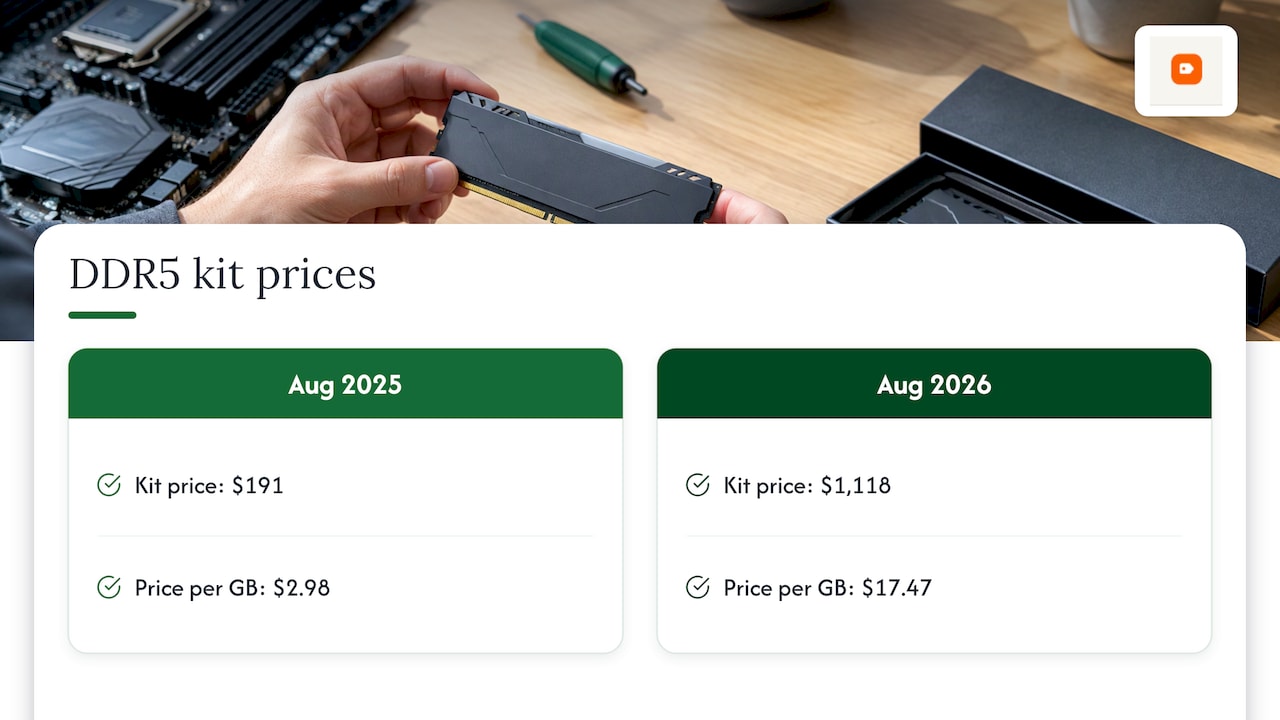
A global memory shortage has pushed prices up since 2025. On August 17, 2026, Tom's Hardware reported that DDR5 prices had climbed by as much as 500% in 12 months. A 64GB (2×32GB) DDR5-5600 kit went from $191 in August 2025 to $1,118 in August 2026, a rise of 485%. In per-GB terms that is about $2.98 rising to $17.47. DDR4 kits rose too, by roughly 120% to nearly 180%.
The rise began earlier and was visible well before the peak. In October 2025, Gaming News reported median US prices for DDR5 2×16GB kits climbing from $95.20 on September 1 to $132.10 on October 8. That is $2.98 per GB rising to $4.13 per GB in about five weeks.
The lesson for your budget: a price-per-GB number from last spring, or from a forum post, tells you very little about today's market.
DDR5 vs DDR4 on price per GB
If you are choosing between the two, the first question is not price. It is compatibility. DDR4 and DDR5 sticks are physically different and do not fit each other's slots. Your motherboard decides which generation you can buy, so a cheap DDR4 kit is no bargain if your board is DDR5.
If you are building a new PC and can pick either platform, the per-GB gap matters a lot. Using the November 11 figures, 32GB of DDR5 costs $310 more than 32GB of DDR4 at the lowest listed prices ($507 against $197). That difference is a real share of the budget for a mid-range build, and it is worth weighing against what the faster platform gives you.
If you are upgrading an existing machine, buy the generation it already uses. Then use price per GB to choose between kits of that generation.
Why price per GB varies between kits
The same capacity can carry very different unit prices. These are the factors behind that.
- DDR generation. DDR5 costs more per GB than DDR4, as shown above.
- Speed and timings. A faster rated speed usually carries a premium. A kit marked DDR5-5600 is not priced like one marked DDR5-6400.
- Form factor. Desktop sticks (DIMM) and laptop sticks (SO-DIMM) are different products. A laptop maker's DDR5 SO-DIMM prices reported by Tom's Hardware in March 2026 had risen to $13 to $18 per GB, up from $3.75 to $5 in July 2025.
- Capacity and module count. Bigger kits do not always cost less per GB. In a normal market, higher-density modules carry a premium. In a shortage, the pattern can shift, and a 4-stick kit may price differently from a 2-stick kit of the same total size.
- Special types. Server memory with error correction (ECC) or registered memory is priced separately from consumer RAM. Do not compare them.
So a fair per-GB comparison means matching generation, form factor, capacity layout, speed and timings first. Only then does the lower number actually mean the cheaper kit.
How to compare RAM kits fairly
Follow these steps for any shortlist.
- Confirm what your system takes. Check the motherboard or laptop specification for DDR generation, form factor and maximum speed.
- Pick the capacity you need. For most everyday use, 16GB to 32GB is the range shoppers weigh. Decide first, then compare prices.
- Write down each kit's total capacity. Add up all sticks.
- Divide the checkout total by that capacity. Include shipping and tax so the numbers are on the same basis.
- Compare only kits that match on speed and timings. A cheaper kit at a slower rating is a different product.
- Note the date. Record the day you checked. A per-GB figure that is two weeks old can be out of date in this market.
Watch for bundles too. Tom's Hardware has reported that retailers are raising DDR5 prices to match market conditions and sometimes bundling memory kits with processor or motherboard purchases. If you take a bundle, split the price sensibly before you judge the RAM's per-GB cost, or the number is meaningless.
Where to find RAM prices already worked out per GB
Doing the division for every listing is slow, and the numbers change often. That is the job we built OutletPicks for. We calculate and rank products by real cost per unit, so you can compare kits regardless of pack size or brand, and we recheck retailer prices on a rolling cycle. Our RAM on sale this week page is the place to start when you want current RAM deals sorted on that basis.
If you are also pricing a wider build, our category pages cover desktop PCs, tablets, cameras, printers and cables, and our brand index ranks brands by real cost per unit.
Our view: stop reading the sticker, start reading the unit price
RAM is a perfect example of why we exist. A "32GB kit" can be one stick, two sticks or four. The sticker price tells you nothing until you divide it by the gigabytes you actually receive.
The shortage makes this more important, not less. When prices move this fast, a number from three months ago can mislead you by hundreds of dollars. The sensible habit is to compare today's unit prices across retailers, on matching specifications, and to check the date on every figure.
That is how we rank everything on OutletPicks: by what a unit really costs, whether the unit is a gigabyte, a milliliter, a diaper or a foot of cable. We do it so you can see the true cost across pack sizes and brands in one place, and decide with the number that matters.
Alex
Check this week's RAM prices
When you are ready to buy, compare current listings on a per-unit basis rather than guessing from sticker prices. Our RAM on sale this week page does the unit-price comparison for you, so you can see which kits cost less per gigabyte right now.
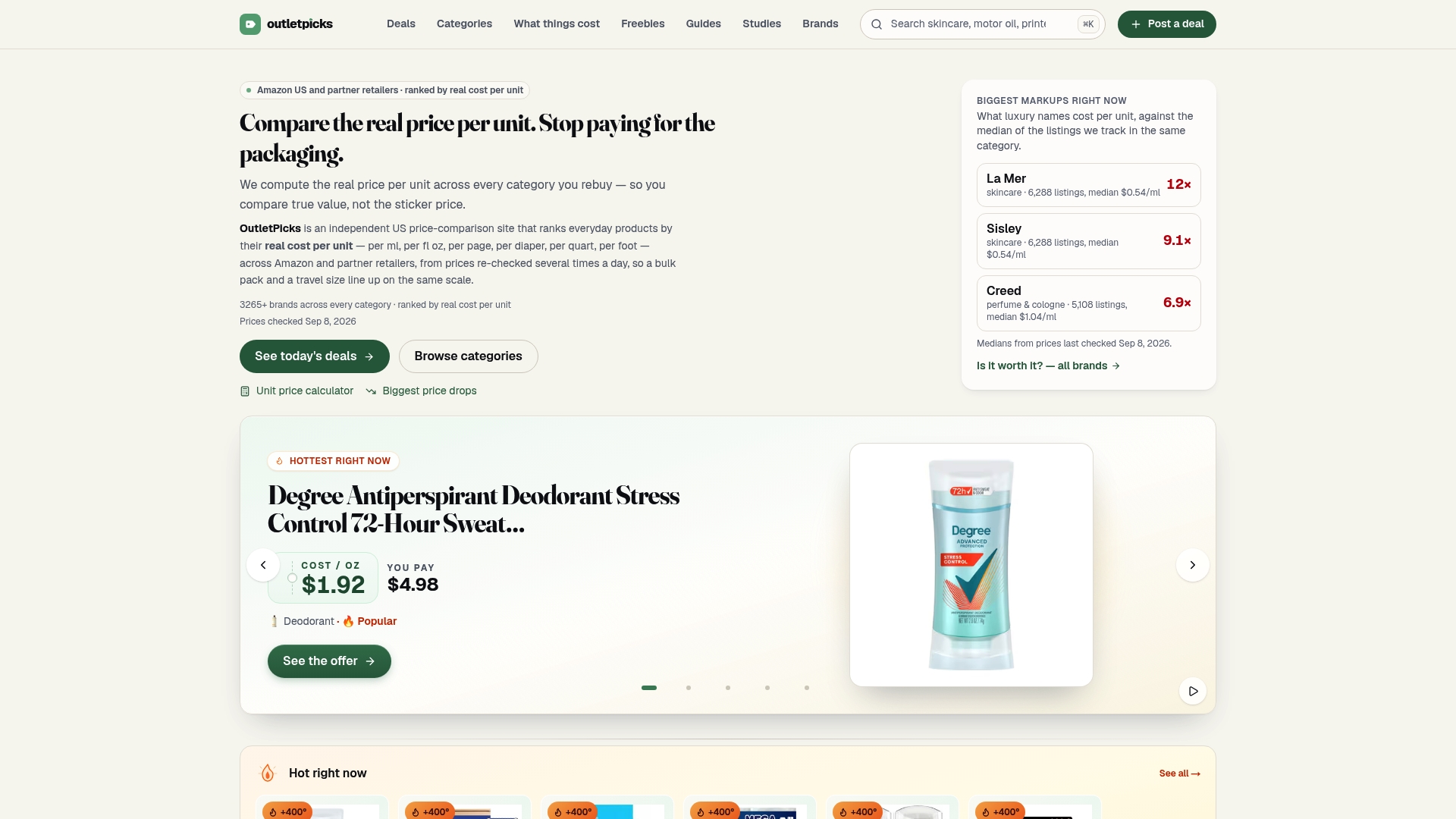
We compare prices across Amazon and partner retailers, and the page is refreshed as retailer data is rechecked. Open it, match the kit to your motherboard's DDR generation, and pick the lowest price per GB among the kits that fit.
FAQ
How do I work out RAM price per GB?
Divide the kit's total price by its total capacity in gigabytes. Add every stick in the kit to get the capacity. A $350 kit of 2×16GB is $350 ÷ 32 = $10.94 per GB. Use the checkout total if you want the true cost.
How much does DDR5 cost per GB?
It depends on the day and the kit. On November 11, 2026, Tom's Hardware's tracker showed a DDR5-5600 32GB kit at $507 ($15.84 per GB) and a 16GB kit at $249 ($15.56 per GB). A 2×16GB DDR5 kit started at $350 ($10.94 per GB) when in stock. Prices change often, so check the date.
Is DDR4 cheaper than DDR5 per GB?
Yes, by a wide margin in the November 11, 2026 figures. A DDR4-3200 32GB kit was $197, or $6.16 per GB, against $15.84 per GB for DDR5-5600 at the same capacity. Your motherboard decides which type fits, so confirm that before comparing.
Does a bigger kit always cost less per GB?
Not in this market. Per-GB prices depend on module count, speed and supply as well as total capacity. Compare kits of the same generation and specification, and divide each one's total price by its total gigabytes.
Why did RAM prices rise so much?
A global memory shortage has driven prices up since 2025. Tom's Hardware reported in August 2026 that DDR5 prices had risen by up to 500% over 12 months. DDR4 rose by roughly 120% to nearly 180%.