

Prime Day wins on Amazon devices, Amazon Basics, and household consumables, while Black Friday and Cyber Monday usually deliver the lowest prices of the year on premium TVs, laptops, and brand-name apparel. The rule of thumb: if the product is Amazon-first, buy it on Prime Day; if it's a premium item sold across many retailers, wait for Black Friday. Either way, check the price history before you click "buy" — a badge that says "50% off" means nothing if the reference price was never real.
TL;DR:
- Prime Day generally offers the best discounts on Amazon-branded devices and Amazon Basics products, often matching or exceeding Black Friday savings.
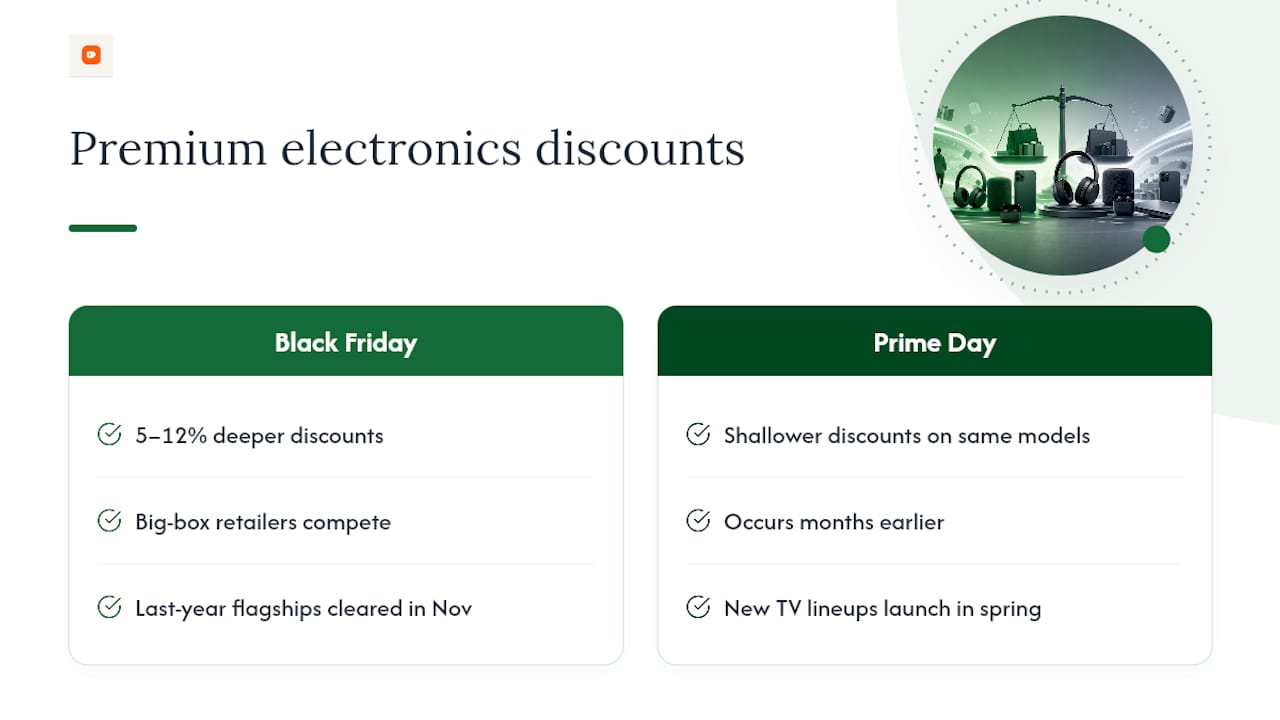
- Black Friday provides deeper discounts on premium electronics, such as TVs, laptops, and audio equipment, due to retailer competition and new product launches.
- For small appliances and mid-tier electronics, October Prime Big Deal Days can rival or surpass Black Friday deals, especially on kitchen gadgets and holiday items.
- Consumables with Subscribe & Save usually see their lowest prices during Prime events, thanks to stacking discounts not available in November.
- If an item is Amazon-exclusive or Amazon-branded, it is best to buy during Prime Day or Prime Big Deal Days to secure the lowest price.
Table of Contents
- Prime Day vs Black Friday: Quick Category Winners
- Why One Event Beats The Other, Category By Category
- When Does Prime Day Happen vs Black Friday?
- How Do You Decide: Buy Now Or Wait?
- How Do You Verify a Discount Is Actually Real?
- What To Do If You Missed The Sale
- What Outletpicks Sees In The Pricing Data
- Check Real Prices Before You Buy Either Sale
- Sources
- FAQ
Prime Day vs Black Friday: Quick Category Winners
Here's the fast version, before you get into the reasoning behind it. Category-by-category price tracking shows a consistent pattern: Amazon-owned products do best during Prime Day, while cross-retailer categories hit their annual low during Black Friday week.
| Category | Likely winner | Typical discount range | Why |
|---|---|---|---|
| Amazon devices (Echo, Fire TV, Kindle) | Prime Day | 30–55% | Amazon controls the SKU and margin entirely |
| Amazon Basics & consumables | Prime Day | 20–40% | Stackable with subscription discounts |
| Premium TVs & audio | Black Friday | 25–40%, often 5–12% deeper than Prime Day | Cross-retailer competition forces price matching |
| Laptops & tablets | Black Friday | 15–35% | Manufacturers time launches and clearances to November |
| Small kitchen appliances | Split, lean Prime/Big Deal Days | 20–45% | October Big Deal Days often matches or beats Black Friday here |
| Major appliances | Black Friday | 10–30% | Big-box retailers (not Amazon) drive this category |
| Apparel & shoes | Black Friday | 20–50% | Brand-name inventory clears hardest in November |
| Toys & gaming | Black Friday, with Big Deal Days close behind | 20–40% | Holiday-driven; retailers compete hardest in Q4 |
Treat these as directional, not absolute. A single SKU can break pattern, especially when a manufacturer runs an exclusive promotion or a retailer overstocks early. The category is a strong predictor, but the individual product still needs a price-history check.
Why One Event Beats The Other, Category By Category
The pattern above isn't random. It comes down to who controls the SKU and who's competing for your money.
Amazon devices and Amazon Basics
Amazon sets both the manufacturing cost and the retail price on its own hardware, so it can cut margin as deep as it wants during its own event. That's why Echo speakers, Fire tablets, and Kindle e-readers routinely hit their year-low price during Prime Day rather than Black Friday. Amazon Basics products follow the same logic: no third-party retailer is pressuring the price, so Amazon discounts on its own schedule. If you've been eyeing a specific Amazon device, buying it in June rather than waiting until November rarely costs you anything.
Premium TVs and high-end audio
This is where Black Friday usually pulls ahead. Big-box retailers like Best Buy and Target compete directly with Amazon for the same 65-inch OLED or the same soundbar, and that competition compresses margins further than Amazon alone would ever go. Paired-SKU tracking across the two events shows Black Friday running 5 to 12 percent deeper on premium electronics than Prime Day managed on the same models months earlier. Manufacturers also time new TV lineups to launch in spring, which pushes last year's flagship into deep clearance territory by November.
Laptops and tablets
Black Friday tends to win here too, with one wrinkle: back-to-school season in August sometimes produces a comparable price on specific laptop models, especially education-focused configurations. If you need a laptop before September, check August pricing first. If you can wait, November almost always beats it.
Small kitchen appliances and mid-tier electronics
This category is the closest to a coin flip. Air fryers, stand mixers, and robot vacuums show up on deep discount during Prime Day, October's Prime Big Deal Days, and Black Friday, and the "winner" often comes down to the individual model rather than the event. The tell is Big Deal Days functioning as an early holiday push, sometimes matching or slightly beating July's Prime Day price on the exact same appliance. If you spot a strong October deal on a kitchen gadget, there's rarely a reason to hold out for November.
Household consumables and Subscribe & Save
Diapers, laundry pods, protein powder, and other repeat-purchase items usually see their best combined pricing during Prime events, because Amazon stacks Subscribe & Save discounts on top of the event's temporary price cut — you can browse all those options in the QAI Hair full product catalog. Black Friday retailers don't typically run equivalent subscription stacking, so consumables rarely get meaningfully cheaper in November than they were in June or October.
- Amazon devices and Amazon Basics: Prime Day, consistently.
- Premium TVs, high-end audio, and laptops: Black Friday, usually by a wide margin.
- Small kitchen appliances: check both events. October Big Deal Days can beat July.
- Consumables with Subscribe & Save: Prime events, thanks to stacking.
- Apparel, toys, and seasonal goods: Black Friday, though early markdowns can start in mid-November.
Toys, apparel, and seasonal items
Retailers save their steepest apparel and toy discounts for the week of Black Friday because that's when foot traffic and ad spend peak across the entire industry, not just Amazon. If a toy or clothing item is already discounted 30% or more in early November, it's worth buying rather than gambling on an extra 5 to 10 percent during Black Friday week itself.
When Does Prime Day Happen vs Black Friday?
Timing drives a lot of the buy-now-or-wait decision, and the two events don't just differ in discount depth. They differ in when they happen, how long they run, and who gets access.
- Prime Day runs as a short, concentrated event. Amazon has confirmed Prime Day 2026 for June 23–26, a four-day window built around multiple daily deal drops and Prime-member-exclusive pricing.
- Prime Big Deal Days lands in October as a shorter, 48-hour event, scheduled for October 6 to 7, 2026. Treat it as a holiday warm-up rather than a repeat of June's Prime Day.
- Black Friday season stretches far longer than a single day now, typically starting in early November with "early Black Friday" pricing and running through Cyber Monday, giving retailers weeks to compete on the same products.
- Membership access matters for Prime events specifically. Every Prime Day and Big Deal Days discount requires an active membership, though Amazon regularly offers free trials around these dates for shoppers who don't already subscribe.
- Deal cadence differs too. Prime events push lightning deals and rotating daily drops that can sell out and restock within hours, while Black Friday pricing tends to hold steady for the full week once it's live, with less minute-to-minute volatility.
Early Black Friday pricing is worth watching closely if you're deciding between a mid-November purchase and holding out for the actual date. Retailers increasingly front-load their best deals into the first two weeks of November specifically to beat Amazon's own event to market.
How Do You Decide: Buy Now Or Wait?
A few rules of thumb cut through most of the guesswork:
- If it's Amazon-branded or Amazon-exclusive, buy it during Prime Day or Big Deal Days. Waiting for Black Friday rarely gets you a better price on these SKUs.
- If it's a premium, widely-distributed product (a name-brand TV, laptop, or jacket), wait for Black Friday unless you need it immediately.
- If it's a consumable with Subscribe & Save eligibility, buy during whichever Prime event is closest, since the subscription stack often beats anything November offers.
- If a small appliance is already 30%+ off during Prime Day or Big Deal Days, don't gamble on Black Friday for an extra few percentage points.
Before checkout, run through a short checklist:
- Check the 90-day price history. A tool that shows the last three months of pricing will immediately reveal whether "40% off" is real or measured against an inflated reference price.
- Verify the price-per-unit, not just the sticker price. A 24-pack marked "on sale" can still cost more per diaper, per ounce, or per sheet than a smaller, unmarked pack.
- Compare bundles carefully. A "bundle deal" that throws in an accessory you don't need isn't a discount if it costs more than buying the base item alone elsewhere.
- Check the warranty and return window. Some deep discounts come with shortened return periods or open-box conditions that aren't disclosed until checkout.
- Weigh the stock risk. Lightning deals and doorbusters sell out fast; if the item is genuinely rare, that urgency is real, not manufactured.
Red flags that mean you should abort the purchase: a "was" price with no visible history to back it up, a percentage-off claim that shrinks to almost nothing once you subtract a required coupon or shipping fee, and any listing where you can't find the item's price from 60 or 90 days earlier.
Pro Tip: Set a specific target price before the sale starts, based on the lowest price you've actually seen the item hit in the past three months, not the “original” price on the tag. Then use a price-tracking alert so you get notified the moment it drops there, instead of manually refreshing a product page for two weeks.
How Do You Verify a Discount Is Actually Real?
The FTC has spent years documenting how "regular" prices on tags and ads get inflated to make a sale price look bigger than it is. Its analysis of department store reference pricing found that advertised "regular" prices are frequently higher than what the item actually sold for on the open market, which makes the percentage-off badge unreliable on its own. Separately, FTC guidance under 16 CFR Part 233 requires that former prices used in comparisons be genuine, not manufactured for the sale.
Two checks protect you from both problems:
- A 90-day price history shows whether the "before" price was ever a real, sustained price or just a number set high right before the discount.
- A cost-per-unit comparison shows whether a bigger pack size is actually cheaper per ounce, per diaper, or per sheet, or whether the retailer is using size to disguise a weaker discount.
Cost-per-unit normalization matters most for consumables and toiletries, where pack sizes vary wildly between the "sale" version and the everyday version of the same product.
Outletpicks records baseline prices before major sales and applies cost-per-unit normalization across retailers, which turns a confusing percentage-off claim into a single comparable number. Checking a product's page before you buy tells you in seconds whether a listed discount reflects a genuine drop in the per-unit price or just a temporary reshuffling of the sticker.

What To Do If You Missed The Sale
Missing Prime Day isn't the end of the story. A few realistic windows still exist for the same or a better price.
- Watch October's Prime Big Deal Days, since it frequently matches or slightly undercuts July's Prime Day pricing on kitchen appliances and toys, giving you a second shot without waiting until November.
- Set price alerts now rather than manually checking back. A tracked alert catches early Black Friday drops the moment they post, which increasingly happens in the first two weeks of November.
- Stack cashback and coupons on top of whatever discount is live. A smaller sale price combined with a cashback portal or a stored coupon code can beat a bigger headline discount with no stacking available.
- Decide your risk tolerance before you wait. If the item is Amazon-first, holding out for Black Friday is a low-reward gamble. If it's a premium, cross-retailer product, the wait is usually worth it.
What Outletpicks Sees In The Pricing Data
A price comparison platform tracks baseline prices ahead of both events and runs them through cost-per-unit normalization to see which sale actually moves the real price, not just the sticker. The consistent pattern: Amazon-first categories bottom out during Prime events, while cross-retailer categories bottom out during Black Friday week. Prices refresh on a rolling cycle, so checking a category page close to checkout gives you the most current read on whether a deal is genuinely low.
— Alex
Check Real Prices Before You Buy Either Sale
Outletpicks gives you something neither Prime Day nor Black Friday ads will: the actual cost per unit, tracked before the sale starts, so you're comparing real value instead of a percentage badge someone else picked for you.
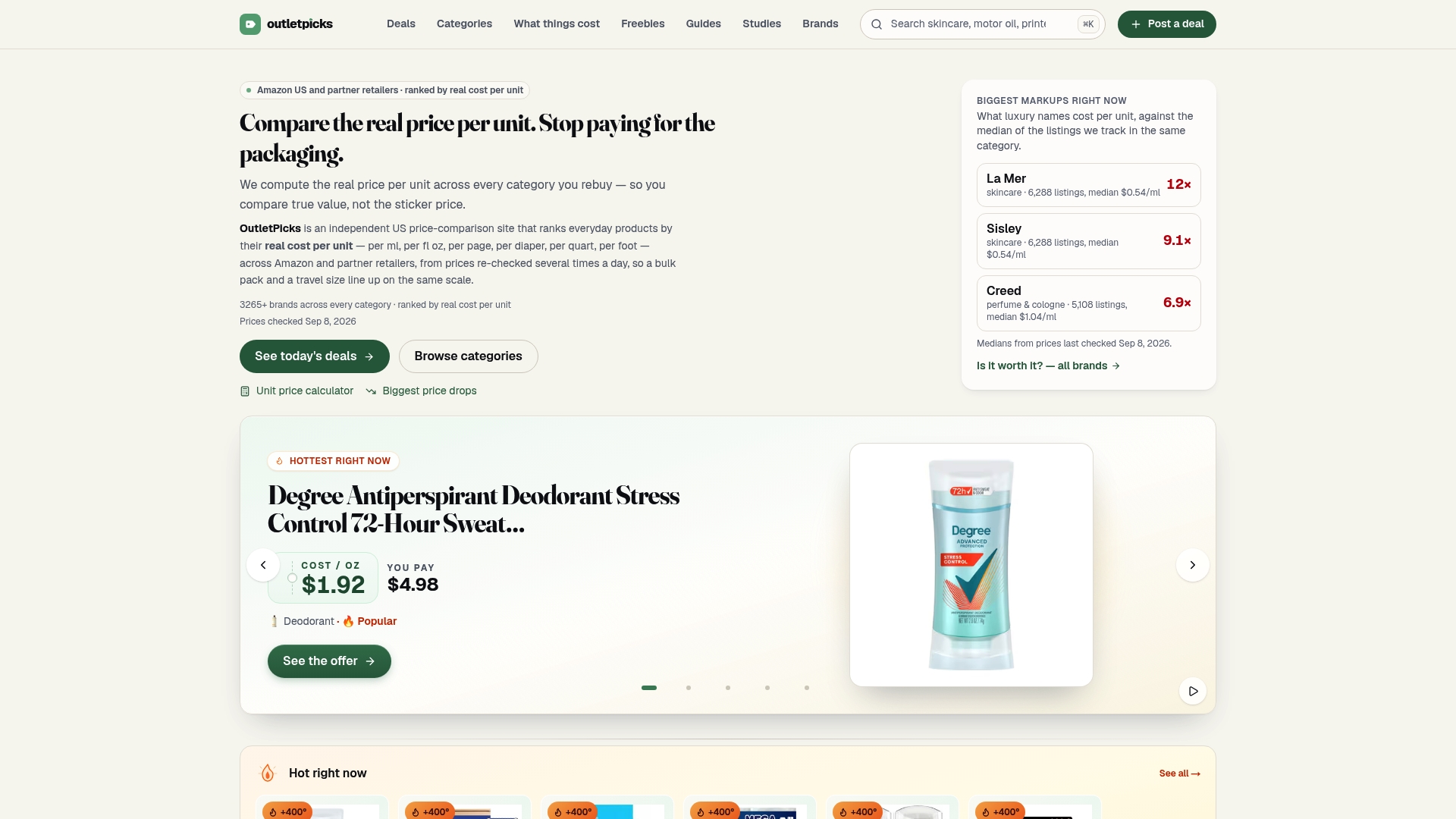
During either event, pull up the live price drops feed to see which categories are genuinely moving and which are just relabeled. If you're deciding between two brands or two pack sizes, the brand versus brand comparisons show you which one actually costs less per ounce, per spray, or per unit, regardless of which sale it's tied to. Browse the full category index now to bookmark the items you're watching, so when Prime Day or Black Friday pricing drops, you already know your target price and can check it in seconds.
Sources
For price history, use a dedicated tracker rather than trusting the tag. For event dates, go straight to Amazon's own announcements. For discount legitimacy, the FTC's guidance on reference pricing explains what retailers are legally required to disclose. Outletpicks' methodology page breaks down exactly how cost-per-unit prices get calculated.
FAQ
Is It Better To Buy On Prime Day Or Black Friday?
It depends on the category: Prime Day usually wins for Amazon devices, Amazon Basics, and consumables, while Black Friday usually wins for premium TVs, laptops, and brand-name apparel. Checking a 90-day price history before buying settles most edge cases either way.
Does Prime Membership Go On Sale For Black Friday?
Amazon periodically offers discounted or trial access to Prime around major shopping events, though the specific offer changes each year and isn't guaranteed to appear every November. Check Amazon's own account page directly before the event, since third-party sites don't control this pricing.
How Do I Get 50% Off My Prime Membership?
Amazon has offered discounted Prime memberships to specific groups, such as students and shoppers on qualifying government assistance programs, at various points, but this isn't a universal Black Friday or Prime Day offer.
Why Are People Canceling Amazon Prime Memberships?
Shoppers cite a mix of reasons, including rising annual fees, underuse of shipping and streaming benefits, and a sense that Prime-exclusive deals aren't as different from public sale prices as they once were. Comparing prices across retailers rather than assuming Prime always wins is exactly the kind of check a cost-per-unit comparison is built to answer.