
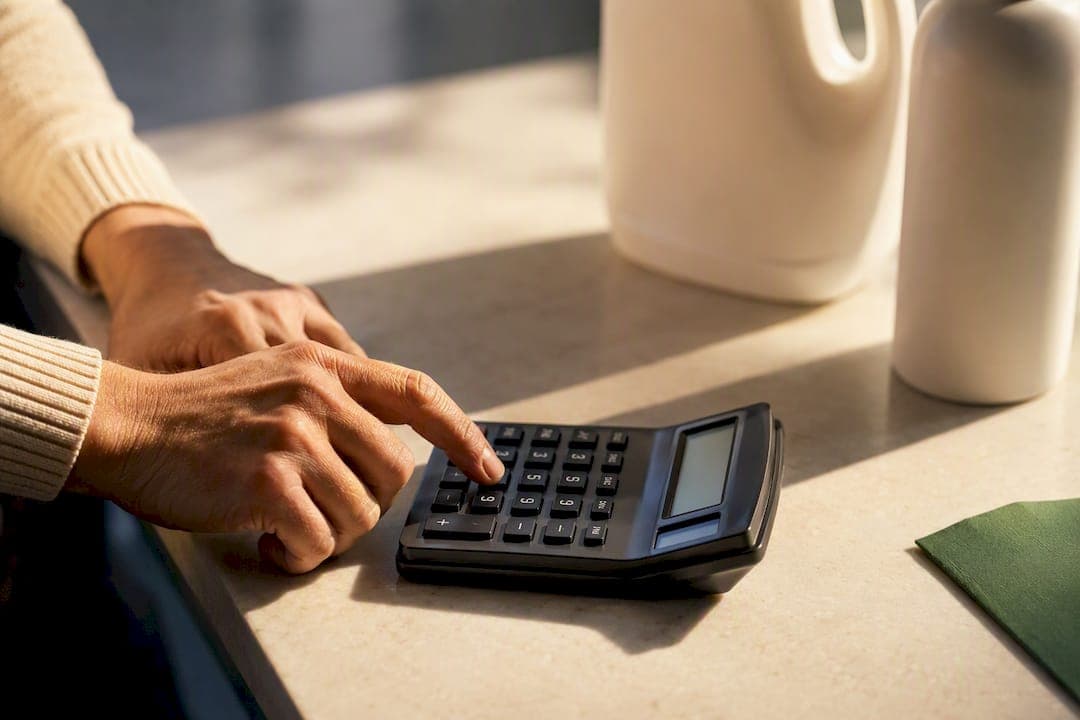
Price per use is what an item actually costs you every time you wear it, run it, or log into it: total cost divided by real number of uses, not the number printed on the receipt. The formula is simple (cost ÷ expected uses), but the honesty is in the inputs. A coat worn multiple times runs a few dollars per wear; a database subscription used actively by three people beats one that costs less but sits idle. Tools like OutletPicks' calculator exist because that division only works when the numbers going in are real.
TL;DR:
- The true cost of ownership includes expenses like delivery, energy, repairs, and resale value, not just the sticker price.
- Relying on optimistic use estimates inflates the perceived value, making conservative calculations with halved estimates more accurate.
- The maximum red flag for everyday clothing is a price per wear exceeding $10 for pieces worn fewer than five times.
- A higher initial purchase price can be justified if the item is durable, time-saving, or provides safety benefits that lower per-use costs overlook.
- OutletPicks offers tools that normalize price per unit and per use across retailers and pack sizes, helping consumers make more accurate purchase decisions.
Table of Contents
- What price per use actually measures (and how it's different from unit price)
- How to calculate price per use (formula and three worked examples)
- The hidden costs that quietly change your math
- Calculators, templates, and shortcuts that keep the math honest
- Quick benchmarks for common purchase categories
- Mistakes that quietly wreck the calculation
- How OutletPicks builds price-per-use math into its tables
- What the math actually tells you (and what it doesn't)
- Check your own numbers before you buy
- Sources
- FAQ
What price per use actually measures (and how it's different from unit price)
Price per use only makes sense for things you use more than once. It applies to clothing, appliances, vehicles, memberships, software, and tools, anything with a repeat-use pattern. It does not apply cleanly to groceries, toiletries, or anything consumed in a single use, which is where unit price takes over.
Unit price and cost per use get confused constantly, and the mix-up leads to bad decisions.
- Unit price measures value inside a single purchase: dollars per ounce, per sheet, per pound. It tells you whether the 24 pack beats the 12 pack.
- Cost per use measures value across the item's lifespan: dollars per wear, per cycle, per session. It tells you whether the item was worth buying at all.
A gallon of laundry detergent has a unit price. Your washing machine has a cost per use. Buy the cheaper detergent by the ounce, sure, but decide on the washer by dividing its total cost by every load it will ever run. Mixing the two up is how people end up praising a "cheap" purchase that turns out to be the more expensive one in practice.
How to calculate price per use (formula and three worked examples)
The core formula never changes: total cost ÷ expected number of uses = price per use. What changes is what counts as a "use" and what belongs in "total cost."
- Pick your use unit. Wears for clothing, cycles for appliances, sessions for subscriptions, days for anything you own continuously.
- Total the real cost. Purchase price, tax, shipping, plus any consumables or maintenance the item requires. Subtract expected resale value if you plan to sell it later.
- Estimate uses honestly. Base it on your actual habits, not your intentions, then adjust downward if you tend to overestimate.
- Divide. Cost divided by uses gives you one comparable number.
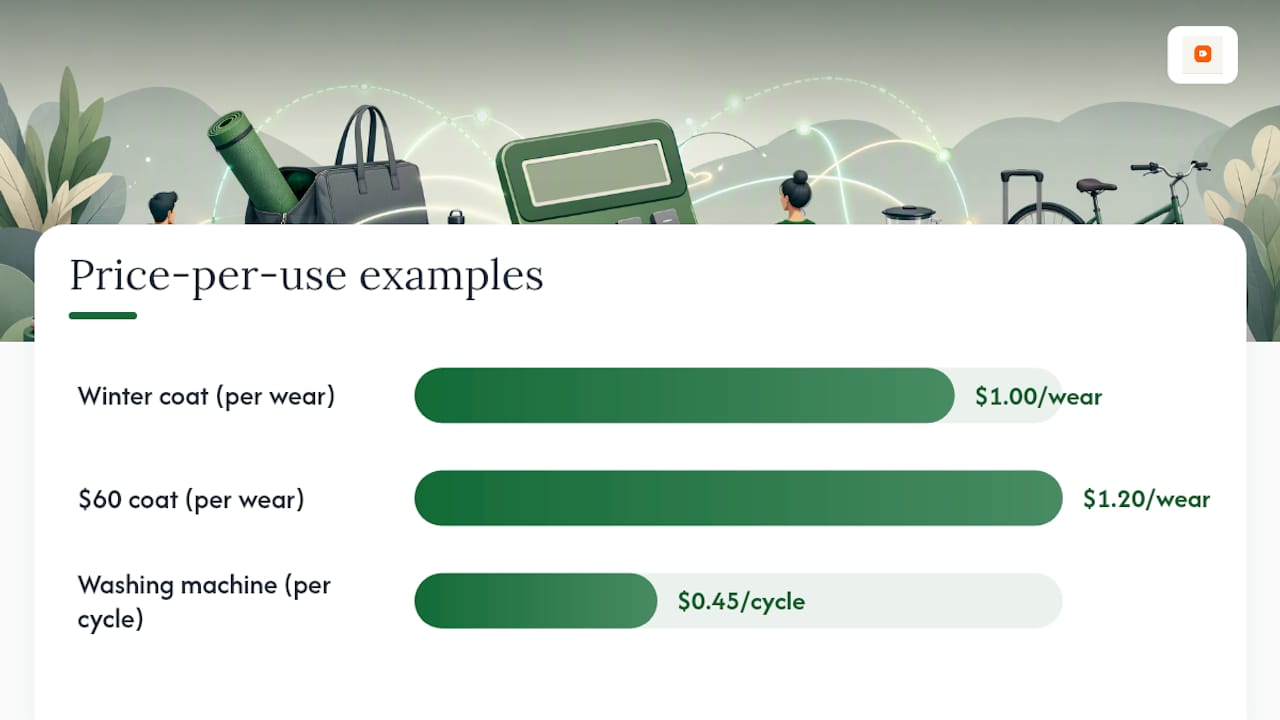
Worked example 1: clothing cost per wear. A winter coat worn multiple times per week during seasonal months over a few years may cost about a dollar or so per wear. Compare that to a $60 coat that falls apart after one season and gets worn 50 times: $1.20 per wear too, but with zero winters of warmth left over.
Worked example 2: appliance cost per cycle. A washing machine used multiple times weekly over several years can cost a few cents per cycle before electricity and water. A $350 machine that dies after 3 years (780 cycles) costs $0.45 per cycle, worse despite the lower sticker price.
Worked example 3: subscription cost per session. A monthly streaming service's cost per session varies widely depending on actual usage.
Pro Tip: Run the breakeven math before you buy. Divide the price gap between two options by the cost-per-use difference to see how many uses it takes for the pricier item to win. If that number is realistic given your habits, paying more upfront can be worth it.
This breakeven logic is exactly how worked cost-per-use comparisons show that a higher purchase price can produce a lower lifetime cost once use volume climbs high enough.
The hidden costs that quietly change your math
Most people calculate price per use using only the sticker price, then wonder why the real cost of ownership feels higher than the math predicted. The gap usually comes from expenses that never made it into the equation.
- Delivery and installation fees, especially on large appliances or furniture.
- Energy and water use for anything that runs on electricity or plumbing.
- Consumables: filters, batteries, blades, cartridges, and refills.
- Repairs and servicing over the item's expected lifespan.
- Dry cleaning and alterations for clothing that isn't machine washable.
- Storage costs, particularly for seasonal or occasional-use items.
Maintenance costs like dry cleaning and periodic repairs are the ones people skip most often, and they can flip a calculation entirely, turning what looked like the cheaper item into the pricier one once you tally three years of care, according to reporting on the social media trend around cost-per-wear math.
Resale value works the opposite direction. If you expect to sell an item, subtract a conservative resale estimate from the total cost before you divide. A laptop bought for $1,200 that you resell for $300 after three years has an effective cost of $900, not $1,200, spread across however many days you actually used it.
Pro Tip: For subscriptions and software, count active sessions or logged-in days, not the number of seats or months you paid for. A "seat" nobody uses skews the per-session number down and hides the real waste.
Calculators, templates, and shortcuts that keep the math honest
A cost-per-use calculator does the same division you'd do by hand, but it forces you to fill in fields you might otherwise skip: purchase price, recurring costs, expected lifespan, and realistic uses per week or month. That structure alone catches a lot of bad estimates before they turn into bad purchases, since a typical calculator's input set is built specifically to stop people from plugging in only the sticker price.
A few shortcuts make the process faster and more reliable:
- Halve your optimistic estimate. If you think you'll use something 4 times a week, plan the math around 2. Most people overestimate future use by a wide margin.
- Track your first month of real usage before finalizing the calculation, then recalculate with actual numbers instead of guesses.
- Subtract expected resale value first, then divide. Don't treat resale as an afterthought bonus.
- Use category templates rather than building a formula from scratch every time. Clothing, appliances, and subscriptions each have slightly different inputs worth standardizing.
OutletPicks' unit price calculator applies this same structure to everyday purchases, letting you plug in pack size, price, and expected use to see the real per-unit and per-use numbers side by side instead of trusting the shelf tag.
Quick benchmarks for common purchase categories
Once you've run the math a few times, you start recognizing numbers that look off before you even finish the calculation. These ranges are rough starting points, not hard rules, but they're useful for a gut check.
| Category | Reasonable price per use | Red flag |
|---|---|---|
| Everyday clothing basics | $0.50–$3 per wear | Over $10 per wear on a piece you wear less than 5 times |
| Occasion wear (formal, event) | $8–$25 per wear | Over $50 per wear unless resale is planned |
| Major appliances | $0.45 per cycle | Over $1 per cycle within the warranty period |
| Streaming or app subscriptions | $0.50–$3 per session | Over $8 per session for months in a row |
A higher price per use isn't automatically a bad deal. Durability, safety, time saved, and sentimental value all justify paying more per use than the raw math suggests. A $400 winter boot that survives a decade of hard commutes is a better buy than a $60 pair replaced every year, even if the per-wear numbers land close. Time saved matters too: if a $25 per session meal kit saves you three hours a week you'd otherwise spend meal planning and shopping, that number stops looking expensive.
Mistakes that quietly wreck the calculation
The single biggest error is estimating uses based on intentions instead of history. People plan to go to the gym 5 times a week and actually go twice, then calculate cost per workout using the fantasy number instead of the real one.
- Using aspirational use counts instead of past behavior or a conservative half-estimate.
- Forgetting recurring costs like filters, batteries, and periodic repairs.
- Ignoring resale value entirely, even when it's realistic and predictable.
- Treating subscription "availability" as the same thing as actual use.
Pro Tip: For low-use items like a pressure washer or a fondue set, check whether a rental service or a tool library in your area beats ownership entirely. Sometimes the correct price per use is $0, because you never buy the thing.
How OutletPicks builds price-per-use math into its tables
OutletPicks is an independent price comparison platform built specifically around true cost per unit, not sticker price, across categories from household essentials to electronics. The same logic that drives a good manual price-per-use calculation runs underneath every table on the site.
- Prices get rechecked on a rolling cycle across retailers, so a per-unit ranking reflects current numbers rather than a snapshot from months ago, which is explained in detail in why prices change by location.
- Comparisons pull from Amazon and partner retailers, normalized into one consistent view so a 12-pack and a 30-pack can be judged fairly against each other.
- Category tables cover everyday cost-per-unit comparisons across dozens of product types, which is the same normalization principle behind cost per use, just applied to per-unit pricing instead of per-wear or per-cycle pricing.
The goal is the same one this guide has walked through by hand: strip out the noise of pack size, list price, and marketing, and leave you with one honest number to compare.
What the math actually tells you (and what it doesn't)
The conventional advice around cost per use treats it like a purity test: lower number wins, always. That's backwards. The real value of the calculation isn't the number itself, it's the discipline of asking "how many times will I genuinely use this" before you buy, not after.
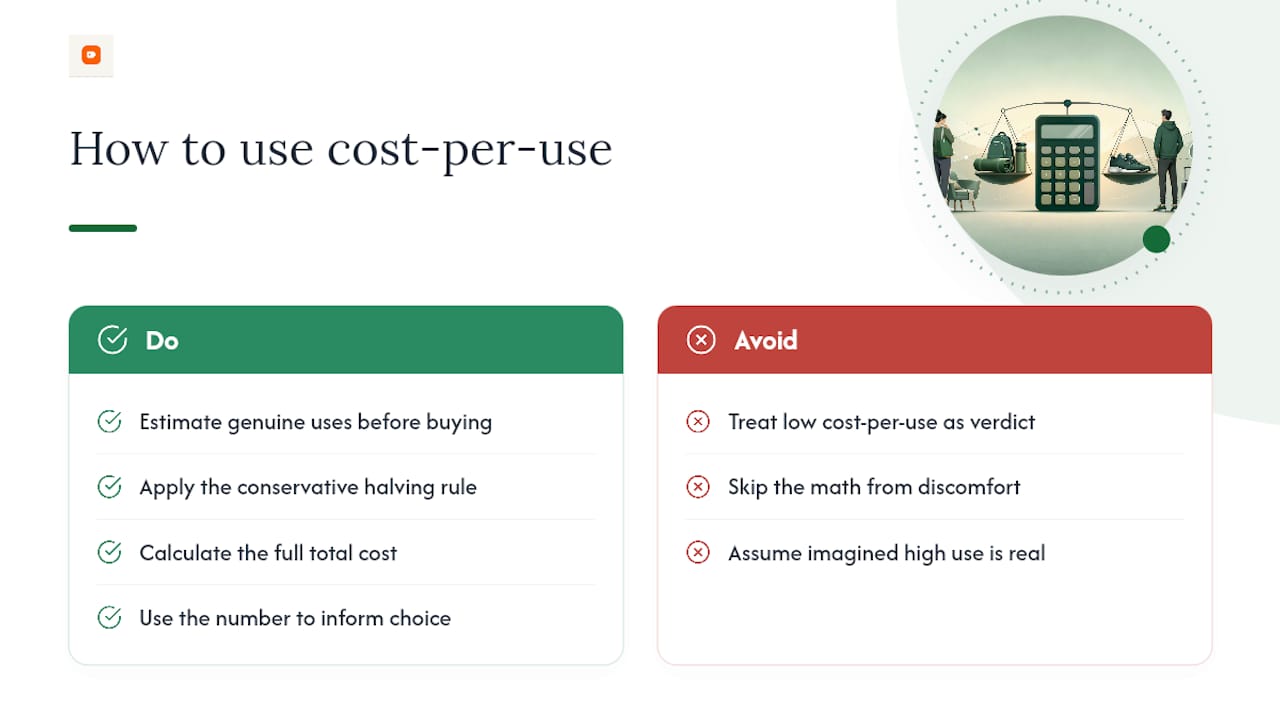
Most people who skip this math don't skip it because they can't do division. They skip it because honest use estimates are uncomfortable. Nobody wants to admit the treadmill will get used six times, not the sixty they're imagining while paying for it at checkout. That discomfort is exactly why the conservative halving rule works so well as a personal check: it forces the math to survive contact with your actual habits.
Where I'd push back on the standard framing is the idea that a low price per use is always the goal. Sometimes the right answer is paying more per use for something that saves you time, keeps you safer, or simply gets used because you love it. The number is a decision tool, not a verdict. Start with honest use estimates, run the full total cost, and let the math inform the choice instead of making it for you.
— Alex
Check your own numbers before you buy
Running this math by hand works fine for one purchase. It gets tedious fast when you're comparing five detergent sizes, three washing machines, and two subscription tiers in the same afternoon. OutletPicks exists for that exact moment: a platform built to normalize price across pack sizes and retailers so you're not doing division in a parking lot on your phone.
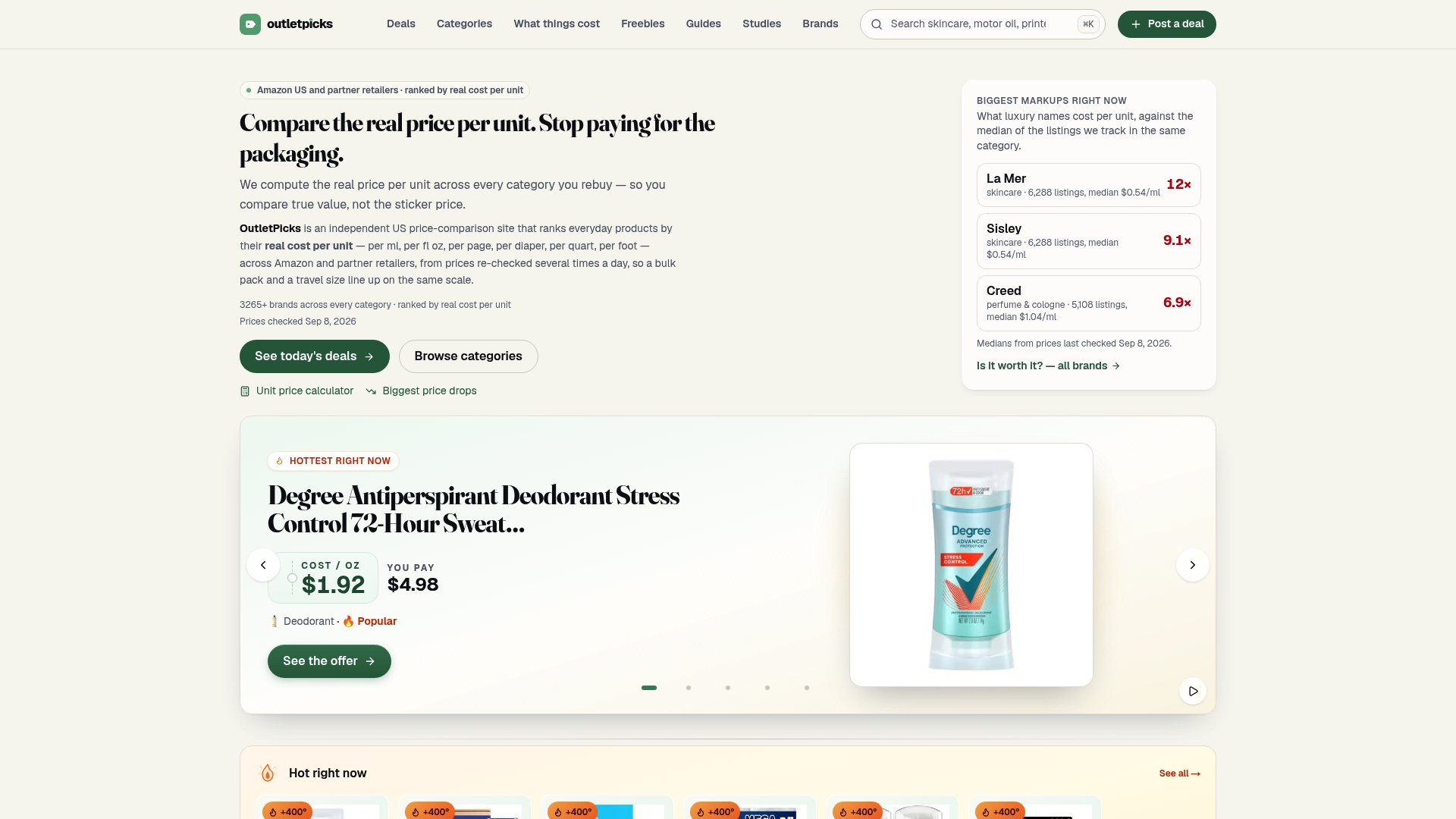
The unit price calculator takes the inputs from this guide, price, size, and expected use, and returns a clean per-unit or per-use figure you can compare across brands instantly. If you'd rather browse pre-built comparisons, the category cost tables already rank dozens of everyday products by real per-unit cost, updated on a rolling cycle so the numbers stay current. Open a category table for whatever you're about to buy and see where it actually lands before you check out.
Sources
- Cost Per Use - SPARC
- Cost per use calculator
- Cost Per Use Calculator — Calculini
- How Not To Waste Money: Use The Cost Per Use Formula — Forbes
- Cost Per Use Calculator – PaycheckKit
FAQ
How do you calculate price per use?
Divide the total cost of an item, including tax, shipping, and any recurring expenses, by the number of times you realistically expect to use it. Subtract expected resale value first if you plan to sell it later, per the standard cost-per-use method.
What is a reasonable cost per wear?
For everyday basics, $0.50 to $3 per wear is typical; occasion wear can reasonably run $8 to $25 per wear given how infrequently it gets worn. Anything far above those ranges, especially on items worn fewer than five times, is worth reconsidering.
What does "cost per use" mean?
Cost per use means the true price of an item spread across every time you actually use it, not just the number on the price tag. It's a way to compare a cheap item you'll barely use against a pricier one you'll use constantly, as personal finance writers frequently recommend when steering shoppers away from impulse buys.
How much is $10,000 per minute in a day?
The example uses high per-unit cost logic applied to time, illustrating price per use concepts without specific numbers, emphasizing the same principle applies to time as to objects.
Does OutletPicks have a price-per-use calculator?
Yes. OutletPicks offers a unit price calculator that takes price, size, and expected use as inputs and returns a normalized per-unit or per-use figure for comparison across brands and retailers.