
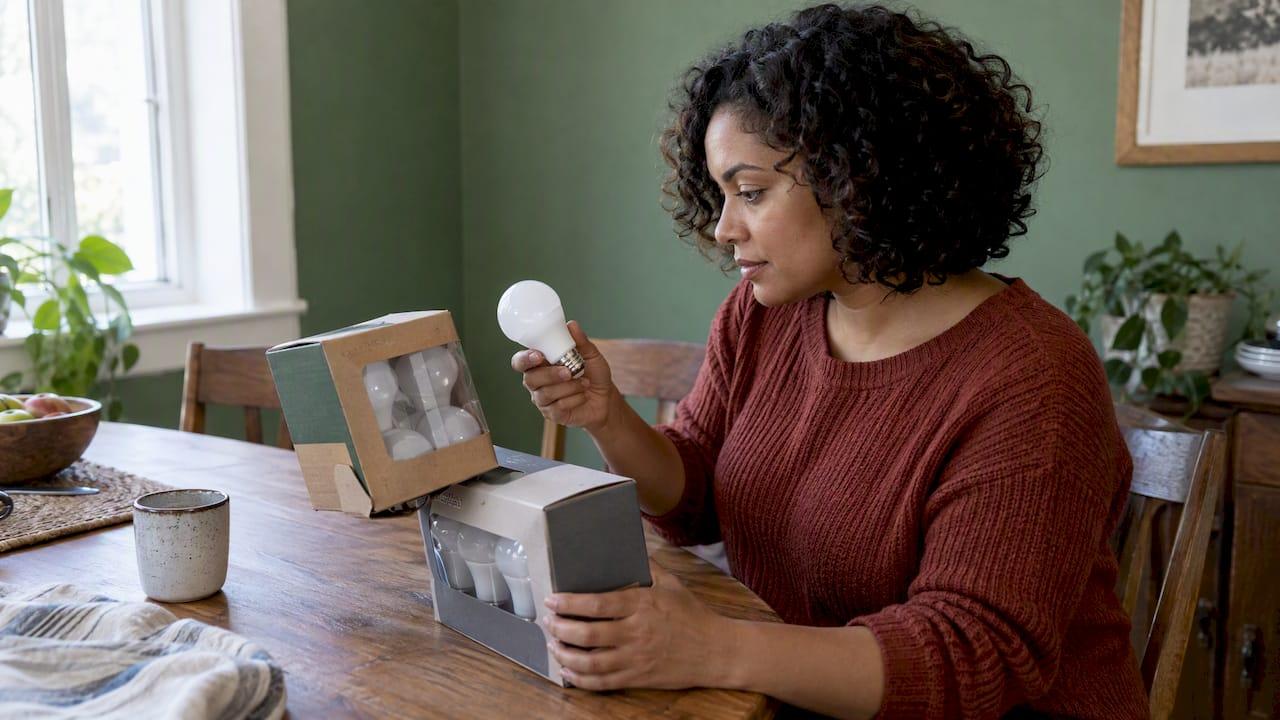
Price per lumen is the cost of a light divided by the light it produces. Take the total price of a package, divide it by the total lumens in that package, and you can rank any bulb, strip or fixture on one scale. A six-pack of cheap bulbs is not a deal until you know how much light it delivers. Many shoppers also flip the math and ask for lumens per dollar. It is the same comparison, read the other way around.
Below, you'll find the formula, worked examples, the benchmarks shoppers use, and the three things price per lumen leaves out.
TL;DR
- Price per lumen = total package price ÷ total package lumens. Lumens per dollar = total lumens ÷ total price. Use whichever you find easier to read, but stay consistent.
- Always multiply lumens per bulb by the number of bulbs in the pack. Comparing the price per bulb is the most common mistake.
- One workshop-lighting guide treats more than 400 lumens per dollar as a great deal and under 300 as poor value. Treat that as a rule of thumb for task lighting, not a law.
- The metric ignores dimming over time, color quality and electricity cost. Check lifetime ratings before you buy the cheapest option.
Table of Contents
- What a lumen measures, and why wattage no longer tells you the price of light
- The formula, step by step
- What counts as a good price per lumen?
- Where price per lumen misleads you
- How to compare different kinds of lights
- Perspective: why we rank by unit cost
- Shop by cost per unit
- A quick checklist before you buy
- FAQ
- Sources
What a lumen measures, and why wattage no longer tells you the price of light
A lumen measures how much visible light a source gives off. A watt measures how much power it draws. When incandescent bulbs were the only choice, watts were a fair stand-in for brightness. With LEDs they are not. The Department of Energy's consumer guide to energy-efficient lighting tells shoppers to compare lumens, not watts, and notes that a 60-watt incandescent bulb gives about the same light as an LED producing 800 lumens.
That is why price per lumen is a better yardstick than "price per bulb" or "price per watt." It prices the thing you actually want, which is light.
One common mix-up is worth clearing up. A lumen is not the light of a candle. The candela, the SI unit of luminous intensity, is the one that roughly matches a single candle, as NIST explains in its definition of luminous intensity. The lumen counts the total light a source sends out in every direction. A bulb's lumen rating is therefore the number to use when you compare packs.
If you want to translate old wattage habits into lumens, our lumens to watts chart and calculator does the conversion and shows current bulb prices next to it.
The formula, step by step
The math takes about thirty seconds once you know where to find the numbers. Lumens are printed on the Lighting Facts label or on the box front, usually next to the wattage.
- Find the lumens per bulb. Use the lumen figure, not the watt equivalent printed in large type.
- Multiply by the number of bulbs in the pack. This gives you total lumens for the package.
- Take the total price. Use the price you would pay at checkout for that pack, not a per-bulb price from a different pack size.
- Divide. Price ÷ total lumens gives dollars per lumen. Total lumens ÷ price gives lumens per dollar.
Price per lumen produces very small numbers, such as $0.002, which are awkward to compare. Most shoppers prefer lumens per dollar or price per 1,000 lumens. We use price per 1,000 lumens because it gives figures you can read at a glance.
A worked example with made-up prices
The prices below are illustrative, not current listings. They show how the ranking can flip once you do the math.
| Pack | Bulbs | Lumens each | Total lumens | Pack price | Lumens per dollar | Price per 1,000 lumens |
|---|---|---|---|---|---|---|
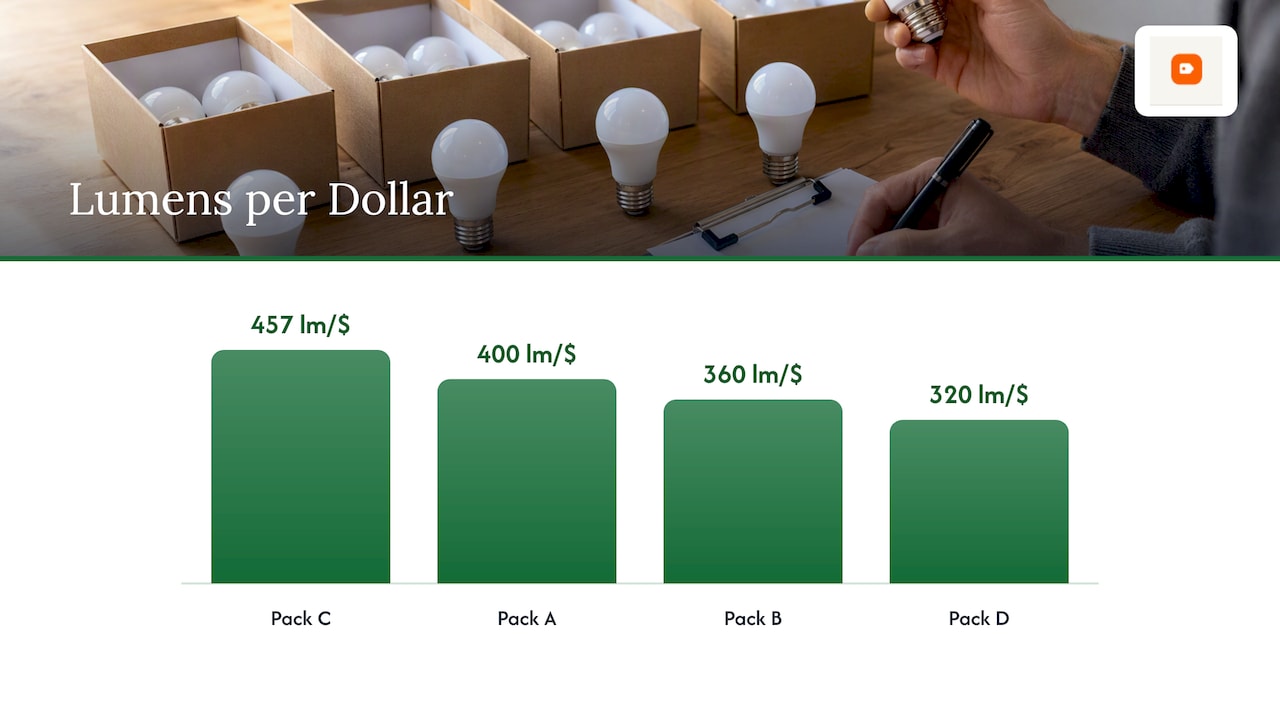
| A | 4 | 800 | 3,200 | $8.00 | 400 | $2.50 |
| B | 12 | 450 | 5,400 | $15.00 | 360 | $2.78 |
| C | 2 | 1,600 | 3,200 | $7.00 | 457 | $2.19 |
| D | 8 | 800 | 6,400 | $20.00 | 320 | $3.13 |
Pack B looks like the winner if you compare price per bulb, at $1.25 each. Pack C looks expensive per bulb, at $3.50 each. By lumens per dollar, C is the best of the four and B is only third. Pack D is the priciest per lumen even though it holds the most bulbs.
The lesson is the one a lighting test by a workshop-focused site makes: divide the lumens of the whole package by the whole price, instead of comparing how many fixtures you get. Counting fixtures hides the real cost.
What counts as a good price per lumen?
There is no official standard, because bulb prices move with promotions, brand and bulb type. Still, a benchmark helps you spot outliers.
The workshop-lighting guide we mentioned sets its benchmark for task fixtures: above 400 lumens per dollar is a great deal, and below 300 usually signals poor value. The same testing found that some big-box store fixtures could cost up to ten times more per lumen than high-value alternatives. That gap is the reason to do the math at all.
A few ways to use that benchmark sensibly:
- Compare within a type. Standard A19 bulbs, shop-light fixtures, LED strips and decorative bulbs do not share a price range. Compare like with like.
- Compare within a similar color temperature. A "daylight" and a "warm white" bulb of the same lumen output are not interchangeable in a living room.
- Use the benchmark as a flag, not a verdict. A pack at 250 lumens per dollar may still be right if it has the dimming, color or lifespan you need.
To see where current bulb prices land, check LED light bulbs on sale this week, where listings are ranked by cost per unit.
Where price per lumen misleads you
Price per lumen is a first-order comparison. It tells you what the light costs on day one. Lighting engineers writing about price per lumen for stage fixtures point out that it should be read alongside color rendering, color temperature, beam control and total cost of ownership. Home shoppers face a lighter version of the same list.
Lumens fade over time
LED light output is not constant. The Department of Energy's report on the lifetime of white LEDs explains that output declines gradually, and that a lifetime rating such as L70 refers to the hours until output falls to 70% of its initial level. A bulb with an impressive lumens-per-dollar figure on the box can lose that advantage if it dims quickly. When two bulbs are close on price per lumen, pick the one with a stated L70 or a longer rated lifetime.
The same report notes that incandescent bulbs lose roughly 10 to 15% of their initial output over a 1,000-hour life. Dimming is not just an LED issue, but the L70 number is how you compare it fairly among LEDs.
Running costs can outweigh the sticker price
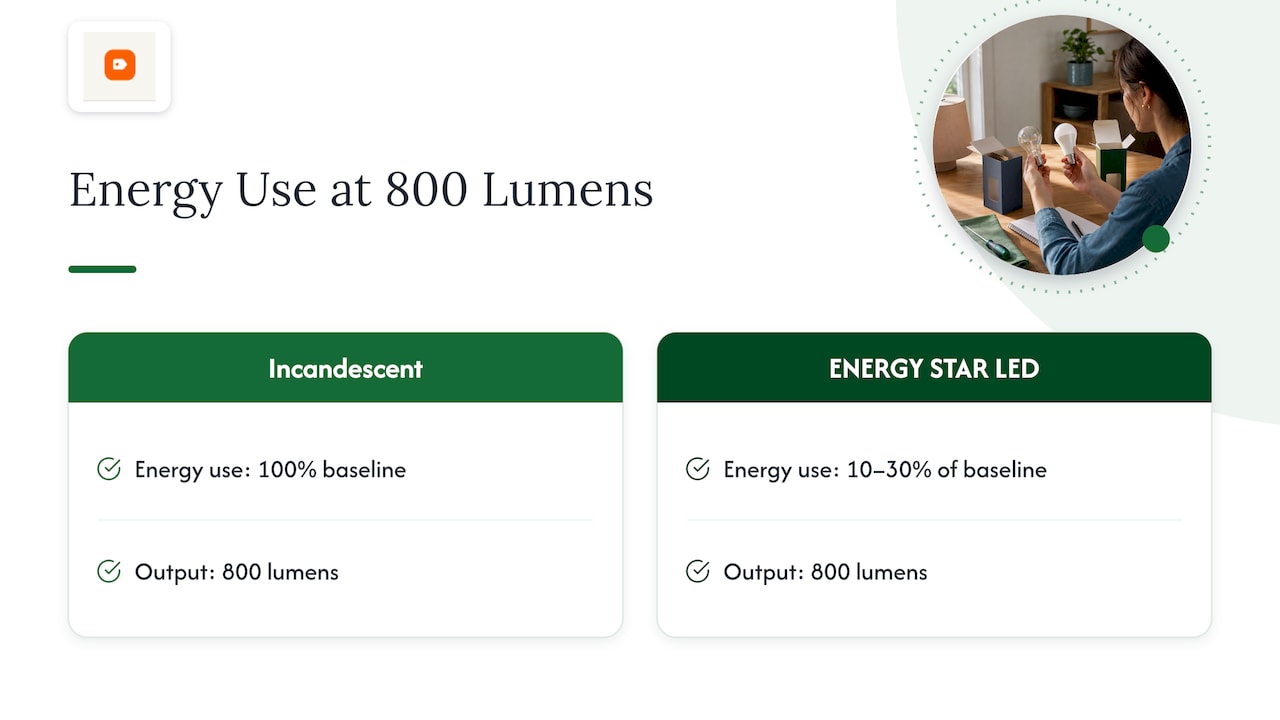
The purchase price is only one part of the cost. ENERGY STAR notes that lighting carries two price tags, the purchase price and the cost to operate and maintain it. The Department of Energy's guide says ENERGY STAR certified LEDs can use 70 to 90% less energy than traditional incandescent bulbs for the same 800-lumen output.
For a bulb that runs several hours a day, efficiency matters. If you want to put a dollar figure on a fixture's power draw, our watts to amps calculator also shows what a watt costs.
Quality of light is not in the number
Two bulbs with identical lumens can look very different on a wall or a face. Color rendering index (CRI) and color temperature shape how colors and skin tones appear. A bargain bulb with low color quality can be the wrong buy in a bathroom or kitchen, even if the math looks good.
Extras the formula skips
Price per lumen does not include mounting hardware, wiring, dimmer compatibility or, for some garage fixtures, interference with devices such as garage door openers. The workshop guide mentioned above flags these secondary costs. Read the box for what is and isn't included.
How to compare different kinds of lights
The method works for more than screw-in bulbs, as long as you count total lumens and the full price.
- Multi-packs. Multiply lumens per bulb by bulb count. Check whether the pack has mixed bulbs, such as some 800-lumen and some 450-lumen.
- Shop lights and garage fixtures. Use delivered lumens if the listing states them. Some fixtures list a higher "raw" figure than they actually put out.
- LED strips. Strips are often sold by length. Divide the total lumens on the spec sheet by the price. Our page on LED strip lights on sale this week lists current offers.
- Seasonal and decorative lights. Brightness is rarely the point, so lumens per dollar matters less. Use price per foot or per bulb instead, and see Christmas lights on sale this week.
- Portable and bike lights. Here the lumen number also tells you what the light is for. A guide to choosing front bicycle light lumens breaks down how many lumens you need to be seen compared with spotting hazards, so match the output to the use before you chase the cheapest price per lumen. For runners after dark, the question of headlamp versus chest light matters as much as raw brightness per dollar.
Perspective: why we rank by unit cost
We built OutletPicks around one idea: the sticker price rarely tells you what you pay for the thing you want. For diapers it's the cost per diaper. For skincare it's the cost per milliliter. For light bulbs, it's the cost per unit of light.
Lighting is a good example of how pack sizes confuse comparisons. A pack of twelve looks like a bargain next to a pack of two until the lumens say otherwise. That's why we normalize listings across Amazon and partner retailers and recheck retailer prices on a rolling cycle, so a ranking reflects what a shopper would see today and not last month.
We also think a good metric should come with its limits. Price per lumen is the right first filter. It cuts through marketing and pack-size tricks. It is not the last filter. After you've narrowed the list to two or three, look at lifetime ratings, color quality and the electricity the bulb will use. If a cheaper bulb dims fast, the "deal" disappears. We would rather you buy the right bulb than the cheapest one.
— Alex
Shop by cost per unit
If you want the math done for you, OutletPicks ranks products by real cost per unit across retailers. Start with LED light bulbs on sale this week for current bulb listings, or browse our full list of categories to compare everyday products the same way. If you like a little practice, try the daily Packle game to see whether you can spot the cheapest pack per unit.
A quick checklist before you buy
- Write down total lumens for the pack, not per bulb.
- Compute lumens per dollar, or price per 1,000 lumens, for every option.
- Throw out options that are far below others in the same bulb type.
- Between the top two or three, compare rated lifetime or L70, color temperature and CRI.
- Check the wattage and your hours of use to estimate running cost.
- Confirm that dimmer, enclosure and fixture compatibility match your setup.
This takes a few minutes and often changes your choice. It is most valuable when you're buying in volume, such as for a whole home, a garage or a workshop, where a small difference per lumen turns into a large bill.
FAQ
How many lumens do I need in a room?
It depends on the room's size and use. One lighting guide suggests 30 to 50 lumens per square foot for living and sleeping areas and 60 to 80 for kitchens, offices and bathrooms. Multiply by the room's square footage to get a target. Then compare the packs that reach it by price per lumen.
How much is 1,000 lumens of light?
One thousand lumens is roughly the output of an older 75-watt incandescent bulb, and it's a normal output for a bright LED bulb. Its price depends on the product. If you divide a pack's price by its total lumens and multiply by 1,000, you get the cost of 1,000 lumens for that pack. That gives you a number you can compare directly.
Is 1 lumen equal to a candle?
No. A candle is closer to a candela, which measures intensity in a given direction, as NIST describes. A lumen measures total light output in all directions. For buying bulbs, use lumens.
Is a higher lumens-per-dollar figure always better?
Not always. A bulb can have a high initial figure and then dim quickly, which is why the Department of Energy stresses lifetime ratings like L70. Color quality, dimmer support and running cost also matter. Use lumens per dollar to narrow the field, then check those details.
Sources
- Consumer Guide to Energy-Efficient Lighting, U.S. Department of Energy
- LED Lighting Shootout, Shop Hacks
- Lifetime of White LEDs, U.S. Department of Energy
- Comparing Price Per Lumen for Stage Profile Lights, BK Lite
- SI Units: Luminous Intensity, NIST
- Efficient Lighting and Appliances, ENERGY STAR
- How Many Lumens Do I Need?, Lighting Tutor