
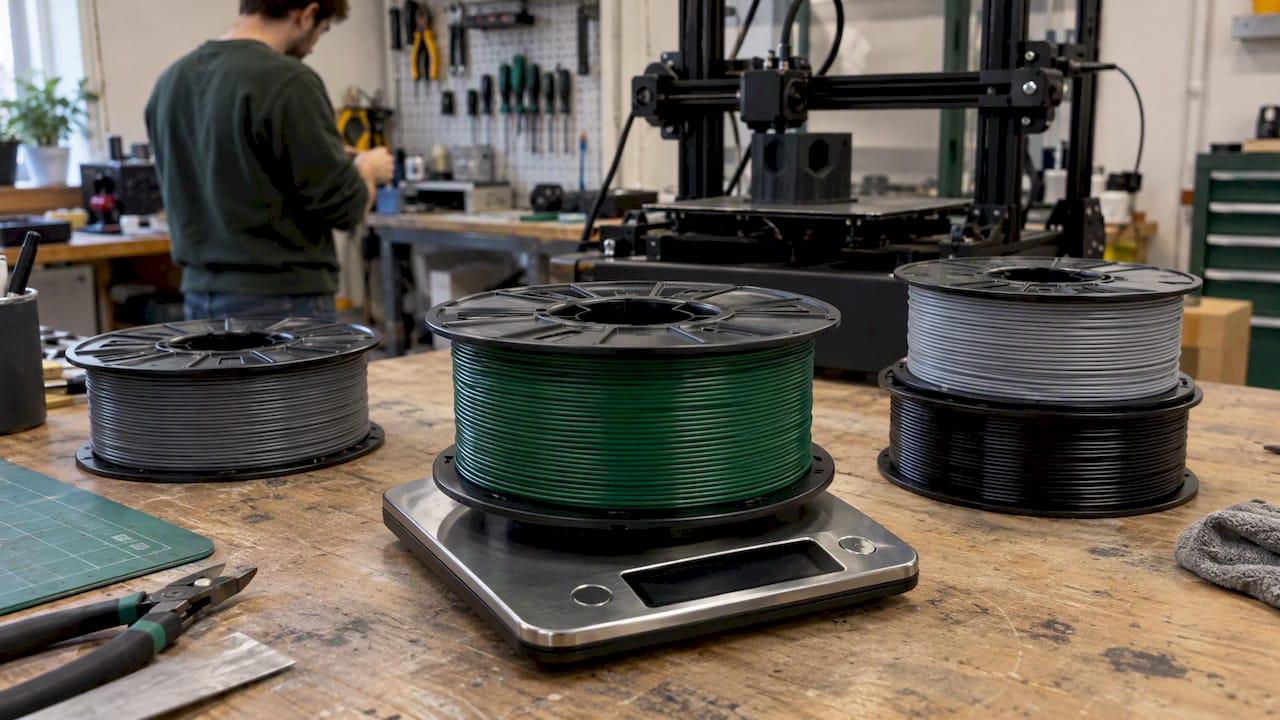
Most 3D printer filament in the US sells for roughly $15 to $30 per kilogram, and common PLA and PETG spools land in the low $20s. Bulk packs of name-brand PLA can fall to about $16 per kg, according to a 2026 cost guide from 3dprinting.com. The sticker price on a spool tells you little, though. What matters is the delivered price per kilogram, the weight of filament actually on the spool, and whether the material suits your printer. This guide gives you the price ranges, the math to turn them into cost per gram, per print and per meter, and a checklist for buying.
TL;DR
- Expect about $15 to $30 per kg for PLA, and about $20 to $35 per kg for PETG and ABS, based on May 2026 figures from 3dprinting.com.
- Price per gram is the price per kg divided by 1,000. A $20 spool costs $0.020 per gram.
- Multi-spool packs often beat single rolls by several dollars per kg. Always compare on delivered price per kg, not the pack price.
- The cheapest kilogram is not always the cheapest successful print. Material fit and failed prints change the real cost.
- Use our 3D print cost calculator to add electricity to the filament cost.
Table of Contents
- What a kilo of filament costs in the US right now
- PLA price per kg
- PETG price per kg
- From price per kg to cost per gram
- Cost per meter of filament
- What 1 kg of filament does not tell you
- Cheapest per kg is not always cheapest per part
- How to compare filament deals properly
- Our perspective: why we rank filament by cost per kg
- Find current filament prices
- Market context: why prices are where they are
- FAQ
- Sources
What a kilo of filament costs in the US right now
Prices move weekly, so treat any number as a range. The recent public data agree on the shape of the market:
| Material | Typical price per kg | Notes |
|---|---|---|
| PLA | $15 to $30 | Store-brand and bulk spools can dip to $12 to $15 per kg |
| PETG | $20 to $35 | Often grouped with ABS in price guides |
| ABS | $20 to $35 | Needs an enclosure and good ventilation |
| Nylon and engineering blends | $30 to $60 | Carbon-fiber and composite blends sit at the top |
The PLA, PETG, ABS and nylon ranges come from the 3dprinting.com 2026 guide, which dates its filament figures to May 2026. Other guides print slightly different bands, for example $18 to $25 for a standard spool, because they sample different brands and different weeks. That spread is normal. It is also why we recommend checking live prices before you buy.
A few patterns hold across all of them:
- Black, white and gray are usually cheapest. Silk, glitter, dual-color and matte finishes cost more.
- Bulk beats singles. The same guide notes a five-pack of name-brand PLA at $80 works out to $16 per kg, against $22 to $25 per kg for single rolls.
- Premium brands charge for consistency, not for a different chemical. Tighter diameter tolerance and cleaner winding matter most on multi-hour prints.
- Sales are frequent. Spool prices in this category swing by a few dollars around retail events, so a "normal" price is a moving target.
PLA price per kg
PLA is the default filament, and the price floor of the hobby. Brand-name spools generally run $15 to $30 per kg. If you print mostly decorative parts, prototypes and toys, you rarely need to leave this material, and the Rapid Prototyping Centre at the University of Waterloo lists PLA as the easiest of the standard filaments to print.
What a fair PLA price looks like depends on how much you print:
- Occasional printer, a spool every few months: a single 1 kg roll in the high teens to low $20s is a sensible target.
- Regular printer, a spool a month or more: buy multi-packs and aim for the mid-teens per kg.
- Trying a new color or brand: buy one spool first. A great price per kg on a roll that strings or jams is not a bargain.
If a listing shows a price far below the range, check the weight. Some spools are 750 g or 500 g, and the price per kg is then higher than it looks.
PETG price per kg
PETG usually costs a few dollars more per kg than PLA, with common listings in the $20 to $35 band. You pay that premium for durability. The Waterloo centre describes PETG as suited to more durable, functional parts, with better chemical resistance than PLA.
PETG is worth buying when the part will be handled, flexed, or kept somewhere warm, such as brackets, tool holders, and outdoor-ish fixtures. For a figurine on a shelf, it is just a more expensive way to print the same thing. PETG also absorbs moisture, and wet filament prints badly, so budget for storage. A filament dryer can pay for itself if you have thrown away a spool that went brittle or bubbly.
From price per kg to cost per gram
The conversion is simple. Divide the spool price by the net weight in grams.
Cost per gram = spool price ÷ spool weight in grams
For a 1 kg spool, that is the price divided by 1,000. Adafruit's costing guide uses the same logic: multiply the spool cost by the print weight in grams, then divide by 1,000. Its worked example is a $40 spool and a 110 g part, which gives $4.40 of filament.
Here is a quick table for common prices:
| Price per kg | Cost per gram | 50 g print | 250 g print |
|---|---|---|---|
| $12 | $0.012 | $0.60 | $3.00 |
| $16 | $0.016 | $0.80 | $4.00 |
| $20 | $0.020 | $1.00 | $5.00 |
| $25 | $0.025 | $1.25 | $6.25 |
| $30 | $0.030 | $1.50 | $7.50 |
The 3dprinting.com guide gives the same example for a $25 per kg PLA spool and a 50 g print: $1.25 in material. Your slicer shows the grams for each model, so the calculation takes seconds.
How far does 1 kg go?
A 1 kg spool holds 1,000 g of nominal filament. A model your slicer rates at 100 g uses about 10% of the spool, and a 250 g model about 25%. The number of objects depends on the model, not on a fixed rule. The Waterloo centre bases its own printing charge on total material mass, supports included, which is the right way to think about it: grams, not parts.
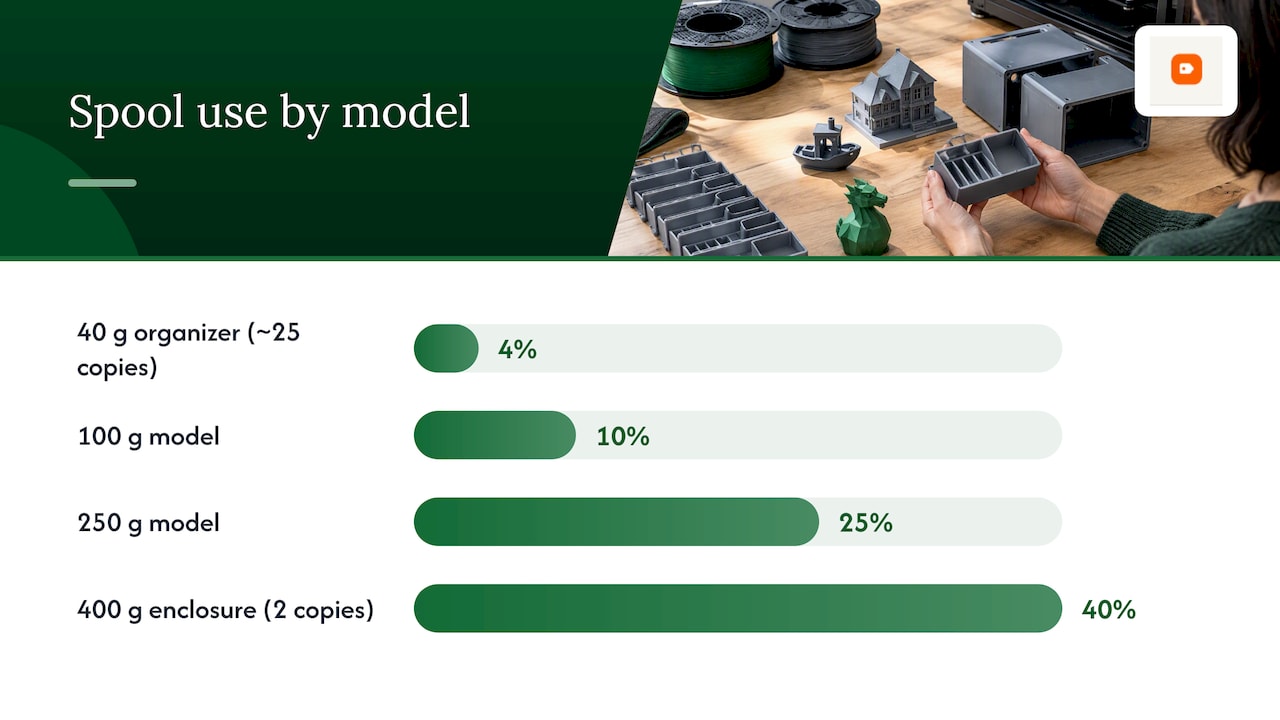
A small desk organizer at 40 g gives you about 25 copies per spool before waste. A 400 g enclosure gives you two, with a little left over.
Cost per meter of filament
Some buyers want the cost per meter, especially when they compare 1.75 mm spools to listings that quote length. The length depends on the material's density and the filament diameter, so there is no single figure. Here is a worked example with an assumption you should replace with your spool's datasheet value.
Assume 1.75 mm filament and a density of 1.24 g/cm³:
- Cross-section area: π × (0.0875 cm)² ≈ 0.0241 cm²
- Mass per meter: 0.0241 cm² × 100 cm × 1.24 g/cm³ ≈ 2.98 g
- Length per kg: 1,000 ÷ 2.98 ≈ 335 m
At $20 per kg, that works out to about $0.06 per meter. Denser materials give you fewer meters per kilogram, so a price per kg comparison across materials hides a small difference in length. In practice, slicers report grams, so grams is the more useful unit for budgeting.
What 1 kg of filament does not tell you
The per-gram number covers filament only. Adafruit's guide is clear that supports, purge material, failed prints, electricity, labor and equipment costs must be added for a full print cost. Slicer estimates also tend to leave out failed-print waste.
So a real budget has more lines:
- Supports and brims. They can add 10% to 30% to the grams on overhang-heavy models.
- Purge and color changes. Multi-color printers waste material at every swap.
- Failures. One failed 200 g print at $20 per kg costs $4, which can wipe out the saving from a cheaper spool.
- Electricity and machine time. Small per print, but real on long jobs.
Our 3D print cost calculator puts filament and electricity into one per-print figure, so you can see how much of a job is material.
Cheapest per kg is not always cheapest per part
The Waterloo centre's comparison makes a point we agree with: PLA is easiest to print, PETG suits durable functional parts, and TPU is flexible but the hardest of the three to print. A slightly higher material price can be the economical choice if it avoids failed prints or meets what the part needs.
Three practical consequences:
- Do not substitute materials purely on price. A low-cost PETG or TPU spool is not a drop-in replacement for PLA. Printer profile, nozzle, bed and temperature requirements differ, and moisture-sensitive materials need drying.
- Match the diameter. Most consumer printers take 1.75 mm. Some take 2.85 mm. A bargain in the wrong diameter is worth nothing.
- Price per kg only compares like with like. Compare PLA with PLA, PETG with PETG, and the same diameter.
How to compare filament deals properly
Use this checklist before you click buy:
- Find the net weight. Is it 1 kg of filament, or 1 kg including the spool? Some listings are 750 g or 1.1 kg.
- Divide the total price by total kg. Include shipping if the retailer charges it.
- Check the pack size. A four-pack at $80 is $20 per kg. A single at $18 is cheaper per roll but not per kg if the single is 750 g.
- Confirm material and diameter. PLA, PLA+, PETG, 1.75 mm or 2.85 mm.
- Read recent reviews for your printer. Look for notes about clogs, tangles and color accuracy.
- Check whether the spool fits. Some printers with enclosed spool holders need a specific spool width.
That is the same cost-per-unit logic we apply to diapers, paper towels and shampoo. The label price is a starting point; the unit price is the comparison.
Our perspective: why we rank filament by cost per kg
We built OutletPicks around one idea: the price on the page is not the price you pay for the thing you want. Filament is a clean example. A $17 spool that holds 750 g costs more per kilogram than a $21 spool with 1 kg, and a four-pack that looks expensive often wins by a few dollars per kg.
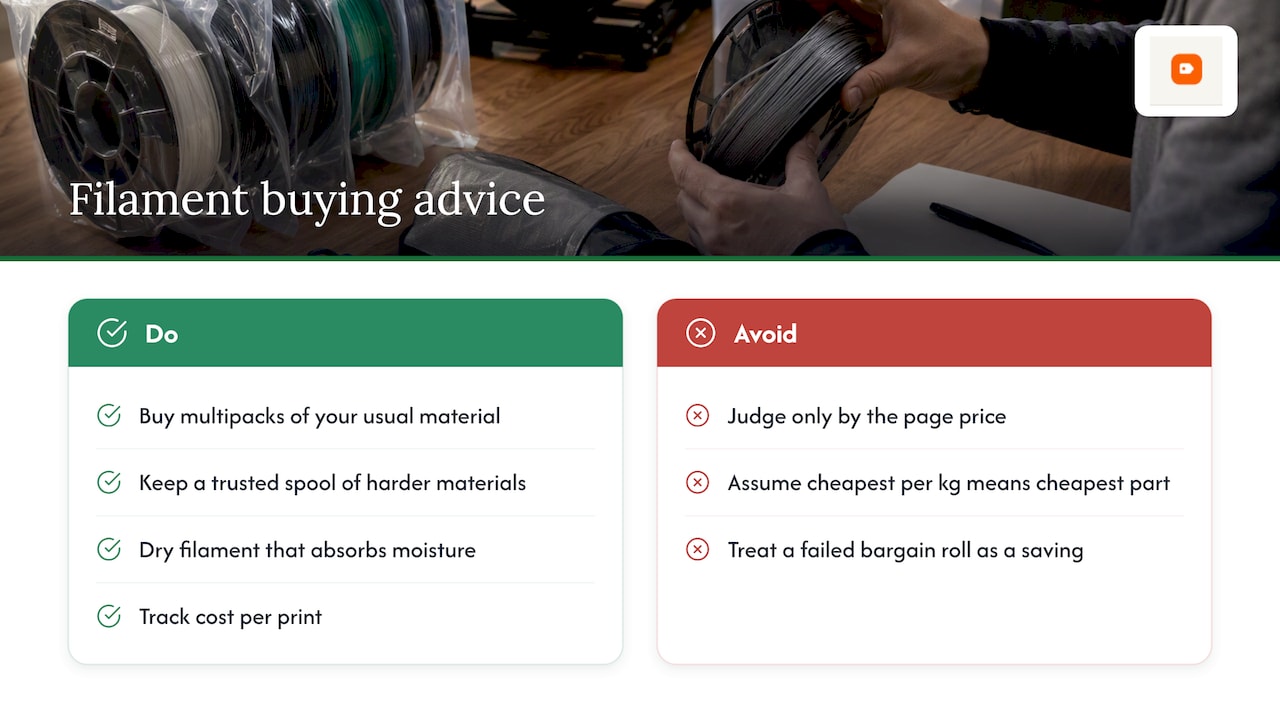
When we look at filament listings, we normalize them to price per kg and compare like with like: same material, same diameter. We also keep in mind what our research and the university data both show. The cheapest kilogram is not automatically the cheapest successful part. If a PETG roll prints cleanly at your temperatures and a bargain roll leaves you with spaghetti, the bargain was not one.
Our advice is plain. Buy multi-packs of the material you use most, keep one trusted single spool of the harder materials, dry what absorbs moisture, and track your cost per print rather than your cost per roll.
— Alex
Find current filament prices
Prices change often, so a static article is only a guide. We update our 3D printer filament on sale this week page on a rolling cycle, with listings normalized to price per kg so you can compare single rolls and multi-packs on one scale. If you are also shopping for the machine itself, see 3D printers on sale this week, and browse the full list of categories we rank by real cost per unit.
Market context: why prices are where they are
Raw PLA resin costs far less than finished filament. A PLA price index from businessanalytiq put North American PLA at US$2.39 per kg in its September 2026 update. The gap between that and a $15 to $30 spool covers extrusion, dyeing, winding, spooling, packaging, shipping and margin. It also explains why filament prices are fairly stable, and why the bigger swings come from retailer promotions rather than from the raw material.
That gap is also why quality varies. Two spools at the same price can differ in diameter consistency and moisture content. If you print for hours at a time, paying a few dollars more for consistent spools can be cheaper than a failed overnight print.
FAQ
What is the price of 1 kg of PLA filament?
Most branded 1 kg PLA spools in the US cost about $15 to $30, per 3dprinting.com's May 2026 figures. Bulk packs and store brands can come in at $12 to $16 per kg. Always divide the total price by the net kilograms to compare.
How much is 1 g of filament worth?
Divide the price per kg by 1,000. At $20 per kg, one gram costs $0.020, and a 110 g print from a $40 per kg spool costs $4.40 in filament, as Adafruit's guide shows. That covers material only, not electricity, supports or failures.
How much will 1 kg of filament print?
It depends on the model's weight in your slicer. A 100 g model uses about 10% of a spool and a 250 g model about 25%, before supports, purge waste and failed prints. Count grams rather than objects.
Is PETG more expensive than PLA per kg?
Usually, yes, by a few dollars. PETG commonly runs $20 to $35 per kg against $15 to $30 for PLA. It is worth it for durable, functional parts and not for display pieces.
Sources
- How Much Does 3D Printing Cost? 2026 Complete Guide, 3dprinting.com
- DIY 3D Printing Filament: Print Cost, Adafruit Learning System
- FDM Materials and Cost, Rapid Prototyping Centre, University of Waterloo
- Polylactic acid (PLA) price index, businessanalytiq