
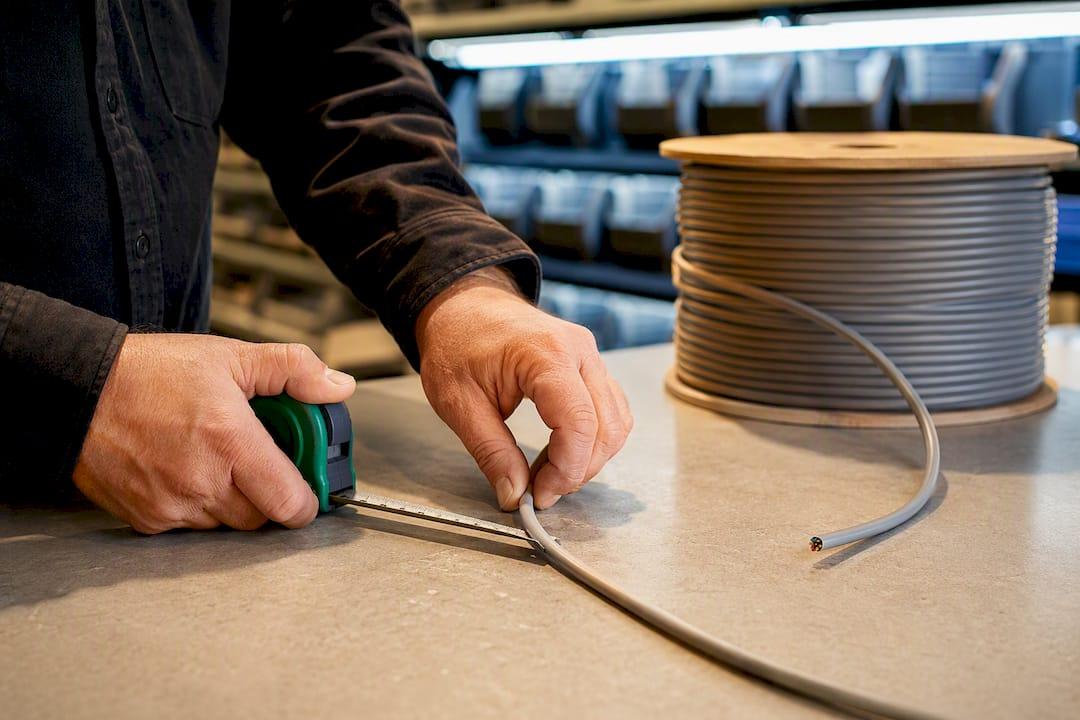
Budget about $0.10 to $0.20 per foot for Cat5e, $0.15 to $0.35 per foot for Cat6, and $0.40 to $0.60 per foot for Cat6a. For most home and small-office installs, Cat6 hits the right balance of speed headroom and cost. Your final per-foot price still shifts with shielding, jacket rating, and how many feet you order at once.
TL;DR:
- The true per-foot cost varies based on category, gauge, shielding, and jacket rating, with shielded and plenum-rated cables costing more.
- For most small-office and home applications, Cat6 offers the best balance of speed support and price, supporting gigabit speeds over 328 feet and 10-gigabit over shorter distances.
- Buying from vendors that sell by the foot, such as automation and industrial suppliers, allows more accurate cost comparison and reduces waste.
- Copper Ethernet runs should not exceed 328 feet; beyond that, fiber or extenders are necessary to maintain reliable performance.
- Always calculate the actual cost per foot to compare options effectively, including cut fees and waste buffers, before making a purchase decision.
Table of Contents
- How Much Does Ethernet Cable Cost Per Foot by Category?
- Cat5e vs. Cat6 vs. Cat6a vs. Fiber: What Actually Matters
- What Determines the Per-Foot Price You're Actually Paying?
- Where to Buy Ethernet Cable by the Foot
- How Long Can a Single Ethernet Run Actually Be?
- How OutletPicks Calculates True Per-Foot Cost
- What Buyers Get Wrong About Buying Cable by the Foot
- Use OutletPicks to Compare Real Per-Foot Prices Before You Buy
- Sources
- FAQ
How Much Does Ethernet Cable Cost Per Foot by Category?
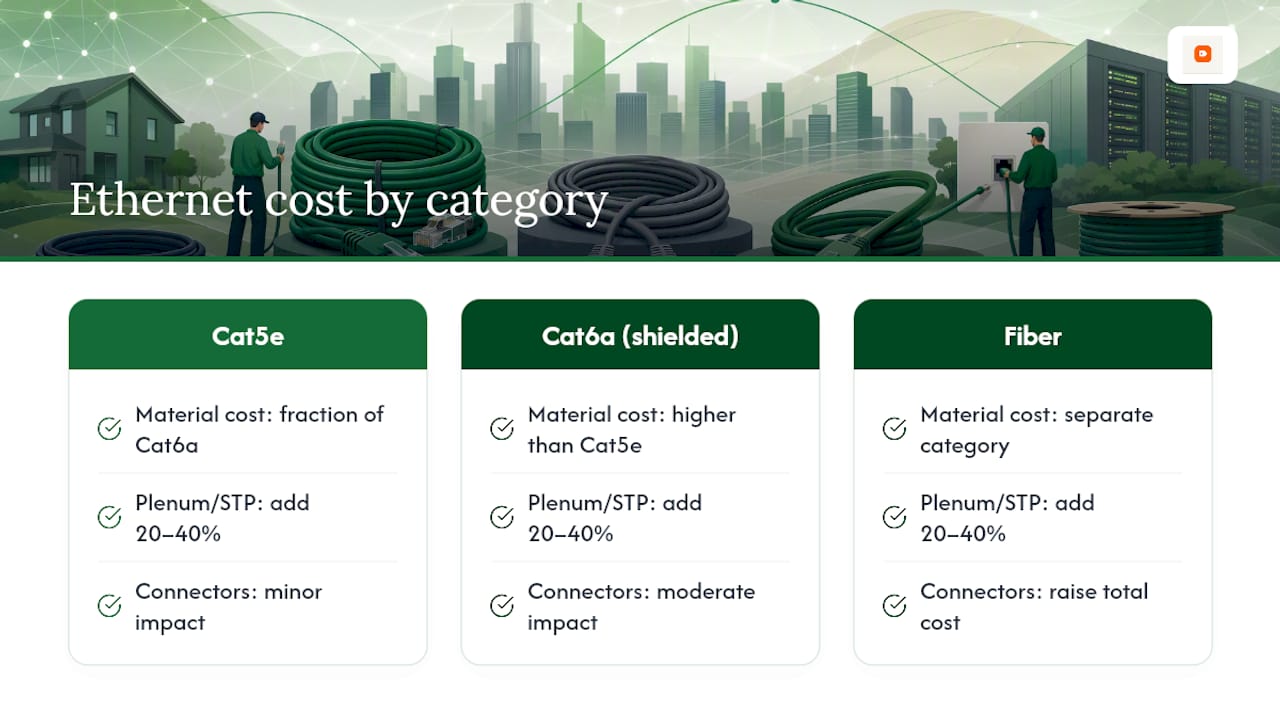
Price scales with how much copper and protection you're paying for. A basic Cat5e run costs a fraction of what shielded Cat6a runs cost, and fiber sits in its own category entirely once you factor in connector and termination costs.
These ranges track closely with what Thenetworkinstallers and Fixr both report for material-only pricing. Add 20 to 40% to any row here if you need a plenum-rated jacket or shielded twisted pair (STP) construction, since fire codes and EMI protection both drive up manufacturing cost.
Cat5e vs. Cat6 vs. Cat6a vs. Fiber: What Actually Matters
Category number isn't marketing fluff. It maps to real bandwidth and distance limits that determine whether your network keeps up five years from now.
Cat5e handles gigabit speeds over its full 328-foot (100 meter) run, which is plenty for streaming, browsing, and most VoIP setups. Cat6 supports gigabit reliably and can hit 10 gigabit speeds, but only up to about 165 feet before you risk crosstalk-related slowdowns. Cat6a fixes that, running full 10-gigabit performance the entire 328 foot distance, which matters if you're wiring a small business with a NAS server or multiple 4K security cameras pulling bandwidth simultaneously.
- Cat5e: fine for basic home use, weakest resale value if you ever upgrade your router
- Cat6: the sweet spot for most buyers, gigabit now with headroom for 10-gigabit gear later
- Cat6a: worth it for server closets, PoE lighting systems, or any run carrying serious power alongside data
- Fiber: the only real option past 328 feet, or in warehouses with heavy electrical interference
Solid-core cable costs less per foot and works best for permanent in-wall drops. Stranded cable flexes better and costs slightly more, making it the right call for patch cables that get moved, coiled, or run through cable trays.
Pro Tip: If you're running Power over Ethernet (PoE) for cameras or access points, size up to Cat6 minimum. Thinner Cat5e conductors heat up more under sustained PoE loads over long runs, which can cause voltage drop.
What Determines the Per-Foot Price You're Actually Paying?
A listed price per foot can hide a lot. Here's what pushes the number up or down before you ever get to checkout.
- Category and copper gauge. Higher categories use tighter twist rates and sometimes thicker 23 AWG conductors instead of 24 AWG, adding cost per foot.
- Jacket rating. Plenum-rated (CMP) cable costs noticeably more than riser-rated (CMR) cable because the jacket material resists fire and smoke differently, a distinction thenetworkinstallers.com's cost guide breaks out clearly in its materials table.
- Shielding. Shielded twisted pair (STP) adds a foil or braid layer that protects against interference, and that extra material shows up directly in price.
- Testing and certification. Cable verified to TIA/EIA-568 standards with UL markings costs slightly more than unverified stock, but it's the only way to confirm the cable performs at its rated category.
- Seller policies. Cut fees, minimum order lengths, and whether you're buying from a full spool versus a cut-to-length listing all change your effective per-foot rate.
A 1,000-foot spool priced at $150 works out to $0.15 per foot, but a cut-to-length seller charging $0.22 per foot with no minimum might still be the better deal if you only need 60 feet.
Where to Buy Ethernet Cable by the Foot
Three vendor types dominate this market, and each fits a different buying pattern. AutomationDirect's cut-to-length bulk listings cater to industrial and networking buyers who want a specific footage without committing to a full spool, and the site lists per-foot pricing directly on the product page. Vetco takes a similar approach with its solid Cat6 bulk listings, which explicitly sell by the foot and target installers doing in-wall runs rather than short patch jobs.
Big-box retailers and general electronics stores mostly sell pre-made patch cables in fixed lengths, which works fine for connecting a router to a single device but wastes money if you need something between the standard sizes.
Before you order from anyone:
- Confirm UL and TIA/EIA-568 markings are printed on the product listing, not just claimed in marketing copy
- Check whether the cable is 23 AWG or 24 AWG solid copper, since gauge affects both PoE performance and price
- Verify plenum rating if the run passes through HVAC spaces, which many local codes require
- Ask about cut fees and minimum order lengths before adding to cart, since these often appear only at checkout
- Add 5 to 10% extra footage for routing bends and mistakes, and choose a jacket color that makes labeling easier later
How Long Can a Single Ethernet Run Actually Be?
Copper Ethernet has a hard practical ceiling: 100 meters, or about 328 feet, per the distance limit both Fixr.com and industry cabling standards cite for reliable signal transmission. Heat, nearby electrical interference, and lower-quality cable can all shrink that reliable distance further. Past 328 feet, switch to fiber or a network extender rather than pushing a copper run beyond its limit and getting intermittent dropouts.
- Test every run with a cable tester before closing up walls
- Label both ends with the run's destination and length
- Leave a service loop at each end for future re-terminations
- Write down the category, gauge, and jacket rating for each run you install
How OutletPicks Calculates True Per-Foot Cost
Spool prices and box prices rarely list the same unit, which makes side-by-side comparison hard without doing math yourself. OutletPicks normalizes every listing to a per-foot rate using rolling price checks across retailers, the same methodology applied across other per-unit categories on the site.
- Enter a spool or box price and total footage to get an instant per-foot number
- Compare that rate against cut-to-length listings that already show per-foot pricing
- Factor in the 5 to 10% waste buffer recommended for routing and mistakes before finalizing your order
Normalizing the number is the only way to know if a "cheaper" spool is actually cheaper once you divide it out.
What Buyers Get Wrong About Buying Cable by the Foot
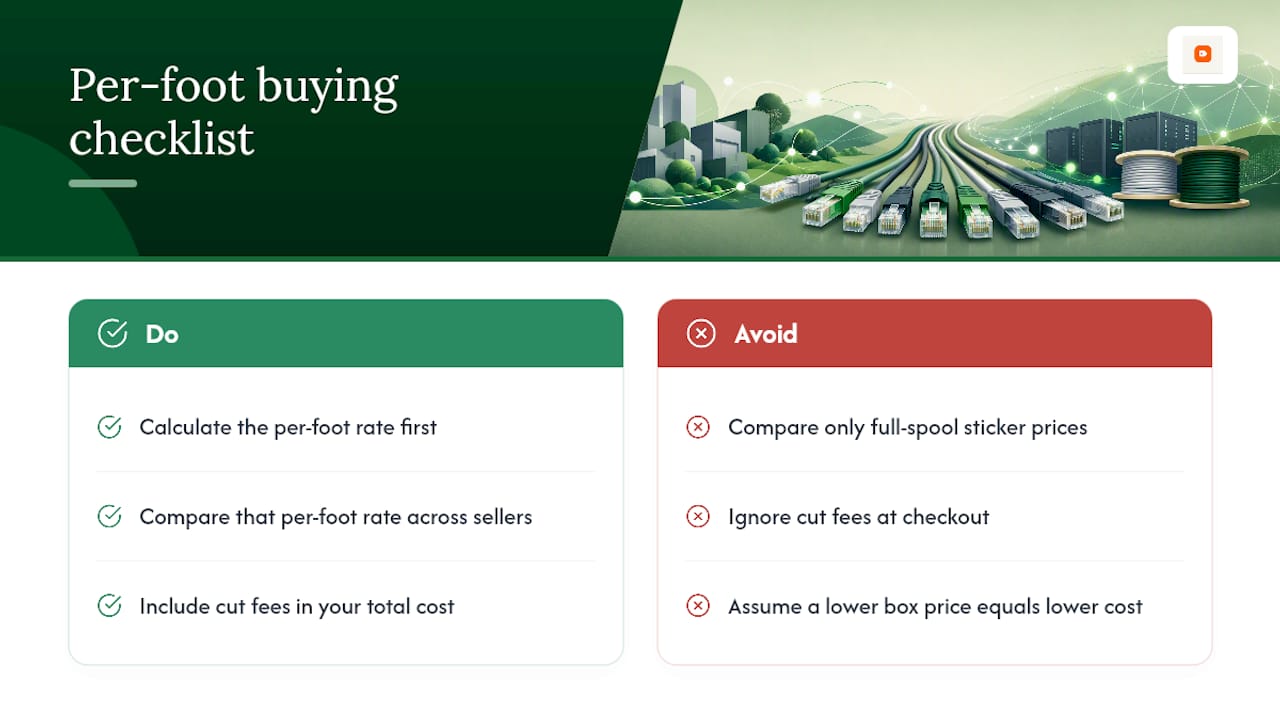
Most shoppers fixate on the sticker price of a full spool without dividing it into a real per-foot number, then get blindsided by cut fees at checkout. The simple fix: always calculate the per-foot rate first, then compare that number across every seller you're considering, not the total box price.
— Alex
Use OutletPicks to Compare Real Per-Foot Prices Before You Buy
Price comparison platforms strip out the guesswork sellers build into spool and box pricing by converting every listing to the same per-foot number, so a 500-foot spool and a 50 foot cut-to-length order can actually be compared side by side.

Paste any spool or box price into the Unit Price Calculator to get an instant per-foot rate, then add in cut fees or shipping to see your real total. Multiply that per-foot number by the exact length you need, whether that's 20 feet for a desk setup or 300 feet for a whole-house run, and you'll know the true final cost before you commit to a vendor. Head to Outletpicks to run the numbers on your next cable purchase.
Sources
- Ethernet Installation Cost: Comprehensive Pricing Guide (2026)
- Fixr
- Cat5e Industrial Ethernet Bulk Cable: 22 AWG, cut to length (PN# Q5941-1) | AutomationDirect
FAQ
How Much Does Ethernet Cable Cost Per Foot?
Cat5e runs about $0.10 to $0.20 per foot, Cat6 runs $0.15 to $0.35 per foot, and Cat6a runs $0.40 to $0.60 per foot, according to thenetworkinstallers.com's pricing guide. Shielded or plenum-rated versions of any category cost more per foot.
Is 100 Feet Too Long for an Ethernet Cable?
No, 100 feet is well within the safe range. Copper Ethernet reliably handles runs up to about 328 feet (100 meters), a limit confirmed by Fixr.com's installation cost guide, so 100 feet leaves plenty of margin.
How Much Is Cat6 Cable Per Foot?
Cat6 typically costs between $0.15 and $0.35 per foot for material-only pricing, based on Fixr.com's Cat6 cost breakdown and other sources.
How Much Does a 20 Foot Ethernet Cable Cost?
At Cat6 pricing of roughly $0.15 to $0.35 per foot, a 20 foot cable runs about $3 to $7 in cable cost alone. Pre-made patch cables at that length often cost a bit more once connectors, testing, and packaging are factored in.